
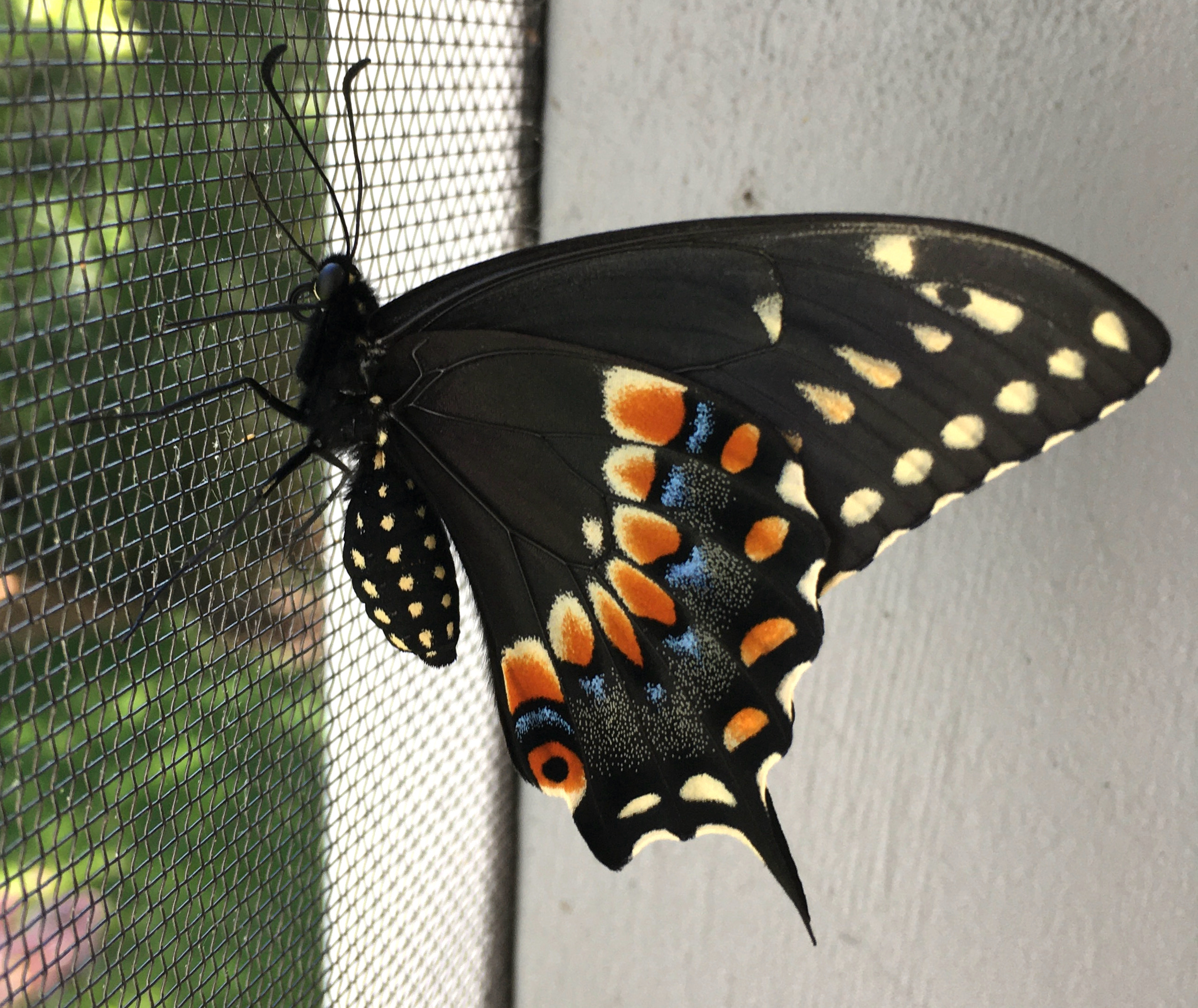
This one eclosed late this afternoon; when I photographed him, he was still fanning his wings to dry and stiffen them. (Males are characterized by prominence of the yellow pattern on the forewing and subtlety of the blue spots on the hindwing above the eyespots).
This one is a little small in body size, as is typical for the late-season ones which overwinter here as a chrysalis (the caterpillars often don't get very fat in the fall before the cold weather forces them to pupate), but the outstanding beauty of the wings is wonderfully characteristic of the species - click to enlarge to bigger-than-screen size.
He will spend the night on our screen porch, then warm himself in the sunshine before heading out for whatever adventures await. Five more chrysalids from last autumn's batch are still waiting to hatch.
Reposted from last month to add a photo of the latest one to eclose:
The color patter on the underside of the wings is truly remarkable and not usually visible when you see them soaring around your garden.
Reposted from 2022 to add the first BST of the year for 2026:

This fellow showed up in our garden as a caterpillar on the rue by our mailbox (see link for pix including cat and chrysalis). Last autumn he was wandering on top of the rue looking for a place to form a chrysalis, so I brought him into a terrarium in our screen porch and within a day or two he did his magic transformation into chrysalis form (file photos below):


He then proceeded to tolerate late-January temperatures to -20 degrees Fahrenheit on the unheated screen porch. My only contribution to his welfare was to spritz the chrysalis with water mist on those days when in nature it would have been snowed or rained on.
The photo above on the wire porch screen was taken with the wings backlit by the morning sun while he was drying the wings and letting them harden. After about an hour I moved him out to a branch of an oak tree that extends over our back porch and took another photo -

This time the full afternoon sun was behind him and me. Note he has those wings spread horizontally to the max to soak up the solar energy. And note how the color spots are more vivid with reflected light rather than the transmitted light in the earlier image. That color pattern is different from that of the female, who has more subtle coloration presumably to make her less susceptible to predation.
Truly magnificent creatures. I don't know how anyone can not be in awe of their beauty and the incredible transformations they undergo in their life cycles.


Absolutely gorgeous!! TFS ~
ReplyDeleteDo they hang around your house afterwards? imprinted with the location?
ReplyDeleteNot the swallowtails. This one zoomed up to the treetop as soon as it was released in order to catch some solar energy, then flew off on butterfly business.
DeleteThe butterflies with the most prominent sense of "place" seem to be the male Monarchs, which discover our garden is full of milkweed, and they then "cruise" back and forth across the yard, waiting for the arrival of females. Red Admirals also sometimes hang around especially when there are lots of nectar sources in bloom.
He is beautiful and poses like he knows it.
ReplyDeleteLOVE your blog. Can't figure out how to "sign-in" so it will remain anon. But truly love your efforts. I've learned so much and thank you
ReplyDeleteThe easiest way to "sign in" is just to make up a name/identity and type it after your comment... "Ralph in Peoria" "Dodgers fan" "redheaded stranger" etc. Then others can direct replies specifically to you.
Delete