Showing posts with label real estate. Show all posts

22 April 2019

The underground city of Derinkuyu, Turkey


In 1963, an inhabitant of Derinkuyu (in the region of Cappadocia, central Anatolia, Turkey), knocking down a wall of his house cave, discovered amazed that behind it was a mysterious room that he had never seen, and this led him room to another and another and another to it ... By chance he had discovered the underground city of Derinkuyu, whose first level could be excavated by the Hittites around 1400 BC

Archaeologists began to explore this fascinating underground city abandoned. It managed to forty meters deep, but is believed to have a fund of up to 85 meters. At present 20 levels have been discovered underground. Only eight can be visited at the highest levels; others are partially blocked or restricted to archaeologists and anthropologists who study Derinkuyu.

The city was used as a refuge for thousands of people living in the basement for protection from the frequent invasions suffered Cappadocia, at various times of their occupation, and by the early Christians.

The city benefited from the existence of an underground river, water wells and had a wonderful ventilation system (52 wells have been discovered vents) that amazes engineers today.
Text credit and photos here (original sources have undergone linkrot).  Wiki here. Reddit here.

Reposted from 2008 to add this newer and vastly improved image - 


 - which enlarges with a click.  Via.

27 March 2019

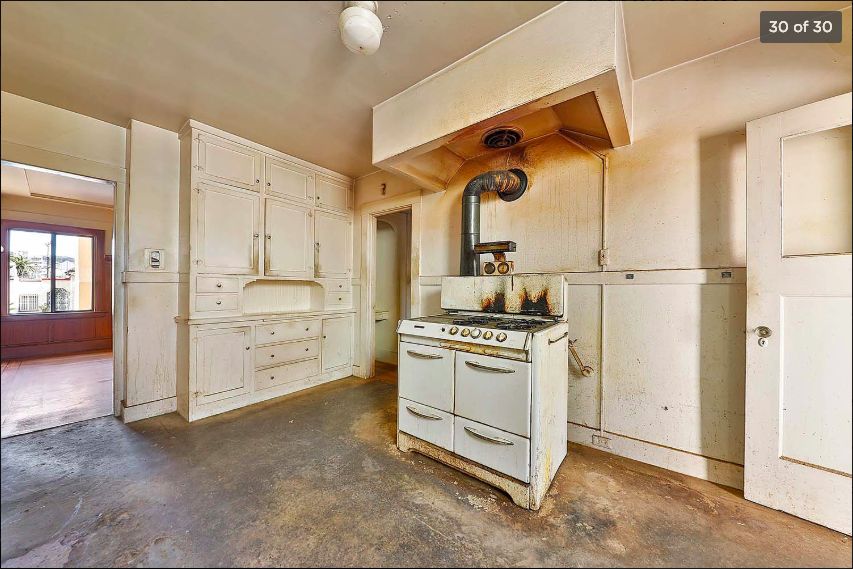
"There's only so much lipstick you can put on the pig"

Climb Real Estate Sales Agent Michelle Stephens, who put out the listing last week, told Yahoo Finance that the reason why she didn’t “dress the place up” was because she wanted to be “more transparent — they need to know what they’re buying.”

Stephens added: “There’s only so much lipstick you can put on the pig. And it just didn’t make sense. It’s visceral too, because you get to the property and there’s an actual aroma as well. Years of not cleaning up kitchen grease has really impacted the property.”

The tenants had moved out a year ago and insisted on the million-dollar price tag
It's not a total dump.  The full listing has 30 photos.  The basement is unfinished, the yard is primeval, but the San Francisco house does have locationlocationlocation.

27 February 2019

How much snow can the roof of your home tolerate?


This extraordinary winter has created much anxiety among homeowners worried about whether their roof can withstand the weight of the snow.  When should you worry?  I had to look it up, and found the answer in Reuben Saltzman's excellent Home Inspector column at the StarTribune (I highly recommend that homeowners bookmark and browse his home inspection blog).

For southern Minnesota, the building code stipulates load-bearing of snow by the roof of 35 pounds per square foot.  But... as anyone who has ever shoveled snow understands, there is a world of difference between light fluffy snow that falls when temps are near zero and the heavy wet snow that falls when the temps are closer to freezing.  The table embedded above sorts this out,

Water weighs 62 pounds/cubic foot, ice just a little less.  Heavy and light snow are shown in the first two columns (from 1/3 the weight of water to 1/20th); this is obviously a continuum, but the two numbers shown are useful to make the point.

The bottom part of the chart translates the numbers into snow depth.  If a roof was built to withstand 20 pounds per square foot, it would be at risk with a foot of heavy wet snow, but can handle over 6 feet of light dry snow.

It gets more complicated, because as snow remains on a roof, it becomes progressively more compact, and note that the tolerance for ice is way less than for snow.

In point of fact, residential roofs rarely collapse from snow.  But here in Wisconsin this week there have been reports of barn roofs and outbuilding roofs on farms collapsing, because building standards for those structures are less rigorous.

And a bigger problem than roof collapse is water penetration from ice dams.

06 February 2019

This (very, very) old house


"With 25,000 euros and 1000 hours of work, Maurizio Cesprini and his partner Paola Gardin rebuilt a ruined home in the medieval village of Ghesc, Italy. They hope other young families will consider their example with a plentiful supply of medieval ghost towns. They also feel drawn to save the rich architectural heritage of artisanal stonework dotting villages throughout the Alps, and beyond."
This is a long video, but a relaxing and uplifting one to watch.  Even if you skip through with the slider, it will still be impressive.

27 August 2018

Cozy


And only $1,375 monthly rent for this 140 square-foot third-floor-walkup apartment.  And no windows.

That same monthly rental would get you a three-bedroom, two-bath home with 1,400 sq ft of living space in Wisconsin.  The difference is location.  And location.  And location.

31 March 2017

Mark Twain's "writing hut"

At his most productive, Twain practically chain-smoked cigars, and his craving for a quick burn was conspicuous at 250-acre Quarry Farm, a nest of solitude away from the social hurly-burly of Hartford.
Mindful of her health, perhaps, sister-in-law Susan Crane had a windowed study built specially for Twain in 1874 not far from her Victorian farmhouse. Equipped with a writing table, wicker chair, cot, fireplace and cat door, it was designed to resemble the pilot house of a Mississippi steamboat.

After a steak breakfast, Twain would saunter 300 feet across a lawn flecked with buttercups and black-eyed susans and climb the stone steps to a promontory where the octagonal cabin was perched. Amid the chirp and crackle of nature, overlooking a panorama he called a "foretaste of heaven," Twain often churned out as many as 2,600 words a day...

To thwart vandals and accommodate tourists, the cabin was moved down to the Elmira College campus in 1952.  
The top photo shows the study at its current location on the campus.  The original location offered way more spectacular views.
“It is the loveliest study you ever saw…octagonal with a peaked roof, each face filled with a spacious window…perched in complete isolation on the top of an elevation that commands leagues of valley and city and retreating ranges of distant blue hills. It is a cozy nest and just room in it for a sofa, table, and three or four chairs, and when the storms sweep down the remote valley and the lightning flashes behind the hills beyond and the rain beats upon the roof over my head—imagine the luxury of it.”—Mark Twain, Letter to William Dean Howells, 1874
I would love to have a similiar tiny "hut" in the north woods of Minnesota to use as a retreat.

Top photo credit Alamy, via The Guardian.   Black-and-white photo via Twainquotes.

14 March 2017

"Deconstructing" a house

It's not the same as "demolishing" the house:
Deconstruction... entails taking a house apart, piece by piece, down to the foundation. The majority of what is removed from a house via deconstruction can be recycled or reused. Everything removed from the house and donated to a qualified 501(c)3 charity can be claimed by the property owners on their taxes as a donation at fair market value...

The deconstruction appraiser determines what materials can be salvaged and estimates the value of the donations. As the process unfolds, the appraiser prepares a report that lists every component to be donated and its fair market value; completes IRS Form 8283 for the donor valuing the material (the nonprofit recipients complete the form, too); ensures that the donor has the required documentation to claim full benefits from the donation, and stands behind all this if the IRS has any questions about the donation. The deconstruction company dismantles the house, sorts the materials and transports them to centers for recycling or resale...

Deconstruction costs more than conventional demolition because the materials need to be carefully removed and preserved in usable condition. Stahl says demolition might cost $8,000 to $11,000 for a typical house and take up to a week to complete. Deconstructing the same house might cost as much as $24,000, she says, and take two weeks...

Generally speaking, Smith says, “85 to 90 percent of a house can be recycled or repurposed. About the only things that cannot yet be salvaged or repurposed are drywall, rotted materials and broken pieces of ceramic tile or marble.”

What typically can be salvaged? The list is long: hardwood flooring, carpeting, interior lumber, beams, cabinets, appliances, molding and trim, doors, switch plates, light fixtures, ceiling fans, mantels, bathroom vanities, toilets, mirrors, tubs, shower surrounds, granite and laminate countertops, sinks, windows, vent covers, shelving, insulation, heat pumps, hot-water heaters, air-conditioning units, washers and dryers, screens, siding, slate roofing and sub-roofing, flagstone, bricks and decking.
Kudos to people who do this rather than bulldoze the old house.  More information, and a gallery of photos, at the Washington Post. (embedded photo cropped for size).

04 May 2015

London underground

"The super-rich are maximizing property value in the heart of London as never before. But they're not building up, they're digging down, creating mega-basements or 'iceberg homes' - nicknamed because there's more square footage under the ground than above. Over the last ten years an estimated 2000 new basements have been dug in central London. Into these multi-level subterranean structures owners are building anything from cinemas, swimming pools, beauty parlours, squash courts, wine cellars and servants' quarters. Some take as long as three years to complete. As well as the noise of the digging, fleets of concrete mixers and lorries taking away the dug soil service the sites. So life for neighbours in some of London's poshest addresses has been hell.

As the Royal Borough of Kensington Council responds to angry residents and tries to regulate the number of mega-basements and the disruption they cause, this BBC film goes behind the hoardings to look inside the extraordinary structures and talk to builders, owners and irate neighbours to tell the story of the conflict that has gripped the millionaires and gold-paved streets of London's smartest postcodes."

24 April 2015

The "urban forest" of Minneapolis


American Forests offers a list of "The Ten Best Cities for Urban Forests" in the United States.  Among them is my old stomping ground:
Minneapolis can now add the credential of having one of the top urban forests. The City of Lakes is home to an abundance of varied parkland — a park every six blocks — including those designed for off-road cycling and those for hiking, canoeing and swimming. Minneapolis’ tree canopy of 31 percent is only 6.5 percent shy of its potential canopy of 37.5 percent based on geographic information system (GIS) analysis and modeling. Minneapolis was actually one of the first cities to use the U.S. Forest Service’s iTree assessment tool to determine the benefits of its urban forest. Today, it’s estimated that the city’s urban forest has a structural value of $756 million and also reduces energy use by $216,000 per year.
The photo shows Minnehaha Creek above the falls, by zuluadams, via Stuff about Minneapolis.

(Reposted from 2013 for Arbor Day 2015) 

22 August 2014

For homeowners: an open thread on "mudjacking"


If you own a house long enough, most of the components will need to be repaired or replaced (a fact often overlooked by young couples eager to purchase as much home as they can afford). Take my driveway.  Please.

Our house is only about 20-25 years old, situated near the crest of a hill overlooking woods.  It's clear that some regrading of the lot was necessary to position it where it is.  The driveway has a series of concrete slabs separated by tiny expansion grooves.  Over the past decade or so, some of the slabs have begun to shift.  These depressions first make themselves manifest in the winter when you are shoveling snow vigorously and the shovel comes to a sudden stop, sending a shudder through your body.

What's happening underneath may represent a "settling" of fill originally used to level the ground or perhaps some erosion as rainwater and winter meltwater work their way between the slabs, perhaps exacerbated by the burrowing of critters like chipmunks or the action of the roots of some nearby very large trees.

The traditional repair method is to hire a construction firm to jackhammer out the concrete, adjust the base as necessary and then pour new slabs.  The alternative is "mudjacking" (sandjacking, slabjacking).  This involves drilling a small hole in the concrete slabs and injecting under hydraulic pressure a material (originally mud or sand, but more recently a polyurethane foam) which fills the space and then lifts the slab until it is flush with its neighbors. (details at the link)

"Jacking" the slabs back up is generally faster, less labor intensive, less disruptive, and less expensive (probably by a factor of 3-5X - I'm still studying that) than removal and replacement of the driveway.  But when slabs are cracked (as some of ours are), there is a risk that the segments will separate, and even a smooth lift of an intact slab may not align perfectly with all the neighboring ones.

I'm writing this post to encourage readers who have dealt with similar driveway/sidewalk problems to respond with comments (for me and for other readers who have - or will someday have- the same problem to deal with), because this isn't the kind of information one learns in school.  Success stories and horror stories are equally welcome.

10 June 2014

Netherlands medieval cathedral converted into a bookstore

Utrecht-based architectural practice, BK. Architecten, have designed the Waanders In de Broeren project. Completed in 2013, the 15th-century cathedral has been converted into a modern book store and can be found in Zwolle, The Netherlands.

This radical concept in a 15th-century Broerenkerk cathedral spans over three floors and includes a shop in the former church building. The architect radically changed the interior design of the 547-year-old Gothic building, but had to ensure they left the original features, such as the pipe organ, stained glass windows and decor intact.
Architectural details and a dozen more photos at Adelto, via Erik Kwakkel.

20 November 2013

Why hurricanes cause so much damage

"A coastal town in the Samar province of the central Philippines that was wiped out by Typhoon Haiyan is shown in this Nov. 11 photo. The typhoon, which packed 150 mph winds and 20-foot waves, swept through the archipelago Nov. 8, leaving a trail of devastation in its wake."
This coastal town was effectively built on a sandbar, with virtually zero setback from the ordinary high water level.  

From a photo gallery in the Washington Post.  Credit: Erik de Castro / Reuters.

16 September 2013

26 August 2013

Fixer-upper


You can explore the intricacies of this interesting 1936 dormered cabin in Georgetown County, South Carolina in a wallpaper-size photo at Shorpy.

22 June 2013

Man remodeling an old house finds treasure

In his decade of working construction and home remodeling, David Gonzalez always dreamed of finding some hidden treasure in the demolition work. He’d even put dollar bills in new walls for folks to unearth in the future.

So he chalks up to karma the 1938 Action Comics #1 book he found amid old newspapers used to insulate a wall of a fixer-upper he was gutting in Elbow Lake, Minn. The old comic book, from June 1938, features a new character named Superman lifting a car on its cover...

The comic could have been worth more had it not been for a heated argument with one of his in-laws... When his wife’s aunt grabbed the comic book amid all the excitement of the discovery, he grabbed it back and tore the back cover. Experts downgraded the comic book’s condition to a 1.5 on a 10-point scale...

Still, it’s going for more than 10 times what Gonzalez paid for the abandoned house in Elbow Lake.. He and his wife went to the Grant County courthouse and researched the owner, who told them a neighboring restaurant had offered $10,000 to buy it. They planned to demolish the house and put in a parking lot. “So I offered $100 more and got it for $10,100,” he said.
Video report at the StarTribune link.  The comic book sold at auction for $175,000.

15 April 2013

Special outhouses


The Posthorn, a publication of the Scandinavian [stamp] Collector's Club, reports in the most recent (February) issue that Finland is releasing a booklet of four stamps whose designs were chosen from 500 entries in a photo contest for "the prettiest outhouses" in Finland.  More details (and purchase information for the booklets) at Posti - the website for the Finnish postal administration.

The contest was conducted to promote ingenuity and innovation in outhouse design; the 10,000 Euro prize was awarded to an entry that adapted the many knotholes in spruce as light sources and ventilation sources while preserving necessary privacy.

While briefly researching this topic last night, I discovered that the historic Hopper-Bowler-Hillstrom house in Belle Plaine, Minnesota which features a five-hole, two-story outhouse connected to the main house via a skyway; the outhouse was added in 1886 as an upgrade to the original 1871 home.  The house is now open to the public; visitors may see the outhouse (but may not use it).  The image embedded at right is cropped from the original.

I was going to end with that - until I found the photo of the twelve-family, three-story outhouse (the Missouri History Museum does not allow the image to be embedded.)

30 January 2013

Plumbing vents in houses explained

These vents through the roof are designed to prevent the S-trap under your sinks from being siphoned dry.
Plumbing vents prevent traps from being siphoned. They also prevent back-pressure on traps, but today the focus is on siphoning. You may have heard that plumbing fixtures will drain faster when they're vented properly, and I know I've said this myself, but it's not necessarily true. The common, improper analogy is to talk about dumping a soda bottle upside down. You watch the water glug out while air replaces it, and this makes it drain super slow. Once you put a hole in the other side, the water drains out very quickly. This analogy doesn't hold water because the top side of every plumbing fixture is wide open. The top of a toilet is open...

Every plumbing fixture has a trap, which prevents sewer gas from coming in to the home. When a lot of water drains through a plumbing fixture, it can be enough water to create a siphon effect, which has the potential to pull water right out of the plumbing trap...

When water is siphoned through the drain, the water in the trap gets siphoned. This can lead to sewer gas coming in to the home. In short, plumbing vents are there to help prevent sewer gas from coming in to the home.
Text and image from my favorite home-repair/DIY blog in the StarTribune, which also has two videos illustrating the physics of plumbing vents.  Only homeowners will find this of interest.

16 January 2013

Cabin photos

A sand dune shack on Nantucket Island, MA. Photo credit: Spencer Sight.

Ladder House near Dale, Norway. Photo credit: Olga Gladykowska.

Saami hut in Amarnas, Sweden. Photo credit: Charles Gaspar.

Island cabin on Senja, Norway. Photo credit Kristian Helgesen.

Four selections from the many hundreds assembled at Cabin Porn.  The bottom Norwegian one appears to me to be constructed in the old Viking tradition of upending a boat.
Related Posts Plugin for WordPress, Blogger...