Showing posts with label John Dickson Carr. Show all posts

15 February 2019

The final seven Henry Merrivale mysteries

In July of last year I covered the first four Henry Merrivale novels.  In November I tackled the next five, then six more in January.  Today we finish with the final seven, discussing the language only, with no plot-spoiling comments.

The Curse of the Bronze Lamp (1945)
No locked room.  Instead an introductory dedication to Ellery Queen with a "cryptic reference to Mr. James Phillimore and his umbrella."  Carr is obliquely referring to John Watson's line in Doyle's The Problem of Thor Bridge:
‘Among these unfinished tales is that of Mr James Phillimore, who, stepping back into his own house to get his umbrella, was never more seen in this world.’
I'll say no more (for those interested, there is a review here).  On to the language.
[A row involving H.M.] ".. is still mentioned with respect by Arab porters and hotel commissionaires, even in that city of memorable schlimozzels."  That's a word I first (and last) heard in the introductory song for Laverne and Shirley!  "Schlemazel, also schlimazel, "born loser," 1948, from Yiddish shlim mazel "rotten luck," from Middle High German slim "crooked" + Hebrew mazzal "luck." British slang shemozzle "an unhappy plight" (1889) is probably from the same source."

"The sunlight made a living entity of the picture carvings which fretted every inch of the bowl."  "To decorate or ornament, especially with an interlaced or interwoven pattern, or (architecture) with carving or relief (raised) work."

"She slipped out over the up-ended front seat, as trim and soignee as though the waterproof were a kind of cellophane wrapping."  Fashionable and elegant, borrowed from the French.

"... met an odd cove named Beaumont."  Informal British for "a fellow, a man."  Said to be from Romany (Gypsy) cova "a thing," covo "that man".

"By the six names of Satan, she was here! I heard her!"  One online reference says there are six names of Satan found in Scripture: Satan, Beelzebub, Devil, Lucifer, Dragon, Prince.

"But I was there.  So was a josser named Alim Bey."  Lots of meanings, depending on the context - a foolish man, a clergyman. an outsider working in a circus, a person of influence or importance.

"Kit would have recognized him by the red tarbush on his head."  A fez. (Arabic: tarboosh).

"... a kitchen maid or a tweeny."  Slang for "between-maid" - a sort of servant to the servants.

"She was gettin' scared.  She didn't dare keep the dibs any longer." In context, stolen merchandise, perhaps related to claiming "dibs" (ownership).


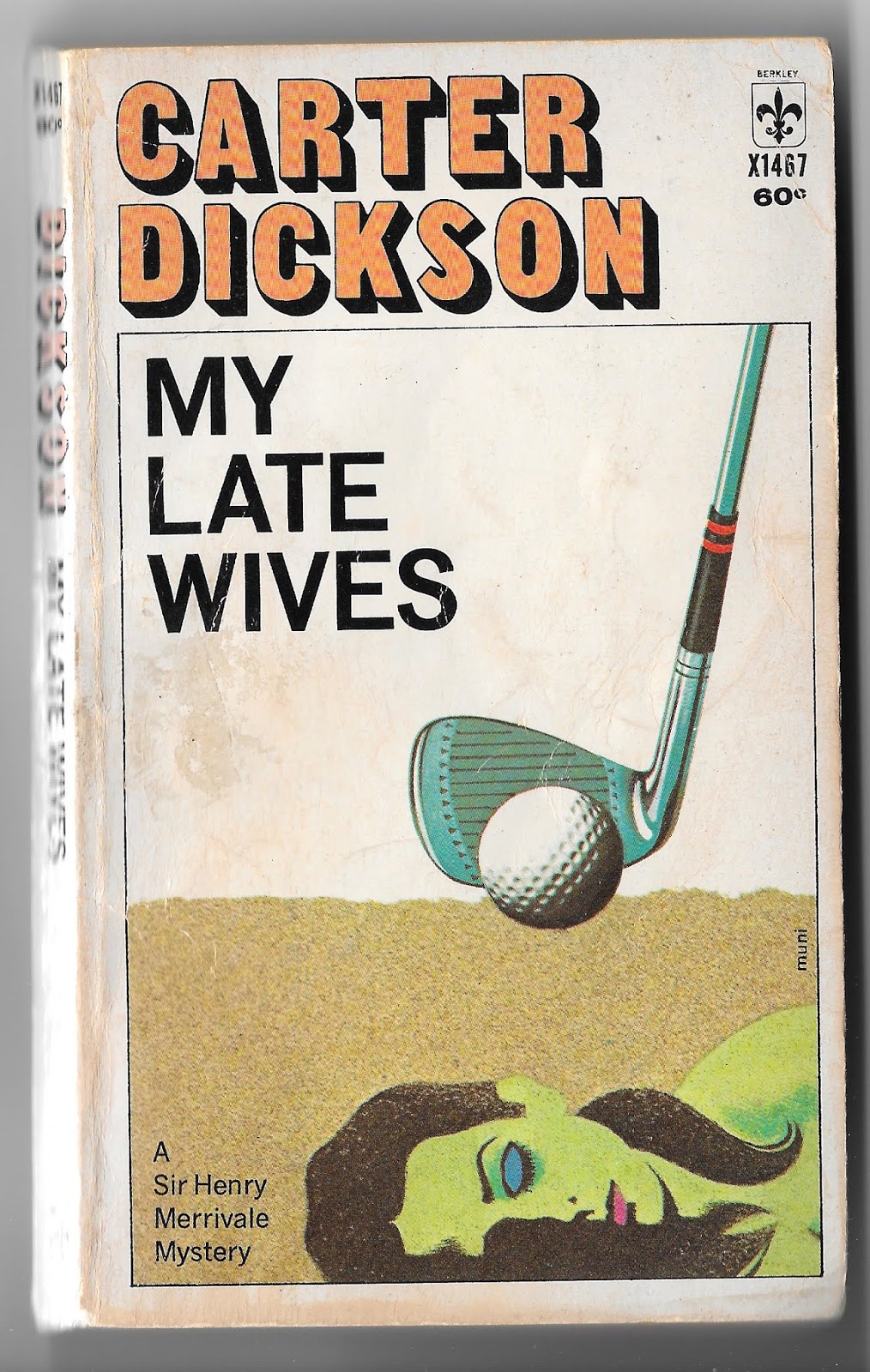
My Late Wives (1946)
Not a locked-room mystery; the puzzle to be solved is how a murderer can dispose of a dead body from a room under constant surveillance.  Not one of JDC's best.
"In the spring of 1933 he took her north, to a bosky cottage near Scarborough..."  Covered by trees or bushes; wooded.  (Late 16th century: from Middle English bosk, variant of bush.)

 "This is especially so in post-war London, where browned-off troops and equally browned-off civilians find their nerves scratched by so many small annoyances..."  Irritated or depressed, bored, fed up, disgusted.  "The slang phrase became popular in the Second World War.  The reference is probably to a dish that has been overcooked. See also cheesed off..."

 "You leave it to me, cock.  I'll see you don't get lagged." To transport as a punishment for crime (British archaic slang).

"Sir, do you think I'm off my chump?"  Insane, crazy. 

"Is that your Goddamned theatrical habit?"  Interesting to see it capitalized.

"Commander Renwick, obviously, was very pukka, very much the sort of person who does not let you forget that he has been an officer and a gentleman."  High quality, genuine, first class.  From the Hindi, Punjabi, and Urdu.

"By any sane computation, that ought to carry the perisher round and land him slap on the green..."  Annoying child or brat, used as a term of contempt (or pity).  "Perishing" can be used as an intensifier in British speech.

"Beyond it was a car, an S.S. Jaguar in whose big dickey, or rumble seat, you could easily hide a body."  The manufacturer's name 'SS Cars', used from 1934, maintained a link to the previous owner, Swallow Sidecar, founded in 1922 to build motorcycle sidecars. In March 1945 the S. S. Cars shareholders agreed to change the name to Jaguar Cars Limited.

"H.M. was at the wheel of the car, a big but very old relic with isinglass-windowed side-curtains..."  I've always equated isinglass with mica, but that wouldn't make sense in this context.  Turns out the word is also used for "a form of gelatine obtained from the air bladder of the sturgeon and certain other fish, used as an adhesive and as a clarifying agent for wine and beer.  And in fact the word itself is from the Dutch/German for "sturgeon-bladder."  “With isinglass curtains y’ can roll right down/In case there’s a change in the weather.”—“The Surrey With The Fringe On Top,” from Oklahoma!, 1943.  Photo of 1926 car with "large isinglass side curtains" (perhaps the term is used interchangeably with "celluloid."

"... along an open coast where rain-gusts flew at them with harpy violence..."  Commonly encountered as a noun; I don't recall seeing it used as an adjective.

"... and owing to a concatenation of circumstances..."  A series of links united, from the Latin catena = chain.

"That's when J.M. realized this blighter was up the pole, a lunatic with designs on Daphne..." "'Up the pole' is an odd phrase, or rather, it is an odd collection of phrases, in that it has numerous meanings..." In context, insanity, so perhaps thus: "In a classic example of folk etymology, 'up the pole' has been suggested to be named after De La Pole Psychiatric Hospital, Hull, UK."


Skeleton in the Clock (1948)
The plot involves locked rooms (execution chambers at an abandoned local prison), but the murders don't take place there.
"Who the devil are these two powerful jujus, grandmother and Aunt Cicely?"  Borrowed from the West African.

"Didn't you hear Beowulf's Mother yellin' for chuckers-out?"  "Ejection or dismissal, usually the sack. Late 19th century Austrlia/NZ. Also the end of drinking time in a public house, or place of entertainment, when customers are asked to drink up and leave."  The second definition makes more sense in context.

"... it made him jump to his feet, miry-eyed, and peer round..."  Related to a mire (swampy), but in context presumably meaning the eyelids stuck together from recent sleep.

"For some reason Martin's gorge rose sickeningly at the very thought of eating."  Throat, gullet, from the Latin.  If it rises, the implication is impending vomiting.

"You're not likely to forget the first h.e. bomb that fell close to you..."  Colloquial term for high-explosive bomb used by the Luftwaffe.

"Martin thought he could detect one brass band, a panotrope with a bad needle, and the steam organ of a merry-go-round." "A device for playing records, especially one that plays them loud enough for fairground or similar use." 


A Graveyard to Let (1949)
The setting is the equivalent of a locked room.   A wealthy man is visiting with six or seven guests at his swimming pool.  When police arrive he dives into the pool.   His hat floats to the surface, along with his sandals, but he disappears.  The water is murky, so while watching the pool, the police have it drained.  His body is not in there.  And there are no secret exits from the pool.

"The revolver was not a Colt .38 police positive, as Cy half expected."  "The Colt Police Positive was an improvement of Colt’s earlier “New Police” revolver, upgraded with an internal hammer block safety. Colt named this new security device the “Positive Lock”, and its nomenclature ended up being incorporated as a partial namesake for the new revolver

"Sir Henry, you have a popsy in New York."  (in context, a kept woman)


Night at the Mocking Widow (1950)
Probably the weakest JDC novel I've reviewed to date, because the solution relies more on psychology and motives rather than clues - more reminiscent of an Agatha Christie than a JDC (the crimes in this book are poison pen letters, not murders).
"Theo Bull swears 'e won't have no nance amateur three rounds [of boxing]. 'E wants a perfessional fifteen..." Short for "nancyboy" = homosexual or effeminate man.

"The woman seemed to sag, like a dim droopy witch, as she indicated a door on the left side."  I have no clue on this one, and don't know where to start.

"... so you see, my dolly, there's no call to be scared of that sausage-eatin' faker downstairs.  He's only wind and gold-rimmed gig lamps.  He sticks the gig lamps in your face and talks a lot of tommyrot." A lamp on the side of a gig (carriage, two-wheeled, horse-drawn).  The person referred to in the story was a psychiatrist.


Behind the Crimson Blind (1952)
Another weak  novel, written late in JDC's career, and during a time when his other detective, Gideon Fell, was getting the best plots.  Carr still has a way with words, vide this introduction of a principal character: "Though his best friend could not have called him handsome, his thin face showed traces of an intelligence and humour which were masked, as a result of his official duties, by a formal courtesy close to stateliness." As with The Mocking Widow (above), there is too little detecting and too much romance, comedic episodes, and derring-do; it's a "light read."

In his critical study of John Dickson Carr, S.T. Joshi notes a decline in the later Merrivale mysteries: "It is not very profitable to trace the course or history of the Merrivale novels: not one, I believe, is to be compared in scope or brilliance with the four or five best Fell novels, or even with the best of the Bencolin series, and in general there is simply a gradual decline in quality and readability."

Remarkably, in this novel H.M. even kills someone: "H.M.'s powerful left hand whacked down on Middle Europe's head, seizing and rolling a good handful of hair to hold  hard.  As he forced the man downwards, H.M.'s right hand drove the Riff knife through the side of white robe's throat, just behind the Adam's apple."  In the concluding chapter Merrivale says "Maybe I had to do something like that in Marseilles once; or two or three times at Port Said; or maybe in Occupied Germany..."
Riff knife was hard to find, in part because of dilution from references to a knife owned by a character named Riff in West Side Story.  Finally found a proper reference in Agatha Christie's Murder is Easy:" He had a knife in his hand--a long slender blade. "Perfect workmanship," he was saying. "One of my young men brought it back to me from Morocco, where he'd been special correspondent. It's Moorish, of course, a Riff knife."

 "I'm not asking for any Bertillon measurements..." [re someone's head]  "A system for identifying people by a physical description based upon anthropometric measurements, notes of markings, deformities, skin colour, impression of thumb lines, etc." Named for the French anthropologist (who also invented the mug shot).

"... young Arabs in modern clothes whose pinched-in waists and white ties made them resemble wide-boys from Soho."

"... breakfast of two hard-boiled eggs, huge slices of ham together with those red sausages... his collation was placed on the table piece by piece over a smooth linen cloth."  A collection or bringing-together.  Also a light meal taken by monks after a reading in a Benedictine monastery, perhaps used here jokingly."

 "... [redacted] had got to the point, that night, where he and Collier had got to part brass rags."


The Cavalier's Cup (1953)
Classic locked-room mystery, though the mystery is overwhelmed by lengthy and sometimes tedious side-stories of humor involving Signor Luigi Ravioli, a caricatured Italian.  ["Well! She isn't bad at all.  Except for one thing, she would meet with anyone's approval.  Though I hate to put it quite so crudely, Dad did seem to be getting to first base."  "First-a base?" exclaimed Signor Ravioli in horror.  "You want-a to insult-a your Pop?  He's-a tear around-a bases going straight-a for home plate!"  Virginia did not stop to correct this vulgarism..."]
"Just then they both heard horsemen in half-armour and buff-coats..."  "The European buff coat (the term deriving from the ox or buffalo hide from which it was commonly made and its yellowish colour) was an item of leather clothing worn by cavalry and officers during the 17th century, it also saw limited use by some infantry. It was often worn under armour. It was derived from the simple leather jerkins worn by huntsmen and soldiers during the Tudor period, these in turn deriving from the arming doublet worn under full plate armour."

"Rapidly, as though they were alone on some fond, isolated island, Virginia sketched out what she had been telling the others..."  An odd adjective to choose, perhaps meaning "foolish, silly."

"What's the idea of the tile?" yelled H.M.  "Lord love a duck, haven't you got any better manners than to stick on your hat in the house?"  Definitions of "tile" do include "a stiff hat."  In this case the hat was a top-hat and clearly not discoid or tile-shaped; perhaps the usage refers to the application of tiles to cover a roof.
Thus endeth my survey of language in twenty-two Sir Henry Merrivale novels (one week after H.M.'s 148th birthday).  I need a change and will switch my reading elsewhere.  When I return to John Dickson Carr, it will be to cover the historical mysteries.  I'm saving the final group (and the best of the lot) - the Gideon Fell novels - for last.

10 January 2019

Six more Sir Henry Merrivale mysteries

This is the ninth in an ongoing series of posts about the mystery novels of John Dickson Carr (aka Carter Dickson).  Last July I covered the first four Henry Merrivale novels.  In November I tackled the next five.  Six more today, discussing the language only, with no plot-spoiling comments.

And So To Murder (1940)
Not a locked-room mystery.  Plot rather weak.
"In Mr. Hackett's experience, the ladies who wrote passionate love-stories were usually either tense business women or acidulated spinsters..."  What Mark Twain would have called a "two-dollar word" that simply means "sour" (made more acid).

"She was very casual, but she swanked like billy-o."  To swagger, show off.  Billy-o is a slang term for "the greatest extent or degree of something."

"The speaking-tube whistled again."
"The speaking tube supplemented the array of remotely controlled hand bells that were operated in the upstairs rooms and rang in the servant's quarters in even modest houses in the 19th century. The phrase "get on the horn" and "give him a blow" as well as the use of "blower" as a synonym for "telephone" are generally accepted as having their origin in this feature of speaking tubes."
"The dozenth pledge was broken."  We've seen JDC use this odd word before, but I note while looking it up again that it may be preferable to twelfth when referring to the final entity in a set of twelve, because "twelfth" might imply the existence of a thirteenth. 

"... fell overboard and was confined to bed with 'flu."  Yet another example of proper indication of a shortened word [but then maybe it should be 'flu' ?]

"What's the matter, honey?" she asked, in a different voice.  "Got the whips and jingles?"  In context the implication was "are you in love?" but online dictionaries list it as an idiom for delirium, especially DTs.

"Monica's a nice kid.  She's what I'd call a ginch; sweet voice, and big eyes...:  Oxford dictionaries suggest "An attractive woman, especially (frequently depreciative) one regarded as an object of sexual gratification," with "earliest use found in John Dickson Carr." (!)  Other online dictionaries offer only demeaning definitions and usages.

"So he was a cashiered prophet, was he?"  Dismissed, discarded.

"... I'd rather take a chance and trust you than have you chivvyin' Joe all over the landscape..."  To pursue, chase, hurry along, sneak up on, or verbally abuse.   Probably from the title of the 15th century Ballad of Chevy Chase, about a hunt at a chase [estate where game may be hunted].

"He would be sitting in a spacious office, all mahogany and deep carpets, with bronze busts on bookcases, and an Adam fireplace."  Eighteenth century neoclassical, named after three Scottish brothers.

"She [actress] incited what young ladies in the ninepennies had been overheard to describe as a "goosey feeling."  Cheap seats in the theater.

"It was a conference to which Monica and Bill were not admitted; they were compelled to kick their heels and fume in an outer room."  To wait impatiently or restlessly.

Nine - and Death Makes Ten (1940)
Not a locked-room mystery, but has a fiendishly clever plot with a "last person you'd suspect" outcome.
"His trunk stood beside one of the white-counterpaned berths."  Quilt or blanket.  Etymology ultimately from Latin pannus = cloth.

"But needs must when the devil drives."

""Crab cocktail," said the doughty Lathrop, consulting his menu."  Brave bold, from Middle English.

"Beside the grand piano there was a full trap-drummer's outfit for dancing."  The outfit here is apparently not clothing but a "drum kit" [set of drums].  Re the "trap" I found "drums, cymbals, bells, etc.," 1925, from earlier trap drummer (1903) "street musician who plays a drum and several other instruments at once," perhaps from traps "belongings" (1813), shortened form of trappings.

"But, you're tight as an owl already.  Can you hold any more?"   Intoxicated, in context.  But an odd idiom; I haven't found any logic behind it.

"It sounded blattering and almost obscene."  Blather, foolish talk.  "1520s, blether, Scottish, probably from a Scandinavian source such as Old Norse blaðra "mutter, wag the tongue," perhaps of imitative origin, or from Proto-Germanic *blodram "something inflated" (the source of bladder)."

"... and then look like a martyr and say you're sure some poor goop will trust you?"  Silly, stupid person. 

"... like one of those nature-study motion pictures where they show a flower coming up whingo overnight."  I found nothing on this.

"She had him on the hip now.  She was winning this exchange..."  Borrowed from horse-racing I think, presumably the opponent's nose it at your horse's hip.

"The doctor laughed.  Max thought that his constant twingling, or laughing, or pointed innuendo, might have got on their nerves..."  I found nothing on this.

"... I could kick myself from here to the forepeak."  The part of the hold of a ship that is within the angle of the bow.

"Give me that torch," he said.  "If you try to press the button I'll have to slosh you."  British colloquial for "punch" (used here during a war blackout on a ship under submarine threat.)

"When I heard that [torpedo] alarm-signal go, I thought it might be a have."  In Australia/NZ it refers to a fraud or deception - would be correct in context here.

Seeing is Believing (1941)
Clever plot twist, but the reader is required to believe in the efficacy of hypnotism (a modern reader would be skeptical of this as a plot element, but 1930s readers were more accepting in that regard).  The book does make note of Henry Merrivale's birthday (Feb 6, 1871) and offers this concise precis by Chief Inspector Masters of Henry Merrivale's typical cases: "Whoever you think it can't be, that's always the person it is."
"... the polished hardwood floor, with rugs scattered on it, which was badly sprung in places and had a tendency to creak near the windows..."  In modern usage a sprung floor is a flexible one designed for dancing.  In context here it appears to refer to misaligned boards.

"... who now run a bucket-shop in the City and are almost as crooked as he was."  "An office with facilities for making bets in the form of orders or options based on current exchange prices of securities or commodities, but without any actual buying or selling of the property".  "The origin of the term bucket shop has nothing to do with financial markets, as the term originated from England in the 1820s. During the 1820s, street urchins drained beer kegs which were discarded from public houses. The street urchins would take the dregs to an abandoned shop and drink them. This practice became known as bucketing, and the location at which they drained the kegs became known as a bucket shop. The idea was transferred to illegal brokers because they too sought to profit from sources too small or too unreliable for legitimate brokers to handle."

"... life for George Byron Merrivale was not all ginger-pop either."  I found one other usage from 1925 referring to life not being all "ginger pop and chocolate cake."  Presumably viewed as a luxury.

"'Oh, I was no mollycoddle,' said H.M.... "  Pampered, overprotected person. "one who coddles himself," from Molly (pet name formation from Mary), which had been used contemptuously since 1754 for "a milksop, an effeminate man," + coddle (q.v.).

"Sir Henry Merrivale, in a white short-sleeved shirt and white flannels, was engaged in playing clock-golf."  "Clock golf is a game based on golf, originating in the mid 19th century. Players putt a golf ball from each in turn of 12 numbered points arranged in a circle as in a clock face, to a single hole placed within the circle."

"It would be rather awful, wouldn't it, if somebody we thought figured in one rôle really figured in exactly the opposite rôle?"  Discussion thread about the use/nonuse of the circumflex.

"... immersed in a curious anecdote about the Devenport brothers and their use of a lazy-tongs in the middle-'eighties."   A pantograph (item that extends or contracts like an accordion) (see the example of the mirror at the link).  Also the use of an apostrophe on "eighties" to make note of an elision.

"Would you like me to rub some embrocation on [a sore spot]?" Moistening or rubbing with spirit or oil.  From Latin and Greek for "lotion."

"Played the rip..."  In context, unfaithful to a spouse.

"But that very evening the case had the tin hat put on it when Agnew reported..."  "To put the tin hat on something is to finish it off or bring it to an end."  Thought to be an expression from the First World War.

The Gilded Man (1942)
Very gratifying to finally solve one (murderer, method, and motive) before the reveal at the end - but it required stopping near the end and spending an evening rereading from page one onward again.  Also notable for JDC's incorporation of humor unrelated to the plot, as for example after Sir Henry Merrivale finished his performance in the persona of "The Great Kafoozalum" for a magic show at the country estate, attended by a particularly annoying schoolmarm:
... H.M. himself [was] still in costume of the Great Kafoozalum, with a small girl clinging tightly to either hand.  The boys, though sneeringly disdaining such effete signs of friendship, nevertheless circled round and round him like Red Indians at a campfire, firing questions faster than newspaper reporters.
"Was it a trick when you dropped Miss Clutterbuk down the trap-door?"
"Why did you tie her up like that?  Was it the Indian rope-trick?"
"And gag her?"
"Did she really have that bottle of gin in her handbag?"
"Why didn't she reappear again on top of the bar counter, like you said she was going to?"
"Well, now, son, I expect something went wrong with the spell.  These tough old hyenas are pretty hard to put the hoodoo eye on..." 
But on to the language...
"... she was pretty, in the conventional sense of good features and rather wax-bloom complexion."  Not quite sure about this.  I found the word used to refer to the migration of salt to the surface ("efflorescence") of a artwork (especially colored pencils), and the coating of wax on the outer surface of a plant cuticle.  Also happens to lipstick. Can't quite see the application to complexion.

"Do you know what a beignoir is?"..."They have them in French theaters... a private box, a sort of cell with a hole cut in the wall, where people in mourning can go to the performance without being observed."

"El Greco, who saved his fingers from the Inquisition, had called that picture The Pool."  Presumably there's an interesting story behind this, but I couldn't find it.

"You come charging in here and look jail at everybody instead."  Another idiom I couldn't find.

"It's an old trick... Like the anonymous-letter ramp, you see."  Still another I couldn't find.  Not having a good day.

"Don't be surprised if you find my dabs on that knife." In context: fingerprints - presumably with reference to the method they are obtained.

"H.M. picked it up, while Nick retailed the evidence of the fingerprints."  To repeat or circulate.

"The flicker of firelight, from under a carved overmantel as big as an arch..."  Decorative panel over a fireplace (pix).

"... she was half-whistled herself." I finally found whistle-drunk meaning "too drunk to whistle."

"He says you hit him in the mush, whatever that is, with a snowball."  Mouth or face [Brit. informal]

"Commander Dawson, sitting in one of the embryo boxes with his feet irreverently on the rail..." ????

"... anybody but a Child Psychologist would have seen that this bottling-up presaged signs of explosion in a first-class beano."  Noisy celebration or party, also called beanfeast.

"On his head the Great Kafoozalum wore a huge bulging turban, fastened in front with a single paste ruby, from which a tall white aigrette rose up like the radio antennae of a police car."  Feather or plume (etymology from egret).

 "But it bled like billy-o."  (see above)

She Died a Lady (1943)
A mystery that relies a lot on the science of footprints, and a novel that has a bit too much forced humor, but one that reveals the murderer as absolutely the very last person you would expect.  I'll say no more.
"... a little causerie with her father--"  Informal conversation (from the French).

"I saw the quick, glutinous interest of the eye, and I didn't like it."  Glue-like.  Not sure how this applies to a gaze, except perhaps as a fixed stare.

"He'll go before the beak in the morning, and get fined ten shillings."  Court/judge in context.  Also used to refer to a schoolmaster.  Derivation not found - perhaps relates to an article of clothing or headwear?

"... Tom large and breckled and hollow-eyed..."  Couldn't find anything - not even in my OED.  Perhaps it's a printing error?

"It was while I was bucketing around a curve past Shire Oak..." Driving, in context.  Found definition "to travel quickly," "to move jerkily", and "to ride a horse hard," but not sure why.

He Wouldn't Kill Patience (1944)
Classic locked-room murder.  A herpetologist (and his favorite Bornese tree-snake named Patience) are found dead in his office at the Royal Albert Zoological Gardens.  Gas from a fireplace has asphyxiated them both.  The office is hermetically sealed, with locked door and windows, and with paper glued over the keyhole and other spaces ("Every microscopic opening in that room - the tiny little crack under the door, the keyhole, the joins of the two windows where the sashes meet - every place is sealed up as tight as a drumhead by glued paper fastened on the inside.")  So it appears to be suicide, but... "he wouldn't kill Patience."
"Aloof, disdainful of the canaille, he moved majestically down between the rows of specimens."  The lowest class of people; the rabble; the vulgar (from the French).

"The young man waved a brief-case."  Interesting to see the word hyphenated.  A reminder that originally it was a carrying case for legal briefs.

"In the middle of the front lawn, clearly seen by westering sunlight, stood a thickset man..."  Moving toward the west, obviously.  Apparently there is also an eastering.  And northering.

"Up to this time [the theater's] windows had been blind-eyed, its little foyer closed..."  not blitz-blackout-related since the time period is since 1928.  A search yielded many descriptions of blind-eyed buildings, but no definition.  Not apparently curtained, because often refers to abandoned buildings.  Maybe it's empty windows like blind eyes in a face.

"In that event, it wouldn't be worth while opening the new show."  Interesting to see it written as two words.

"It was very warm and stuffy in the sitting-room.  Its blackout, thick rep material, showed unevenly..."  A cloth woven with ribs.

"... Carey chose a B-middle-size and probed for the wards of the lock." (while trying to pick it).  Presumably the "protected part" inside the outer covering.

"Even Sir Henry Merrivale... fussed over her like a boiled owl."  Odd.  The Oxford Reference defines as "very drunk": "also drunk as a biled owl, …an owl, …two hoot owls, full as a boiled owl, lushy as…, tight as…, stewed as an owl, tight as…)"

"Far below, through the ropes and cords and raised drop-scenes of the flies, he could see a dim stage... His eyes moved over the cluttered stage, the battens with their pouring rays, the big dim theatre."  Flies in a theater refers to the "rigging system of rope lines, blocks (pulleys), counterweights and related device."  In a theater, battens are lengths of timber used to stiffen a surface of canvas.
Enough.  There's a limit on how much time I'm willing to spend searching arcane words and outdated dialect.

Four of the above are now listed on eBay.

01 November 2018

Five more Sir Henry Merrivale mysteries

This is the eighth in a very long and just-begun series of posts about the mystery novels of John Dickson Carr (aka Carter Dickson).  In July I covered the first four Henry Merrivale novels; continuing in chronological order, today I tackle the next five (focusing as always on the language, not the plot):

The Punch and Judy Murders (1935)
Although the two deaths occur in locked rooms, the method of death is not complicated (both victims have taken poison and locked themselves in the rooms).  The fiendish part is trying to figure out the perpetrator before the last chapter.  There are only about a dozen characters in the story, and if I had listed them in order of my suspicions, the true killer would have been very near the bottom.
"Now of course, H.M.'s conduct at its mildest can seldom be described as homely or commonplace..."  Interesting use of homely in its strictest sense of being ordinary.  Carr uses the word elsewhere to describe a person's visage as being unremarkable.  Modern usage of course implies that a "homely" person is unattractive or ugly.

"Outside [Torquay railway station] I was looking for a station-wagon for the Imperial Hotel..."  This term originated as a designation for vehicles used to transport people and supplies from a train station, long before it was applied to extended-length automobiles.

"This is a telescopic jemmy; finest thing made; a yard long extended, and its got a powerful leverage."  An alternative spelling of "jimmy" (crowbar).  Not sure how the word came to be used for that tool. 
"From the outer room I could hear the sergeant still droning on the telephone; and through the open window to the rear yard, somebody was commenting on the lascivious habits of carburetors."  
Clever and humorous bowdlerization.  And again later:
"Why don't you look where you're going," I snarled.  "Laundry!" I added, and thrust the bundle at him.  This was too much.  "I don't want the sanguinary copulating laundry," howled Dennis, who had been under a great strain that night."  
We know those are not the words Dennis used...

"I glanced down, and found myself looking into the frosty gaze of a genuine Anglican clergyman.  He did not seem to be the dominie for your money."  Alternate spelling of domine (clergyman or schoolmaster).

"And apparently it's a big ugly turnip-ghost; nothin' else."  Halloween jack-o-lanterns were once crafted out of turnips.  I presume this usage is related.

"Now that the little digression's over," he pursued almost cheerfully, "we can go back to horses and beans again."  Idiom, presumably.  Anyone ever heard it before?

"He got a whole coruscating whirl of nasty shocks."  Sparkling, from the Latin for "flash."

"Yet the car sped us out again, and down into an effulgent Whitehall."  Shining, radiant (from the Latin).


The Peacock Feather Murders (1936)
A concise summary (without spoilers) is at the Wikipedia  page.   Also of interest is a brief explanation by the author (via Henry Merrivale) of the reasons why a murderer would create a locked-room scenario.  In addition to the expected ones (to fake a suicide, because of a series of accidents), he adds here "a fourth motive, the neatest and most intelligent of all... if he can really create an impossible situation, he can never be convicted for murder no matter if all the other evidence is strong enough to hang a bench of bishops.  He is not tryin' to evade the detecting power of the law so much as to evade the punishing power."
"Why in the afternoon, anyway?  There's somethin' fishy about the sound of it.  I don't mean it's a hoax or a have; only that there's a queer and fishy element about it."  I don't know this phrase, and don't know how to look it up.  Is it familiar to any reader?

"He had been in such a fettle of triumph after winning this argument..."  Condition; unusual to see it used without "fine."

"She had, like that which has been vulgarly attributed to a certain danseuse, a glance that could open an oyster at sixty paces."   Not sure what female dancer he's referencing, but the phrase is directly borrowed from P. G. Wodehouse's description of Roderick Spode.

"Gor," he said.  "Burn me, son, I always regarded you as rather a tough walnut to crack."  An oath, more often seen as "gor blimey or cor blimey" (corruption of God blind me!)

"She is the last woman in the world who would throw her bonnet over the windmill; of that I can assure you."  To act in a deranged, reckless, or unconventional manner (refers to Don Quixote, who tossed his hat over a windmill as a challenge).  In context here, noting that the woman is virtuous.

"You will have observed," said Derwent, smiling gravely, "that no moths have settled on me.  Good night, gentlemen."  (there were some moths at the scene, but I don't know the implication of the phrase - maybe it means "I've been active and moving.")

"He strode out after her.  This passage-at-arms had been so brief and unexpected that nobody knew what to say..."  In this context a brief conversation involving an exchange of terse comments.  Classically apparently refers to a chivalric battle.

"But how are we to explain the fact that, whoever took [the teacups] there, we find no mark on them at all?  Somebody must have touched them, if only to range them on the table."  For "arrange".  Also used to mean to place in a row, rank, or classify.

"My father - made mistakes.  That I admit.  There were times when we were in very low water." Financial insecurity implied; interesting that both being in deep water and in very low water are bad situations (the low water probably implies the person is in a boat).

"That was also why he scattered so many clews - scattered 'em lavishly - scattered 'em like a paperchase."  A cross-country race ("Hare and Hounds") in which a trail of torn-up paper marks the trail.

"I had reason to think that somebody was deliberately maneuvering me into a snare which should end with a well-soaped rope and a ten-foot drop."  I used to lecture about death by asphyxiation, including the physiology of hanging, but don't recall any mention of the nooses being lubricated.  I'm guessing that doing so would facilitate the noose tightening on the neck rather than getting stuck on its own internal friction.  Interesting.

"Which is just as good as an alibi.  But on one point their apparent good sense seemed to go skew-wiff."  Out of alignment - obviously related to "askew."   I finally found skew-whiff: "The expression 'skew weft' dates at least from the 18th century as a term used by handloom weavers, typically in northern England. It was used originally to describe fabric which was out of alignment... The modern spelling comes from a corruption of 'skew-wift' whose sound developed colloquially in spoken English from the original. Bow weft also exists."

[why didn't they coordinate their alibis]... It would have been aes triplex, which no amount of batterin' would be able to break in court."  Literally "triple brass" = indestructible.


The Judas Window (1938)
The deceased is found in a study that has bolted steel shutters on the windows and a heavy door locked from the inside with a large sliding bolt.  In the same room a man lies unconscious; his fingerprints are on the murder weapon.  The best locked-room mystery so far.  Interestingly the action takes place in a courtroom only, with H.M. as the attorney for the defense of the man falsely accused.  Three parts to the book: "What Might Have Happened (first chapter)," "What Seemed to Happen (18 chapters)," and "What Really Happened (last chapter)."  Totally the last person I would have suspected as the murderer; I defy anyone to solve it before the name is revealed in the last two words of the penultimate chapter.  This PocketBook edition offers a schematic floorplan at the beginning.

In a poll of 17 mystery writers and reviewers, this novel was voted as the fifth best locked room mystery of all time. The Hollow Man, also by John Dickson Carr, was voted the best.
"Those arrows are trophies of the grand target, or annual wardmote, of the Woodmen of Kent."  A meeting of the inhabitants of a ward.

"He took silk before the war, but Lollypop told me herself he hasn't accepted a brief in fifteen years."  The award of Queen's Counsel is known informally as "taking silk."

"He was a member of the Royal Toxophilite Society and of the Woodmen of Kent."  From Toxophilus, the title of a 1545 book by Roger Ascham intended to mean ‘lover of the [archery] bow’, from Ancient Greek.

"With an effect like a Maskylene illusion, a little man thrust himself out of the crowd..."  John Nevil Maskelyne was an English stage magician (and the inventor of the pay toilet)

"There is insanity in the family, you know... Nothing much, of course.  Only like a touch of the tarbrush a few generations back."  A derogatory term implying real or suspected African or Asian distant ancestry in a person of predominantly Caucasian ancestry.

"Y'see, I'm the only feller who'd believe him.  I got a fancy for lame dogs," he added apologetically."  Helping a lame dog over a stile is an idiom for assisting a helpless or needy person.

"You remember the way the lines swing in John Peel?  'From a point to a check: from a check to a view: from a view to a kill in the morning.'"
The original title "From A View to a Kill" was taken from a version of the words to a traditional hunting song "D'ye ken John Peel?": "From a find to a check, from a check to a view,/From a view to a kill in the morning".
[Foxhunting glossary:
A Find: Discovering the fox's trail;
A Check: Losing the trail again (when the hounds lose the scent);
A View: Visually spotting the fox;
A Kill: Self-explanatory.]
So the truncated title basically means having the prey in your sights before killing it.
"... and then she mentioned that the one thing in prison Jim Answell hated most was the Judas window.  And that tore it, you see."  I think I'll not explain what a Judas window is, because it might give away an essential clue to solving the mystery.

"Her method of putting her hands on the edge of the box was to grasp it with both arms extended, as though she were on an aqua-plane."  Surfboard or bodyboard towed behind a motorboat.

"I thought you'd probably run straight to your friend Tregannon, and gone to earth among the bedclothes and the ice-caps in his nursin'-home."  An icepack worn on the head, according to Wiktionary.  Hypothermia cap used for chemo wouldn't have been relevant in the 1930s.

"He got out his watch, a large cheap one of the turnip variety, and put it on the table."  Slang for a timepiece that's big and awkward.  Apparently Winston Churchill's watch was referred to in these terms.

"I had to put that whole crowd under oath: I had to have a fair field and swords on the green: I had to have, in short, justice."  I'll need help with this idiom.

"So [redacted] was laid by the heels," I said, "all by perverting the pure rules of justice..."  Shackled or imprisoned.


Death in Five Boxes (1938)
Not really a locked-room mystery, but a clever murder mechanism perpetrated by the absolutely last name you would choose from a list of the principal characters.  I'll say no more.
"... and if the man who killed him isn't hanged higher than Haman, it won't be for lack of help I can give you."  From the book of Esther: "A gallows 50 feet high stands by Haman's house. He had it made for Mordecai, who spoke up to help the king."  The king said, "Hang him on it!"  So they hanged Haman on the gallows he had prepared for Mordecai.

"For pure perverted cleverness, their ways of wriggling out of things with explanations are as good as anything I ever heard.  Oh, they're mustard, all right!"  One British slang dictionary says the word can be used to mean "excellent."  Also carries the connotation of "hot stuff." "People and things weren't just like mustard, they were mustard."

... and just how in lum's name he figures in this case anyway..."  I couldn't find this one.

"I'm afraid you'll have to give me a lift home in your Black Maria or police car or whatever you call it."  Slang for a police wagon, but the origin of the phrase is uncertain.

"... oranges, apples, lemons, Brazil nuts, greengages, and bananas."  A type of plum.  However, not all gages are green, and some horticulturists make a distinction between the two words, with greengages as a variety of the gages...  Apparently Gage was the name of an English botanist.

"As soon as we get to the nearest A. A. box, I'll see that the damage is attended to."  Automobile Association boxes.

"Especially a re-fained long-legged prude like Bonita Sinclair?"  I have no idea, unless a mocking term for "refined."

"He could not in honesty deny that Marcia was very good-looking, but he suspected her of certain pawky humors, moods, and artistic tempers."  Shrewd, sly (Scottish).

"... he produced a half-flagon bottle of Ewkeshaw's Pale Ale."  A flagon is about a liter.  Etymology related to "flask" and to the practice of wrapping bottles in a straw casing.

"Hand the lady a cokernut," said H.M.  "That's idyllic, that is.  Do you honestly believe all that?"  Archaic form of coconut.

"What in the flamin' acres of Tophet do you expect to prove by it?"  Tophet was a location in Jerusalem in the Gehinnom where worshipers influenced by the ancient Canaanite religion engaged in the human sacrifice of children to the gods Moloch and Baal by burning them alive. Tophet became a theological or poetic synonym for Hell within Christendom.  So H.M. is asking "what in hell do you mean?"

"I can't be mixed up in any cloth-headed monkey-business like that."  Stupid (?), like soft-headed?

"He had devoted himself to his studies with the earnestness of one swotting for an examination..."  To study, from the Old English word for sweat.

"Heavy shutters were on the windows, backed with thick rep curtains to exclude every chink of light."  A silk, wool, rayon, or cotton fabric with a transversely corded surface.  Couldn't find the etymology.

"It's the draw of the town, like the Blackpool illuminations."  An annual lights festival.

"Mrs. Bartlemy, Sanders's landlady, was in the offing.  They heard her puff along the passage outside, and knock at the door like a steam hammer."  Foreseeable future, on the horizon.  A nautical term referring to distant sea but visible from shore.

"All that's worrying you is a social convention. 'They eat and drink and scheme and plod, And go to church on Sunday.  And many are afraid of God, But more of Mrs Grundy.'"  The poem from which this is taken is here, and the interesting history behind it is at Word Histories.

"Mrs. [redacted] and Mr. [redacted] were pull-baker, pull-devil every second of the time."  Anyone know this idiom??

"If a solemn lie is used to cheat an honest man, or sell some useless claptrap... then, say I, blow it higher than Boney's kite."  I found an old print mocking Napoleon flying a kite.  There must be a story (or an allegory) behind it.  I leave that up to my curious readers.

"Most of us, a' course, grow out of that.  Things get adjusted, and we come to accept necessary humbug lento risu."  In a Google book on the odes of Horace, the phrase was translated to mean "with a quiet smile."

"His worst moment was when [redacted] suddenly appeared in the bedroom, and began takin' an energetic dekko through the door to the living-room."  A look or glance. From the Hindustani, dekho. [1890s].


The Reader is Warned (1939)
Apart from the detectives there are only six characters in the book, and two of those are killed, but it's still not clear who the murderer is until the denouement.  S.T. Joshi considers this to be the best of the Merrivale novels, not for plot, but for character delineation.
"Sanders judged her to be very fashionably dressed, though her hat was put on anyhow."  The meaning is obvious, but the usage is odd.

"Colonel Willow, I believe, kept a straight bat and a stiff upper lip..."  Obviously a cricket reference.  Apparently used to refer to honest, honorable behavior.  Not sure what it means on the pitch.

"What I mean is that he's maybe got a new, simon-pure, fool-proof way of polishing people off..."  Absolutely pure.  From the phrase "the real Simon Pure", from the character Simon Pure (who is impersonated by another, and obliged to prove his identity) in Susanna Centlivre's 1717 play A Bold Stroke for a Wife.

"... he began to lumber back and forth with his thumbs hooked in his waistcoat pockets and his corporation, ornamented with a large gold watch-chain, preceding him in splendor like the figure-head of a man-'o-war."  John Dickson Carr uses this term frequently to refer to a protuberant abdomen. 

"I was just thinkin' -- where do you get the material for all these reelin' mysterious deaths?"  Not sure - maybe in the sense of shocking (send someone reeling)?

"As for your challenges... make 'em or not, but it's waste effort."  Modern usage would be "wasted."

"They waited in the dining-room, under huge dropsical pictures..."  Dropsy, from Latin hydrops, is dependent edema or anasarca.  Odd to apply it to paintings hung on a wall.  In one of the mysteries I reviewed earlier, he referred to walls as being "dropsical."

"They saw him get out of his car and waddle in through the rain, in a large transparent oilskin with a hood..."  Oilskins were waterproof raincoats.  Didn't know they could be transparent (would look like a condom).

"But people are believing it!"  "Oh, yes.  Pennik's mustard." [later] "Sort of astral projection.  I told you he was mustard." (see one possible explanation in Death in Five Boxes above)

"... it was the dozenth time he had told it, but he omitted nothing."  Apparently a perfectly good word, but the first time I have ever seen it used.

"I hope you noticed that? But oh, no. Down went the gage of battle on the floor, and I hope you're feelin' proud of yourself."  The giving of gage, or pledge, for trying a cause by single combat, formerly allowed in military, criminal, and civil causes, and finally abolished in 1819. In writs of right, where the trial was by champions, the tenant produced his champion, who, by throwing down his glove as a gage, thus "waged", or stipulated, battle with the champion of the demandant, who, by taking up the glove, accepted the challenge.  (Gage is from Old French)

"Put it down on the table and let's have a dekko at it."  (see above)

"Steady on!" advised Dr Sanders, in genuine concern.  "You'll have him chewing the carpet in a minute."  "Chew, or chewing, the carpet is not in the OED but it is in Jonathon Green's Dictionary of Slang. Green describes it as being US slang from the 1950s and defines it as 'to lose emotional control, to have a temper tantrum'."  [obviously the usage dates back well before the 1950s since this book was written in 1939].

"Is there a kind of judge, or court of appeal, or something like that, that an take back our verdict and say it's n.b.g.?"  Maybe "no bloody good"?

"... helping tend the lares and penates of an admirable house."  Guardian deities of the home.

"Darling, what on earth is the matter?  I never saw such an absolute juggins!  Is anything wrong?"  Someone very credulous or easily fooled.

Whew.  Lots of colloquial terms.  I'm exhausted.  But before i go, here is a useful link for those interested in mysteries:  99 novels for a locked room library.

Today I listed all five of these books on eBay, as a single lot.

12 July 2018

The first four Sir Henry Merrivale novels

The first time I encountered John Dickson Carr's novels featuring Henry Merrivale, I read them in random order as I discovered them in used book stores.  For this final re-read, I'm going to progress through them in the order they were written.  The Merrivale novels were written under the pseudonym of "Carter Dickson," presumably because Carr was already writing several Gideon Fell mysteries each year under his own name. 

The Plague Court Murders (1934)
This is a classic "locked-room" mystery.  The victim is slain in a blood-spattered small outbuilding ("house") located in the center of an estate's courtyard.  Here's how the author describes the scene:
"First, the house.  The walls are solid stone; not a crack or rat-hole in 'em.  One of my men has been going over the ceiling inch by inch, and it's as solid and unbroken as the day it was put in... We've been over floor, ceiling, and walls.  Any idea of hinges or trap-doors or funny entrances you can get out of your mind... Next, the windows, and they're out.  Those gratings are solid in the stone; no question of that.  The gratings are so small that you can't even get the blade of that dagger through 'em, for instance; we tried it.  The chimney isn't big enough to admit anybody, even if you could drop down into a blazing fire; and finally, there's a heavy iron mesh across it only a little way up.  That's out... The door... bolted, and barred; and not one of those bolts you could do tricks with, either.  It's hard enough to pull back even when you're inside the place... Finally, here's the incredible thing... With the exception of the tracks you and I made... there isn't a footprint anywhere within twenty feet of that house.  And you and I know... that when we first walked out there we saw no footprints at all along the direction we went?"  That was unquestionably true...

In silence we walked all around the house, keeping to the margin of the yard.  The puzzle grew more monstrous and incredible as we stared at every blank side.  Yet I have not overlooked, omitted, or misstated anything, and all was exactly as it seemed to be: a stone box, with door and windows solidly inaccessible, no tricks of secret entrances, and no footprints near it anywhere before [Inspector] Masters and I had gone out.  That is literal truth."
For this book and the three below, I'll defer any discussion of the plot and focus instead on curiosities and uncommon language usage.
"The old man, Dean's father, had side-whiskers and a turkeycock nose."  A turkeycock is a male turkey; the term also refers to a pompous, conceited person.  Not sure if the usage here implies a shape to the nose, or a turned-up position (?).

"[They say] that this one mass of dead evil is always waiting for the opportunity to take possession of a living body... Do you think, then, that the clot could take possession...?"  ???

"... that's one of the oldest, stalest, childishest tricks in the whole bag.  Talk about whiskers... Lummy!"  I noted this in a review of an earlier book: "Madame doses herself with sleeping-tables on the same night that she burns with impatience to meet her lover?  Whiskers to you!  You make me laugh."  The sense is obvious, but it's a curious phrase.  Anyone seen it before? [answer in one of the Comments]

"The passage was narrow, but of great length, and reënforced by heavy beams..."  This placement of an (can we call it an umlaut?) over a doubled letter to guide the reader on the separation of syllables.  Less clumsy than "re-enforced" perhaps, but I think not standard modern usage.

"Staring at the dropsical walls, I wondered why they called it Plague Court."  Affected with dropsy (edematous).  ?? not sure of the applicability of the term to walls, unless in the sense of swollen if they are bowing outward.

"There were six of us present [including] a glucose old party named Lady Benning..."  In context she was definitely not a "sweet" lady.  I totally don't understand this usage.

"Inside were three things: a large folded sheet... a short newspaper-cutting... and a bundle of foolscap..."  A size of printing or drawing paper, 13.5x17".

"Beaton, waked and roused from the truckle-bed by a cry, found him clutching back the bed-curtains and grasping at his neck as though in dreadful pain..."  A low bed on casters, pushed under another bed when not in use.  Derived from ME trocle = roller, and thus related to trochlea (pulley/tendon).

"So none [of the plague victims] were suffered to go out into the air, save only within the enclosure of our wall; and these with myrrh and zedory in their mouths."  Also zedoary, an East Indian drug consisting of the rhizome of curcuma, whatever that is.

"... he grew to a thing shunned like the plague itself, nor would any tippling-house take him in."  Must refer to a tavern.

"... the noon editions broke their front pages open with a double column of leaded type." ?boldface

"... five minutes later we had swung left off the stolid, barrack-windowed dignity of the Be-British Street..."  Probably windows like an army barracks and therefore simple and repetitive?

"... if that girl hasn't tumbled off the apple-tree years before this, then somebody's been damned unenterprising."  In context clearly a reference to losing one's virginity, presumably an idiom of the era.

"How long has Joseph Dennis lived here?" "I believe it will be three years this quarter-day..."  In England, one of the four days marking the quarters of the year (Lady Day, Midsummer Day, Michaelmas, Christmas) (in Scotland Candlemas, Whitsunday, Lammas, or Martinmas).

"She backed away and sat down in a horsehair chair behind the table."  I had assumed it referred to the stuffing in a comfy chair, but I found a reference from the 1760s comparing horsehair to a silk textile: "The chairs are plain horsehair and look as well as Paduasoy."  Next stop Wikipedia: "Horsehair fabrics are woven with wefts of tail hair from live horses and cotton or silk warps. Horsehair fabrics are sought for their lustre, durability and care properties and mainly used for upholstery and interiors."  So, perhaps a traditional way to "extend" a supply of silk, but maybe adds to the durability of a chair arm or bottom.  Probably worthy of a separate blog post.  You learn something every day.

"Well, I thought, they're pretty happy, those two.  They've been through hell and blight for some time..."  Blight - etymology Old Norse blikna (to become pale) - is a category of diseases familiar to gardeners.  Unusual usage here.

"... that she and Darworth should set up in this line of mulcting the gullible..."  To punish by fine or forfeiture, or by fraud/extortion.  From Latin mulct = a fine. 

The White Priory Murders (1934)
A variant of the "locked room."  The corpse (beaten to death) is found in a marble pavilion located on a small island in a lake on a historic estate.  It's winter - "A hundred straight feet of unmarked snow on every side of the 'ouse.  Not a tree, not a shrub.  And sixty feet of it thin ice on every side..."  The island is connected to the mainland by a causeway containing only one set of footprints in the newly-fallen snow, leading to the pavilion.  There is nobody hidden in the building, and no secret tunnels etc.
"Bennett remembered him craning and peering over the heads of smaller men: very lean, with one corded hand jabbing his umbrella at the concrete floor."  Stringy or ribbed, from the prominence of veins, muscles, etc.

"Bennett wondered whether he would see any of them again.  Ship's coteries break up immediately, and are forgotten."  A group of people who associate because of common social purposes, a clique.  From MF term for association of tenant-farmers.

"In the course of a starched evening, he had fallen in with a group of Young England who also felt restive."  Stiff, formal.

"In a square about it, extending out about sixty feet with the pavilion in the center, ran a low marble coping..."  A finishing course on an exterior masonry wall.  Related to cope as a long cloak or mantle of silk worn by ecclesiastics, and thus related to "cap" (and probably cape).

"I met your ostler or groom or somebody."  Hostler, one who takes care of horses at an inn.  Related to hosteler, hostel, and hospital.

"He lay back in an overstuffed chair and stared at the groined roof with the red firelight flickering on it."  In architecture, a groin is a curved line or edge where two vaults intersect.  From OE grynde = abyss.  Obvious relation to the human groin.

"... Masters' face had assumed a blank and tolerant sadness as of a teacher in an idiot-school, touched now by a satiric grimness."  Self-evident meaning for a word unlikely to resurface in public usage in modern society, except maybe by Donald Trump.

"There was an ancient topheavy geyser-bath in the dingy oilcloth [bath]room."  British instantaneous heated-water bath contraption.

"Maurice was in very high feather tonight; he had even issued orders that some special sherry was to be served, in place of cocktails..."  Idiom meaning to be in excellent form, health, or humor.  From a 15th-century referring to a healthy bird's plumage

"Well, we are to act our parts as of last night; we are to reënact the attempted murder of poor Marcia on the staircase in King Charles's Room."  See reënforced above.

The Red Widow Murders (1935)
"Red widow" in French history ("veuve rouge") was apparently a term applied to the guillotine, and this novel has an entire 20-page chapter devoted to a backstory involving the Terror, but the book has a contemporary setting in the 1930s, which involves the inevitable locked room:
The whole subject of this game to-night is a room in this house - a room at the end of a passage off the dining-room - a room whose door has been locked and sealed up with six-inch screws through the jamb since 1876, the year my grandfather died... The window is covered with locked steel shutters, and the door was watched by five people..."
And now on to the language:
"(the houses) were uniformly tall, with heavy bay-windows, areaways, and high steps."  Outdoor passage leading to a basement, typically under an arch (also archway).

"Tairlaine could see the link-brackets beside the door."  A link is a torch made of tar or pitch.  Ultimately derived from proto-Indo-European "leuk-" meaning light/brightness, whence also leukocyte for white blood cell.

"... I'm head of the house, and I'll open the ball." [in context: start the conversation, give the history].  I've not heard this phrase before.


"... coolest hand in an emergency, with or without express-rifle, I ever saw."  High-velocity rifle, especially used for big game hunts.

"All I've got to say is, it ought to have been scragged, anyhow.  I hate parrots."  To kill, especially by wringing the neck, strangling.  Danish skrog is a carcass.

(in the dining room) "Covers were set for nine on the long table..."  Here I beg ignorance of table settings for a formal dinner.  The Etiquette Scholar webpage on "table setting terms" says cover is "the space allotted the diner on which tableware is placed."  You learn something (useless) every day.

"He consciously interposed himself as a buckler."  A shield.  From Latin buccula = boss (of a shield).  Swashbuckler is related.

"Especially loony-doctors, as you put it.  I myself am on sufferance.  I am permitted to speak only of sport."  "a person who was not a member or official of the House of Commons was officially a stranger, who was allowed to be present at debates on sufferance. "

"By the light of the lamp on the desk, Ravelle and Carstairs were bending over a bagatelle board."  A table game of bar-billiards, played with cues and balls and obstacles.

"She sat propped up under the bed-canopy, the rush-light beside her shining greenish on a face without paint..."  A rushlight is a type of candle or miniature torch formed by soaking the dried pith of the rush plant in fat or grease. For several centuries rushlights were a common source of artificial light for poor people throughout the British Isles. They were extremely inexpensive to make. English essayist William Cobbett wrote, "This rushlight cost almost nothing to produce and was believed to give a better light than some poorly dipped candles.

"She sat in a big fat chair with cretonne on it..."  A fabric noted for its strength, made with hemp warf and linen weft.  The word derived either from a French village or a Frenchman in the textile business.

"And also he probably had a very long steel bodkin almost as thin as a needle..."  A dagger or a sewing needle with a large eyehole.  So I had to look up odds bodkins, and found the best answer at The Phrase Finder: This term borrows the early bodikin version of that word, not for its meaning but just because of the alliteration with body, to make a euphemistic version of the oath God's body. This would otherwise have been unacceptable to a pious audience. That is, odds bodkins is a minced oath.

"Then I'd see how Mr. Brave Hero felt when he wasn't swanking it, and thought he'd really been poisoned!"  Fashionably elegant, not rare as the swank adjective, but a bit odd as a verb "to swagger/ show off."

"... he found H.M. blinking at the menu and Masters warming his hands before the fire in a private room with a sanded floor."  When I lived in Dallas, some local (cheap) bars had floors sprinkled with sawdust, probably to sop up spilled beer or vomit, but I doubt sand would serve the same purpose.  And not likely for traction in a dining room.  I guess this refers to the boards being sanded smooth rather than left rough.  Apparently a chic feature of the 1930s.

"I'll give you five to one he's out of quod by tomorrow at the latest..."  British slang for prison - not sure why.

"Guy had threatened to split, and was in gay feather."  Maybe similar to high feather  above.

The Unicorn Murders (1935)
A variant of the locked room concept.  The victim dies on a stairway; neither the people on the floor at the base of the stairs, or the people on the floor at the head of the stairs, are able to see an attacker or the weapon (which makes a unicorn-horn-shaped hole in the front of the victim's skull).  The plot was too complicated for my simple mind (the penultimate chapter is entitled "The Triple Impersonation.")
"This girl - who has always struck you as rather a starched proposition, by the way..."  Like "starched evening" above.

"... and slid like a man on skiis." The OED gives the plural as skis (or ski), but not with a doubled i.  Probably a simple missppellinng by the printers.

"... there really had been two policemen waiting at that red car, and now they were on the view-halloo bellow after me."  Google search yields three usages - all by John Dickson Carr.  I'm guessing it refers to police instructions if you see the malefactor, yell out for others to join you in the chase. [Answered in the Comments, with a Mary Poppins video]

"We saw a lean man of probably sixty-odd, whose walk was saved from a dodder only by the humor in his eyes..."  The verb means to shake/tremble/totter while walking as in old age or infancy.  Straight from the Middle English.

"Ramsden, whose boiled eye had been wandering about the hall gave an almost guilty jump."  I have no clue.  Maybe a shortening of "hard-boiled" (callous, unsentimental).

"Without pity or bowels I described Harvey Drummond..."  Compassion, sympathy.  Apparently, just as the interior of a ship is its bowels, the innermost feelings are the "bowels" - the source of the gentlest emotions.  Bowelless means "without pity."  In The Devil in Velvet, Carr describes a character as "loud-mouthed, without pity or bowels, the dread of all sober men."  And again in Most Secret: "Towering, formidable, his every movement betraying the expert swordsman without pity or bowels, he circled catlike..."

"Would he, for instance, growl and retire beaten when Gasquet [cop] snaffled off Flamande [criminal] first?" A snaffle is a "broad-mouthed, loose-ringed bit (metal in a horse's mouth). It brings pressure to bear on the tongue and bars and corners of the mouth. Often used as a training bit."  From Dutch (snavel), German, and OE words referring to the nose.

"Ken, I don't like all this.  It's creepy, and it's muggy, and there's something wrong with it."  The humidity-related meaning doesn't fit.  Probably old English slang.

"Then all of a sudden she let out a skelloch that scared me half to death."  Scream (Scottish).

"H.M. seemed distrait."  (French) Absent-minded, distracted, troubled.  The third meaning might connect to distraught

"You agreed to coöperate." Third time on this post - see reënact and reënforced above. Somebody must know what the two dots are called (umlaut for German, what for English?).  [A tip of the blogging cap top reader Kniffler, who provided a link to the relevant info in Wikipedia]:
The diaeresis mark is sometimes used in English personal first and last names to indicate that two adjacent vowels should be pronounced separately, rather than as a diphthong. Examples include the given names Chloë and Zoë, which otherwise might be pronounced with a silent e. To discourage a similar mispronunciation, the mark is also used in the surname Brontë. It may be used optionally for words that do not have a morphological break at the diaeresis point, such as naïve, Boötes, and Noël. However, it is far less commonly used in words such as coöperate and reënter except in a very few publications—notably The New Yorker
"As for me, to say that I was getting the breeze up is to put it mildly."  I found a minor definition: "An excited or ruffled state of feeling; a flurry of excitement."  Maybe related to "getting the wind up" but I don't have time to look all this stuff up.

"Listen, Gasquet: this fellow's either innocent or bughouse..."  Crazy, insane from the use of the term for an asylum.

"Auguste whoomed, getting up out of his chair with indignant snortings and shakings of his head."  I couldn't find this.

Today I listed all four of these books on eBay, as a single lot.

10 May 2018

"Fatal Descent," "The Emperor's Snuff Box," and "The Nine Wrong Answers"

Today we finish the "non-series" works of detection.

Fatal Descent (1939) (aka Drop to his Death)
This novel fits the "locked room" genre.  A man enters his private elevator on the fourth floor of his office building.  When the elevator door is opened in the lobby, he is found shot dead.  There is nobody else in the elevator (and no gun).

Written in collaboration with John Rhode (pen name for Cecil Street, a novelist and mystery writer), perhaps to take advantage of the latter's well-known penchant for incorporating science into puzzles of detection.  None of the principal characters are employed in Carr's other novels, but the language and style seem to be that of Carr.  The text presents four or five possible solutions to the impossible crime, before debunking all of them and revealing the true answer.  Herewith some of the non-plot items that I found interesting:
Carr's sense of humor is more evident in the Gideon Fell series, but crops up in this exchange between the chief inspector and the police surgeon:
(discussing another case) "I knew the butler was guilty all along.  So did everybody else.  But would you have that?  Oh, no! You showed, with your fishing line and your putty, that the Countess of Daimler was really guilty; and the things you said about that lady's past--"

Glass was annoyed.  "I said nothing about her past.  I merely pointed out that the influences of her childhood showed a tendency toward nymphomania--"

"That's fine," said Hornbeam bitterly.  "And what do you think the Count thought about that?  You didn't even tell me what the blasted word meant.  I thought it was some kind of stealing, and I told her husband it might be dangerous to turn her loose in a large department store."
"The murderer fastens a revolver to the concrete roof of the shaft--"  "How?" asked Hornbeam practically.  "Don't be so blasted footling," said Glass.  "I'm an artist; not an artisan.  I leave you to work out the vulgar details." Footling = "foolish, trivial, irritating" rel to footy = poor, worthless.

[a suspect had hidden a whiskey bottle]  "Haviland, in fact, kept the City of Refuge behind a picture hooked against the wall."  Possibly a brand?? (capitalized

"It wasn't bad, was it?  As a flight of imagination, I am proud of it; and I accept the meed of applause that my genius deserves."  Meed = payment for services rendered (directly from the Middle English).

"I will not descant on the tragic irony of the matter." Descant = lengthy discourse (or
counterpoint melody), via French and Latin.  Emphasis on the first syllable, btw.

"I don't see anything bourgeois about it.  What's got into you?  There was a time when nothing in skirts was safe from you.  Why this anchorite attitude all of a sudden?"  Anchorite = one who lives in isolation (from Greek, via Latin).

"Anybody who is triple-dyed ass enough to conduct practical experiments with Dave Hornbeam can think himself lucky if he gets off with a couple broken legs and irreparable damage to the coccyx."  I found other uses of this term, including "Triple-dyed and quadruple-dyed idiot, to have allowed yourself to be caught..." "Do you, O triple-dyed scoundrel, dare to speak disrespectfully to me?" but haven't found how it applies to an insult.  My best guess is that it means "total," as a fabric gets stronger color when it is double-dyed or triple-dyed etc.  Anyone know?

"The first person he saw, urbanely talking to Sergeant Biggs..." "From the city", obviously, apparently with connotations of courteous and polite.

"You're now in control.  The whole show is yours, with the power and the fullness thereof.  You can do as you like here..."  Repurposing a Biblical phrase.

"Let's cut the cackle and get down to horses." I found this I think definitive explanation in a 1929 issue of The Spectator:
I think I can enlighten your correspondent " H. M. W.," who asks for the origin of the slogan, " Cut the cackle and get to the 'osses." The words were originally "Cut the dialect and come to the 'oases," and were a favourite saying of Andrew Ducrow, one of the most famous circus-riders of the early nineteenth century.
"He thought he was safe as houses."  World Wide Words has a post about this phrase.

The Emperor's Snuff Box (1942)
Begins with an uncharacteristic bit of melodrama.  It has been suggested that this was done to counter the criticism that his other novels are pure logic puzzles.  The amateur detective is Dr. Dermot Kinross.  Not a locked-room mystery and not an "impossible crime."  Instead, the victim has his head  bashed in with a fireplace poker in his unlocked study (while examining a snuff box said to have belonged to the emperor Napoleon).   The murderer was - and this is the maddening and endearing aspect of JDC's novels - totally unexpected.  As always, I defer discussing the plot to avoid spoilers and focus instead on language curiosities and things-you-wouldn't-know:
"Taking cigarettes and a lighter from his pocket, he lit a cigarette and inhaled deeply. The flame of the lighter wabbled in his hand before he snapped it out."  Not a typo - just a less-common spelling of "wobble."

"For one horrible second she thought he was going to laugh in her face.  But even Ned Atwood was not ironist enough for this."  If a person using satire is a satirist, then a person using irony is logically an ironist - but I have to say I've never seen this word before.

"But, by the Lord Harry! - for a gal of your age and presumed experience, you've got more dewy-eyed illusions about the sweet simplicity of the world than anybody I ever did see!"  "Old Harry" has been euphemism for the Devil since the 18th century.  "the phrase was popular with 19th century writers, Dickens, Wilkie Collins, Fenimore Cooper, Stevenson, etc."  Wikisource has an extensive review of English expletives.

"Janice at twenty-three was small and round, trim and trig, bouncing and assertive..."  The phrase refers to something "neat and tidy, in good order, immaculate."  Convoluted origins dating back prior to 1600, explained at the World Wide Words link.

"Fifteen years on the island: that is most probable.  Ten years perhaps, or even five, if she has a clever lawyer... Of course, you understand, even five years on the island is not a bag of shells."  In context the "on the island" refers to someone being in prison; this novel is set in France, so Alcatraz not the reference - perhaps Elba or Devil's island being referenced figuratively.  "Bag of shells" I presume is a humorous corruption of "bagatelle."

"The prefect of police wore a bowler hat which accentuated his bulbousness, and carried a malacca stick."  A walking stick made of rattan palms.

"Dear doctor, I am not a detective.  No, no, no!  But as for zizipompom, that is different.  Any form of zizipompom I can detect at a distance of three kilometres and in the dark."  I wasn't able to track down any precise definition, though I did find the word used in a book about French people.

"And how, in the name of a small green cabbage, should I know?"  Carr has a propensity to pepper his narratives with idioms and local phrases.  The intent here is clear; not sure if the phrase has a backstory.

"Then why, in the name of a name, doesn't she speak out?"  Another euphemism, apparently the equivalent of "wtf."


"Some of the exhibits stood in lonely splendor, others were ticketed with neat cards in the same tiny copperplate writing."  A style of calligraphy (illustrated at the link).

"That damned maid of yours is behind all this, or I'm a Dutchman."  I found this: "The phrase '...or I'm a Dutchman' (meaning x is true, and if it is not true then I am something I am not), comes from a George Elliot novel, 'The Mill on the Floss'... This phrase was in fairly common use, and then was partly replaced by '.... or I'm a Chinaman'.

"The effect of his swinging the carriage round was like one of those  newsreel effects by which the film is speeded up, and a whole street suddenly becomes galvanized."  In this instance I think the author is using the term to mean "covered with zinc, as a protection against rust."  It can also mean to startle or to stimulate, as a muscle of a dead frog with electricity.

"What would you do, if you'd been handed the mitten in that suave and gracious way?  I was properly jilted, wasn't I?"  A curious phrase which essentially means "given marching orders." Discussed at considerable length at World Wide Words.  Used frequently by P.G. Wodehouse.  "probable that it derives from a French tradition by which a young lady who wished to decline a marriage proposal sent her suitor a pair of mittens."  This novel is set in France, so this fits in well.

"The person who planned it deserves no mercy, and is going to get none.  I shall see you tonight.  And then, heaven willing, we are going to settle somebody's hash."  The dictionary definition is "to get rid of; to subdue." Origin of the phrase is discussed here.

"As to what she may have told you, that's another pair of sleeves.  I can't say."  Obviously equivalent to "a different kettle of fish," but the origin is interesting: "... a colorful expression that we use in Italian to describe something that is about a completely different thing with no connection to a previous one. The expression comes from the Medieval and Renaissance use of interchangeable sleeves in men's and women's dress in particular."  Very interesting.  I'll blog that separately.  You learn something every day.

"These last couple of days," she continued, "everything hasn't been exactly gas and gaiters."  Wiktionary defines it simply as "a pleasant situation," quoting Charles Dickens (Nicholas Nickleby): "'Aha!' cried the old gentleman, folding his hands, and squeezing them with great force against each other. 'I see her now; I see her now! My love, my life, my bride, my peerless beauty. She is come at last--at last--and all is gas and gaiters!'  But why this pairing??

The Nine Wrong Answers (1952)
Carr described this work as a novel of "character" and "fast action" without "police investigation."  There is no detective; the protagonist has to solve the problem of why an old man is trying to murder him.  I was so pleased with myself for having deduced the plot twist near the beginning of the story - only to find myself (as usual) totally wrong. 
"Bill snatched up the brief case."  Not a typo - the item is described in this way on multiple occasions.

"Cheero," Bill said without enthusiasm."  I always thought the word was "Cheerio," but that's probably a bastardization from movies and TV.  The Oxford dictionaries indicate that it can also be spelled cheeroh and cheer ho.

"Many streets away he found a dog-wagon.  Ordering bacon and eggs, pie, and coffee, he held the brief case on his knees..."  I found the term used to refer to a short-order or fast-food restaurant.  Not sure why.

"Satan's teeth!"  I found nothing relevant.

"Everything was flung in, including Larry's shaving tackle..."  Obvious in context; apparently from Middle English takel (gear, apparatus).

"Damn this arm rest between us!  It's like the wall between Pyramus and Thisbe."  Ill-fated lovers in Ovid's Metamorphoses.  Details at Wikipedia.  My education fell short on this one, so I'll write it up for a blog post.

Several references to Heath Row airport - always written as two words.  The airport was built at the site of the hamlet sometimes spelled as two words; I don't see any other reference to the airport thus written.

RAF written as Raf.  Suspect this must be a typesetter's error.

"His doctors' and nurses' fees, the estimated correctly at about a hundred quid." (for a week in hospital.  How times change.)

"He might greet you with the cry of the old clo'man, or Sir Laurence Olivier playing Richard the Third."  I found nothing - anywhere - until this YouTube video, where the word is written the same way, with an apostrophe.  In the video it may refer to a banjo player.  ???  And a Google-listed book has this sentence: "Othello became a Christy Minstrel, Shylock an old clo'man from Hounsditch..."  I'm guessing (and it's only that) that the apostrophe shortens "clothing man," maybe referring to a rag-and-bone man.  Maybe the nature of Hounsditch offers a clue.  Some reader may know...

"Tonight, [I] dropped into a newsreel theater for a time..."  I'm old enough to remember newsreels preceding movies.  Not old enough to remember theaters devoted entirely to newsreels and other short features.
This was my second or third - and at my age final - read of these books, so I've combined them with the other four non-series detective novels (The Bowstring Murders, Below Suspicion, Patrick Butler for the Defense, and Poison in Jest) and have listed all seven on eBay (as a lot of three and a lot of four books), starting at nominal opening bids.  Domestic shipping only at Media Mail rate.

Next I'll move on to the Henry Merrivale and Gideon Fell mysteries.
Related Posts Plugin for WordPress, Blogger...