30 May 2025

"Sami Blood"


This is an excellent movie.
Sami Blood is set in Sweden in the 1930s and concerns a 14-year-old girl who experiences prejudice at a nomad school for Sami children, and decides to escape her town and disavow her Sami heritage.

The film premiered at the 73rd edition of the Venice Film Festival in the Venice Days section, in which it was awarded the Europa Cinemas Label Award and the Fedeora Award for Best Debut Director.

Reposted from 2018, because today I rewatched the movie with new eyes, after having discovered that the "Fin-" part of my Finseth family name indicates that some ancestor had been from the Sami ethnic group. 

The movie is a bit dark because it examines prejudices the southern (Uppsala) Swedes had (1930s) against the subarctic Samis - prejudices that starkly resemble ones the Europeans in North America had against the Native peoples there.  The acting was superb - especially by the lead - Lene Cecilia Sparrok - who is a Norwegian Southern Sami reindeer herder/actress. 

29 May 2025

An observation on political dialogue - updated

"We know they are lying.
They know they are lying.
They know we know they are lying.
We know they know we know they are lying.
But they are still lying."
I found this quotation in Scribal Terror back in 2021 (it's sad that blog is no longer active).  At the time it was attibuted to Aleksandr Isayevich Solzhenitsyn in his 1973 work, The Gulag Archipelago.

After I posted the quotation here, an anonyous reader found documentation that this attribution is spurious and that the source is apocryphal.  The discussion at the Quote Investigator site is worth reading, and the sentiment expressed in the quotation is worth preserving, so I'll leave the quotation here.

Map of British English dialects


Discussion at the source includes the definition of a dialect, the inaccuracy of borders, and the meaning of "British."

Rotate your insulin injection sites


These accumulations of subcutaneous amyloid developed on the lower abdominal wall of a 47-year-old man at the sites of his repeated insulin injections.
"In this case, surgical resection was performed for cosmesis. Histopathological assessment showed amorphous eosinophilic deposits, positive Congo red staining, and apple-green birefringence under polarized light. The specimen also stained positive for thioflavin T under fluorescence."

28 May 2025

A pianist with phocomelia


VERY impressive. This seems to be part 1 of several parts, but I haven't located the others yet.

Credit to Alex at Neatorama for finding and posting this.  Reposted from 2009.

27 May 2025

Sapsucker damage


I've seen this type of damage on trees and assumed it was related to constriction as a sapling by encircling vines, because my favorite Kentucky walking stick is in fact "vine-curled":


But the image embedded at the top, from the marijuanaenthusiasts subreddit, has a totally different pathogenesis.
A common cause of tree damage in backyards and small woodlands is from sapsuckers (Sphyrapicus spp.), which are a species of woodpecker... Sapsucker damage is easy to identify. The holes are approximately .25 inch in diameter and are drilled (pecked) in horizontal and vertical rows. There are usually many holes close together. This is often mistaken for insect damage such as that by bark beetles or other boring insects. Insect damage will typically have fewer, smaller holes, and the holes will be randomly distributed, not in rows like sapsucker holes. Insect holes may also have some boring dust (frass) in or on the ground under them, whereas sapsucker holes will not.

You learn something every day.  And I also learned this:
The presence of sapsucker damage does not necessarily mean the tree has an insect infestation. Unlike other woodpeckers, sapsuckers are actually drilling for the tree sap, not for insects living in the tree. However, sapsucker damage may attract opportunistic damaging insects, which the sapsucker may then subsequently feed on.

26 May 2025

In memoriam, Lieut. L. Stanley Finseth, 1920-1943


Born Jan 31, 1920 and raised on the family farm at Kenyon, MN, my uncle Levi Stanley Finseth graduated from Byron High School in 1938. He then enrolled at St. Olaf college and later enlisted in the Air Force in 1942. As navigator of a bomber crew he flew 35 missions in North Africa, but died with his crew when their plane was brought down by a combination of enemy action and friendly fire over Switzerland on October 1, 1943.

Memorial gifts in his honor were directed to St. Olaf's WCAL, the first listener-supported public radio station. In 1946, when I was born, my parents named me after him.


Levi Stanley (identified as "baby"), next to my mother and the oldest sister Ona on their farm in 1921.  They will come of age in the Great Depression of the 1930s, then do their parts for their country in WWII.


Standing next to his proud parents, Knute Olaus and Selma, as he goes to St. Olaf College.  Knute Olaus' father was one of the Norwegian immigrant farmers who contributed funds to purchase the land in Northfield for the establishment of the college.


A portrait from those college years, which were interrupted by the onset of the war.


At a Chicago airport, visiting family on a stopover during his deployment. 


The obituary prepared by his family for St. Olaf and the local paper.  Such a waste - as all wartime deaths are.

Reposted for Memorial Day 2025.

24 May 2025

The garlic on this salmon turned blue while baking


The discussion thread in this mildlyinteresting subreddit post is fragmented, but knowledgeable.  You learn something every day.

Pondering infinite monkeys


We've all heard the old adage about monkeys at typewriters, sometimes expressed as a million monkeys (as above, via Savage Chickens), or as infinte monkeys, or as a monkey for infinite years.  Recently, Australian mathematicians have reconsidered the Finite Monkeys Theorem, and calculated that "given the expected time until the heat death of the universe, we demonstrate that the widely-accepted conclusion from the Infinite Monkeys Theorem is, in fact, misleading in our finite universe."  Their data as applied to various works of literature -


- is available online at Science Direct.

Sadly, I have lost my favorite cartoon on the subject.  It depicts a monkey turning in his paper to the teacher, who reads "To be, or not to be, that is the glbiftza" and tells the monkey "Sorry, try again."  Bob Newhart worked the same joke into one of his standup monologues.

A tip of the blogging cap to John Farrier at Neatorama for the via.

Reposted from last year to add one more cartoon variation on the joke:


"Hypernormalization" explained

The term has been nicely explained in an Instagram video, and that explanation has been converted to text in a Guardian article this week:
“Hypernormalization” is a heady, $10 word, but it captures the weird, dire atmosphere of the US in 2025.

First articulated in 2005 by scholar Alexei Yurchak to describe the civilian experience in Soviet Russia, hypernormalization describes life in a society where two main things are happening.

The first is people seeing that governing systems and institutions are broken. And the second is that, for reasons including a lack of effective leadership and an inability to imagine how to disrupt the status quo, people carry on with their lives as normal despite systemic dysfunction – give or take a heavy load of fear, dread, denial and dissociation.

“What you are feeling is the disconnect between seeing that systems are failing, that things aren’t working … and yet the institutions and the people in power just are, like, ignoring it and pretending everything is going to go on the way that it has,” Harfoush says in her video.
This is exactly the feeling I have been experiencing for most of this calendar year.
Donald Trump is dismantling government checks and balances in an apparent advance toward a “unitary executive” doctrine that would grant him near-unlimited authority, driving the US toward autocracy. Billionaire tech moguls like Elon Musk are helping the government consolidate power and aggressively reduce the federal workforce. Institutions like the National Institutes of Health, the Centers for Disease Control and Prevention and the Food and Drug Administration, which help keep Americans healthy and informed, are being haphazardly diminished.

Globally, once-in-a-lifetime climate disasters, war and the lingering trauma of Covid continue to unfold, while an explosion of generative AI threatens to destabilize how people think, make a living and relate to each other.

For many in the US, Trump 2.0 is having a devastating effect on daily life. For others, the routines of life continue, albeit threaded with mind-altering horrors: scrolling past an AI-generated cartoon of Ice officers arresting immigrants before dinner, or hearing about starving Palestinian families while on a school run.

Hypernormalization captures this juxtaposition of the dysfunctional and mundane.

“Donald Trump is not something new,” Curtis tells me, calling him “the final pantomime product” of the US government, where the powerful are abandoning any pretense of common, inclusive ideals and instead using their positions to settle scores, reward loyalty and hollow out institutions for personal or political gains.  Trump’s US is “just like Yeltsin in Russia in the 1990s – promising a new kind of democracy, but in reality allowing the oligarchs to loot and distort the society”, says Curtis...
My apologies to The Guardian for excerpting so much of their content for this post, but I feel this concept is important to understand, and I feel some relief in knowing I'm not alone:
Naming an experience can be a form of psychological relief. “The worst thing in the world is to feel that you’re the only one who feels this way and that you are going quietly mad and everyone else is in denial,” says Caroline Hickman, a psychotherapist and instructor at the University of Bath specializing in climate anxiety. “That terrifies people. It traumatizes people.”

People who feel the “wrongness” of current conditions acutely may be experiencing some depression and anxiety, but those feelings can be quite rational – not a symptom of poor mental health, alarmism or a lack of proper perspective, Hickman says.

“What we’re really scared of is that the people in power have not got our back and they don’t give a shit about whether we survive or not,” she says...

Marielle Greguski, 32, a New York City-based retail worker and content creator, posted about everyday life feeling “inconsequential” in the face of political crisis. Greguski says the outcome of the 2024 election reminded her that she lives in a “bubble” of progressive values, and that “there’s the other half of people that are not feeling the same energy and frustration and fear”...

When we feel powerless in the face of bigger problems, we “turn to the only thing that we do have the power over, to try and change for the better”, says Curtis – meaning, typically, ourselves. Anxiety and fear can trap us, leading us to spend more time trying to feel better in small, personal ways, like entertainment and self-care, and less time on activism and community engagement.
More at the link.  It's a real gem.  

The International Dublin Literary Award

Just this week I learned of the existence of the International Dublin Literary Award.
"Since its inception in 1996, the Dublin Literary Award has celebrated outstanding achievements in global literature. Awarded annually by Dublin City Council, this prestigious prize is among the most significant literary honours worldwide, distinguished by its unique nomination process that involves libraries from cities across the globe. The award recognizes a single work of international fiction, whether originally written in English or translated into it, with a generous prize of €100,000. If the winning title is a translation, the author receives €75,000, while the translator is awarded €25,000. In 2025, the Dublin Literary Award will proudly commemorate its 30th anniversary."
Kudos to them for honoring - and rewarding - translators.

I have certainly been aware of the Booker Prize, and have featured some of their selections as entries in my recommended books section.  So I looked over the list of Dublin award shortlist entries, and found only four that I had read (out of hundreds) - but two of those I have already featured in posts in TYWKIWDBI (Prophet Song and North Woods) because I thought they were outstanding.

Clearly this is a list that deserves further exploration.  By me at least.

22 May 2025

"Chicken-footed" building (Sami storehouse)

Traditional raised Sami storehouse, displayed at Skansen, Stockholm. A similar structure, the izbushka, is mentioned in Russian children stories as a house with chicken feet.
I haven't found any further information on this design.  The izbushka is mentioned in a Wikipedia article on Baba Yaga:
He journeyed onwards, straight ahead [...] and finally came to a little hut; it stood in the open field, turning on chicken legs... Ivan walks for some time before encountering a small hut identical to the first... After walking for some time, Ivan eventually finds the chicken-legged hut of the youngest of the three sisters turning in an open field.
There are a number of images of chicken-legged huts retrievable at Google Images, most of them related to the Baba Yaga tale.

I would have to assume that the Sami structure is a practical rather than a whimsical creation, developed in response to the types of wood/driftwood available and probably the presence of a difficult-to-penetrate (frozen) ground or unstable (thawing) tundra and the need to elevate the storehouse above predators.

No time to look it up now.  Some readers may wish to pursue the matter on their own.

Photo credit m.prinke. 

Addendum: Reader Steve notes the similarity to English "staddle stones":

...originally used as supporting bases for granaries, hayricks, game larders, etc. The staddle stones lifted the granaries above the ground thereby protecting the stored grain from vermin and water seepage. In Middle English staddle or stadle is stathel, from Old English stathol, a foundation, support or trunk of a tree...

The staddle stones usually had a separate head and base which gave the whole structure a 'mushroom' like appearance. Different areas in the United Kingdom had different designs. The base varied from cylindrical to tapered rectangular to near triangular. Flat topped cone shaped staddle stones are to be found in parts of the Isle of Wight. The tops are flat to support the beams, however some variation does exists, such as square tops, fluted designs, slate tops, etc.

Old land deeds in northeastern United States often refer to Oak Staddle or Walnut Staddle. These deeds are from the late 18th century to the middle 19th century. Either the owners would cut a tree leaving the stump and request that the surveyors measure to it, or the surveyor would measure out to the location of a new lot corner and a staddle would be inserted into the ground like a boundary stone.

Reposted from 2012 because I just discovered that I have some Sami blood, so I'm doing some research.

Addendum: reader adeus found an example of a Sami storehouse with a less elaborate design -

21 May 2025

"Habeas corpus" redefined


As discussed in The Atlantic:
Appearing before a Senate hearing this morning, Noem was asked by Senator Maggie Hassan, “What is habeas corpus?” Noem, whose hearing prep clearly did not anticipate any questions with Latin terms in them, replied, “Habeas corpus is a constitutional right that the president has to be able to remove people from this country, and suspend their right to—”

At this point, Hassan interjected to explain that habeas corpus is, in fact, “the legal principle that requires that the government provide a public reason for detaining and imprisoning people.” In other words, it’s the opposite of what Noem said. It’s not a right the president possesses, but a right the people possess against the president.

Habeas is an extremely basic right, for the obvious reason that, if the government can simply throw anybody in jail without justifying their imprisonment in court, its power is absolute. It dates back to the Magna Carta, and is one of the few rights the Founders included in the original Constitution, without waiting for the addition of the Bill of Rights. Noem—the head of a department with a budget exceeding $100 billion a year, more than a quarter-million employees, and vast domestic enforcement powers that critics warned upon its creation had dystopian police-state potential—would ideally be familiar with the concept...

Upon having habeas defined for her by Hassan, Noem recovered enough to declare, “I support habeas corpus,” as if it were a bill before Congress or an aspirational slogan. Then she immediately contradicted herself by adding, “I also recognize that the president of the United States has the authority under the Constitution to decide if it should be suspended or not.”

If the president had the authority to suspend the right of habeas corpus, then it wouldn’t be a right. That’s how rights work. Generations of Americans feared that liberty might perish under the thumb of ruthless leaders who ignored or undermined constitutional rights. There turns out to be an equal threat from leaders who simply don’t understand them.
Pitiful.  Sad.  And dangerously incompetent.

19 May 2025

Canine freestyle


This is better than some of the ones I've seen presented at Crofts.   I can't begin to imagine the countless hours these two have spent together developing this routine.

The music is Stevie Wonder's "Faith."

Via Neatorama.

Reposted from 2017 because I'm assembling a playlist for someone and wanted to move this up from the archives.

Fun variants of Scrabble

Many bloggers and blog-readers were up in arms this past week when a story circulated that the game of Scrabble was going to begin allowing proper names to be used during gameplay.   What will actually happen is that another Scrabble variant will be produced by Mattel, but the standard game will still adhere to the traditional rules.

I found it amusing that so many people got their panties in a twist over this announcement, because at our house, Scrabble is played using house rules that would horrify a traditionalist.

The "house rules" are that Scrabble will be the "open book, double bag, triple return, blank start and recycle" version. This means that each player starts with a blank, and after it is played as a given letter, anyone with that letter in their rack can play the letter and pick the blank up for reuse (that's the "recycle" part).

The "double bag" refers to the fact that we keep consonants and vowels in separate bags. When you draw your letters you can do so from either bag in whatever proportion best balances your rack. If you get three of a letter, you can exchange one of them for a different letter. This prevents winding up with the dreaded IUIUCIW-type rack.

The "open book" part is fairly common among recreational Scrabblers. We have not only several dictionaries available, but also a variety of word building books, and sometimes a laptop logged on to an anagramming website.

And finally we spin our racks around to ask the other person (I wouldn't use the word "opponent") for advice/suggestions.

Using these rules, an inlaw and I had a game with 2000+ combined points, including 14 "bingoes" (scorecard at bottom of this post). I suppose it's not really "Scrabble" - it's more of a mutual word-puzzle game. But it's fun - especially when the players are also lubricated with their favorite recreational beverages.

Reposted from 2010 to add this video of championship Scrabble:


The 2019 North American SCRABBLE Championship was played July 20-24, 2019 in Reno, NV. Almost 300 players battled it out over 31 games of SCRABBLE to crown 2019’s North American SCRABBLE Champion. This year, the top two finishers faced off in a best-of-three match to decide the winner.
The video includes live expert commentary. 

Reposted from 2019 for an addendum:  I found in my  memorabilia this photo of the scorecard from 2008 when a family member and I played a game using the "house rules" mentioned above -


All of the circled score increments (except the final pair) are from playing 7-letter words.  Way more fun than standard Scrabble.

A scholarly lecture on postal fakes, forgeries, and counterfeits

18 May 2025

"The Quilters"


A brief (33 minute) documentary about men in a maximum security prison making quilts for foster and autistic children.  Absolutely worth watching.  Currently available on Netflix, but not in our library system.

16 May 2025

Alexis conquers the hurdles


This video has been featured widely on the internet.  I'm going to repost it here because it struck a chord with me on a very personal level, which I'll explain at the end.

This is a remix; the original video (which you can view here) shows an 8th-grade girl named Alexis participating in her first school track event.  The YouTube poster comments "This video is 6yrs old. Alexis did run the hurdles again and didn't fail. She did give me permission to post the video and all of her friends have seen it, while they do find it funny they do support her and her courage."

The remix adds the audio of the Scala and Kolacny Brothers' version of Radiohead's "Creep."
The classically trained Kolacny brothers, Steven (piano) and Stijn (conducting) have turned this Belgian girls’ choir into an international phenomenon, performing imaginatively reworked covers of Radiohead, U2, Rammstein and Nirvana songs...


One can debate whether the lyrics for Radiohead's "Creep" are totally appropriate for the hurdles video, but the rendition by this girls choir is so beautifully executed, and some phrases are so perfect that the remix really "works" for me.  The original hurdles video was time-stretched to match the audio, and the resultant slo-motion effect is quite dramatic.

I've reviewed the comments about the video at 3-4 different websites.  Not surprisingly perhaps, given the shallowness of many websurfers, the dominant theme is that this is a "fail" video.  That the girl is a loser, that she missed a hurdle, that her coaching was dreadful, that this is the funniest LOLs video they've ever seen.

I have a different viewpoint.  And for that I need to tell a story.  In 1952 I contracted polio; after recovering I was left with some residual atrophy of my right quad, so I could ambulate, but couldn't run very fast.  I attended a school where participation in sports was mandatory all three seasons of the school year.  In the spring the school also held an all-school track day in which everyone was required to participate in several events.  I was entered in the discus and the 220 yard run.  For the latter event I can still remember being in the back stretch when the leaders were crossing the finish.  By the time I got to the finish line they were setting up for the next heat.

When I crossed that finish line, the school's track coach came over to me.  Mr. Bettels was a man who knew what impairment was.  He had what I think in retrospect was severe kyphoscoliosis, but he was an inspirational coach and classroom teacher.  He came to me and very quietly and privately congratulated me on finishing the race.  I hadn't viewed my circling of the track as anything heroic; I was just doing what was expected.  He viewed it a bit differently, and it took me some time to fully appreciate the import of his commendation.  In the decades since then I've won a variety of non-athletic honors and have a smattering of trophies and plaques, but those words from Coach are one of the treasured memories of my youth.

So... I offer my congratulations to young Alexis.  I don't find the video to be funny at all - it's inspirational, and it choked me up to watch it.   It's also a good reminder that every day there are children whose bravery and courage goes unrecognized.  We all need to take moments now and then to commend the "losers."

Reposted from 2010 to commemorate the 20th anniversary of Radiohead's initial release of this, their debut song.

See also this animated version and Chrissie Hynde's cover of the song.

Reposted from 2012 because t's been thirteen years since I created this post.  It needs to see the light of day again, however briefly.  Lots of courage needed in our current world in the U.S.

15 May 2025

Two offerings from xkcd


In the title at the source, these items are referred to as "anachronyms," which highlights the evolved impreciseness of the terms.  Confusion can arise (it did in me) from the term's similarity to "anacronym" - which is an acronym (word composed of first letters of longer phrase) that is no longer thought of as such (examples include "scuba" and "radar.")

For the next one, about Pascal's Law - I have to take off my English major hat and put on my science lab coat...


... because I had no idea what "runia montium" is/was:
Ruina montium (Latin for "wrecking of mountains") was a mining technique in Ancient Rome described by Pliny the Elder...  It is thought to draw on the principle of Pascal's barrel. Miners would excavate narrow cavities down into a mountain, whereby filling the cavities with water would cause pressures large enough to fragment thick rock walls.

14 May 2025

The arboretum in May - updated


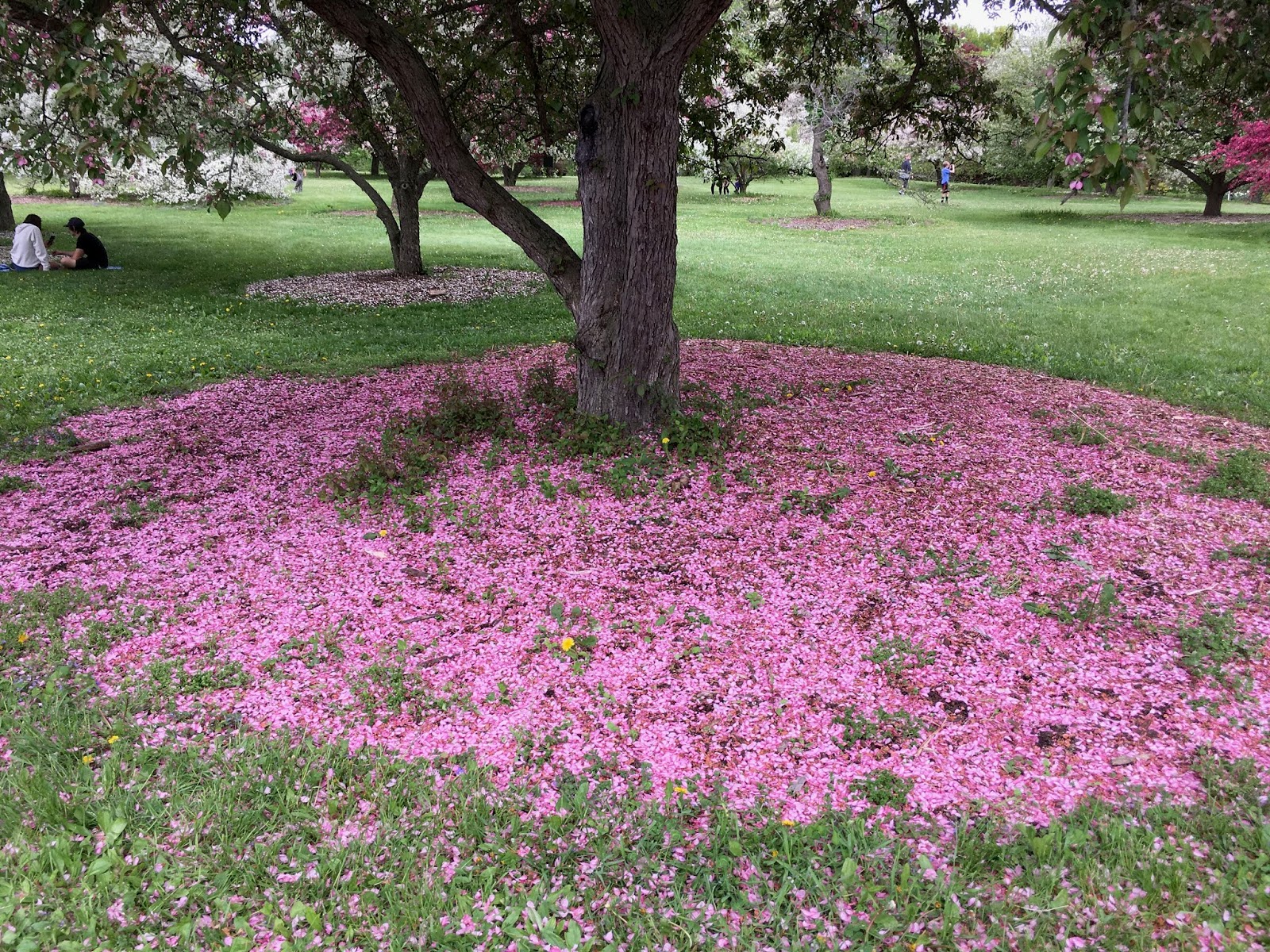
Yesterday [pandemic spring 2020] I hiked at the University of Wisconsin's arboretum here in Madison.  May is a favorite time to visit because of the arboretum's famous collection of lilacs.  In fact, yesterday (Thursday) the parking lot was absolutely full - none of the "social distancing" between cars I noted back in April.  The only other time I've seen the parking lot full has been for the annual native plant sales.  I think the lockdown is triggering more arboretum visits, and social distancing is not difficult with the immense acreage available (about half the visitors I encountered were wearing masks).


As shown above, the cool spring has retarded the blossoming of the lilacs, so after a quick walk-through to sample some fragrances I moved past the lilac collection to the fruit trees.


I didn't take time to ascertain which ones are cherry vs. apple vs. crabapple etc.  It's a stunning visual treat to see all of these bursting into bloom.


Apologies for the relatively low-resolution images, because I hiked with only my cell phone, not with the proper digital camera I have used for some of the autumn foliage hikes.

In addition to the fragrance and the colors, there is an interesting variety of conformations of the fruiting trees.  Some, like the one above, may be naturally splayed out, but the one below has clearly had its lower branches trimmed by the arboretum staff.


I didn't realize a tree that young could be pruned that extensively.  You learn something every day.


Beyond the fruit trees is the collection of maples - a favorite destination in the autumn, but even the spring foliage is impressive, as illustrated by the contrast between the lime green and the deep purple in the two maples above.


Some azaleas still in bloom, and then on the way back to my car I encountered a tree I had never noticed before:


This mountain silverbell is not native to Wisconsin, but apparently has tolerated our winters because it was huge.  Conveniently, there was one branch near the label displaying the iconic downward-hanging blossoms.


As I drove home, I decided that my love for flowering trees probably dates back to imprinting when I was a toddler.  I was born in Washington, D.C. because the Navy stationed my dad there after the war.  Every spring without fail, mom and dad took me to visit the cherry blossoms.  In the photo above near the Jefferson Memorial I was less than a year old, and the one below, also in the Tidal Basin, I was two and a half years old.


One final thought.  The trees will be here all year, but the blossoms are ephemeral.  Any readers living within a half-day drive of Madison who don't take advantage of this remarkable facility in May are missing out on a visual and olfactory treat.  I strongly encourage a visit soon (or to your local arboretum).


Reposted from five years ago to add new photos, including more lilacs -


... and more crabapples -


... a better image of the appropriately-named "silverbell" blossoms -


... and a surprise encounter with a mated pair of sandhill cranes -


- who were teaching their chicks how to probe the grass for food.  Sandhills at the arboretum are tolerant of humans - I have had adults walk past me on a hiking path within arm's reach - but these two had chicks, so I didn't try to get any closer for a better image.  I have in the past encountered turkeys with their young, and their aggressive attempt to scare me off was fully successful.  I didn't want to trigger a similar response in birds with beaks that reach to my eye level.

And one final avian matter:


I saw several bluebird nesting boxes (one of which had a pair in attendance, but they didn't linger for a photo).  This box has an unusual adaptatiom on the front, which presumably serves to deter predation by ?squirrels ?larger birds.  Some reader can perhaps provide some information about this.

I'll close with a repetition of how I closed the post in 2020.  If you live near an arboretum, go visit during the spring season.  And please, if you can, support the institution financially as a "friend" or donor.  These are valuable, educational, entertaining refuges from the hassles of the everyday world.

10 May 2025

Remembering my mom on Mother's Day


Edythe Gertrude Finseth was born in 1918 to a classic second-generation Norwegian immigrant family in southern Minnesota, in an era when children were expected to help work the farm. She wore a huge bonnet in the summer sun, so that neighbors said "it looked like a big hat was driving the rig." She learned to drive that team of horses in a straight line so the cultivating tines wouldn't disturb the planted corn (and in that era, cornfields were cross-cultivated). She was 8 years old when she did the field work; a hired man had to hitch up the work horses, but after that it was her job to cultivate and get the team back to the barn.  As an elderly woman she told me one of the proudest moments of her youth occurred when she successfully maneuvered the horses pulling the haywagon so that it went backwards up the ramp where her brothers could hoist the hay to the loft.


Her first school is pictured above - a one-room schoolhouse on a far corner of the farm, to which she walked each day (in cold weather her little brother went earlier to get the fire started before the students and teacher arrived). The teacher lived upstairs in the family farmhouse.

She did well in school, and was admitted to St. Olaf college (at age 16) at a time when girls were expected to study secretarial skills. She preferred science courses, so she left college to attend nursing school in Rochester, Minnesota in the hopes of earning some money to help support her family.

In the early 1940s the fledgling commercial aviation industry needed a new type of employee called a "stewardess" to take care of passengers on what at the time were many-hour-long flights across the country, and they recruited nurses for this work. She received her "wings" in the first graduating class of stewardesses for American Airlines, and was assigned the Chicago to NY route, cooking individual meals aboard the flights for the passengers, and being lodged by American Airlines at the Blackstone Hotel in Chicago and The Plaza in New York during layovers.  It was a glamorous lifestyle in an era when everyone dressed up to go on a plane trip, and stewardesses knew the names of all the passengers.

She met and married a young Navy officer; they settled in Washington, D.C., where her two children were born, later moving to Minnesota in the 1950s. When the children were reasonably self-sufficient, she went back to school to catch up on 20 years of nursing innovations, then resumed working, first as a school nurse, then as a burn unit and dialysis nurse in a county hospital, then in her 70s as a private-duty home care nurse.  She lived as a widow in our old family home, mowing the lawn and clearing the snow until age 70, when she opted for a condo in a senior living center.  

She had saved and invested her nursing salary in mutual funds during the boom of the 70s and 80s, then used those funds to purchase the condo unit; two weeks later the market crashed in October of 1987. She let the rest grow during the bull market of the 90s and the dot-com bubble, cashing out in June of 2007, just before the market cratered again.  And after 60 years of voting for Republican presidential candidates (including George W. Bush x2), she switched allegiance in 2008 to cheer wildly for the election of Barack Obama.

She lived quietly in her condo unit, following world events via television (but not the internet), and cheering for all Minnesota sports teams. Every day, without fail, she solved the "Crytoquip" in the local newspaper.

In 2011, at age 93, she walked from her condo unit down to the central office area to pick up her mail and realized she couldn't remember how to get back to her unit after having lived in the building for about 20 years.  She knew what that meant, and immediately phoned me, and we began making arrangements for her to move to my home city of Madison, Wisconsin.  

In Madison she insisted on living independently as long as possible in a nice "senior apartment," but as the dementia progressed she agreed to downsize to a single room in an assisted-living facility that offered meal service.  Later it became necessary to hire "sitters" to prevent nocturnal wandering, and finally on the morning after her 97th birthday she passed away quietly.  

She was greatly loved by her passengers, patients, and those who spent time with her.  I will always remember that as we wheeled her body on the gurney from her room out to the waiting mortuary vehicle, the nurses, cooks, and cleaning staff of the assisted living facility had formed a "color guard" on the sides of the hallway to say goodbye to her.  I had been calmly composed during all of the final hours, but that group response brought tears to my eyes.

PostNord will stop delivering letters in Denmark

As reported by the American Philatelic Society:
"The state postal service of Denmark, PostNord, has announced it will cease handling letters in Denmark at the end of 2025 "to focus on becoming the Danes’ favorite parcel delivery service." The cut in service is tied to a reported 90% decline in letter volumes since 2000.

Postnord has also announced that any postage stamps bought in 2024 or after could be refunded for a limited time in 2026, presumably marking the end of the country's stamp issues.

Denmark's Transport Minister, Thomas Danielsen, told Danes concerned about the future of their mail that "a free market" would ensure they could still send letters, just not through a national postal service...

An increase in use of digitial communication is largely cited as the reason for the decline in number of letters sent in the country. However, Denmark's Postal Act of 2024 also allowed private firms to enter the postal arena, and inland letters are no longer exempt from value-added tax, or VAT, meaning that a letter cost Danes 29 krone ($4.20) to send...

Exceptions were previously made for populations in remote areas and with vision impairment, but PostNord's statement does not suggest that will be the case again. The statement also does not directly say whether letters can be sent from other countries to Denmark; however, at this time we can only infer that international letters will not be accepted or distributed..."

Mother-of-the-Year candidate


Reposted for Mother's Day, 2025.

09 May 2025

The long crystals in a meteorite


Comment from the discussion thread at the mineralcollectors subreddit:
To be clear, large crystals can and do form on Earth, most are much larger than those in these structures. There are stable places in the earth crust where this can happen - but the cooling rates required for this iron-nickel pattern is what makes them unique.

These interlocking structures are like a fingerprint for iron-nickel meteorites. They can only form only in space, where asteroid cores cool at an incredibly slow and stable rate—about 1 to 100°C per million years. That kind of slow cooling doesn’t happen on Earth.

Edit: Had to look up the name. They’re called Widmanstätten patterns.

So molten metal gets ejected into space from some collision, and then in a vacuum there is nothing to conduct the heat away, so it cools only by radiation and only a couple degrees per million years.  You learn something every day.

More info on Widmanstätten patterns.

U.S. Secretary of Education mispronounces "A.I."


There has been quite a bit of press about her letter to Harvard University that was riddled with grammatical errors, but I found this report only in the Irish Star.
The former promoter, who co-founded World Wrestling Entertainment (WWE), shared her thoughts during a recent panel discussion in San Diego, California. McMahon said to an assembled crowd: “I heard…there is a school system that is going to start making sure that first graders, or even pre-K, have ‘A-one’ teaching in every year, starting that far down in the grades.”

How do people botch a firing squad execution ?

The shooters were standing 15 feet away...
Mahdi was sentenced to death in 2006, and the execution was carried out on 11 April [2025]. On the evening of his killing, Mahdi was brought into the state’s execution chamber, strapped to a chair and had a red bullseye target placed over his heart. Witnesses were positioned behind bulletproof glass, and three prison employees on the firing squad stood roughly 15ft (4.6 metres) away.

Officials placed a hood over Mahdi’s head before the staff fired, according to an Associated Press reporter, who was a witness. As shots were fired, Mahdi cried out and his arms flexed, and after roughly 45 seconds, he groaned twice, the AP said. His breaths continued for around 80 seconds, then a doctor examined him for a minute. He was declared dead roughly four minutes after the shots.
South Carolina regulations call for the shooters to fire bullets “in the heart … using ammunition calculated to do maximum damage to – and thereby immediately stop – the heart”.

But the autopsy report commissioned by the SCDC indicates there were only two gunshot wounds, not three, and that the bullets largely missed his heart before hitting his pancreas, liver and lower lung, Mahdi’s lawyers say.
Text from The Guardian.  Details re the case at Associated Press.

Sea anemone sting


This lesion developed on the posterior thigh of a 28-year-old woman who fell on a rocky beach in Greece.  The central clearing is a characteristic pattern reflecting the morphology of the anemone.  Case published in the New England Journal of Medicine.
Related Posts Plugin for WordPress, Blogger...