Showing posts with label religion. Show all posts

17 May 2026

The White House doubles down on Christian Nationalism

Pastor Paula White (2nd L) and other faith leaders pray behind US President Donald Trump during a National Day of Prayer event in the Rose Garden of the White House in Washington, DC, on May 1, 2025. © Jim Watson, AFP
As reported by France 24:
Thousands of people gathered Sunday in downtown Washington for a mass prayer festival featuring speeches by top Trump administration officials – an event critics see as an overt display of Christian nationalism undermining the separation of church and state...

The gathering was organized by the White House as part of a program of celebrations for America's 250th anniversary and, in a video message inviting Americans to attend, Hegseth said it was an opportunity to "rededicate this republic to God and country."

Muscular Christian nationalism has enjoyed a prominent platform since Trump's return to power, and evangelicals form a core element of the president's support base...

Attendee Sarah Tyson, holding a "Jesus Saves" sign, said she believes Trump was chosen by God to lead the nation through a new spiritual revival.
Addendum: Just to clarify one point, citing Heather Cox Richardson:
But the United States of America was not founded as a Christian nation. The Founders were quite clear about that. In the 1796 Treaty of Tripoli, ratified unanimously by the Senate just a decade after the Constitution went into effect, U.S. leaders said “the government of the United States of America is not in any sense founded on the Christian Religion” and has “no character of enmity against the laws, religion or tranquility of” Muslims. They went on to say that “no pretext arising from religious opinions shall ever produce an interruption of the harmony existing between” the U.S. and Tripoli.

Thomas Jefferson, the key author of the Declaration of Independence, and James Madison of Virginia, the key thinker behind the Constitution, both wrote explicitly about the importance of keeping the government separate from religion. Jefferson wrote that “religion is a matter which lies solely between Man & his God, that he owes account to none other for his faith or his worship.” “[T]he legitimate powers of government reach actions only,” he wrote, “[and] not [religious] opinions.”

03 March 2026

Christian Nationalism in the armed forces command structure? Or not...?

The embed shows allegations I've seen in several posts on Facebook.  I don't trust Facebook material to be accurate.  Have any readers seen evidence to support/refute this claim in the mainstream fact-checked media?

Here is the link for the cited reference to the Military Religious Freedom Foundation.

Addendum:  Before you get too excited, read this link from Friendly Atheist, submitted by one of the readers here.  It expresses severe skepticism regarding the validity of the claims made in the embed.

The most amazing musical instrument is the human voice


I don't really have time to blog today, but I wanted to share this video I found last night at Nag on the Lake (which I invite you to explore if you like TYWKIWDBI).  

It took a bit of searching to find the lyrics (excerpted from Psalm 84) at Light on Dark Water:
"How beloved is your dwelling place,
O lord of hosts,
My soul yearns, faints,
My heart and my flesh cry out.

The sparrow found a house,
And the swallow her nest,
Where she may raise her young.

They pass through the Valley of Bakka,
They make it a place of springs;
The autumn also covers it with pools."
You don't need the lyrics to appreciate the beauty of the harmonies.  Had I heard this music without the video, I probably would have assumed it came from a synthesizer, similar to the many programs I've recorded from Music from the Hearts of Space.  But these are human voices.  Awesome.

02 March 2026

You are here


The European Space Agency is compiling a 3D map of the Milky Way, showing the color and brightness of 1.8 billion stars.  In this image, we are located where the lines for 180 degrees vertically and 90 degrees horizontally cross.  

If we were able to travel at the speed of light for the rest of our lives, we would not get out of the pixel we are currently in.  

The Milky Way is one galaxy.  There are about 2,000,000,000,000 galaxies... in the observable universe (via Hubble).   Note for comparison the small circle around us in the image designating the limits of what the human eye can see when looking at the sky.  

These are data that need to be considered if/when we ponder why we exist and what our purpose is/should be.

Want more?  There are over 600 images accessible via this link.

20 January 2026

"The Ark Before Noah"


Cultures around the world are awash with "great flood" myths.  Wikipedia has a list of flood myths that includes too many for me to count today.  It takes no leap of imagination to assume that ancient peoples traversing mountains and seeing fossilized obvious seashells on mountains used basic logic to accept that in ancient times a huge flood must have covered the world.

I have previous reviewed a very scholarly book discussing in details the great floods after the ice age and the submersion of Doggerland in the North Sea and Sundaland in southeast Asia.  Also related is my old post on The Black Sea Deluge as a source of ancient flood myths.

This post is about another book, published in 2014 (Doubleday) and recommended to me by a reader many years ago.  The author has the awesome title of "Assistant Keeper of Ancient Mesopotamian script, languages, and cultures" at the British Museum.  He is the person in charge of the gazillion cuneiform tablets stored at the museum, and he can read those nicks in the clay the way that I can read cursive.  This book focuses on an "ark tablet" in the museum holdings that presents in detail a myth of a world flood and the survival of mankind thanks to a man who builds an ark.   Here is the tablet (more pix at the link):


And here are some of my excerpts and thoughts after browsing the book...

Modern scholars generally agree that the ark described in Babylonian times was constructed of reeds (which are huge and plentiful in Mesopotamian wetlands).  Jewish scholars recognize that the word translated into the Hebrew Bible as "gopher wood" if pronounced slightly differently would also mean "reeds."
While I was pondering this problem, I was simultaneously reading about ancient Babylonian versions of the flood story. Of course, there are different approaches regarding how to reconcile these with the Torah's account, which are not our concern here. But I suddenly realized that they describe the ark as being made of reeds - which, in Hebrew, is kannim, the very word that our verse uses, albeit vocalized differently. And this was apparently the standard technique used for creating boats in ancient Mesopotamia - they were made of reeds, sometimes hybridized with a wooden frame for greater strength. (Note that this technique would have been unknown to later generations in other parts of the world, where boats were made exclusively from wood.)
It is also clear from three different cuneiform flood tablets that the ark was round like a circle (p 129).  And see this 2012 post.

There are two Hebrew sources for the description of the flood ("J" and "P").  The "J" says forty days of rain and everything dies.  The "P" source says flood rose for 150 days to cover  mountains, then takes 150 days to go down.  (217)

The kingdom of Judea was conquered in battle by Nebuchadnezzar II of Babylon in 597 BC, and the people of Jerusalem were taken into exile in Babylon -"all the officers and fighting men, and all the skilled workers and artisans - a total of ten thousand.  Only the poorest people of the land were left."  Those Judeans were then incorporated into Babylonian society, where they would have learned of the flood story. (227).  They would have seen the immense Tower (ziggurat) of Babel - seventy meters in height, way more than anything in Jerusalem.  It is incorporated into the 11th chapter of Genesis.

It is during this time of exile that two important shifts occur (pp 240s).  The Judeans incorporate the ark story into their own heritage, because all the intelligent young men of the society are being educated in Babel.  Conversely the Babylonian society, famously polytheistic, begins to view the gods in a more monotheistic arrangement (in accordance with the strictly monotheistic Jews).  The second commandment of the Judean Hebrew bible states "Thou shalt have no other gods before me" indicates a recognition of the existence of other gods.  But the Babylonians conversely start blending their various "gods" into Marduk - previously the "king of the gods" but now viewed as a single god with multiple manifestations:


The Judeans life in exile in Babylon is arguably the reason for their creation of their bible, nicely delineated on page 247:

"In the years before Cyrus the Great conquered Babylon in 539 BC the Judeans certainly did more than sit about and weep.  They adjusted and settled.  In time they became Mesopotamian citizens.  By the time Cyrus arrived by no means all of Nebuchadnezzar's displaced persons wanted to go "home" to Jerusalem.  However, the Judeans' ancient and somewhat ramshackle religious identity had meanwhile been crystallising into permanence due to their encyclopaedia of history, custom, instruction and wisdom.  They became literally the people of the book.  From this angle it can be argued that the Babylonian Exile, far from being the disaster it is usually judged, was ultimately the process that forged what became modern Judaism."
And that eventually led to the formation of Christianity six centuries later.  A fascinating idea.

There is more in the book than the ark story, including some discussion of the Babylonian Map of the World (the earliest known map of the world):


Inside the inner circle are the great rivers and the major cities.  They are surrounded by a great sea, beyond which are huge mountains.  The resemblance to the famous T and O map of the world is compellling.

I'm going to stop here.  If you are interested, the book should be in most public library systems.  It's TMI regarding cuneiform lettering and texts, but fascinating in its overall scope.  I highly recommend Chapter 11 (excerpted at length above) and Chapter 14 ("Conclusions: Stories and Shapes") for the TL;DR readers.

The Black Sea deluge


Another addition to my list of recommended books, this one explaining in detail the hypothesis that an immense and abrupt irruption of water into the Black Sea from the Aegean/Mediterranean seas was responsible for major cultural disruptions and may have been the basis for the "great flood" hypothesis seen in so many cultures.


In prehistoric times what is now the Black Sea was an immense freshwater lake, fed by glacial meltwaters.  When the outflow drainage at the Bosphorus closed and when the climate changed (disappearance of glaciers, aridity of the overall watershed), the lake evaporated to a smaller size.

The schematic at right shows the approximate relative sizes and shapes of the ancient freshwater lake and the current Black Sea.  That freshwater lake was a magnet for early human civilization because of the presence of water, game, and arable land.

When the Bosphorus "opened up," the inflow of seawater was on a scale not seen anywhere in the modern world.  The Mediterranean was open to the Atlantic, and the sea level was about 500 feet higher than the lake.  When water found a crack in the Bosphorus the flow would have started as a trickle, then as the passage eroded the flow would increase exponentially.  
"Ten cubic miles of water poured through each day, two hundred times what flows over Niagara Falls, enough to cover Manhattan Island each day to a depth of over half a mile."  
The lake then began to rise 6" per day, and depending on the gradient, the shore would expand by as much as a mile a day - every day, without pause.  The people living on the shores of the lake would be forced to flee.
"It is hard to imagine the terror of those farmers, forced from their fields by an event they could not understand, a force of such incredible violence that it was as if the collected fury of all the gods was being hurled at them.  They fled with family, the old and the young, carrying what they could, along with fragments of the other languages, new  ideas, and new technologies gathered from around the lake."

The diaspora is detailed in several chapters of the book.
"All these people appeared in Europe shortly after the flood.  All have been described [by archaeologists] as outsiders: people who migrated from some distance... all seem to have been more culturally advanced than those [original European residents] whom they displaced.  Perhaps not so coincidentally, at that time in the middle of the sixth millennium B.C., Europe began a rapid ascent into what has been called a "Golden Age"...


The diaspora also happened in the other direction, creating enormous population changes in Anatolia and the Middle East.
"In the [Mesopotamian] epic of Gilgamesh the seven sages are credited with building the walls of Uruk and bringing the arts of civilization to the Sumerians - irrigation, farming, and the use of copper, gold, and silver.  The question of where the Sumerians came from is still unanswered."

"The oldest known written versions of the flood were committed to clay tablets over two millennia after [this flood] event in Sumerian, the language of the first known writing, a language with no known roots and no known descendants..."
The final point to make is that the story of the flood would have been passed by oral history down through dozens of generations.  Archaeologists have noted that the peoples who fled to Europe tended to settle some distance away from freshwater lakes and streams.  But those who fled to the fertile crescent would have been reminded of the great flood because their new territory was also subjected to annual flooding from the Tigris and Euphrates, which may explain why the legend was maintained there until the invention of cuneiform writing.

If you don't have time for the book, you can browse the high points at the Wikipedia page for the Black Sea deluge hypothesis.

Other interesting bits from the book:
"[King Darius I the Great] governed skillfully and managed a vast empire long before that of Alexander the Great, a regime that encompassed all the prior realms of the Egyptians, Chaldeans, Ionians, Persians, and Medes, extending to the east as far as the Indus Valley, to the west into Europe, and to the south into Africa, flourishing in economy and culture."

"Apparently what had so deeply moved Smith was the realization that the [cuneiform] fragments he had assembled contained an independent version of the biblical deluge.  The heathen words told almost exactly the same story as the Hebrew narrative, right down to the selection of a survivor of the deluge through the intervention of a god, the forewarning that gave time to build a wooden ark, the refuge in it of every kind of animal, bird, and reptile, the grounding of the boat on the side of a mountain, the details of dispatching a swallow, raven, and dove to find land, the offering of a sacrifice, and the pledge that the gods would never again return the world to its primeval watery chaos."  "... after the feast one of the goddesses flung her jeweled necklace into the sky to be the sign of a covenant never again to drown the world."  "There was no doubt that the deluge described so vividly in the Gilgamesh legend had been inscribed on stone tablets long before the writing of the first books of the Old Testament."

The fact that the Mediterranean basin had once been a desert is confirmed by the discovery that the Nile River has an immensely deep central gorge (now filled with sediment) as a result of erosion when the Nile used to empty into a much lower basin.  The separation of the Mediterranean from the Atlantic occurred during the Messinian time interval between 7.2 and 5.4 million years ago.  "The transition from sea to land and back to sea had taken less than half a million years."  "Although no humans lived five million years ago, had any been present, they would have witnessed the Mediterranean desert disappearing permanently beneath a mile of salt water in a matter of a single human lifetime."

"... the Sumerians and Akkadians, and even the Greeks, did not believe in a reward after death.  Death might be postponed through a petition to a god, but  no one could escape it.  The body returned to clay, and a duplicate "phantom" entered a new abode through an aperture in the grave, leading to an immense, dark, silent, and sad netherworld where one had a torpid and gloomy existence forever."

Reposted from 2022 to accompany other posts. 

"Eden in the East" - Southeast Asia as the epicenter of prehistory


I suppose everyone is startled when they first encounter these passges in the Epic of Gilgamesh:
"What I had loaded thereon, the whole harvest of life I caused to embark upon the vessel; all my family and all my relations, The beasts of the field, the cattle of the field, the craftsmen, I made them all embark.  I entered the vessel and closed the door...

For six days and nights Wind and flood marched on, the hurricane subdued the land.  When the seventh day dawned, the hurricane was abated, the flood which had waged war like an army; the sea was stilled, the ill wind was calmed, the flood ceased. I beheld the sea, its voice was silent, And all mankind was turned into mud! As high as the roofs reached the swamp;...

I beheld the world, the horizon of sea; Twelve measures away an island emerged; Unto Mount Nitsir came the vessel, Mount Nitsir held the vessel and let it not budge... When the seventh day came, I sent forth a dove...
These words [more at the link] were inscribed onto clay tables in Ninevah centuries before the Bible was assembled.

What I didn't realize until reading Eden in the East is that there are some 500 flood myths from around the world - not just from the Middle East, but also in northern Europe, North America, China and the far East.  This book undertakes the immense task of collating the flood myths in search of a unifying hypothesis.   

I'll offer just a bare-bones thumbnail sketch.  Everyone agrees that the world has experienced marked changes in sea level since the appearance of Homo Sapiens, the most dramatic of them occurring when changes in the global climate resulted in melting of the glaciers:


The time scale in Figure 1 above goes back to 18,000 years before the present - about the time that early humans were traversing Beringia (on land or via near-shore vessels) from Asia to the Americas.  Note that early in human prehistory (10-15,000 years ago), sea levels around the world were 50-100 meters lower than their present levels.


Figure 3 above "zooms in" on the third world-wide flood about 8,000 years ago, and shows geologic evidence of that rise in regions as far apart as the Arabian Gulf, the Caribbean, and Southeast Asia.

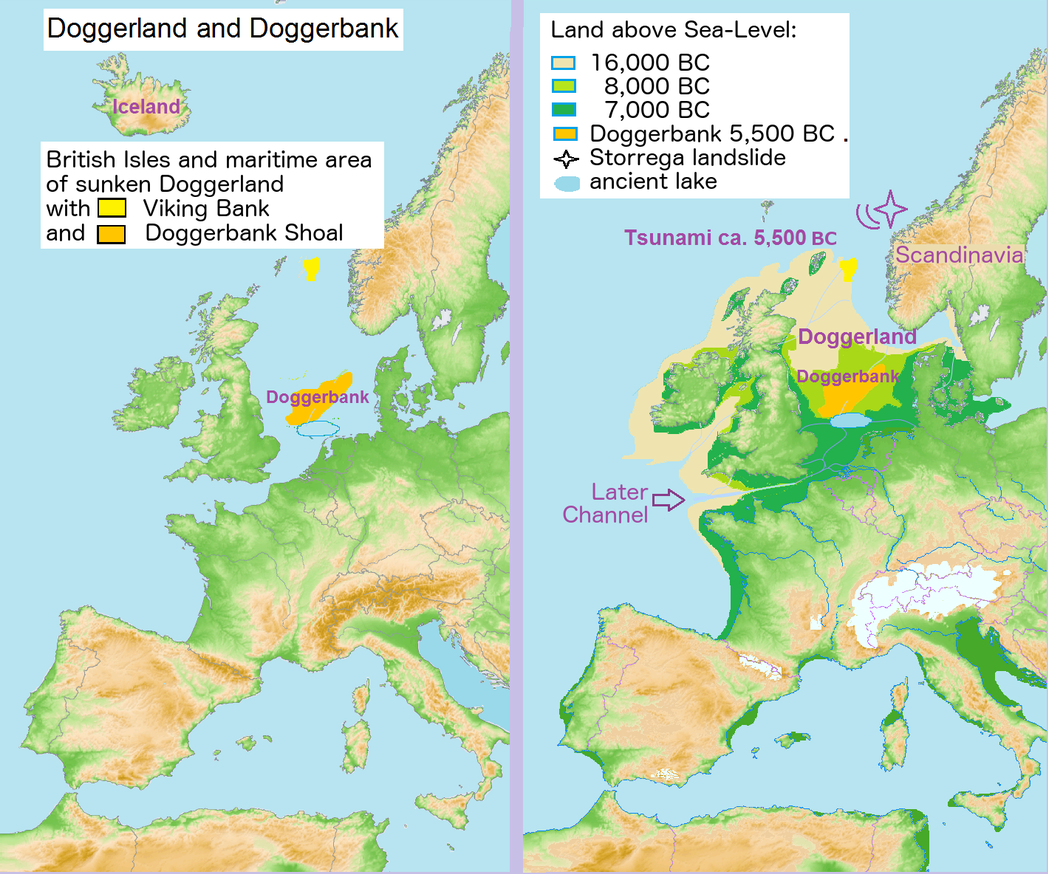
Those glacial melts flooded continental shelves around the world - as for example Doggerland:


That land between GB and Europe was above water and inhabited by modern humans, and if you dredge the bottom of the North Sea, you can haul up artifacts from that era.

I bookmarked Doggerland years ago as blogworthy material, but for now I'm going to shift back to Eden in the East.  Oppenheimer notes that there was an immense low-lying coastal landmass between what is now Thailand/Cambodia/Vietnam and what is now Borneo/Mayasia - the undersea area now referred to as "Sundaland."


Oppenheimer uses this area as the focus of his book, and postulates that cultural diffusion from this Sundaland may have spread to Austronesia, the Indian subcontinent, Mesopotamia, and then worldwide.

That's the big picture.  Here's a smattering of excerpted tidbits - starting with the science of the megafloods:
"Around 12,500 years ago, not long after the first flood, pottery appeared for the first time in southern Japan.  Some 1500 years later there is evidence of pots being made in China and Indo-China.  These examples of pottery making antedate any from Mesopotamia, India or the Mediterranean region by 2500-3500 years.  Stones for grinding wild cereal grains appeared in the Solomon Islands... as early as 26,000 years ago, whereas they were not apparently used in Upper Egypt and Nubia until about 14,000 years ago..." [p. 18-19]

"The third dry cold period was interrupted suddenly around 8000 years ago by an event which, although only discovered in the last decade, has been described as 'possibly the single largest flood of the [past two million years]'.  The melting Laurentide ice cap had dammed up vast volumes of fresh water in glacial lakes occupying a third of the land area of eastern Canada...  Geologists have calculated that the combined surface area of these glacial lakes... exceeded 700,000 square kilometres... Calculations of the total unfrozen water volume discharged instantly vary between 75,000 and 150,000 cubic kilometres - enough to raise the global sea-level by 20-40 centimetres instantaneously...  The centre of the ice cap that was also flushed out through the Hudson Strait, however, would have rapidly added another 5-10 metres to the sea-level..." [33-35]

"This last rapid rise in global sea-levels was presumably also responsible for breaching the Hellespont and flooding the partially desiccated Black Sea... Bill Ryan and Walt Pitman... who discovered this flood, suggest that this may  have given rise to the legend of Noah's flood.  This is possible for the Middle East, but it does not explain all the other 500 flood stories from around the rest of the world." [38]

"Southeast Asia has the highest concentration of flood myths in the world.  It is an area with few large river deltas and no recent reputation for flooding, but it lost more than 50 per cent of its landmass after the Ice Age." [62]

"... the strong likelihood of superwaves arising from the crustal strains when the Laurentide ice sheet of Canada collapsed and melted around 8000 years ago... The release of energy from the Earth's crust would have produced waves rolling across the Pacific and inundating all shores and flat hinterlands in direct line..." [107]
The excerpts above are from Part I of the book, which details the geologic events that would have produced widespread flooding. Part II shifts the focus to how the displacement of large coastal populations by the floods could have led to the diffusion of knowledge/customs/technologies from southeast Asia to other parts of the world, using new information from linguistics, anthropology, and genetics.
"I believe that Southeast Asia was the centre of innovations after the Ice Age and long-distance seeding of ideas from the region led to technological breakthroughs elsewhere.  The Austronesians may have contributed sailing technology, magic, religion, astronomy, hierarchy and concepts of kingship.  The Austro-Asiatic speaking people may have contributed the more down-to-earth skills of cereal farming, and even bronze.   A combination of all these traits was necessary for the first city-builders of Mesopotamia..." [221]

"If there were so many bad riverine floods in Mesopotamia, as the sedimentary record shows, one very bad one would not be remembered so long.  Instead the recurrent aspects would be recalled.  The myths from around the world do not usually refer to periodic river floods.  In any case most flood myths come from island Southeast Asia, which, unlike Mesopotamia, lost most of its alluvial flood-plains after the great melt when the Ice Age ended." [227]

"After 200 pages of concentrated flood myths he [Sir James Frazer] concluded that such ancient myths were widespread on every continent except Africa...  A large proportion of the Earth's surface was permanently lost to settlement and agriculture somewhere between 18,000 and 5000 years ago as a result of the sea-level rising...  Africa, with narrow continental shelves, would have been relatively spared... " [230-232]

"There is now general agreement that the stories of Noah's Flood and the floods of the Sumerians, Babylonians and Assyrians are related, although there is no agreement on the original source... There are now at least eleven related Ancient Near Eastern versions, including the two in Genesis and Berossus's account of Xisuthros.  The three Assyrian versions were committed to tablet in the seventh century BC.  This was perhaps a hundred years before the writing of the Priestly account in Genesis, but probably well after the Jehovistic account, for which a date is still under discussion.  The two surviving Babylonian accounts were written thousands of years earlier, somewhere between 1850 and 1500 BC..." [242-8]

"Frazer lists fifteen Greek flood stories in his Folklore in the Old Testament, twelve of which record a mountain landing." [258]

"A number of the Moon stories I have sketched contain the number seven.  I have suggested the lunar week as a possible origin for the use of this numeral... After one, two, and three, the number seven appears more frequently in Old World sacred texts than any other number.  This applies particularly for the Bible, the Koran, Babylonian texts and the Egyptian Book of the Dead...  Although five is a prime... the number of fingers on a hand and a half unit in the decimal system it is not more common in sacred texts than expected... [345-6]

"And did God first mould a model from blood and clay and blow into it to give it life?  Did he take the bone, Ivi, from man's side among the dark rainforest trees of Southeast Asia?.. Stories of the creation of humanity are universal.  They can be divided into two main varieties, people evolving from a totem, such as a tree or animal, and the creator fashioning man from clay.  These two archetypes have distinct distributions which overlap most dramatically in eastern Indonesia.  The merging of these two themes in that location eventually resulted in the beautiful and mysterious story of the Garden of Eden... In this chapter we trace the origin of the Genesis version of the clay-man myth from Southeast Asia... Polynesian informants insisted on the antiquity of stories stating that the first woman, who came from a bone in the man's side, was called Eevee/Ivi (the word for a bone in many eastern Polynesian languages).  Yet most of the Christian ethnographers assumed a missionary source for these stories rather than the disturbing possibility of a more ancient origin... It is likely that they were unaware of the widespread ancient distribution of the story elsewhere and thus could simply not believe their informants.  This selective bias is discussed at length by Sir James Frazer." [355-9]

"The Garden of Eden story holds a cherished place in Western literature... Yet the Genesis writers assembled this story less than three thousand years ago from a selection of fertility and immortality myths that were in common circulation at the time.  The separate elements of these myths are still to be found today in Southeast Asia and Melanesia."  [382]

"The tree of knowledge played centre stage throughout the snake's temptation of Eve.  The tree of life, however, remained in the wings unnoticed until it was nearly too late and Jehovah realised that Adam and Eve could eat from that too, and become immortal like Him.  He therefore shooed them out of the garden before they could gain immortality as well as knowledge... Frazer's view was that there were originally two trees, but that the tree of knowledge of good and evil had really been the tree of death contrasting with the tree of life.  This hypothesis may explain the verses:
'But of the tree of the knowledge of good and evil thou shalt not eat of it: for in the day that thou eatest thereof thou shalt surely  die.' (Genesis 2:16-17)
Clearly, humankind did not die on that day of the Fall, but instead became mortal." [384]

"In certain Aboriginal cultures, the Moon was regarded as a deity with the secret of immortality because it 'died' for three days every month, subsequently renewing itself during the first half of the next month." [386]

"The location of paradise has always worried Bible scholars, particularly since the lush forest description given in Genesis fits so poorly with anything we know about the environment of ancient Mesopotamia.  Rainfall may have been better 6000-7000 years ago, but nothing fits the picture of paradise as well as tropical jungles such as in Southeast Asia.  Both ancient Mesopotamians and Egyptians described their respective sites as far across the water towards the rising Sun, that is in the East." [405]
This is an impressive book, extensively annotated with relevant references from the literature.  I first encountered it shortly after its publication about 20 years ago, and after being duly impressed by the scholarly writing I set it aside for a re-read "sometime in the future" (that future having arrived this year).  I think it is sometimes erroneously grouped with the fantasy books about Atlantis or ancient aliens, but the existence of the "drowned continent" of Southeast Asia is factual, and the hypotheses presented here are eminently logical.

The book has probably "too much information" for the casual reader, so for the TL;DR crowd I can recommend the final ten-page "Epilogue" as a reasonably concise summary.  I've already created a mega-post here and I'm tired of typing, but I'll close by adding several excerpts from the Epilogue:
"In their partial rejection of diffusion as the reason for these links [between diverse cultures], folklorists of the twentieth century have had to propose the only two other possible causes of similarity: chance and the inner workings of the human mind.  While chance may operate for single obvious motifs, such as the worship of the Sun, I have shown that it is statistically extremely unlikely that complex story-types, sharing from three to ten distinct motifs, could have occurred more than once.  Yet this is what would have to happen for the distribution of myths in a diagonal band across Eurasia - with Polynesia at one end and Finland at the other - to have all occurred independently.  That these were the core myths that were preserved so carefully by the Mesopotamian, Middle Eastern and Egyptian civilisations can also be no coincidence.  All the main stories in the first ten chapters of Genesis are found in this cultural band and all occur in the Far East: the watery creation, the separation of skies and earth, the creation of man from red earth, and Eve from his side, the Fall, Cain and Abel, and, of course, the flood.  With the exception of the flood, the relative paucity of evidence for these complex story-types elsewhere in the Americas and Africa not only supports diffusion as a reason for the distribution, but also argues against both chance and the 'inner workings of man's brain' for their similarities."

"If we can accept the statistical evidence of trans-continental relationships in myths, then the dating of the first written versions of the Eurasian myths becomes crucial.  We are lucky here, since the Sumerians and Babylonians were so assiduous in recording the motifs on tablets and cylinder seals.  The date bracket that comes out of such an enquiry reveals that the myths, with their religious connotations, were among the first of all written records in the third millennium BC.  Since in the majority of cases the structure and content of the Mesopotamian myths show them to be derived from earlier Eastern versions, we may suppose that the direction of diffusion was East-to-West, and that the date of diffusion may be been earlier than the beginning of the third millennium.  This means that East-West cultural links may be older than 5000 years.  Such cultural links could only have occurred if there were people in Southeast Asia to hold the stories, and that they were capable of traveling to India and Mesopotamia to transmit them... The Sumerians and Egyptians themselves wrote about the skilled wise men from the East, a fact often dismissed as the embellishment of a fertile imagination."

Reposted from 2022 to accompany some newer posts. 

13 January 2026

"Sinnerman" (Nina Simone)


While watching Hunt for the Wilderpeople a couple nights ago, I heard this song in the soundtrack, and remembered hearing it in The Thomas Crown Affair.  Found more information at Wikipedia:
"Sinner Man" or "Sinnerman" is accepted as an African American traditional spiritual song that has been recorded by a number of performers and has been incorporated in many other of the media and arts. The lyrics describe a sinner attempting to hide from divine justice on Judgement Day. It was recorded in the 1950s by Les Baxter, the Swan Silvertones, the Weavers and others, before Nina Simone recorded an extended version in 1965...

Simone learned the lyrics of this English song in her childhood when it was used at revival meetings by her mother, a Methodist minister, to help people confess their sins. In the early days of her career during the early sixties, when she was heavily involved in the Greenwich Village scene, Simone often used the long piece to end her live performances.
Reposted from 2016 to add the lyrics;
Oh, sinnerman, where you gonna run to?
Sinnerman where you gonna run to?
Where you gonna run to?
All on that day
We got to run to the rock
Please hide me, I run to the rock
Please hide me, run to the rock
Please hide here
All on that day
But the rock cried out
I can't hide you, the rock cried out
I ain't gonna hide you there
All on that day
I said rock
What's the matter with you rock?
Don't you see I need you, rock?
Good Lord, Lord
All on that day
So I run to the river
It was bleedin', I run to the sea
It was bleedin', all on that day
So I run to the river
It was boilin', I run to the sea
It was boilin', all on that day
So I run to the Lord
Please hide me, Lord
Don't you see me prayin'?
Don't you see me down here prayin'?
But the Lord said
Go to the Devil, the Lord said
Go to the Devil
He said go to the Devil
All on that day
So I ran to the Devil
He was waitin', I ran to the Devil
He was waitin', ran to the Devil
He was waitin', all on that day
I cried, power, power (power, Lord)
Power (power, Lord)
Power (power, Lord)
Power (power, Lord)
Power (power, Lord)
Power (power, Lord)
Power (power, Lord)
Kingdom (power, Lord)
Power (power, Lord)
Power (power, Lord)
Power (power, Lord)
Power (power, Lord)
Power (power, Lord)
Power (power, Lord)
Power (power, Lord)
Power (power, Lord)
Power (power, Lord)
Power (power, Lord)
Power (power, Lord)
Power (power, Lord)
Oh yeah
Oh yeah
Oh yeah
Well, I run to the river
It was boilin', I run to the sea
It was boilin', all on that day
So I ran to the Lord
I said Lord, hide me
Please hide me
Please help me, all on that day
He said, hide?
Where were you?
When you oughta have been prayin'
I said Lord, Lord
Hear me prayin', Lord, Lord
Hear me prayin', all on that day
Sinnerman, you oughta be prayin'
Outghta be prayin', sinnerman
Oughta be prayin', all on that day
Up come power (power, Lord) 

Power (power, Lord)
Power (power, Lord)
Power (power, Lord)
Power (power, Lord)
Power (power, Lord)
Power (power, Lord)
Power (power, Lord)
Power (power, Lord)
Power (power, Lord)
Power (power, Lord)
Power (power, Lord)
(Power, Lord)
Hold down (power, Lord)
Go down (power, Lord)
Kingdom (power, Lord)
Power (power, Lord)
Power (power, Lord)
Power (power, Lord)
Na-na-na, na-na-na-na
Woah, ho

Ha-ha-ha-ha
Ha-ha-ha-ha, oh Lord
Nu, nu, nu
No-no-no-no, ma-na-na-na-na, don't you know I need you Lord?
Don't you know that I need you?
Oh, Lord
Wait
Oh, Lord
Oh, Lord, Lord

05 September 2025

Medieval mindset in Afghanistan

"Women and children on Monday in Mazar Dara, Kunar Province, where male rescuers would not pull women from under rubble or tend their wounds, witnesses said".Credit...Wakil Kohsar/Agence France-Presse — Getty Images

Excerpts from a report in the New York Times:
The first rescue workers reached Bibi Aysha’s village more than 36 hours after an earthquake devastated settlements across eastern Afghanistan’s mountainous areas on Sunday. But instead of bringing relief, the sight of them heightened her fears; not a single woman was among them.

Afghan cultural norms, enforced even in emergencies by the ruling Taliban, forbid physical contact between men and women who are not family members. In the village of Andarluckak, in Kunar Province, the emergency team hurriedly carried out wounded men and children, and treated their wounds, said Ms. Aysha, 19. But she and other women and adolescent girls, some of them bleeding, were pushed aside, she said.

“They gathered us in one corner and forgot about us,” she said. No one offered the women help, asked what they needed or even approached them.

Tahzeebullah Muhazeb, a male volunteer who traveled to Mazar Dara, also in Kunar Province, said that members of the all-male medical team there were hesitant to pull women out from under the rubble of collapsed buildings. Trapped and injured women were left under stones, waiting for women from other villages to reach the site and dig them out...
More at the link.

02 June 2025

The ultimate legacy of our lives

"Assuming 128 grams a day and a lifetime in the vicinity of seventy-five years, you’ll leave behind around three and a half metric tons of feces when you die. The volume of your urine will be closer to thirty-eight thousand liters, a bit larger than a standard twenty-foot shipping container and about double the accumulated volume of your flatulence. You’ll have made hundreds of liters of tears, though even for the most emotive of individuals, the portion derived from feelings will represent a minuscule fraction of that number. For all the hullabaloo surrounding ejaculation, the total semen production of even the most alacritous masturbator could be contained handily by a shelf of two-liter soda bottles, and though a period sometimes seems as though it will never end, you could only barely paint a closet with the three or so liters of menses produced during a lifetime. You’ll have made a great deal of mucus, though, close to a hundred thousand liters. And when Atropos snips the thread of your life, the hair from your head, measured as a single strand, will stretch more than three and a half million feet. This is what you will leave behind.

Of course, you’ll leave behind another thing: your body itself. It’s uncomfortable to think of the body in this way, in the same category as feces and hair, but despite the desires of countless theologians, the trajectory of your body’s final journey will be less like the fiery passages of the stars and more akin to those meandering pilgrimages taken by your feces and urine, your blood and vomit and tears. It will become something that must be dealt with, something that must be disposed of. We may disagree over the existence and nature of an afterlife, but not about the stench of rotting flesh...

What, if anything, remains? In the most purely physical sense, your body contains about five hundred megajoules of energy, enough to run a sixty-watt light bulb for one hundred days or to drive a midsize sedan a mile, or, to put things in dietary terms, roughly 120,000 calories, the equivalent of a hundred Big Mac combos. This energy, stored in the form of chemical bonds—namely as molecules of glucose, protein, and fatty acids—will remain intact after you die. It needs only to be converted into adenosine triphosphate to continue its chemical journey in the shape of another. Since no single creature will be capable of digesting your body in its entirety, the scavenging of this energy will take the form of a vast buffet. The glucose in your thigh muscle might be catabolized via glycolysis by a rat while a fungus might hydrolyze the proteins in your skin. The real prize at this feast, however, will be those molecules that most efficiently store energy, your fatty acids, so that the caloric orgy reaches its apotheosis in that fattiest of all your organs, that thing which seemed most you: your brain..."
Excerpts from "Mortal Coils," in turn excerpted from Earthly Materials by Cutter Wood, via the April 2025 issue of Harper's Magazine.  Posted for me for future reference re the meaning of life and humankind's role in the cosmos.

27 March 2025

"Bye and Bye" (Punch Baldwin, with the Georgia Mass Choir)

 
Hard to sit still while listening to this music.  Here are the lyrics:

(Bye and bye) Bye and bye
(When I reach) When I reach
(That home) That home
(Beyond) Beyond the sky
(Where the) Wicked will cease from troubling
(And the) Weary will be at rest
(Every day) Every day will be Sunday
Bye and bye

When I reach that city (oh yes)
City so bright and fair (oh yes)
When all my friends and loved ones (oh yes)
Are gonna welcome me up there (oh yes)
Put on my long white robe
Lay down my heavy load
(Everyday) Everyday will be Sunday, bye and bye

Chorus

Verse
When I reach that city (oh yes)
City so bright and fair (oh yes)
Well all my friends and loved ones (oh yes)
Are gonna welcome me up there (oh yes)
Gonna look up Job, John, and Elijah
God told them to prophesy
(Everyday) Everyday will be Sunday, bye and bye

Chorus

When I reach that city (oh yes)
City so bright and fair (oh yes)
Well all my friends and loved ones (oh yes)
Are gonna welcome me up there (oh yes)
Gonna look up Job, John, and Elijah
God sent them to prophesy
(Every day) Every day will be Sunday, bye and bye

Chorus

(Every day) Every day will be Sunday (4 times)

(Oh Everyday ) Every day- (Will be Sunday) Every day
(Every day) Every day- (Will be Sunday) Every day (3 times)
(No more crying) Every day- (Over yonder) Every day
(No more dying) Every day- (Over yonder) Every day
(No more sickness) Every day- (Over there) Every day
(No more pain) Every day- (Over there) Every day
(Nothing but Joy) Every day
(Joy) Every day (7 times)
(Joy Joy) Every day-(Joy Joy) Every day-(Joy Joy) Every day-(Joy Joy) Every day
(Will you) Every day - (Be There) Every day (2 times)
(Wave your hands) Every day- (If you?re going) Every day (2 times)
(Will you) Every day- (Be There) Every day (2 times)
(Over Yonder) Every day (4 times)
( I feel like Praising) Every day ( I feel like dancing) Every day( I feel like Dancing) Every day
(When I get to Heaven) Every day- (Gonna shout) Every day (2 times)
(Nobody there) Every day- (Nobody) Every day- (Nobody there) Every day- (Will put me out) Every day
(Every day) Every day- (will be Sunday) Every day
(Every day) Every day will be Sunday bye and bye
bye and bye

"The Georgia Mass Choir is an American Gospel music choir from Macon, Georgia.  The ensemble, which numbers 150 members, was founded in 1983 by Rev. Milton Biggham, the lead vocalist and songwriter for the group. He put together the group from over 600 applicants, and recorded with them on his label Savoy Records in the middle of the decade.  In 1996 the ensemble appeared in the Whitney Houston movie The Preacher's Wife and performed at the 1996 Olympic Games."

This gospel song is different from the Christian hymn (and country western favorite) In The Sweet By and By that has been covered by Dolly Parton, Willie Nelson, Elvis Presley et al, but I wonder if there might be some relationship between the two.

Reposted from 2021 to share with a Zoom group in which I'm currently participating.

15 February 2025

John Milton, wordsmith

I had always assumed that Shakespeare* had added the most words to our modern English vocabulary. An essay in the Guardian today suggests that honor should be bestowed on John Milton:
According to Gavin Alexander, lecturer in English at Cambridge university and fellow of Milton's alma mater, Christ's College, who has trawled the Oxford English Dictionary (OED) for evidence, Milton is responsible for introducing some 630 words to the English language, making him the country's greatest neologist, ahead of Ben Jonson with 558, John Donne with 342 and Shakespeare with 229. Without the great poet there would be no liturgical, debauchery, besottedly, unhealthily, padlock, dismissive, terrific, embellishing, fragrance, didactic or love-lorn. And certainly no complacency...

Milton's coinages can be loosely divided into five categories. A new meaning for an existing word - he was the first to use space to mean "outer space"; a new form of an existing word, by making a noun from a verb or a verb from an adjective, such as stunning and literalism; negative forms, such as unprincipled, unaccountable and irresponsible - he was especially fond of these, with 135 entries beginning with un-; new compounds, such as arch-fiend and self-delusion; and completely new words, such as pandemonium and sensuous.
More at the link.   *Edward DeVere, 17th Earl of Oxford

Reposted from 2009 to provide more information on pandemonium, because I recently read this paragraph in the Booker-prize-winning novel Orbital:
"They watched yesterday the lunar rocket go cleanly into the night.  They saw the fireball create a corona that lifted like a sudden sun, the ripping of the rocket boosters, a tower of smoke.  Then the rocket forcing itself from the pandemonium of its launch and sailing up in effortless peace."
Milton would have loved that usage of the word to incorporate both noise and flames.  Our modern usage seems to focus entirely on chaotic sounds, as evidenced by its incorporation into rock bands and albums.  But for Milton, pandemonium was the literal capital of Hell, as depicted in this painting by John Martin:

"The name stems from the Greek pan (παν), meaning 'all' or 'every', and daimónion (δαιμόνιον), a diminutive form meaning 'little spirit', 'little angel', or, as Christians interpreted it, 'little daemon', and later, 'demon'. Pandæmonium thus roughly translates as "All Demons"—but can also be interpreted as Pandemoneios (Παν-δαιμον-ειον), or 'all-demon-place'.

John Milton invented the name in Paradise Lost (1667), as "A solemn Council forthwith to be held at Pandæmonium, the high Capitol, of Satan and his Peers" [Book I, Lines 754-756], which was built by the fallen angels at the suggestion of Mammon. It was designed by the architect Mulciber, who had been the designer of palaces in Heaven before his fall. (In Roman times, Mulciber was another name for the Roman god Vulcan.) Book II begins with the debate among the "Stygian Council" in the council-chamber of Pandæmonium. The demons built it in about an hour, but it far surpassed all human palaces or dwellings; it was probably quite small, however, as its spacious hall is described as being very crowded with the thronging swarm of demons, who were taller than any human man, until at a signal they were shrunk from their titanic size to less than "smallest dwarfs". It was also reputed to be made of solid gold."
Text from Wikipedia.

24 January 2025

Speaking truth to power


Embedded above are the closing moments of an inauguration prayer directed toward Donald Trump, delivered by The Right Rev Mariann Edgar Budde, who is the Episcopal bishop of Washington.

Following the sermon, the president attacked Budde online, labelling her a “Radical Left hard line Trump hater” in a lengthy social media post early on Wednesday. He argued that she had “brought her church into the World of politics in a very ungracious way” and described her tone as “nasty”.

Trump characterized the service as “boring” and “uninspiring”, and asserted that Budde and her church “owe the public an apology.”

Trump's allies joined in the criticism -

The Georgia representative Mike Collins suggested on social media that Budde “should be added to the deportation list”, while the Fox News host Sean Hannity called her a “so-called Bishop” who turned the service into a “woke tirade” and described her prayer “disgraceful” and filled with “fearmongering and division”. 

Yes, because we should deport Americans who express standard Christian values and use them to criticize us. FFS.
Budde said an interview with the New York Times that she felt her sermon offered a “perspective that wasn’t getting a lot of airtime right now” and a perspective of Christianity “that has been kind of muted in the public arena”.


“I wasn’t demanding anything of him. I was pleading with him, like, can you see the humanity of these people?
Following her sermon and the Trump response, the Episcopal Church as a whole has issued a "Statement on Creation Care," urging adherence to the Paris Agreement.

I'll leave comments open for a while, but if the thread devolves into a flame war, I'll close it.

24 December 2024

Tomb of the "real Santa Claus" located

As reported by Archaeology News:
"Recent excavations at the Church of St. Nicholas in Demre, Antalya, Turkey, have revealed a limestone sarcophagus that may be the burial site of Saint Nicholas, the Greek bishop whose life and deeds inspired the legend of Santa Claus...

The sarcophagus, found within the church’s two-story annex, is believed to be the original burial site of Saint Nicholas, who lived in the ancient city of Myra during the 4th century CE. Measuring approximately two meters in length and buried at a depth of 1.5 to 2 meters, the sarcophagus features a raised lid and a pitched roof consistent with burial styles of the region. Its proximity to the church—constructed in the 5th century CE by order of Byzantine Emperor Theodosius II—adds credibility to the theory that this was the saint’s original resting place...

Saint Nicholas, known for his acts of generosity and miraculous intercessions, served as the Bishop of Myra and died in 343 CE. Centuries after his death, his remains were moved to the Church of St. Nicholas, which was built over his original burial site. By the 11th century, his bones were reportedly taken to the Basilica di San Nicola in Bari, Italy, and later, additional remains were transported to Venice during the First Crusade. In 1953, scientific studies confirmed that bones from both Bari and Venice belonged to the same individual, though whether they were Saint Nicholas himself remains inconclusive."
More on Saint Nicholas at Wikipedia.
"In one of the earliest attested and most famous incidents from his life, he is said to have rescued three girls from being forced into prostitution by dropping a sack of gold coins through the window of their house each night for three nights so their father could pay a dowry for each of them."

Interesting items found beside a trail in Seattle


Image cropped for size from the original posted at the mushroomID subreddit: "A bunch of them by a tree trunk, firm but with a wet plaster texture."  Answer posted in the first comment.  You learn something every day.

13 December 2024

Bowling alleys in church basements


Excerpts from an interesting story in Messy Nessy:
There are thought to be fewer than 200 churches with bowling lanes left in America today, but as early as the 1860s, they were quite common across the Midwest and parts of the Northeast...  
In working-class neighbourhoods, it wasn’t unusual at all for churches to have bowling alleys. Recreational facilities served as social gathering spots. If husbands were going to drink, better it be at his local church bowling alley than in a gambling establishment. It kept the youngsters out of trouble too, especially when bowling became so fashionable the 40s and 50s...  
All types of churches built bowling alleys– Catholic, Lutheran, Baptist, Unitarian; and membership wasn’t necessarily a prerequisite to bowl. It was the German immigrants of the 1860s who first started building them as moral refuges for their community. In Milwaukee alone, the city once had at least 13 church bowling alleys. 
More photos at the link, plus a list of some churches that currently have bowling alleys.

I'm adding Messy Nessy to my list of recommended blogs, because the range of content is quite TYWKIWDBI-like.

11 October 2024

The Bann cross worked !

"The Bann Cross, which was placed in 1818 at the base of the Aletsch Glacier by Jesuit priests hoping to stop its advance. The glacier can now be seen at the left, in the far distance."
Image and text from a rather nice photoessay about shrinking Swiss glaciers in The New York Times.

17 July 2024

Annie Dillard redux


After reading Pilgrim at Tinker Creek, I decided to give Annie Dillard's other writing a try.  When Holy the Firm was published in 1977, some readers wondered if she had been taking hallucinogenic drugs while writing the book (she indicated that she had not).  I can see why those questions arose, and I''m not going to award this book inclusion in the recommended books subcategory of this blog, but I will share several favorite passages and a few words:
"It is the best joke there is, that we are here, and fools - that we are sown into time like so much corn, that we are souls sprinkled at random like salt into time and dissolved here, spread into matter, connected by cells right own to your feet, and those feet likely to fell us over a tree root or jam us on a stone.  The joke part is that we forget it.  Give the mind two seconds alone and it thinks it's Pythagoras.  We wake up a hundred times a day and laugh.

The joke of the world is less like a banana peel than a rake, the old rake in the grass, the one you step on, foot to forehead.  It all comes together.  In a twinkling.  You have to admire the gag for its symmetry, accomplishing all with one right angle, the same right angle which accomplishes all philosophy.  One step on the rake and it's mind under matter once again.  You wake up with a piece of tree in your skull.  You wake up with fruit on your hands.  You wake up in a clearing and see yourself, ashamed.  You see your own face and it's seven years old and there's no knowing why, or where you've been since.  We're tossed broadcast into time like so much grass, some ravening god's sweet hay.  You wake up and a plane falls out of the sky."     [the last sentence being a real-life event that triggered the writing of this book]

"When the candle is burning, who looks at the wick?  When the candle is out, who needs it?"

"Did Christ descend once and for all to no purpose, in a kind of divine and kenotic suicide, or ascend once and for all, pulling his cross up after him like a rope ladder home?"   When I saw "kenotic" I presumed it was related to "keynote/importance".  But the word is the adjectival form of kenosis, the Greek term referring to "the relinquishment of divine attributes by Jesus Christ in becoming human."  Totally new word for me (Dillard was raised Catholic and later became "spiritually promiscuous.")

"By what freak chance does the skin of illusion ever split, and reveal to us the real, which seems to know us by name, and by what freak chance and why did the capacity to prehend it evolve?"  To lay hold of, to seize.  Related to prehensile and presumably to comprehend.

"It is morning: morning! and the water clobbered with light."  Pounded mercilessly.

"The more accessible and universal view, held by Eckhart and by many peoples in various forms, is scarcely different from pantheism: that the world is immanation, that God is in the thing, and eternally present here, if nowhere else."  Apparently "a flowing or entering in."  But I think she is using (or creating) the noun form of the adjective immanent ("naturally existing as part of something").

"You might as well be a nun.  You might as well be God's chaste bride... Look how he loves you!  Are you bandaged now, or loose in a sterilized room?...  Learn Latin, an it please my Lord, learn the foolish downward look called Custody of the Eyes."
Related Posts Plugin for WordPress, Blogger...