18 July 2021

Who decapitated the wasp?


The discussion thread at the via offers the possibility of a dragonfly - "they like spin them around and use pressure until the wasp's head pops off. Seen it myself after watching a wasp and dragonfly battle for a couple minutes. 

I would have guessed a mantis, but since this specimen was found atop a patio table, perhaps the dragonfly is the more likely culprit.  A National Geographic post lists other animals that decapitate victims.  Here's more info re dragonflies.

15 July 2021

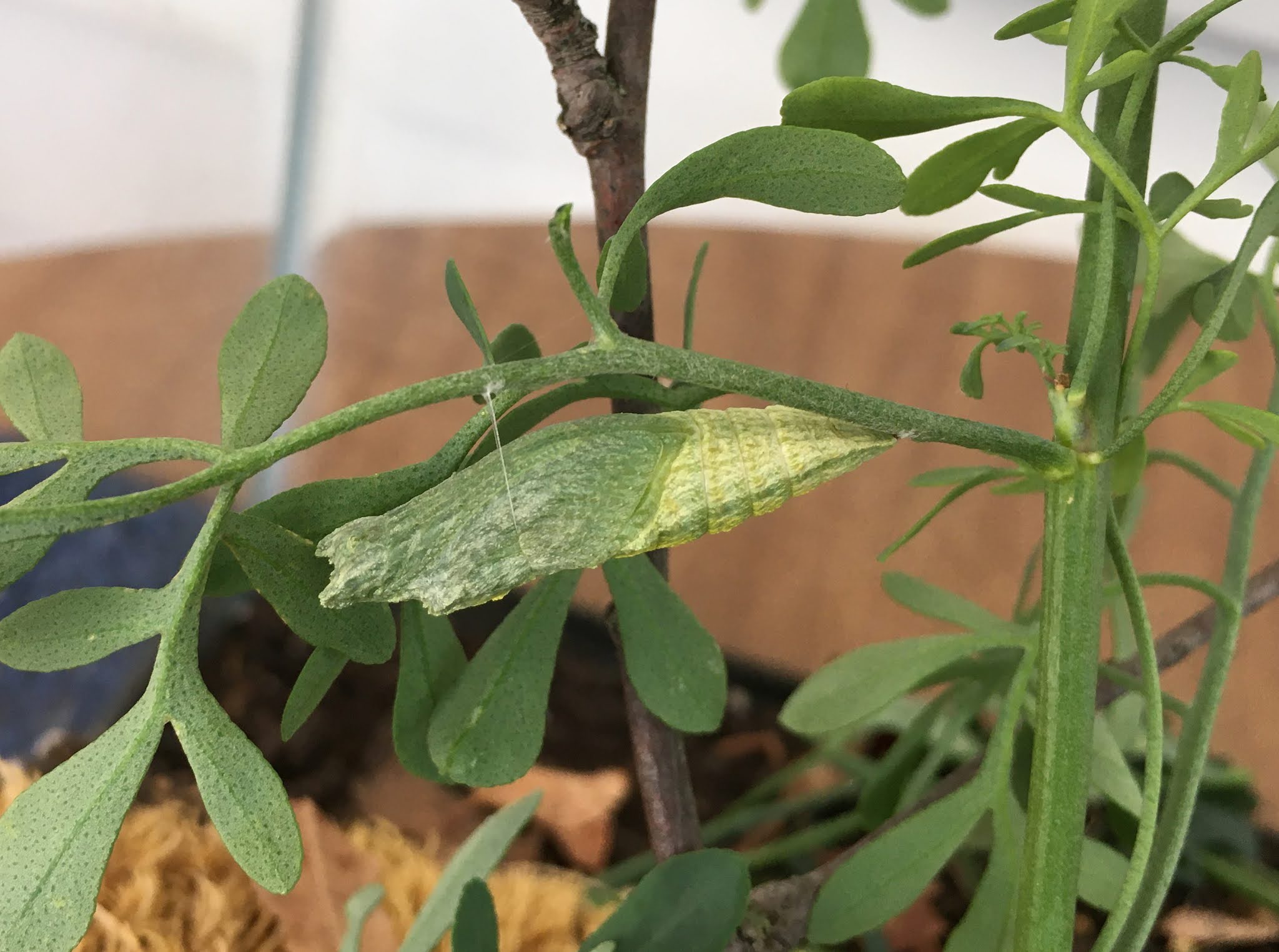
Newest addition to our family - updated


Found this big fellow crawling on the rue by our mailbox.  Brought him in to a terrarium on the screen porch for protection against wasps.  Within a few days it had transformed into a chrysalis:


Now we wait, and after a while we should have a Black Swallowtail butterfly.

Reposted from July 6 to show the adult (click pic to make it bigger than your monitor):


He eclosed yesterday just as a line of severe thunderstorms was rolling into town, so I kept him on our screen porch overnight, so this morning he was eager to start searching for females.

Fortunately when I took him out and placed him on a coneflower to see if he wanted some nectar, he laid those wings down absolutely flat and held them like that for several minutes, soaking in some solar power.  So I had time to get my phone out and got the best pic I've ever had of the dorsum of BST wings (the overcast cloudy conditions also muted the brightness range and took away shadows and glares).

For those interested, this link from the University of Wisconsin Ag School is the best brief summary of information on Black Swallowtails I know of.

12 July 2021

Armored cricket (real - not a toy)


Cosmoderus femoralis from Cameroon.  Image cropped from the original at the via.

Modern treasure


"An unopened copy of Nintendo’s The Legend of Zelda that was made in 1987 has sold at auction for $870,000.

Heritage Auctions in Dallas said the video game sold Friday.  The auction house said it was a rare version that was created during a limited production run that took place during a few months in late 1987."

Treasure chest

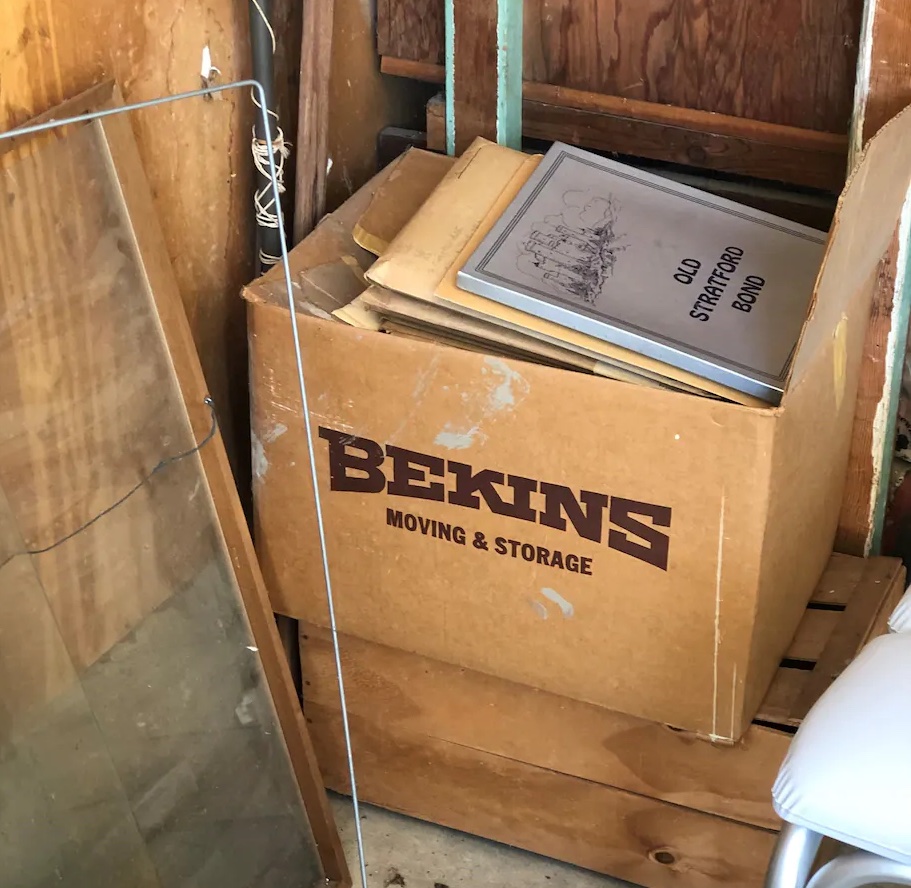
It began with an unmarked, unremarkable box tucked in a corner of a garage in California. Inside, under miscellaneous letters and old high school yearbooks, was a smaller shoe box. Inside that, under old coins and a numismatist pamphlet, lay the 240-year-old diary of sailor John Claypoole, a Revolutionary War prisoner of war and later the third husband of the flagmaker known as Betsy Ross.

“It was wrapped in a piece of paper that said, ‘John Claypoole diary to be handled with great care,’ which was sort of funny we found it in a paper shoe box in a box in this garage,” recalled Aileen Edge, who with her husband uncovered the priceless item in her mother’s Marin County home in June 2020...

Growing up in Marin County, Calif., Aileen Edge always knew she was a direct descendant of John Claypoole and Betsy Ross, who was formally known as Elizabeth Griscom Ross Ashburn Claypoole when she died in 1836 at age 84.  Edge’s mother, Claire Canby Keleher, was the famous flagmaker’s great-great-great-granddaughter and fiercely proud of her family’s role in the nation’s birth.
The rest of the story is at The Washington Post.

Outside steps


Explained here.

With a matching one on the bedside table...


Posted appropriately at the Awful Taste But Great Execution subreddit.

A map with no mistakes - updated


Credit to xkcd.

Reposted from earlier this month to add this map -


Certainly not comprehensive, but interesting nevertheless. Via.

Calculating the volume of a pizza

A pizza with radius z and thickness a has a volume of pi*z*z*a 

 Reposted from 2009.

Beware of browntail moth caterpillars

“Browntail-moth-caterpillar hairs are barbed and hollow. And inside that hollow tube, there’s a reservoir of a toxin,” says Allison Kanoti, the state entomologist for Maine, which is in the middle of a massive browntail-moth outbreak... 

Portland, Maine’s largest city, has had to temporarily relocate its farmers’ market to avoid the insects’ uncanny habit of dropping down from the trees where they nest. In June, Waterville, a city of 16,000, declared a public emergency because of the caterpillars. And all across the state, shoppers covered in itchy abrasions have stripped drugstore shelves bare of witch hazel and cortisone, key ingredients in a DIY compound designed to soothe the downy beast’s ferocious burn. Brushing up against a browntail-moth caterpillar or otherwise encountering its hairs—on a picnic table, on a dock, on a bit of clothes hung out to dry—can leave a person itching for days as a poison-ivy-like rash creeps across the flesh. And as the caterpillar sheds its hairs, they can go airborne, causing wheezing if they’re inhaled. Both reactions can be so severe it necessitates a trip to the emergency room. Research suggests that getting a hair of a browntail-moth caterpillar in your eye can even cause blindness (though this is exceedingly rare). The hairs can remain toxic for up to three years.

“It spread pretty rapidly over 15 years from Massachusetts, to Long Island up into Vermont, New Hampshire, Maine, all the way over to New Brunswick, Nova Scotia, and into Canada,” Angela Mech, an assistant professor of forest entomology at the University of Maine, told me. “It was a huge nuisance.”...

The health risk, at least, is seasonal. By late June the caterpillars have entered their cocoons in preparation of becoming moths, and the caterpillars that hatch from eggs in the late summer or early fall aren’t yet poisonous. Their toxins emerge over months as the caterpillars grow in their winter webs, shedding old skin, and revealing a larger new skin underneath, before becoming toxic shortly after they emerge from their webs in April...

During the initial outbreak in the 1890s, the browntail-moth caterpillars caused so much havoc that, according to Mech, kids were paid to clip down their tents in winter. In a single year more than 24 million browntail-moth webs were clipped off trees and burned, while federal and local governments introduced dozens of different biocontrol agents, including predator insects from Europe... a fungus known as Entomophaga aulicae [is a natural adversary]. Once it takes hold, it can wipe out entire caterpillar colonies. But the fungus needs cool, wet springs to thrive. And Maine, which is located in the fastest-warming region in the lower 48 states, has experienced warm springs in the past few years.
More info at The Atlantic.

10 July 2021

Spiny orb-weaver spider

Macracantha is a genus of Asian orb-weaver spiders recognized as containing a single species, Macracantha arcuata... notable for the extremely long, curved spines on the abdomens of female members of the genus; Eugène Simon created the taxon name from the Greek words μακρός (large, long) and ἄκανθα (spine). It occurs from India and China through Southeast Asia to Borneo.
Photo via.

Having fun at an abandoned Soviet labor camp

"After the seizure of the Baltic states by the USSR, a maximum security prison had been established by the quarry at Rummu [Estonia]. The area was turned into a secure compound, where the incarcerated were used as forced labour. Post-USSR, the prison was closed and the pits flooded. Although the land is privately owned, over time it had become a favourite spot for residents and visitors to swim and relax in."

Rhinoplasty - 1597


I am recurrently startled by flashes of medical brilliance in ancient times. That was the case this week when I read about De Curtorum Chirurgia Per Insitionem  (The Surgery of Defects by Implantations), written in 1597 by Gaspare Tagliacozzi, professor of surgery and anatomy at the University of Bologna.
The tome, which is written in Latin, is illustrated with diagrams, including the rhinoplasty, in which the patient's nose was attached to a flap of skin from his upper arm. In one plate, the patient is seen in bed with his forearm attached to his head and a flap of skin from his bicep region stuck onto his nose.

The book tells how he stayed like that for about three weeks until the skin from his arm had attached itself properly. After a further two weeks the flap of skin was shaped so it resembled a nose and the process was complete.

The book was sold for £11,000 to a modern-day plastic surgeon.
The technique used then is not widely dissimiliar from how some reconstructions are facilitated today.  Facsimiles of the book can be purchased at Amazon ($250), or browsed at Google libri.

Reposted from 2010.

Inca trepanation


The publicity this summer will be about crystal skulls, but this week there's an interesting article from National Geographic:
"Many of the oldest skulls showed no evidence of bone healing following the operation, suggesting that the procedure was probably fatal.

But by the 1400s, survival rates approached 90 percent, and infection levels were very low

Their survey found that trepanation was a remarkably common practice in the Inca capital. Of 411 skulls that were sufficiently well preserved to study, 66 had holes cut through the bone. In one location, 21 of 59 skulls—over a third—had received trepanation.

While methods of trepanation varied over time, Inca surgeons eventually settled on a scraping technique to penetrate the skull without causing wider injury…

Some of the skulls had been perforated more than once, including one individual who had undergone the operation seven times

Archaeologists have long debated whether the skull perforations were conducted as a medical procedure or for ritual or cultural reasons… Nearly all of the surgeries were performed either near the middle of the skull or on the left side—the regions most likely to be injured during combat with a right-handed opponent

The fact that 19 of the surgical patients were women, however, suggests that the operation may have sometimes been performed for other reasons—possibly as an attempted cure for epilepsy or chronic bone infection..."
Reposted from 2008 to add this photo of a successful ancient cranioplasty (in Peru, circa 400 C.E.):


The headline at the via states that there is a gold inlay repairing the surgical defect.

Where not to "get away from it all"


A photo essay at The New York Times illustrates the crowding occurring at our national parks this summer.
Hikers at Zion National Park, in Utah, have faced wait times of four hours to access certain trails. Visitors to Arches National Park, in the same state, are being turned away at the gate... Yellowstone set visitation records this May, hosting 483,159 visitors.
Above:  Mather Point at Grand Canyon National Park.  Below: Thunder Hole at Acadia.

Related Posts Plugin for WordPress, Blogger...