"The phrase is not from the movie itself, but from the novelization that screenwriter Arthur C. Clarke wrote at the same time as the screenplay. The book describes the scene in which Bowman is entering the star gate, and he says the following phrase just before losing contact with Mission Control: "The thing's hollow -- it goes on forever -- and -- oh my God! -- it's full of stars!""
Now let the James Webb Space Telescope show you what's in the Southern Ring Nebula:
"This video zooms through space to reveal Webb’s Near-Infrared Camera (NIRCam) image of the Southern Ring Nebula.
The bright star at the centre of NGC 3132, while prominent when viewed by the NASA/ESA/CSA James Webb Telescope in near-infrared light, plays a supporting role in sculpting the surrounding nebula. A second star, barely visible at lower left along one of the bright star’s diffraction spikes, is the nebula’s source. It has ejected at least eight layers of gas and dust over thousands of years.
Data from Webb’s Near-Infrared Camera (NIRCam) were used to make this extremely detailed image. It is teeming with scientific information — and research will begin following its release."
I don't think the human mind can properly comprehend this scale of vastness.
A Colorado Springs man has successfully pushed a peanut all the way to the summit of Pikes Peak with his nose.
Bob Salem, 53, reached the top of Pikes Peak Friday morning. He broke the previous verified record for the feat - completing the arduous task in seven days. The record was eight days.
Details about this impressive feat at KRCC (an affiliate of Colorado Public Radio).
Addendum with an answer to the question you were going to ask: "It’s a long, hard, 13.5-mile climb uphill with a gain of about 7,400+ feet in elevation. Basically, it’s a half-marathon in hiking form."
Sen. David Gowan asked Shinn about the nature of the work the prisoners do at the Florence West prison. In Arizona, all people in state prisons are forced to work 40 hours a week with exceptions for prisoners with health care conditions and other conflicting programming schedules. Some prisoners earn just 10 cents an hour for their work.
“These are low-level worker inmates that work in the communities around the county itself, I would imagine?" Gowan asked.
“Yes. The department does more than just incarcerate folks,” Shinn replied. “There are services that this department provides to city, county, local jurisdictions, that simply can't be quantified at a rate that most jurisdictions could ever afford. If you were to remove these folks from that equation, things would collapse in many of your counties, for your constituents.”..
The state currently contracts with The GEO Group, one of the largest private prison companies, to run Florence West, a minimum security prison that can hold up to 750 people...
Rep. John Kavanagh said to get companies interested in bidding for the contract, it was necessary to provide a profit motive.
“You have to guarantee that they're going to have people there, and they're going to have a profit that they make, they're going to have income,” Kavanagh said. “No one's going to enter into a contract when you can't guarantee the income that they expect. That's kind of based on basic business.”..
After more questioning from Butler, Shinn confirmed there were currently more than 5,000 empty beds in the Arizona prison system state-wide...
When Butler asked “Why aren’t we closing more prisons?” her line of questioning was halted by committee leadership for being outside the scope of discussion...
An Arizona Republic investigation found that Arizona lawmakers invested more in private prisons after record-high campaign contributions from the industry in recent years.
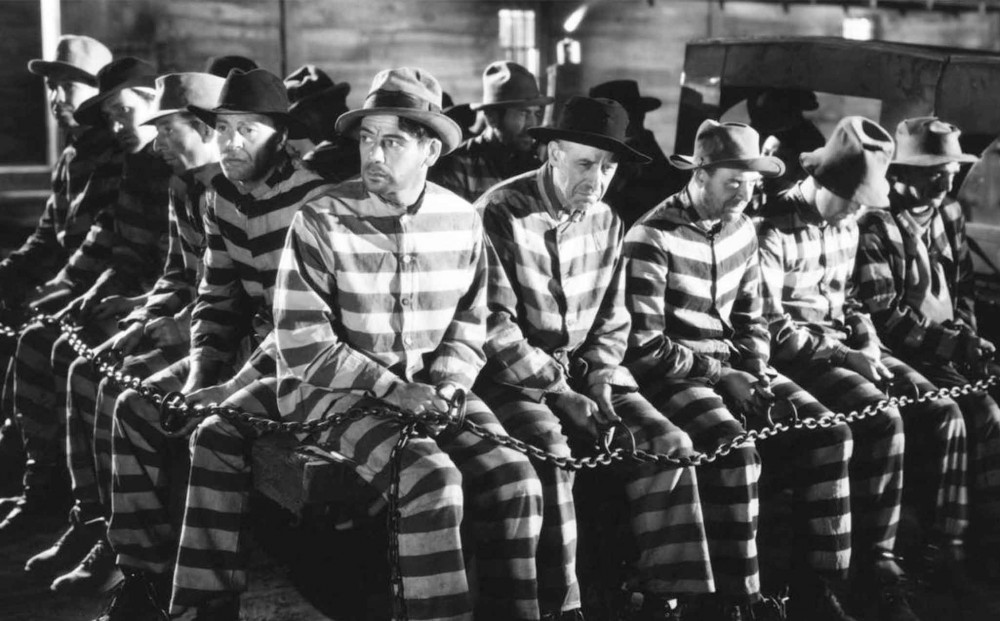
The embedded image is from the movie "I am a Fugitive from a Chain Gang," via Film Forum.
Excerpts from an email I received this evening from one of my cousins:
"I recently returned from a month in PerĂº where I learned more about the proper response to Covid than I had learned over two years in the United States.
The Peruvians seemed willing to follow the rules, almost universally. They wear masks as required and are vaccinated when vaccines are available. Shoppers cannot enter a supermarket or commercial shopping centers without wearing a mask and showing a vaccine card. Travelers on intercity buses, planes or colectivos must do the same, and the buses have curtains between the seats or the seat and the aisle. In Lima and smaller cities I usually saw more pedestrians walking on the sidewalks wearing masks than not wearing masks.
People I knew were very interested in knowing how many shots I had received and were quick to tell me how many shots they had received. I heard nothing about people resisting either vaccines or masks.
The hotels all had large posters with instructions about washing hands, wearing masks, being vaccinated and two or three other practices that people in the United States would not imagine are necessary.
Over the five years in which I have spent time in PerĂº I have noticed the irony of the Peruvians living with successive absolutely incompetent and corrupt governments and the almost universal willingness to cooperate with the directions issued by the Peruvian Department of Health.
In short, with regard to Covid I felt safer in Peru than I do in this country, and it was a joy to get away from the controversies and bickering."
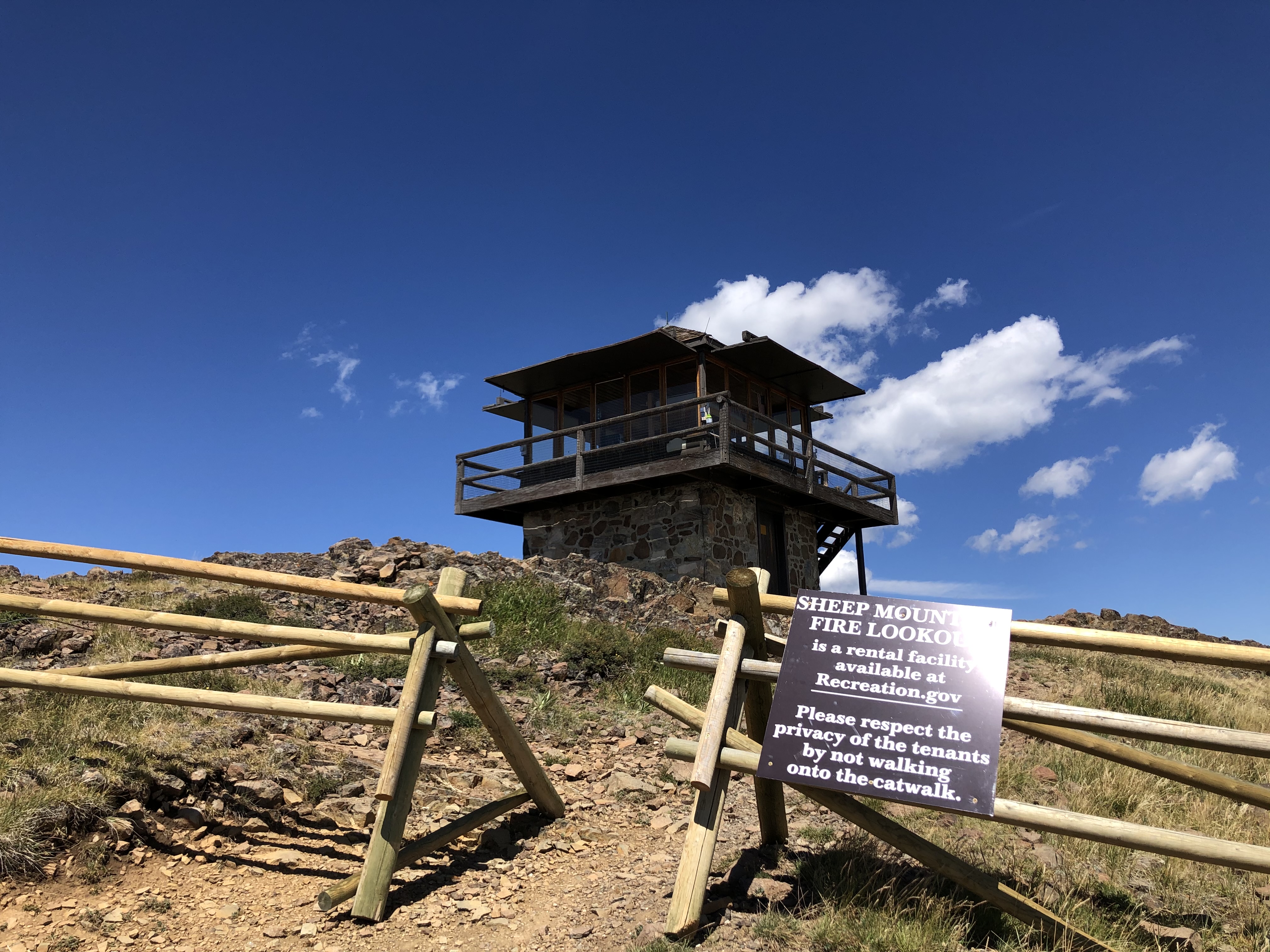
This Wyoming fire lookout station is available to the public for overnight camping.
Perched atop a forested mountain, the historic Sheep Mountain Fire Lookout offers a unique recreation experience -- one of few fire lookouts in the region available for overnight rental. Constructed in 1950 by the Civilian Conservation Corps (CCC) atop Sheep Mountain at an elevation of 9,600 feet, the lookout was historically occupied as a fire lookout until the early 1970s. The lookout is available for rental from June 15 through October 20; however, access to the facility may be limited depending on snow accumulation. Guests are advised to call ahead to confirm access to the facility. Limited amenities are provided; please be prepared to pack in supplies and gear for a comfortable stay. Visitors are advised that this facility has always been a popular destination for recreational visitors to come and enjoy the views and historical nature of the area, therefore, solitude from other forest users may not be an option at this facility.
The facilities are "rustic" -
This facility is primitive in nature. While a single vault toilet and one set of bunk beds are available, there is no running water, indoor plumbing or electricity. Basically, what is available are four sturdy walls, sound roof, no neighbors and commanding views from the lower quadrant of the Bighorn Mountains all the way out to South Dakota's forests. It is recommended that guests bring all their water and accommodations needed for overnight camping. This is a "pack-it-in, pack-it-out" facility; guests will need to carry out all trash and clean the facility prior to leaving.
But the view is...
... spectacular. And not mentioned in the official blurb is that this location in rural Wyoming should offer a relatively dark sky and the opportunity for outstanding stargazing.
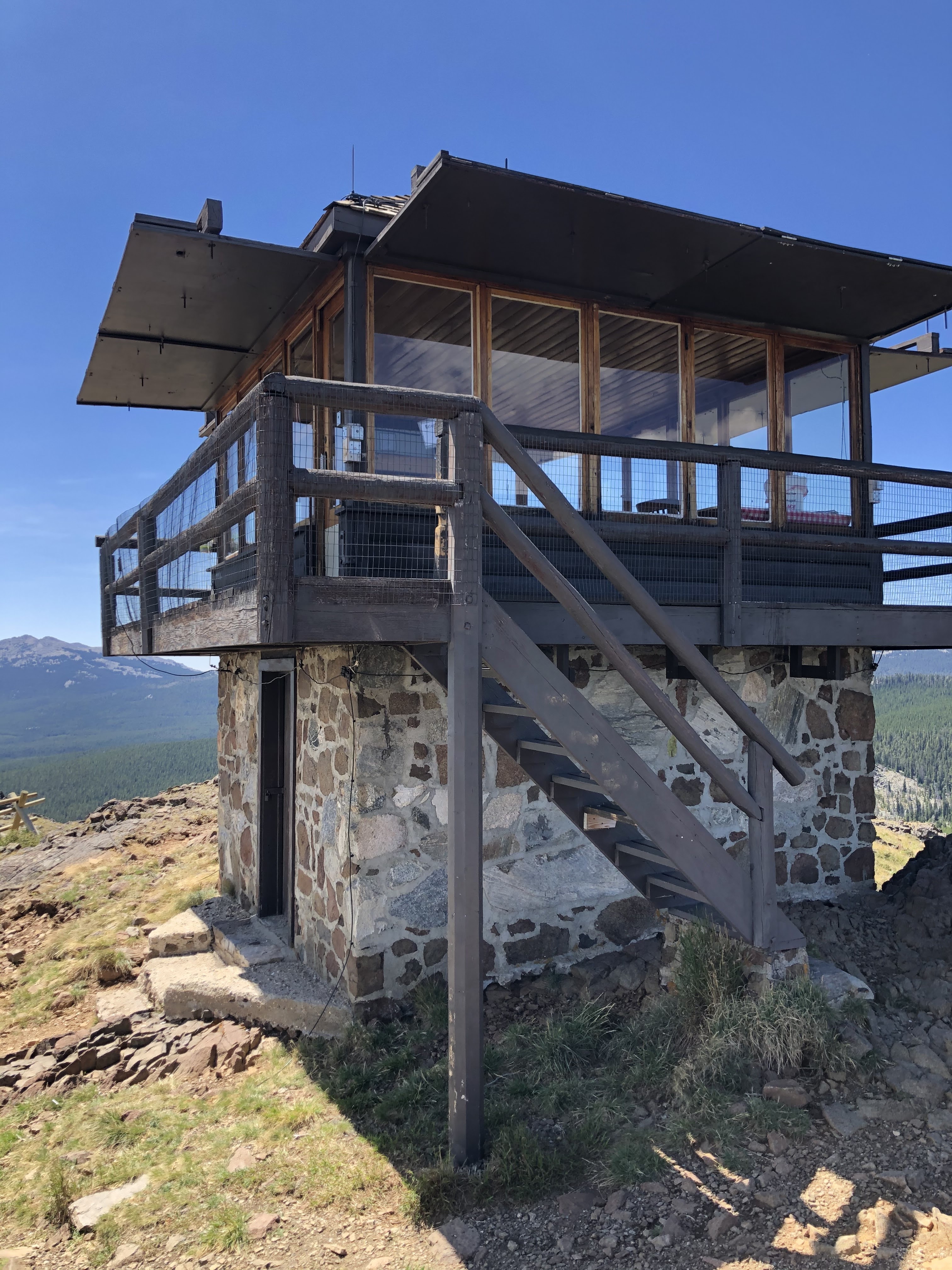
These photos were sent to me by my neighbor Eric, who is aware of my interest in the stonework of the Civilian Constuction Corps. To that end, he added this photo of the base of the fire tower:
Very characteristic of the CCC program, utilizing local material - not brick or concrete blocks. The mortar is rather thick compared to the more snugly-nested stones seen at some other sites, perhaps reflecting the youth and inexperience of the participants, or the absence of a local expert. I note this structure was completed in 1950, well after the bulk of CCC projects and near the end of the program.
The US is the latest country to pass what’s become a critical EV tipping point: 5% of new car sales powered only by electricity. This threshold signals the start of mass EV adoption, the period when technological preferences rapidly flip, according to the analysis.
For the past six months, the US joined Europe and China — collectively the three largest car markets — in moving beyond the 5% tipping point. If the US follows the trend established by 18 countries that came before it, a quarter of new car sales could be electric by the end of 2025. That would be a year or two ahead of most major forecasts...
In the case of electric vehicles, 5% seems to be the point when early adopters are overtaken by mainstream demand. Before then, sales tend to be slow and unpredictable. Afterward, rapidly accelerating demand ensues. It makes sense that countries around the world would follow similar patterns of EV adoption. Most impediments are universal: there aren’t enough public chargers, the cars are expensive and in limited supply, buyers don’t know much about them. Once the road has been paved for the first 5%, the masses soon follow.
More discussion and charts at the link re plug-in hybrids. But here is a counterpoint from Ars Technica:
I'm increasingly convinced that EV adoption is going to run into real problems if we can't get a handle on charger reliability... A few weeks later, it was time to drive from DC to Watkins Glen in the Finger Lakes region of New York, this time in a BMW iX. And despite plenty of planning, I still spent almost as much time stationary, arguing with charging machinery, as I did actually pulling electrons into the car's battery pack throughout the 600-mile journey.
At each charging stop, in Virginia, Pennsylvania, and New York, I ran into problems. A five-minute wait to see if the car and charger would establish communications was invariably the case. Waiting 10 minutes was not uncommon. Even then, there was no time to relax; more than once, an error somewhere in the loop shut everything down after just a few kWh...
Then there was the problem of whether or not all of the chargers at a given location were even functional. At one EA station with a Plugshare rating of 9.8, two of four chargers were completely inoperable and a third was reduced to just 50 kW. Four days later, nothing had changed other than its Plugshare rating, which had increased by 0.2 points to the maximum score of 10, with a note in italics about the reduced-power machine...
I would welcome informed commentary from readers - especially owners of electric cars. My current car is 12 years old, and I'll need to make a decision re replacement soon.
The video is a study of the physics and fluid dynamics of a modern "whistling jar." What amazes me is that the concepts involved here date back to pre-contact Mesoamerica. Here is a whistling jar from the Metropolitan Museum of Art:
Whistling jar with seated man wearing a headdress [circa 1000-1476]
Although numerous pottery instruments survive from pre-Conquest South and Central America, little is known of how they were used before Spanish invaders ravaged the native cultures. Whistles, trumpets and rattles in animal or human form probably had ceremonial functions or served as playthings. The "whistling jar" is a 1- or 2-chambered vessel in which a whistle, often concealed by a bird's head, is sounded by blowing into the spout, or by pouring liquid from one chamber to the other to create a bird-like twittering sound. Smaller whistles in animal shapes, perhaps worn suspended from the neck, sometimes have fingerholes that allow variation of pitch.
The furthest-from-earth non-supernova star was discovered incidentally because its light emissions were lensed around a cluster of galaxies.
MACS J1149+2223 Lensed Star-1, also known as Icarus, is a blue supergiant observed through a gravitational lens and the most distant individual star detected, at 9 billion light-years from Earth... Light from the star was emitted 4.4 billion years after the Big Bang. According to co-discoverer Patrick Kelly, the star is at least a hundred times more distant than the next-farthest non-supernova star observed, and is the first magnified individual star seen.
More at the link. I find it curiously difficult to think about this star using verbs in the present tense, since everything we know about it (position, size, wavelengths) describe it nine billion years ago.
Also related: List of star extremes (nearest, oldest, brightest, hottest, least massive, fastest moving...)
Reposted from 2018 to add this instructional video about gravitational lensing, presented by Patrick Kelly. The lecture was presented at the Minnesota Institute for Astrophysics last year.
Patrick is scheduled to do some projects involving the JWST, presumably to image via lensing some stars even closer to the Big Bang than the current limits of the standard microwave images.
I had to look up the term for the "lookout" in the crow's nest.
Barrelman is in reference to a person who would be stationed in the barrel of the foremast or crow's nest of an oceangoing vessel as a navigational aid. In early ships the crow's nest was simply a barrel or a basket lashed to the tallest mast. Later it became a specially designed platform with protective railing.
According to a popular naval legend, the term ["crow's nest"] derives from the practice of Viking sailors, who carried crows or ravens in a cage secured to the top of the mast. In cases of poor visibility, a crow was released, and the navigator plotted a course corresponding to the bird's flight path because the crow invariably headed towards the nearest land. Some naval scholars have found no evidence of the masthead crow cage and suggest the name was coined simply because the lookout platform resembled a crow's nest in a tree. As ships grew in size and complexity, that station came to be mounted on the highest mast of the oceangoing vessel, and it came to be known as the crow's nest. The simplest construction to providing a lookout and setting course direction for the ship was to lash a barrel to the mast. A member of the crew experienced in the matters of navigation was charged with manning this perch and came to be colloquially known as a barrelman.
Here is The Mast-Head chapter from Moby Dick (with a tip of the hat to reader Bulletholes).
F. Scott Fitzgerald's original quote in The Rich Boy went as follows:
"Let me tell you about the very rich. They are different from you and me. They possess and enjoy early, and it does something to them, makes them soft where we are hard, and cynical where we are trustful, in a way that, unless you were born rich, it is very difficult to understand. They think, deep in their hearts, that they are better than we are because we had to discover the compensations and refuges of life for ourselves. Even when they enter deep into our world or sink below us, they still think that they are better than we are. They are different."
And that was before the invention of prostate artery embolization and botox for the bladder...
Crawling through increasingly insufferable summer traffic to and from their second homes, sometimes as far as 100 miles away, has left many of New York City's wealthiest — especially those on the older side — with increased bladder issues, as there are few places to stop during the multi-hour trip.
To combat "Hamptons bladder," New Yorkers who summer in the exclusive Long Island enclave are seeking a pair of specialized medical procedures: prostate artery embolization, which reduces the size of the prostate in men, and "bladder Botox," which decreases urinary frequency for women.
"A lot of people have problems with this issue. They come out to the Hamptons and have to stop four or five times on the way, but can't find a restroom," said Dr. David Shusterman, a New York City urologist who's been advertising the procedures with the tagline "Race to the Hamptons, not to the bathroom."
A colorized photo shows "Women being arrested in Chicago, because their swimsuits were too short, in 1922."
Or is it perhaps a photo of America's future? And if the Supreme Court can get rid of those pesky science advisory agencies, perhaps we can get back to the skies some of us remember in our youth.
Narejo is wary of the attention Simba has attracted – including from rival breeders – and has resorted to prayer and tradition to try to fend off any ill will. “We recite Koranic verses and blow on him to cast away the evil eye,” Narejo said. “Following a long tradition we inherited from our elders, we have fastened a black thread around him that is fortified with Koranic verses.”
Presumably achieved through selective breeding. And not for the goat's benefit, IMHO.
I had never heard of it either. An article in AlJazeera explains "Why the world should pay attention to unrest in Karakalpakstan."
Last week, rare protests in Uzbekistan’s autonomous Karakalpakstan region, which borders Kazakhstan in the country’s northwest, turned deadly. According to the government, 18 people died and 243 others were wounded as a result of clashes between security forces and protesters. More than 500 were detained... The unrest had broken out in response to proposed constitutional reforms which would see the vast region lose its autonomy and right to secede...
Last week’s violent crackdown on protesters in Karakalpakstan represents a watershed moment for Mirziyoyev’s political, economic, and geopolitical agenda. Its aftermath may therefore shape not only Karakalpakstan and Uzbekistan’s future but that of the strategically important wider region.
Uzbekistan is Central Asia’s breadbasket and home to some 35 million people – nearly as many as Kazakhstan, Kyrgyzstan, Tajikistan and Turkmenistan combined. It is also where Russia, the West and China’s visions of Eurasia collide...
Uzbekistan is wary of increasing Russian influence... The spectre of Russian hostility could see Uzbekistan with little choice but to fall into what Raffaello Pantucci, senior associate fellow at RUSI, has dubbed “China’s inadvertent empire”. Beijing became Uzbekistan’s largest trade partner in 2016 and is by far its largest foreign investor...
The West has long been disengaged from the country, despite Uzbekistan’s open call for investment and collaboration under Mirzoyoyev’s rule... Mirziyoyev may not be a democrat, but he has – at least until very recently – proven to be someone the world, including the West, can do business with. His reaction to Karakalpakstan’s unrest will determine whether this came from conviction or convenience. How the world responds in turn will shape the balance of power at the heart of Eurasia.
Here's the relevant Wikipedia page. Interestingly, that little double blob of blue at the northern border is all that's left of the rapidly desiccating Aral Sea. One wonders how much longer this region can continue to be a "breadbasket" and what implications that has for widespread unrest.