28 January 2020

"Witch bottle" found in Virginia

The bottle, jade blue and less than half a foot in height, was plucked in 2016 from the soil dividing traffic on Interstate 64 between exits 238 and 242 in York County. William & Mary archaeologists were inspecting the area for any remaining artifacts in advance of a highway-widening project by the Virginia Department of Transportation...

Witch bottles can be traced to the East Anglia region of England in the late Middle Ages, according to a summary of research on the subject by JSTOR Daily. The bottles typically included human urine, hair or fingernail clippings and sharp objects such as nails, pins or thorns.
The objects were intended to lure witches or malevolent spirits with the urine, hair or fingernail clippings, then trap them with nails or pins — a low-tech witch hunt. Nearly 200 have been found in Britain, where researchers have launched a multiyear survey and study of witch bottles, complete with a social media-aided #WitchBottleHunt campaign to educate the public on identifying the artifacts. Last year, contractors razing an old pub found a suspected witch bottle containing fish hooks, teeth and a mysterious liquid.
More at the Washington Post.

Solar panels vs. historic preservation committees


As reported in the Washington Post:
It is a debate playing out in towns and cities across the country, as the priorities of historic districts collide with the growing enthusiasm for clean energy. From the Great Lakes to the Black Hills, property owners worried about climate change find themselves debating the fine points of dormer contours and shingle color with preservationists worried about architectural integrity.

The conflict is especially acute in Washington, where a concerted push for solar is taking place amid historic preservation agencies that in their territorial and procedural complexity rival the Seven Kingdoms of Westeros. Some permit seekers have found themselves snarled for months, or even years, trying to convince regulators of the aesthetic merits of proposed solar installations...

Green said she has no problem with existing historic district regulations that allow solar cells on flat roofs, where they cannot be seen from the street. But she believes it would be a mistake to permit installations on sloped roofs like those visible on the facades of many bungalows in her neighborhood...

“I think people just get stuck in trying to preserve a certain look when, gosh, I mean, we do have to evolve,” Stanslaw said. “If that is going to require that we change our views on what is aesthetically pleasing, we really have to find some common ground.”
When we moved into a Madison subdivision twenty years ago, the neighborhood association guidelines allowed solar panels but advised placing them in inconspicuous locations, out of view from the street.  This past year one neighbor retrofitted his house and garage roofs with dozens of panels directly facing the street, with no objections from anyone.  But perhaps a 40-year old subdivision is different from a 200-year-old one.

Interesting comic book advertisement (1960)


I'm in the process of doing a final re-read on my old comic book collection before selling them on eBay.  The "comic" aspects of them have disappeared over the years, but there are some other interesting features, including the advertisements.  Most of the back-cover feature ads have been for bicycles, BB guns, toys, or related comics, but the one above from 1960 was particularly interesting.

I wonder how many "Kraft Ball Parks" were constructed, and if any still exist.  Google didn't locate any for me.

Addendum:  A tip of the hat to reader krossbow, who found this story about Bentleyville, Pennsylvania:
Community life is a focal point of Bentleyville, and residents gather at Richardson Park to support local sports teams, hold graduation parties and weddings, do laps on the walking track or play on the playground.
Caramel Park is home to Bentleyville Youth Baseball. The baseball fields were built in 1960 when Bentleyville won a national contest sponsored by Kraft Corp., after residents sold more than 55,000 bags of the sweet, chewy caramels. Members of Bentleyville’s Little League baseball team were invited to New York City to appear on the Perry Como Show after they won the contest...

Good boy


"I was laughing and my dog thought I was hyperventilating and got me my emergency inhaler."

Via the DogsWithJobs subreddit.

27 January 2020

A visit to a "wet market" in Guangzhou (1986)


The current consensus is that the outbreak of coronavirus in Wuhan probably started in a wildlife market in the city, where residents shop for living and recently butchered animals, as reported in the New York Times:
The typical market in China has fruits and vegetables, butchered beef, pork and lamb, whole plucked chickens — with heads and beaks attached — and live crabs and fish, spewing water out of churning tanks. Some sell more unusual fare, including live snakes, turtles and cicadas, guinea pigs, bamboo rats, badgers, hedgehogs, otters, palm civets, even wolf cubs.The markets are fixtures in scores of Chinese cities, and now, for at least the second time in two decades, they are the source of an epidemic...

“This is where you get new and emerging diseases that the human population has never seen before,” said Kevin J. Olival, a biologist and vice president of research with EcoHealth Alliance, a nonprofit research organization, who has tracked previous outbreaks...

On Taobao, a popular Chinese online shopping platform, all manner of live wildlife can be had. A baby badger costs 1,300 renminbi, or $187. A farmer from Hunan, the province directly south of Hubei, sells civets, the source of SARS, for the equivalent of $215 each — discounted to $200 if one buys 500 or more.
I spent several weeks in the PRC back in 1986, shortly after the country opened to Western visitors.  The trip included a couple days in Guangzhou, where friends of mine went out to a "snake restaurant" for lunch and then to the wildlife market while I was busy with other activities.  After I returned to Kentucky, one of them sent me a couple photos, including the one above.

I don't know if/when I'll get back to this topic again, so before I close this post I'll insert my favorite photo from the trip, taken obviously at the Great Wall (near Beijing):


I was 34 years younger then, and in way better health, because in order to get away from the shoulder-to-shoulder crowds near the entrance to the wall, you have to hike for miles - and mostly uphill - to reach spots like this.  I have nothing but fond memories of that trip and of the Chinese people.

The "Oxford comma" - updated

In English language punctuation, a serial comma or series comma (also called Oxford comma and Harvard comma) is a comma placed immediately before the coordinating conjunction (usually and or or) in a series of three or more terms.

For example, a list of three countries might be punctuated either as "France, Italy, and Spain" (with the serial comma), or as "France, Italy and Spain" (without the serial comma)...  It is used less often in British English, but some British style guides require it, including The Oxford Style Manual...

The style that always uses the serial comma may be less likely to result in ambiguity. Consider the apocryphal book dedication quoted by Teresa Nielsen Hayden:
To my parents, Ayn Rand and God.
There is ambiguity about the writer's parentage, because Ayn Rand and God can be read as in apposition to my parents, leading the reader to believe that the writer claims Ayn Rand and God are the parents. A comma before and removes the ambiguity: To my parents, Ayn Rand, and God.

An example collected by Nielsen Hayden was found in a newspaper account of a documentary about Merle Haggard:
Among those interviewed were his two ex-wives, Kris Kristofferson and Robert Duvall.
The Times once published an unintentionally humorous description of a Peter Ustinov documentary, noting that "highlights of his global tour include encounters with Nelson Mandela, an 800-year-old demigod and a dildo collector". This would still be ambiguous if a serial comma were added, as Mandela could then be mistaken for a demigod, although he would be precluded from being a dildo collector.
Much more at the link.

Related:  Is the semicolon an endangered symbol? 

Reposted from 2017 to add the photo above, from an article in The Guardian reporting on the controversy over the absence of an Oxford comma on the new Brexit 50p coin:
It is a debate that has torn the nation in two, ripped friends and family apart, and entrenched deep and uncrossable lines throughout the land. Should the Royal Mint have used an Oxford comma on its Brexit 50p piece?..

... early responses include His Dark Materials novelist Philip Pullman’s criticism of its punctuation.
“The ‘Brexit’ 50p coin is missing an Oxford comma, and should be boycotted by all literate people,” wrote the novelist on Twitter, while Times Literary Supplement editor Stig Abell wrote that, while it was “not perhaps the only objection” to the Brexit-celebrating coin, “the lack of a comma after ‘prosperity’ is killing me”.
It seems appropriate to close with this observation by Lynne Truss, author of the delightful style guide Eats, Shoots & Leaves*:
"There are people who embrace the Oxford comma, and people who don't, and I'll just say this: never get between these people when drink has been taken." 
 *read this book if you enjoy the English language.

26 January 2020

Best car ever


In 1972 I was in the first year of my first full-time job when my 1966 Ford began to sputter on the highway, then died and wouldn't restart.  I had it towed to a mechanic, who discovered that someone had poured sugar into my gas tank.  The cost to redrill the cylinders and clean the fuel system was more than the value of the car, so I sold it for basically scrap metal.

I had little savings and my salary was only $5,200/year, so I had to quickly find something cheap and reliable to get me to work.   I walked to a nearby Volkswagen dealership and was granted a loan to purchase their basic not-even-a-radio Beetle for IIRC less than $2,000.  As part of the deal, the salesperson taught me how to drive a stick shift.

That lemon yellow Beetle did its job for five years, never failing to get me where I needed to go.  When it came time to sell and I put the Polaroid above on the wall at my workplace, I discovered that people in Dallas, Texas weren't eager to buy a car with no air conditioning.  So I sold it to my mom up in Minnesota.  She drove it another 6-8 years from the distant western suburbs of Minneapolis to get to her downtown job as a burn unit nurse at the county hospital, including through every winter snowstorm.  She was so delighted with it that when she traded it in, she chose another Volkswagen.

I was reminded of this old VW when I encountered a Marketwatch article saying that the road to riches should be driven in a cheap car ("Buying new cars is like taking $40,000 and setting it on fire.")  I totally agree.

"Country Life" humor from Punch, part III

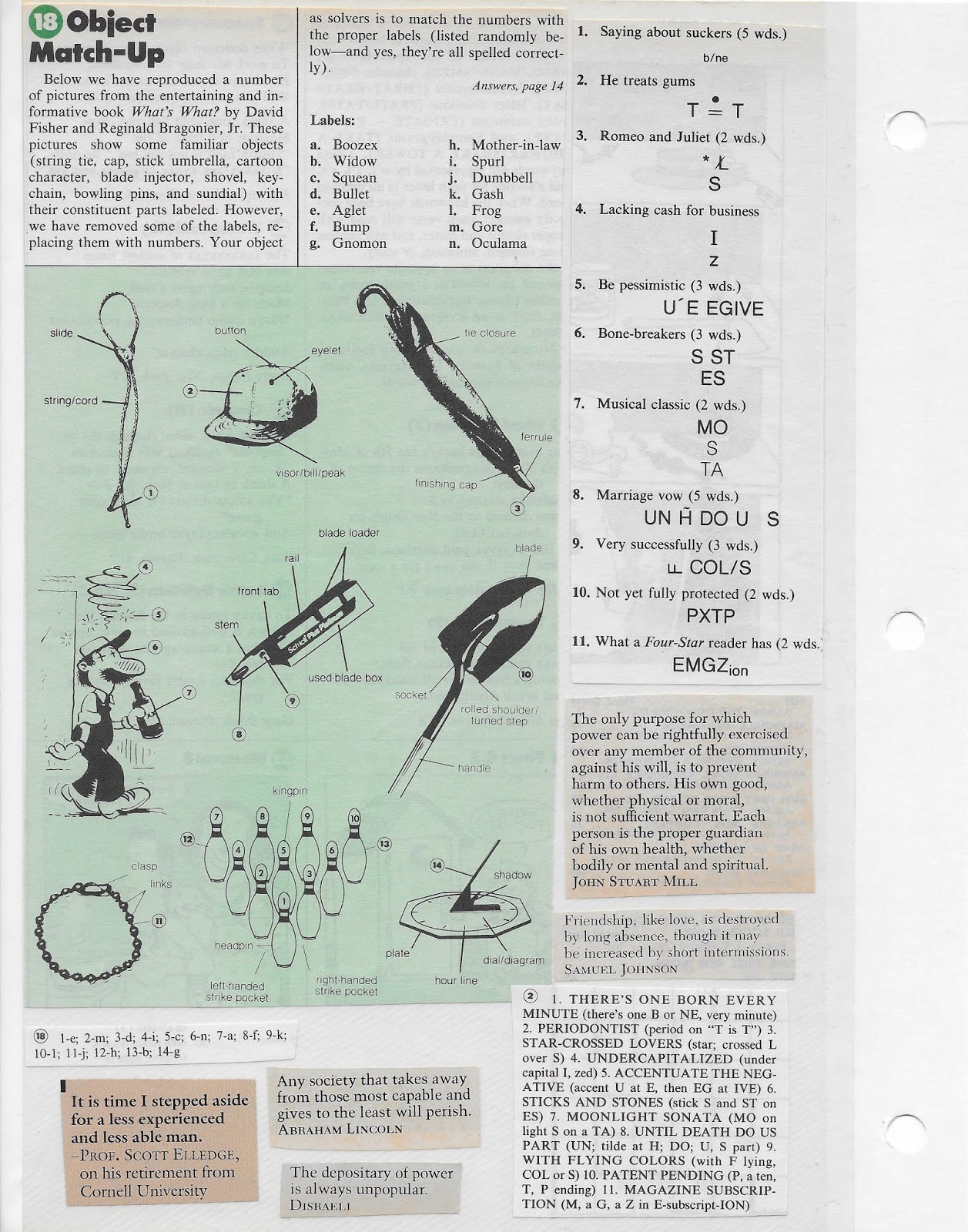
Over a period of many years I clipped out selections from the "Country Life" section of Punch magazine and stored them in a "humor" scrapbook. When I hosted parties at my apartment I would invite guests to sit down and try to read two pages while controlling their emotions and not smiling or laughing. I don't recall anyone successfully doing so. Now I'll try posting the pages here in the blog, a couple at a time.

The text on these pages can be very difficult to read. One possible workaround is to right-click on a page to open it in a new tab, then zoom the image on that tab.

24 January 2020

Can there be a "good" bibliocaust?


Every decries the burning of books - but what if the "good guys" are burning the "bad books"?  Herewith some excerpts from an article in Lapham's Quarterly:
The Allies signed Order No. 4, on the “Confiscation of Literature and Material of a Nazi and Militarist Nature” on May 13, 1946. It prohibited works that promoted Nazism, fascism, militarism, racism, völkisch ideas, antidemocratic views, and civil disorder. It required schools, universities, and public libraries, as well as booksellers and publishers, to remove these works from their shelves and deliver them to Allied authorities; they would then be “placed at the disposal of the Military Zone commanders for destruction.” American officials must have assumed that Order No. 4, as an extension of earlier policies, would attract little notice when they announced it in Berlin that day. Instead, reporters clamored for explanation and demanded a second briefing. In a hastily organized press conference that night, Vivian Cox, an ex-WAC and a low-level assistant in the Armed Forces Division, was called in to address the skeptical crowd. She told them that a single passage could condemn a book and “billions” of volumes might be seized. “Was the order different in principle from Nazi book burnings?” they asked. “No, not in Miss Cox’s opinion,” reported Time. This was a front-page story: Americans were burning books...

Public libraries and universities were initially seen in a different light. The Handbook for Military Government, issued in December 1944, had ruled that books in these libraries “not be removed, impounded, or destroyed.” Education and Religious Affairs in particular favored unrestricted access to any library material, drawing a distinction between adult reading and re­quired school textbooks. Through the spring, however, the policy hardened...

Removing Nazi literature from German homes proved to be a red line. Although a committee drafted a directive to this effect, it aroused strong opposition in the U.S. Control Council. To accomplish this goal, one general objected, they would need not only a vast index expurgatorius of “tens of thousands of titles” but also armies of inspectors to search every home and bookshelf.

A map of Mormonism


Via the MapPorn subreddit, where a reader comments that the map "displays what percentage of the total population are Mormons, not total number of Mormons per county. It also cuts off at 2%."

Boing Boing is celebrating their vicennium

Kudos to Boing Boing, which this week is celebrating 20 years on the internet.  I have been harvesting material from them for about 12 years; they offer a rich source of eclectic information, informed opinions, and incisive comments from their readers.  Two posts this week are of particular note:
Boing Boing is 20 (or33) years old today

Twenty years of blogging at Boing Boing
In the first one, Mark Frauenfelder presents the history of Boing Boing, and in the second Rob Beschizza offers links to a boatload of historic posts.

I had to look up the word for the title.  I was expecting to have to say "double-decennial", but it turns out there is a word for every twenty years: "vicennial" is from the Latin vicesimus+annus.   One could also use "vigintennial", but vice is nice.

Other anniversary terms.

You learn something every day.

There are two "Tywkiwdbis" in World of Warcraft


The acronym isn't copyrighted, and I'm not angry - just puzzled.  I presume it was a reader here who created the character - care to leave a comment on this post about the character?

Addendum: found another one - a High Warlord:

"Crazy worms" severely damage forest ecosystems

I have previously posted about the damage that fisherman inflict on forests when they dump unused bait on the shore:
At dusk Chaffin provided a tour of a colony of night crawlers — the most damaging of the worms — residing beneath a massive basswood tree behind his campsite. Each year, the worms can eat a season’s worth of basswood leaves, depriving the forest floor of “duff,’’ the carpetlike layer of decaying matter that is a critical component of northern American forests.

In a healthy forest, the duff keeps tree roots cool, germinates tree seeds and mushrooms, and provides a home for ovenbirds, salamanders and other small creatures. But below this basswood the earth is bare, a circle of hard-packed dirt 30 feet in diameter. Trees that might fare better here as the climate warms — hardwoods such as red maple and basswood — can’t take root in the packed dirt. Instead, the worms create ideal conditions for invasives such as buckthorn and garlic mustard, plants that evolved with them in Europe.
Recently, a non-native earthworm was discovered at the University of Wisconsin Arboretum
:
The Amynthas agrestis, also called the Asian crazy worm, was discovered last fall in the Arboretum, and the species survived the harsh winter. Officials said it’s the first time the species has been seen in Wisconsin, although it’s been in the East and Southeast U.S. for 50 years, Herrick said.

The eight-inchers come with a ravenous appetite and an advanced ability to reproduce, reaching maturity in just two months and creating offspring without mating. When infestations happen, the worms devour nutrient-rich soil at the forest floor. Erosion sets in, making it harder for native plants to survive. In their place, pesky invasive plants can grow.
The worms are presumed to have arrived in nursery plants received from the east coast.

The best resource I know of online for earthworm-related problems is the Great Lakes Worm Watch, maintained by the University of Minnesota.

Reposted from 2014 to add some excerpts from a recent, detailed article in The Atlantic:
With the exception of a few native species that live in rotting logs and around wetlands, there are not supposed to be any earthworms east of the Great Plains and north of the Mason-Dixon Line...

Gardeners now rejoice to find earthworms in their soil, and you can purchase a 1,000-pack of “Nature’s Wonder Workers” on Amazon for $45. There’s even an entire canon of worm-centric children’s literature, including Wiggling Worms at Work and Richard Scarry’s Best Lowly Worm Book Ever!  But Peter Groffman, a soil ecologist at the City University of New York, says that while worms may do some good in your compost bin, they don’t deserve all the credit for your bumper crops and lush ornamentals. “The earthworms are in the soil because the soil is healthy,” he says. “They are not necessarily doing anything for it.”..

The discovery alarmed scientists. In the absence of worms, North American hardwood forests develop a thick blanket of duff—a mille-feuille of slowly decomposing leaves deposited over the course of years, if not decades. That layer creates a home for insects, amphibians, birds, and native flowers. But when worms show up, they devour the litter within the space of a few years. All the nutrients that have been stored up over time are released in one giant burst, too quickly for most plants to capture. And without cover, the invertebrate population in the soil collapses...

Plants like trillium, lady’s slipper, and Canada mayflower vanish, too. This may be because the worms disrupt the networks of symbiotic fungus that many native plants depend on, or because worms directly consume the plants’ seeds. Or that native species, accustomed to spongy duff, are ill-prepared to root into the hard soil left behind when the worms have finished eating. It could be all of the above...

Bernie Williams remembers when she discovered jumping worms in Wisconsin. October 3, 2013, was “the day that ruined many of our lives,” says Williams, a worm expert at the state Department of Natural Resources.

She was leading a group of researchers and managers on a tour of the University of Wisconsin arboretum. Scientists already knew European worms had taken up residence there, and Williams led the visitors to a heavily invaded spot. But as soon as she saw the soil, she knew something was wrong. “These worms were everywhere,” she says.

Over the next three years, the jumping worms stormed across 25 acres of forest in the arboretum, effectively eradicating their European rivals. They have now been reported in 52 of Wisconsin’s 72 counties, Williams tells me, disproving predictions that the harsh winters would keep them at bay...
Much more at The Atlantic.

"Wilderness solo" longread

"... I was always in the middle of some calculation or quantification with respect to time, and such thoughts were always predicated on an understanding of it as a precious and limited resource. What time was it right now? How much time was left for me to do the thing I was doing, and when would I have to stop doing it to do the next thing?..

I came to a clearing in a forest by a riverbank in Dartmoor national park, far enough from any trail that it seemed unlikely I would encounter anyone while I was there. I gathered some loose branches and stones and arranged them in a circle of about 10 metres in diameter, and then I walked into the circle and did not leave it until the same time the following day.

The short version of this story is that nothing happened in that time: that I did nothing and witnessed nothing, experienced only the passage of the hours and minutes, and the languid dynamics of my own boredom. The long version isn’t exactly The Iliad, either, but in that version something could be said to have happened. Because by the time I walked out of that circle the following afternoon, I’d had an entirely unexpected and intensely cathartic encounter with the passage of time, and with my own mortality.

This is a practice commonly referred to as a “wilderness solo”..."
The story continues at "Splendid isolation: how I stopped time by sitting in a forest for 24 hours"

23 January 2020

Scrapbook, part V

The text on these pages can be very difficult to read. One possible workaround is to right-click on a page to open it in a new tab, then zoom the image on that tab.

Related Posts Plugin for WordPress, Blogger...