06 November 2014

A critique of corporate health-care plans

From an op-ed piece in the StarTribune:
Honeywell International, founded in Minnesota, recently implemented a plan to reduce health care costs and promote healthy living for employees.

Sounds good so far.

But the company went a step further by penalizing workers financially if they and their spouses refused to agree to a biometric testing.

That’s a harmless enough sounding concept. But what it means is you let medical providers for the company draw blood to check for health problems, such as diabetes. It means they would also would test you, and your spouse, for blood pressure, HDL, total cholesterol and glucose. 

Oh, and they’d need your height and weight, and that of your spouse. And while they’re at it, let’s run a tape measure around your waistline to see how you are doing with that diet.
Failure to agree to the tests brings a hefty price, up to $4,000 per family in penalties and lost company contributions.
More details at the link.

A different perspective on the night sky


The time-lapse images of the night sky have been "stabilized" to show the stars in fixed positions and the earth rotating (not vice-versa, as our earth-based bias would suggest).

Via Reddit, where the thread includes brief comments on the lasers emitted from the observatories ("Basically, they use the laser to create an artificial star in the upper atmosphere. They then monitor its shape (which gets distorted due to turbulence in the atmosphere) and use that to correct the shape of the telescope's secondary mirror.")

"Side stitches"

The stitch, an exercise-induced pain in the side, is a medical mystery. Many physicians call it a spasm of the diaphragm. Others say it is akin to the headache—a symptom with a multitude of potential causes. The world’s perhaps most-published authority on the stitch, Australian scientist Darren Morton, disputes both of those theories, calling it an irritation of the parietal peritoneum, the outer lining of the abdomen.

Whatever it is, Dr. Morton’s research shows that the stitch afflicts about one in five participants in a typical distance race... For some it will be debilitating, reducing them to a walk. For others it will be a pace-slowing nuisance...

Though it can feel life-threatening, the stitch doesn’t cause death or injury, sports-medicine specialists say. Unlike a sprain, torn ligament or bone fracture, the stitch doesn’t require rest or recovery. For many, the stitch is fleeting, often vanishing as training increases. Most never seek medical treatment for it...

Defined by Merriam-Webster as “a local sharp and sudden pain especially in the side,” stitch isn’t a new word. “Tonight thou shalt have cramps, side-stitches that shall pen thy breath up,” says Prospero in William Shakespeare’s “The Tempest.” In a first-century mention of the stitch, Pliny the Elder recommended treating it with “the urine of a she-goat, injected into the ears,”...

A 2000 study of his on prevalence by sport found that within the previous year the stitch had stricken 75% of swimmers, 69% of runners, 62% of horse riders, 47% of basketball players and 32% of cyclists.
If I had to bet, I would favor stitches being caused by diaphragmatic spasm induced by respiratory alkalosis.   But that's just a guess.

American sweater (1895)


Nice.  Found at Vintage Blog.

America functions as an oligarchy, not as a democracy

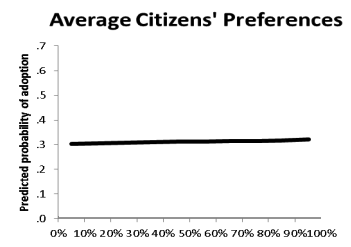
Who really matters in our democracy — the general public, or wealthy elites? That's the topic of a new study by political scientists Martin Gilens of Princeton and Benjamin Page of Northwestern. The study's been getting lots of attention, because the authors conclude, basically, that the US is a corrupt oligarchy where ordinary voters barely matter...
The Vox link discusses these conclusions in some detail.  This graph shows the probability of a policy being adopted by the U.S. vs the percentage of the general population that agrees with the policy:

And this one shows the approval probability vs the preferences of the economic elite and special interest groups:

The study is here.  This from their Abstract:
Multivariate analysis indicates that economic elites and organized groups representing business interests have substantial independent impacts on U.S. government policy, while average citizens and mass-based interest groups have little or no independent influence. The results provide substantial support for theories of Economic-Elite Domination and for theories of Biased Pluralism, but not for theories of Majoritarian Electoral Democracy or Majoritarian Pluralism.

Vintage refrigerator (GE, 1957)


Via Vintage Blog.

How corporations avoid paying income tax

Everyone knows about these shenanigans, but nobody does anything about it. 
Pepsi, IKEA, FedEx and 340 other international companies have secured secret deals from Luxembourg, allowing many of them to slash their global tax bills while maintaining little presence in the tiny European duchy, leaked documents show.

These companies appear to have channeled hundreds of billions of dollars through Luxembourg and saved billions of dollars in taxes, according to a review of nearly 28,000 pages of confidential documents by the International Consortium of Investigative Journalists and a team of more than 80 journalists from 26 countries...

The leaked documents reviewed by ICIJ involve deals negotiated by PricewaterhouseCoopers, one of the world’s largest accounting firms, on behalf of hundreds of corporate clients. To qualify the companies for tax relief, the records show, PwC tax advisers helped come up with financial strategies that feature loans among sister companies and other moves designed to shift profits from one part of a corporation to another to reduce or eliminate taxable income...

Luxembourg agreed to tax only one quarter of 1 percent of FedEx’s non-dividend income flowing through this arrangement - leaving the remaining 99.75 per cent tax-free.
The companies will argue publicly that this is all legal.  It's legal because tax laws have been created by the politicians they bought to make it legal.

05 November 2014

Product with sugar labeled as "no sugar"

Each pack weighs 15–18 g and contains about 36 Tic Tacs. New packs in Australia and Canada weigh 24 g and contain 50 Tic Tacs, and the Tic Tac "Big Box" weighs 49 g and contains 100 Tic Tacs. The "Big Pack" weighs 29 grams (1 ounce) and contains 60 pieces. The "Jumbo Pack" weighs 98 grams (3.4 ounce) and contains 200 pieces.

Each Tic Tac weighs just under 0.5 g. Since US federal regulations state that if a single serving contains less than 0.5 g of sugars it is allowable to express the amount of sugar in a serving as zero, and since a single serving of Tic Tacs is a single Tic Tac, Tic Tacs are labeled in the US as containing zero sugar.
Confirmed at the TicTac FAQs ("Tic Tac® mints do contain sugar").

"Book Week, 1930"


Is there still an official "book week?"

Via Vintage Blog.

An iPhone app that blocks texting while driving

"The AT&T DriveMode app for iPhone is now available on the App Store – making it the first free no-texting-while-driving application offered by a major U.S. wireless carrier that works on the iPhone. The app is easy to use. It silences incoming text message alerts, turns on automatically when one drives 15 MPH or more and turns off shortly after one stops. When activated, it automatically responds to incoming SMS and MMS text messages so the sender knows the text recipient is driving. It also allows parents with young drivers to receive a text message if the app is turned off."

03 November 2014

"The Monkey's Paw"

It's too late for this Halloween, but a classic supernatural horror story by W. W. Jacobs can be enjoyed any time. 
"It had a spell put on it by an old Fakir," said the Sargeant-Major, "a very holy man. He wanted to show that fate ruled people's lives, and that those who interfered with it did so to their sorrow. He put a spell on it so that three separate men could each have three wishes from it."

His manners were so impressive that his hearers were conscious that their light laughter had jarred somewhat.

"Well, why don't you have three, sir?" said Herbert White cleverly.

The soldier regarded him the way that middle age is wont to regard presumptuous youth."I have," he said quietly, and his blotchy face whitened.

"And did you really have the three wishes granted?" asked Mrs. White.

"I did," said the seargent-major, and his glass tapped against his strong teeth.

"And has anybody else wished?" persisted the old lady.

"The first man had his three wishes. Yes, " was the reply, "I don't know what the first two were, but the third was for death. That's how I got the paw." 
Fulltext here, via The Dish.

p.s. - there is a compendium of illustrated short stories by the author at the name link.

Helping a blind dog - updated


One of our neighbors' dogs has suddendly developed blindness, so I've been searching the 'net for applicable resources and tips.  Pictured above is a home-made dog collar that incorporates cable ties to provide the equivalent of a cat's whiskers.

I found this item at Blind Dogs.net, which has a variety of other resources for owners of blind dogs, including a long list of tips to help both dogs and owners cope with the impairment.
5) Sew 1 or 2 "jingle bells" onto an elastic pony tail band (used for hair) to slip onto your own ankle, or attach bell to shoe laces, so your blind dog can hear where you are walking. 

12) Get down on the floor and crawl around at the dog's eye level to find anything that might be dangerous. Do the same in your yard... look for low growing branches etc. that could poke the eyes & trim.

16) Remember to speak to your dog when you are approaching to touch (especially while sleeping) to prevent startling him/her. 

19) Use a short lead to avoid tripping over the leash. Not usually needed, but you can thread the dog's leash through a few feet of PVC pipe to make rigid leash for "directing" in a specific direction. 

20) Sharp corners on coffee tables, furniture legs etc. can be padded with bubble wrap, fabric batting, or foam pipe insulation from the hardware store. 

22) Scent important areas....doorway/doggie door to go outside (vanilla extract, citrus, pine or furniture polish) place "scent" down low on the door or molding for best "sniffing". Scent any "danger" areas.

30) Carpet sample squares are "cheap" and while your dog is learning the layout of the house put carpet squares in the doorways going into each room to make it easier to find the door openings.
Dozens more tips at the link.  If you have experience in this regard and would like to offer helpful tips (or good links), to other owners, please feel free to leave comments.

Addendum:  Reposted from 2012 to add this video showing that more sophisticated "haloes" for blind dogs are now commercially available:


Via Neatorama.

Giant stone circles in the MIddle East

First noticed a centurty ago, but only now being studied:
Archaeologists in Jordan have taken high-resolution aerial images of 11 ancient "Big Circles," all but one of which are around 400 meters (1,312 feet) in diameter. Why they are so similar is unknown but the similarity seems “too close to be a coincidence" said researcher David Kennedy...

Their purpose is unknown, and archaeologists are unsure when these structures were built. Analysis of the photographs, as well as artifacts found on the ground, suggest the circles date back at least 2,000 years, but they may be much older...

The purpose of the Big Circles is a mystery, Kennedy said. It seems unlikely that they were originally used as corrals, as the walls were no more than a few feet high, the circles contain no structures that would have helped maintain an animal herd and there's no need for animal corrals to have such a precise shape, he said.
A gallery of photographs (including several at ground level) is here.

Television. Watching.

A columnist at Salon has trepidations about the newest video technology:
I am now the owner of a new “smart” TV, which promises to deliver streaming multimedia content, games, apps, social media and Internet browsing... The amount of data this thing collects is staggering. It logs where, when, how and for how long you use the TV. It sets tracking cookies and beacons designed to detect “when you have viewed particular content or a particular email message.” It records “the apps you use, the websites you visit, and how you interact with content.” It ignores “do-not-track” requests as a considered matter of policy...

More troubling is the microphone. The TV boasts a “voice recognition” feature that allows viewers to control the screen with voice commands. But the service comes with a rather ominous warning: “Please be aware that if your spoken words include personal or other sensitive information, that information will be among the data captured and transmitted to a third party.”..

According to retired Gen. David Petraeus, former head of the CIA, Internet-enabled “smart” devices can be exploited to reveal a wealth of personal data. “Items of interest will be located, identified, monitored, and remotely controlled through technologies such as radio-frequency identification, sensor networks, tiny embedded servers, and energy harvester,” he reportedly told a venture capital firm in 2012...

Of course, there is always the “dumb” option. Users may have the ability to disable data collection, but it comes at a cost. The device will not function properly or allow the use of its high-tech features.
More at the link.

Science video of the day: a feather falls in a vacuum


Educated viewers will anticipate the result, but seeing it happen is still a jaw-dropping experience.

Via Neatorama.
Related Posts Plugin for WordPress, Blogger...