17 April 2020

The unbroken seal on King Tut's tomb


I thought I had blogged this before, but can't find a relevant old post.
This seal was actually a seal to King Tut’s fifth shrine. The king was buried in a series of four sarcophagi, which were in turn kept inside a series of five shrines. This unbroken seal stayed 3,245 years untouched...

Harry Burton photographed the ornately decorated doors of the second shrine while closed, their simple copper handles secured together tightly by a rope tied through them. The knotted cord was accompanied by a delicate clay seal featuring Anubis, the ancient Egyptians’ jackal god entrusted with the protection of the cemetery.

It’s not uncommon to find rope, wooden carvings, cloth, organic dyes, etc. in Egyptian pyramids and tombs that wouldn’t have survived elsewhere in the world. Egypt’s desert conditions made possible the preservation of far more organic material than would have otherwise been the case. 
Via Rare Historical Photos.

Goodbye to a classic logo


When I was growing up in Minnesota in the 1950s, the logo of the Minneapolis-based Land O'Lakes agricultural cooperative (above, with variations) was everywhere.  Today the Star Tribune reports that the company is dropping the Native American maiden from the image.
In February, the farmer-owned cooperative, founded in 1921, quietly unveiled new packaging ahead of its 100th anniversary. The new design features a facsimile of the serene lakes-and-woods landscape it has long used, minus the illustrated woman.

In some packaging, the figure known as Mia will be replaced by photos of Land O’Lakes member farmers. The words “Farmer-Owned” have been given prominent placement...

Ojibwe artist Patrick DesJarlait remade Mia in the mid-1950s. DesJarlait also created the popular Hamm’s Beer bear, and his work is represented in the collection of the Minnesota Museum of American Art in St. Paul.

The old logo had been subject to predictable criticism (this from 2014):
H. Mathew Barkhausen III,  a writer who is of Cherokee and Tuscarora descent, has criticized the image of the Land O’ Lakes maiden, calling it stereotypical. She wears two braids in her hair, a headdress and an animal skin frock with beaded embroidery. Also, for some, the maiden’s serene countenance erases the suffering indigenous people have experienced in the United States.
The feature of the logo I remember from 60 years ago was not the fact that the maiden was Native American, but that she was female.

Addendum:
The original artist's son replies:  "Mia was never a stereotype."
I know the meaning of stereotypes. I participated in protests against mascots and logos using American Indian images in the early 1990s, including outside the Metrodome in Minneapolis when Washington’s team played the Buffalo Bills in the 1992 Super Bowl. In 1993, I wrote a booklet for the Anoka-Hennepin Indian Education Program about these stereotypes. Mia was originally created for Land O’Lakes packaging in 1928. In 1939, she was redesigned as a native maiden kneeling in a farm field holding a butter box. In 1954, my father, Patrick DesJarlait, redesigned the image again...  
With the redesign, my father made Mia’s Native American connections more specific. He changed the beadwork designs on her dress by adding floral motifs that are common in Ojibwe art. He added two points of wooded shoreline to the lake that had often been depicted in the image’s background. It was a place any Red Lake tribal citizen would recognize as the Narrows, where Lower Red Lake and Upper Red Lake meet... 
Mia’s vanishing has prompted a social media meme: “They Got Rid of The Indian and Kept the Land.” That isn’t too far from the truth. Mia, the stereotype that wasn’t, leaves behind a landscape voided of identity and history. For those of us who are American Indian, it’s a history that is all too familiar.

Unconventional dinner - updated


A Rube Goldberg apparatus is even better than a marble run.

See also:
A marble run incorporating a dozen antigravity mechanisms

A marble run accelerated by rubber bands

Reposted from last year to add this new video.  It's very seldom that such videos get me to laugh out loud, but I did - twice - while watching this.


Via Neatorama.

Brassiere converts to a face mask for emergencies


From Harper's Magazine in 2008.

One Covid commercial to rule them all


Haven't seen a Covid commercial yet?  Here's a supercut of all of them.

16 April 2020

"Nearly half of the moon's soil is made of oxygen."


You learn something every day.  This was totally new information for me:
Nearly half of the Moon’s soil is made of oxygen, an essential resource for human life support as well as a useful ingredient for many fuels. To figure out how to extract extraterrestrial oxygen on future Moon missions, scientists have established the first prototype of a small oxygen-producing plant, according to the European Space Agency (ESA). 
The photo embedded above is from the ESA:
On the left side of this before and after image is a pile of simulated lunar soil, or regolith; on the right is the same pile after essentially all the oxygen has been extracted from it, leaving a mixture of metal alloys. Both the oxygen and metal could be used in future by settlers on the Moon.

Samples returned from the lunar surface confirm that lunar regolith is made up of 40-45% percent oxygen by weight, its single most abundant element...

“This research provides a proof-of-concept that we can extract and utilise all the oxygen from lunar regolith, leaving a potentially useful metallic by-product.

A plan for the far side of the moon


As reported by VICE:
The far side of the Moon is a land of quiet mystery. Because it always faces away from Earth, all the noisy radio transmissions that we humans blast out never reach this part of the Moon. Scientists have dreamed of capitalizing on this unique radio silence for decades, and NASA has now brought that vision one step closer to reality by funding a proposal to build a radio telescope inside a crater on the far side of the Moon...


The proposed observatory would be one kilometer in diameter, making it “the largest filled-aperture radio telescope in the solar system,” according to a NASA abstract about the concept

Not only would this telescope avoid all the radio interference produced by humans, it would also be observing the universe without the veil of an atmosphere.

Egregious waste of medical resources in the U.S.

An op-ed in Bloomberg cites one example of the waste of medical supplies:
A few weeks before my husband died on March 7 at the age of 55, the oxygen arrived: a concentrator for everyday use and a backup tank in case of an emergency. That Barry had never struggled to breathe in the 10 months since being diagnosed with cancer didn’t seem to matter. Once he went into hospice, our living room was stuffed with pieces of equipment, a cornucopia of drugs, diapers, wipes, gloves, masks and whatever else the agency felt he needed to die comfortably at home...

But caring for my dying husband also drove home the system’s inefficiency and waste. Among the unwanted possessions that were bequeathed to me after Barry’s hospice stay were an unused commode chair, a shower chair he’d used twice, a bedside table, packages of ventilator tubing, unopened cartons of fentanyl patches and painkillers, boxes of nitrile gloves, masks and numerous other products that hadn’t been touched. Other than the bed, wheelchair, oxygen tank and concentrator, I was told to throw everything out. The hospice wouldn’t — couldn’t — take any of it back. I now understand how waste costs the health care system up to $935 billion a year, according to research by Humana Inc. chief medical officer William Shrank and colleagues that was published in October in the Journal of the American Medical Association...

Just as fighting the coronavirus has cleared the air in New York and the canals in Venice, perhaps it can help us see more clearly the cost of other choices we’ve made.
I can cite a relevant example from personal experience several years ago, as no doubt can many readers.  After my mother died, I tried to donate her wheelchair, walker, commode etc to the senior living facility - they couldn't accept them.  Nor could the university hospital.  Or the local hospice service.

I finally took those items to a local community senior center, which was grateful to get them.  Her medications - still safely sealed in bubble packs - had to be incinerated at the local police station.

Why can't most organizations accept such material?  Because the next person who needs such an item will simply be given new ones and billed for such through their insurance.  We have such a ridiculous excuse for a health-care system that it's beyond mockery.

Droplets generated when you say the words "Stay healthy!"


As reported in the New England Journal of Medicine yesterday:
We found that when the person said “stay healthy,” numerous droplets ranging from 20 to 500 μm were generated. These droplets produced flashes as they passed through the light sheet (Figure 1). The brightness of the flashes reflected the size of the particles and the fraction of time they were present in a single 16.7-msec frame of the video. The number of flashes in a single frame of the video was highest when the “th” sound in the word “healthy” was pronounced (Figure 1A). Repetition of the same phrase three times, with short pauses in between the phrases, produced a similar pattern of generated particles, with peak numbers of flashes as high as 347 with the loudest speech and as low as 227 when the loudness was slightly decreased over the three trials (see the top trace in Figure 1A). When the same phrase was uttered three times through a slightly damp washcloth over the speaker’s mouth, the flash count remained close to the background level (mean, 0.1 flashes); this showed a decrease in the number of forward-moving droplets (see the bottom trace in Figure 1A).

We found that the number of flashes increased with the loudness of speech; this finding was consistent with previous observations by other investigators.3 In one study, droplets emitted during speech were smaller than those emitted during coughing or sneezing. Some studies have shown that the number of droplets produced by speaking is similar to the number produced by coughing.4
I believe similar results have been found for singing.  The source link has a brief relevant video.

15 April 2020

Nice boat


Don't see the boat?  Look more closely.  Via the oddlysatisfying subreddit.

Related information here and here.

14 April 2020

1 dalmatian


Posted because the image looks so much like a dollop of cookies-and-cream ice cream.  Via.

Hospitals are laying off staff in response to the pandemic

Hospitals across the country have deferred or canceled non-urgent surgeries to free up bed space and equipment for covid-19 patients. But that triage maneuver cut off a main source of income, causing huge losses that have forced some hospitals to let go of health-care workers as they struggle to treat infected patients.

Last week, Bon Secours Mercy Health, which runs 51 hospitals in seven states, announced it would furlough 700 workers. On Wednesday, Ballad Health, which operates 21 hospitals across Tennessee and southwest Virginia, delivered the same bad news to 1,300 employees and said executives would take pay cuts. Employees at Children’s National Hospital in the District were informed this week that they must take off one week, using either vacation time or, if they have none, unpaid leave...

For hospitals already in bad financial shape before the outbreak, the loss of income has raised doubts about their ability to keep treating patients...

Michigan’s Beaumont is one of the more financially stable hospital systems in the country, Fox said. Under normal conditions, the company earns about $16 million each month in net operating income. But after postponing elective surgeries, Beaumont is losing about $100 million a month, he said...

It is not just hospitals feeling the crunch. Family physicians, pediatricians, internists and other doctors who make their money from in-person visits have seen their business dry up because patients are staying home, putting off checkups or putting elective procedures on hold.
A salient reminder (if one is needed) that this country does not have a health-care system.  We have thousands of competing systems.

Infixation

Most readers will already be familiar with more common word-building  processes such as prefixation and suffixation, in which an affix is added to the beginning or end of a base word respectively... Infixation is yet another morphological process which occurs internally in a base word, rather than at either end of the base...

Instances of infixation in English, however, are mostly found in non-standard vernacular speech and usually add a playful, extra-grammatical sense to the word rather than changing its grammatical meaning. For example, the process of expletive infixation is used for added emotional emphasis

In expletive infixation, common obscene expletives or their milder variants, such as fucking/fuckin, freaking, flipping, effing, goddamn, damn (and bloody/blooming in British and Australian English contexts) are inserted productively into words to express a stronger vehemence.
  1. absolutely: abso-fucking-lutely, abso-bloody-lutely, abso-goddamn-lutely, abso-freaking-lutely
  2. Minnesota: Minne-fucking-sota
  3. fantastic: fan-bloody-tastic
We can see how different expletives can be inserted in exactly the same space in the word absolutely. English speakers can also quickly note that constructions such as *ab-fucking-solutely (infixed after the first syllable) and *fanta-bloody-stic (infixed after the second syllable) are technically possible yet do not sound right (linguistically indicated by an asterisk). This is the case even though the expletive happily appears after the first syllable in fan-tastic but the second syllable after abso-lutelyThey somehow violate the unwritten rules of this infixation construction. Why is this so?
For the answer, see the source story at JSTOR Daily.

Reposted from 2015 to add this recent relevant video:


Question:  Is exPLEtive a common British alternative to EXpletive?

Related"Absofuckinglutely" is an "infixation"

Siphonophores are the world's longest creatures

Siphonophores are of special scientific interest because they are composed of medusoid and polypoid zooids that are morphologically and functionally specialized. Each zooid is an individual, but their integration with each other is so strong, the colony attains the character of one large organism. Indeed, most of the zooids are so specialized, they lack the ability to survive on their own. This is somewhat analogous to the construction and function of multicellular organisms; because multicellular organisms have cells which, like zooids, are specialized and interdependent, siphonophores may provide clues regarding their evolution.
Miranda said it best: "O, wonder! How many goodly creatures are there here!"

Reposted from 2014 to add this remarkable photo of a siphonophore:


Via Smithsonian, where there is a video.
The creature was spotted by the Ningaloo Canyons Expedition, a team of researchers from institutes including the Western Australia Museum, the Schmidt Ocean Institute and the Scripps Institution of Oceanography... Researchers have not yet formally determined the creature’s length, but Wilson and Kirkendale tell Science Alert that the outer ring of the siphonophore’s spiral formation was estimated to be about 154 feet long, which would be longer than a blue whale, which typically reaches about 100 feet long. Logan Mock-Bunting, a spokesperson for the Schmidt Ocean Institute, tells Newsweek that the entire creature might measure about 390 feet long.,, it does appear to be longer than any other animal on the planet...

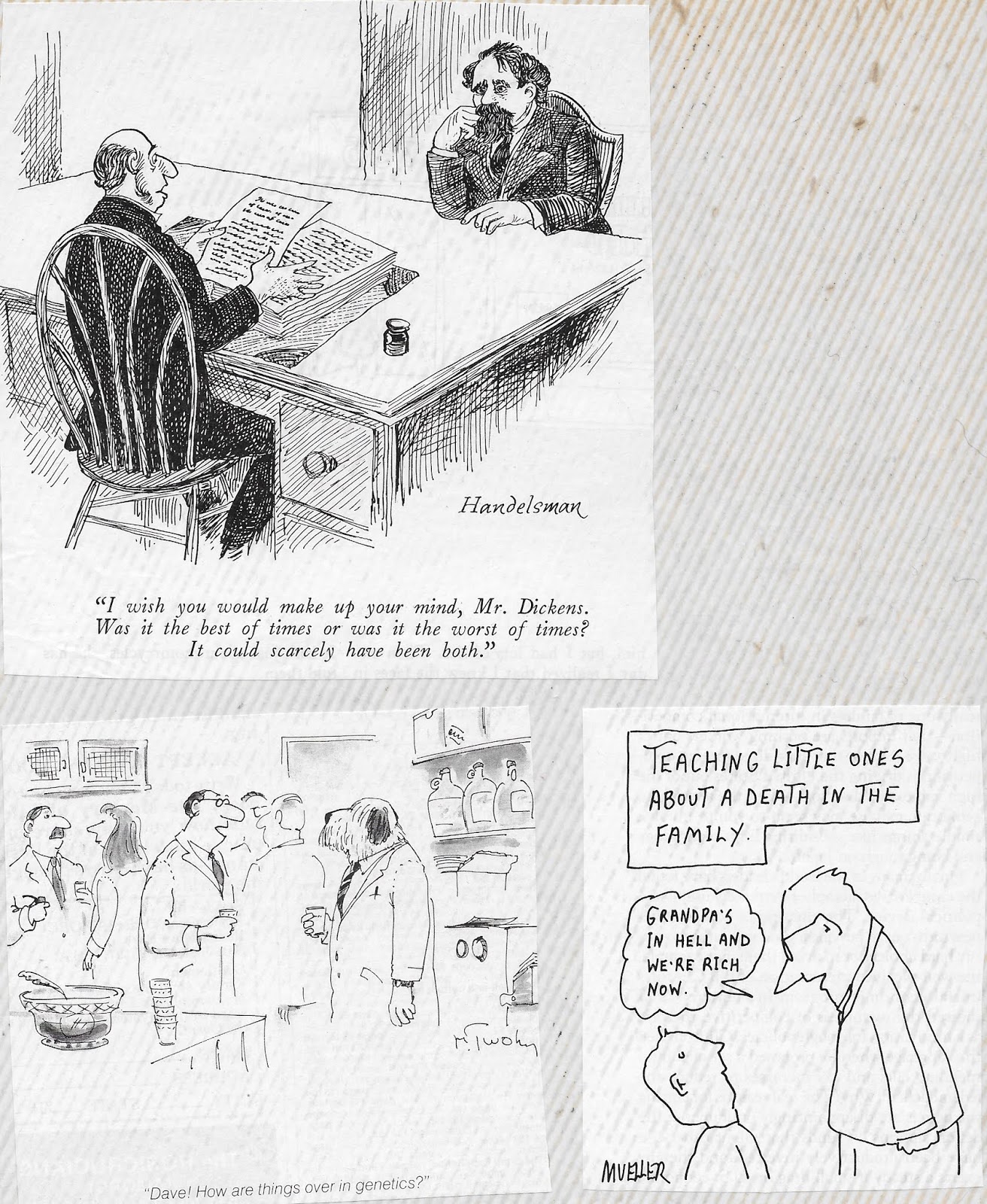
Humor scrapbook, part IX

This is the penultimate of what will eventually be ten weekly posts with material from my old "humor" scrapbook.  The content varies from priceless to junky (especially the case with humor, which often doesn't age well), but there's no time to sort things out or curate the content (which may include material from the 1970s that would be "politically incorrect" nowadays).

The text on "scrapbook" pages can be very difficult to read. One possible workaround is to right-click on a page to open it in a new tab, then zoom the image on that tab.

Related Posts Plugin for WordPress, Blogger...