11 December 2020

Absolute pitch ("perfect pitch") demonstrated


The video should be subtitled, since the audio doesn't pick up the boy's poorly-vocalized responses, but we'll trust them on the details.  It's an impressive talent.
Generally, absolute pitch implies some or all of the following abilities, achieved without a reference tone:
  • Identify by name individual pitches (e.g. A, B, C♯) played on various instruments.
  • Name the key of a given piece of tonal music.
  • Reproduce a piece of tonal music in the correct key days after hearing it.
  • Identify and name all the tones of a given chord or other tonal mass.
  • Accurately sing a named pitch.
  • Name the pitches of common everyday sounds such as car horns and alarms.

    (Reposted from 2015 because it's an awesome talent) 

Planning a collective greeting card for 2021

I first tried something like this in December of 2009 as a Christmas card, then revived the concept in 2017 and again in 2018 as a New Year's endeavor, which is what it will be this year.

Here are the instructions on how to participate:

1) In the comment section of THIS post, give me a LINK to a photo (or a bit of artwork or other image) that you have in your blog, or in your Flickr photostream or in some other online storage site. Don't email me the photo - just give the link and I'll go there and copy/repaste it.*

The picture can be of you, or your family, or your computer, or your cat, or whatever - it doesn't matter.  It should belong to you (not a commercial image with copyright issues).


2) In your comment with the photo link write a brief (25 words max) greeting, directed to the other readers and visitors.  This is to be a greeting to other readers, not a comment to me or about TYWKIWDBI.


3) Sign with the avatar name you use in commenting here, or in your blog, or your real name if you wish. This is not a venue to be used to say "Hi from anon."  I totally recognize that a number of regular readers here prefer to leave comments anonymously - which is fine - but this greeting card is for identifiable people.

Note - as various trolls have realized and bitched endlessly about, for this blog I am the "autocrat at the breakfast table" and reserve absolute right to control the content.  For this venture I may edit comments for length and trim pictures if they are too big.  I may limit the number of entries if there are too many, and I will absolutely vaporize anything that hints of spam or might be offensive to other readers.

*Addendum: I do realize that not everyone has online places to store photos, so I'll try this year to let you email me a photo/text/name if you have no other option.  You can send it to the blog's address: retag4726(at)mypacks.net.  But please send smallish pix (compress them with JPEG if needed).  I don't want to have ten people send 5 MB photos and thus have my emailbox overfull so that I can't conduct my regular life.  Thanks.  I'm looking forward to seeing what arrives...

Christmas greeetings from a KODA


A child of deaf adult, often known by the acronym "CODA", is a person who was raised by one or more deaf parents or guardians. Millie Brother coined the term and founded the organization CODA, which serves as a resource and a center of community for children of deaf adults. Many CODAs are bilingual, speaking both an oral and a sign language (in the United States this is commonly ASL), and bicultural, identifying with both deaf and hearing cultures. CODAs must navigate the border between the deaf and hearing worlds, serving as liaisons between their deaf parents and the hearing world in which they reside. Ninety percent of children born to deaf adults can hear normally, leading to the occurrence of a significant and widespread community of CODAs around the world. The acronym KODA (Kid of Deaf Adult) is sometimes used to refer to CODAs under the age of 18. Please don't skip over this one, especially if you're grumpy because of holiday chores the state of the world.

Reposted from 2015 because it's cheerful.  

10 December 2020

"Carbucks"

Coffee maker as an optional extra in 1959 Volkswagens.  Some relevant discussion here.

Addendum:  A tip of the blogging hat to reader Kolo Jezdec, who found an article in The Drive about a man who located and purchased one of these vintage items.
"... scant information survives about the Hertella Auto Kaffeemachine. There's at least one brochure online in German—in fact, that's one of the few images of the pot that floats around the web—and not much else... the unit was shipped to the U.S. all the way from Serbia...


"I always thought they were a percolator, or espresso machine like a Moka… but nope," he said. "I have no instructions, so can only tell you what I’ve determined on my own. You fill the vessel with water, put your coffee in the (double layer) screen, and heat up the unit. I presume you heat the unit up with the coffee in it, which means this basically brews coffee as though it’s tea."

But while the coffee quality may not be great, the machine does have a few clever features. The porcelain cups that came with it apparently had a metal disc on the bottom of them that allowed them to stick to the machine magnetically. It also mounts to the dash with a simple bracket, allowing for the pot to quickly be removed and cleaned when necessary.

The rarity of these things is really the cool factor here, though. Hord tells me he's only ever seen six of these machines for sale in the three years he's searched for them. And as far as we know, that's how many exist today."

Covidiots in Minnesota

Via the BBC.

The hexagon at Saturn's north pole


"Geometric whirlpools" are discussed in a Nature article:
Researchers at the Technical University of Denmark in Lyngby have created similar geometric shapes (holes in the form of stars, squares, pentagons and hexagons) in whirlpools of water in a cylindrical bucket. The shapes appear easily enough once the bucket is spinning at a rate of one to seven revolutions per second, they say.
But the researchers admit their studies may not be relevant to planetary-sized systems.

Photo via the Space subreddit.

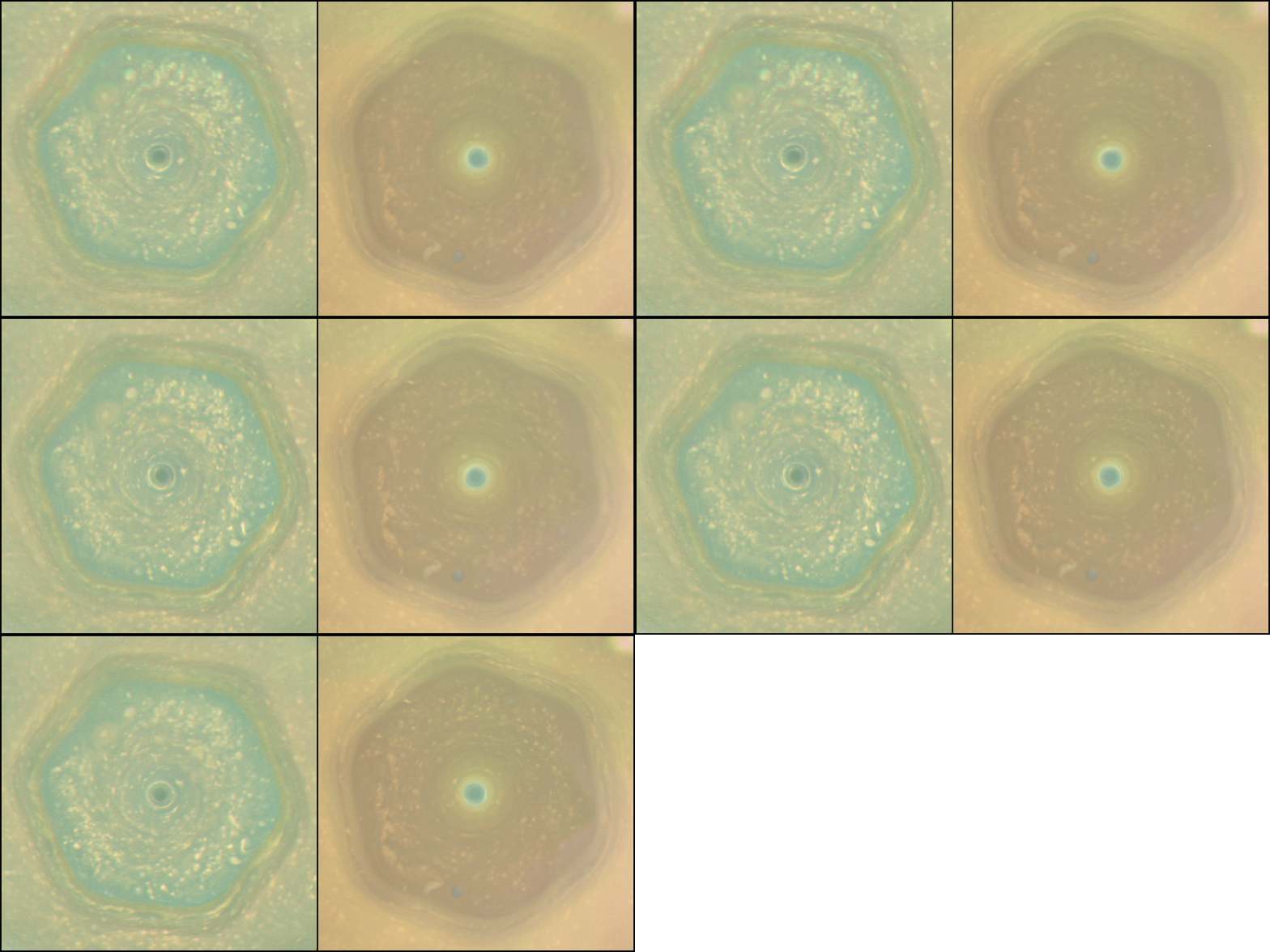
Reposted from 2015 to add these color gif images from NASA:


"These natural color views (and corresponding animated movie sequences) from NASA's Cassini spacecraft compare the appearance of Saturn's north-polar region in June 2013 and April 2017. In both views, Saturn's polar hexagon dominates the scene. The comparison shows how clearly the color of the region changed in the interval between the two views, which represents the latter half of Saturn's northern hemisphere spring. In 2013, the entire interior of the hexagon appeared blue. By 2017, most of the hexagon's interior was covered in yellowish haze, and only the center of the polar vortex retained the blue color. The seasonal arrival of the sun's ultraviolet light triggers the formation of photochemical aerosols, leading to haze formation. The general yellowing of the polar region is believed to be caused by smog particles produced by increasing solar radiation shining on the polar region as Saturn approached the northern summer solstice on May 24, 2017..." [continues at the link]

More here re the motion. 

08 December 2020

Eohippus


The Dawn Horse
By Nellie
The Dawn Horse is the ancestor of all horses. It was completely unlike the horse that we see today. Dawn Horse’s name isn’t really dawn horse, it’s Eohippus. If the meteor that had destroyed the dinosaurs had missed earth, then we would never have ridden a graceful horse, since they would not have been created.

Dawn horse lived with the dinosaurs, and chose the forest as it’s home. The forest was a good choice for dawn horse, since dawn horse was so small. Dawn horse was about the size of a small dog, allowing it to easily find places to hide from predators, in spots like under logs, in bushes, or it could use it’s brown fur to blend in with the forest background.

But, when the meteor hit the earth, dawn horse’s life got a whole lot harder, even though it was already hard enough. Not only did the meteor wipe out the dinosaurs, it wiped out the entire forest where dawn horse lived. Luckily, dawn horse was one of the few animals that survived the meteor. And now the cleared space made room for a new habitat: grassland. Grasslands were not dawn horse’s habitat of choice, but it had no choice. Grassland was dawn horse’s new home, so dawn horse had to adapt. 

First, it’s baby developed certain stuff in it’s stomach when it was born. This allowed it to eat grass, since there was not much leaves in grassland. When two of those mated, the baby would have larger eyes, as well as the stuff in the stomach. The larger eyes would give better eyesight, so they could spot predators from far distances. Next, the baby developed two things: would grow up to be larger than its parents. And longer legs. The larger size would scare off predators that would have eaten the dawn horse, while longer legs allowed it to run quickly away from enemies that they had not spotted. Next, the babies got would grow up even larger, and they got larger ears. Larger size would be helpful for scaring off even BIGGER predators, while larger ears would be able to turn almost all the way around in order to hear predators that they would not see. 

After all that, they just needed to get larger. No special better hearing, just to get bigger so they could scare predators that were too fast. After they got large enough, the tiny dawn horse that could not even scare a caterpillar had evolved into the strong horse who can carry a human that we see today. 
The essay above was written by my neighbor's daughter for her 3rd grade non-fiction assignment.  I was delighted to receive a copy, because it immediately solved the problem for me of what to do with one of the items in my rock and mineral collection.

In the 1970s I moved to Texas for graduate school and realized that the landscape there was ideally suited to reviving my childhood hobby of rockhounding.  I believe it was on a field trip near the Oklahoma border when I was exploring some dry gulches looking for agates and geodes that I found the concretion in the photo.  I carefully packed it in tissue and have stored it away for decades, never once altering any aspect of its shape.  Concretions are often interesting, but this one was remarkable.  But what to do with it???  Now I know.  On Christmas morning a little girl down the street will find a tiny box from Santa under the tree containing a "fossilized Eohippus."

Banana for scale.

"I did what little had to be done."

Lovers of classic murder mysteries will recognize the sentence in the title as a key element in Agatha Christie's The Murder of Roger Ackroyd.  For obvious reasons I'll defer any discussion of the plot, but there were several items of language and usage I thought might be worth mentioning.

"I don't know what Mrs. Cecil Ackroyd thought of the Ferrars affair when it came on the tapis."  Found the explanation on the Wikipedia disambiguation page:  "On the tapis, a Victorian phrase meaning 'on the table' or 'under consideration' (Tapis = tablecloth (Fr.)"

"I didn't think it would [do any good] either, but I protested in duty bound."  "Duty bound" is a familiar phrase, but the "in" seemed anomalous.  Found this: "Sources place this idiom's origin in the 1500s.  Digital records in the form in duty bound or by duty bound go back to at least the 1600s.  It appears as if the word in, however, started to disappear from use around the early 1900s."  

[describing Poirot]: "An egg-shaped head, partially covered with suspiciously black hair, two immense mustaches, and a pair of watchful eyes."  There is a lengthy discussion of this usage at Merriam Webster:

In other words: is mustache, linguistically speaking, properly singular or plural?... One thing that is notable about these early uses is that the plural is frequently used, even when the spelling is closer to the French moustache... Just as there was no consensus on spelling, there was no contemporaneous agreement about whether an individual possesses two mustaches or one. In another bilingual dictionary of the period, the Spanish word is presented as plural but the English word as singular... No less a writer than Shakespeare used the word in the singular (and note that excrement is here used in a now-obsolete sense meaning “outgrowth”):
"…for I must tell thee, it will please his grace, by the world, sometime to lean upon my poor shoulder, and with his royal finger thus dally with my excrement, with my mustachio..."
— William Shakespeare, Love’s Labour’s Lost, 1598
It may well be because of the example of whiskers that mustache was considered a plural for so long; they were, after all, synonymous terms.
More at the link, especially re the correct spelling of the term.  If I learn nothing else today, at least I know I can tell a mustachioed friend "Hey, I really like your excrement!"

"Flora joined me by the silver table, and expressed heretical doubts as to King Charles I ever having worn the baby shoe, "And anyway," continued MIss Flora, "all this making a fuss about things because some one wore or used them seems to me all nonsense.  They're not wearing or using them now.  The pen that George Eliot wrote The Mill on the Floss with - that sort of thing - well, it's only just a pen after all.  If you're really keen on George Eliot, why not get The Mill on the Floss in a cheap edition and read it?"  I'm storing this quote here for future use, because it is directly relevant to the most interesting thing I've read all year - but I don't have time to take a deep dive into that subject right now.

"Ralph's  nerves must have gone phut!  If he suddenly found out that his uncle had been murdered within a few minutes of his leaving him... well, he might get the wind up and clear right out."  I see this idiom all the time in mysteries - especially British ones.  The meaning is always clear - I know the person is alarmed or worried rather than having problems with flatus - but I never could parse the derivation of the phrase.  So today I looked it up and found a proper explanation at The Word Detective: 
“Put the wind up,” meaning “to alarm or make nervous,” as well as its close cousin “to get the wind up” (to become alarmed), both date to just after World War I, and are more often heard in the UK than in the US. The origin of the phrases apparently lies in the armed services slang of WWI (“Shells so close that they thoroughly put the wind up a Life Guardsman in the trench with me,” Wilfred Owen, 1918). But both phrases are still very popular, as can be seen in a recent headline from the UK-based technical website The Register, reporting on US alarm at the theft of a UK government computer containing various secrets: “MoD laptop thefts put the wind up the US.”

Evidently, the origin of “put the wind up” is considered a bit of a mystery. The Oxford English Dictionary is silent on the matter, and most of my reference works don’t even mention the phrase.

In his Dictionary of Slang and Unconventional English, Partridge related (and endorsed) the theory of one of his readers that the phrase comes from a sardonic parody of a standard British Army marching song of the WWI period called “The British Grenadiers.” The “improved” version, popular among enlisted men, contained the lines “Father was a soldier, at the Battle of Waterloo, the wind blew up his trousers, and he didn’t know what to do.” Soldiers sang this song as they marched off to war, and soon, according to this theory, anyone who was flustered or anxious was said to “have the wind up his trousers,” eventually shortened to “have (or get) the wind up.” As Partridge’s correspondent notes, the fact that the song definitely existed, and contained those words, makes this theory highly likely to be true.
That's enough for today.  I don't plan to discuss the other 65 Agatha Christie mysteries; I read them decades ago and had saved just this one for a final reread.

04 December 2020

An "honest trailer" for "A Christmas Story"


About a minute too long, but still enjoyable.

Meriwether Lewis carried an air rifle to the Pacific


In 2010 reader Mikeb302000 sent me a link to the very interesting video above.  The presentation comes from the National Firearms Museum, and provides details about the Girandoni air rifle, manufactured in the 1790s by Austrians and used in European wars.  A rifle similar to the one depicted was carried on the Voyage of Discovery by Lewis and Clark across the Louisiana Purchase to the mouth of the Columbia River.

I found more information at Guns.com:
The Livrustkammarne Museum in Stockholm is home to the earliest example of a mechanical air gun dating back to 1580... The Girandoni was the first pneumatic rifle and first repeating rifle ever used in warfare and it was special issue for the Austrian Army from 1780 to 1825...

And believe it or not it was a stone cold killer at up to 100 yards, able to punch a hole in a 1 inch pine board for the first 30 shots on a single air reservoir. The power dissipated and required a ‘pump up’ after that but the gun was miles ahead of anything seen thus far...

My initial scepticism of these weapons was fuelled by the misconception that they were similar to a Daisy BB gun. When I realized that the Girandoni propelled a .46 calibre ball through a rifled barrel at a muzzle velocity of 900 fps, I realized how wrong I had been. Providing a high rate of fire, there was no smoke from propellants nor muzzle flash to reveal ambush positions nor concern for inclement battle conditions as you needn’t worry about keeping powder dry.
This has permanently changed my concept of "air rifles."  I never owned an air rifle; my first weapon was a .22 caliber conventional rifle, and like most Americans, I conflated an "air rifle" with a BB gun, a mental image formed by repeated viewing of A Christmas Story -
The Red Ryder BB gun was prominently featured in A Christmas Story, in which Ralphie Parker requests one for Christmas, but is repeatedly rebuffed with the warning "You'll shoot your eye out". The movie's fictional BB gun, described as the "Red Ryder carbine-action, two hundred shot Range Model air rifle with a compass in the stock and this thing which tells time", does not correspond to any model in existence nor even a prototype; the Red Ryder featured in the movie was specially made to match author Jean Shepherd's story (which may be artistic license, but was the configuration Shepherd claimed to remember). However, the "Buck Jones" Daisy air rifle, immediately above the Red Ryder in the Daisy line, did have a compass and sundial in the stock, but no other features of the "Red Ryder" model. The guns and a stand-up advertisement featuring the Red Ryder character appeared in a Higbee's store window in the film, along with dolls, a train, and Radio Flyer wagons.
The Girandoni air rifle was most impressive firearm for its era.  Fully recharging the pressure chamber required up to 1500 strokes, but European armies carried spare pressure chambers.  The next step for me was to read a book about the Lewis and Clark expedition.  I chose the classic Undaunted Courage: Meriwether Lewis, Thomas Jeffeerson, and the opening of the American West, by Stephen E. Ambrose, (excerpts here).

Reposted from 2012 because I found this while searching for info on A Christmas Story.

Word for the day: lithornithids


An abstract from the Proc. Roy. Soc. B:
Some probe-foraging birds locate their buried prey by detecting mechanical vibrations in the substrate using a specialized tactile bill-tip organ comprising mechanoreceptors embedded in densely clustered pits in the bone at the tip of their beak. This remarkable sensory modality is known as ‘remote touch’, and the associated bill-tip organ is found in probe-foraging taxa belonging to both the palaeognathous (in kiwi) and neognathous (in ibises and shorebirds) clades of modern birds. Intriguingly, a structurally similar bill-tip organ is also present in the beaks of extant, non-probing palaeognathous birds (e.g. emu and ostriches) that do not use remote touch. By comparison with our comprehensive sample representing all orders of extant modern birds (Neornithes), we provide evidence that the lithornithids (the most basal known palaeognathous birds which evolved in the Cretaceous period) had the ability to use remote touch. This finding suggests that the occurrence of the vestigial bony bill-tip organ in all modern non-probing palaeognathous birds represents a plesiomorphic condition. Furthermore, our results show that remote-touch probe foraging evolved very early among the Neornithes and it may even have predated the palaeognathous–neognathous divergence. We postulate that the tactile bony bill-tip organ in Neornithes may have originated from other snout tactile specializations of their non-avian theropod ancestors.
Photo via The New York Times, where the findings are discussed.  See also Wikipedia re lithornithids.

"Cytokine storm" explained

This year marks 10 years since the first description of a cytokine storm that developed after chimeric antigen receptor (CAR) T-cell therapy and 27 years since the term was first used in the literature to describe the engraftment syndrome of acute graft-versus-host disease after allogeneic hematopoietic stem-cell transplantation. The term “cytokine release syndrome” was coined to describe a similar syndrome after infusion of muromonab-CD3 (OKT3). Cytokine storm and cytokine release syndrome are life-threatening systemic inflammatory syndromes involving elevated levels of circulating cytokines and immune-cell hyperactivation that can be triggered by various therapies, pathogens, cancers, autoimmune conditions, and monogenic disorders... 

In this review, we propose a unifying definition of cytokine storm; discuss the pathophysiological features, clinical presentation, and management of the syndrome; and provide an overview of iatrogenic, pathogen-induced, neoplasia-induced, and monogenic causes. Our goal is to provide physicians with a conceptual framework, a unifying definition, and essential staging, assessment, and therapeutic tools to manage cytokine storm.
For those who, like me, have fallen behind in reading, this New England Journal of Medicine review article is comprehensive (I believe all the coronavirus-related articles are available outside the firewall).

01 December 2020

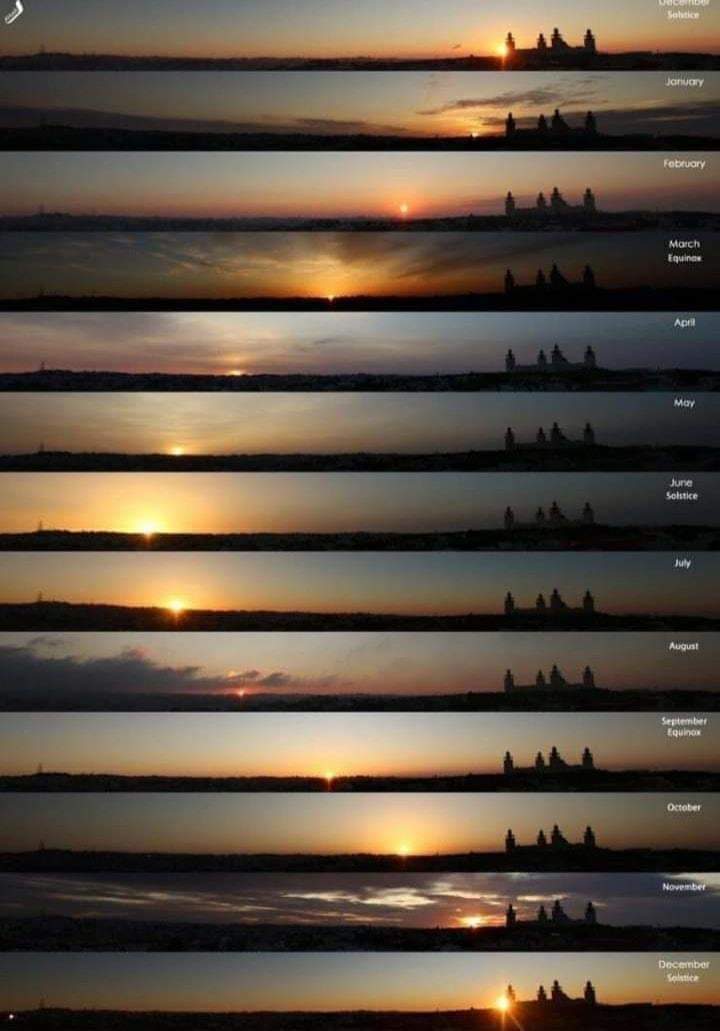
The changing location of sunrise/sunset


As an adult I'm surprised how many people are unaware of this phenomenon, but TBH when I was a teenage driver I remember my disappointment that the Minnesota highway department had positioned a road so that I had to drive directly into the sunset on my way home from work...

The phenomenon is discussed briefly at APOD and at EarthSky.  Image via.

Seeking advice on salt licks and Flowbees

Every now and then I use this blog to get advice from readers about subjects that are a bit hard to find information about online.   My first queries are about salt licks.

We live on the outer fringe of Madison, Wisconsin and have a small woods behind the house.  Over the years we have been visited by a variety of mammals; in addition to the typical suburban chipmunks and raccoons and bats and moles and mice, we have seen deer, fox, coyote, woodchuck, and the occasional opossum - although fewer in recent years as new subdivisions have been replacing farm fields and pastures nearby.

I've been thinking of putting out a salt lick for the critters.  We have a Farm and Fleet store nearby that has product, so my questions are about any potential downside.  Does the leaching of salt from the block result in any problem for nearby plants?  This wouldn't be in a garden setting, but we do have spring ephemeral wildflowers in the woods, and I even wonder about the tolerance of trees.  Conventionally these blocks are out in a pasture far from trees.  I have been told that cattle not only lick the block away, but also nibble down into the soil underneath, carving out a pit to harvest all the available salt.  Similarly if the block is placed on a stump, the stump itself will eventually be eaten away by the animals.  Are the trace mineral supplements important?  How long they last will obviously depend on usage, but I'm wondering if I need to stock up in anticipation of rain and snow melting the block.  Will the bats make use of the salt lick??

The next question is about managing "covid hair."  I've patronized the same barbershop for the past 15 years.  I'm willing to listen to the constant FOX News programs because of the low ($16) price for a haircut.   I'm sure he is wearing a mask this year, but his shop is not much bigger than a modern walk-in closet, and his clientele may not be rigorous in mask use.  When I called this summer to inquire if he was by any chance offering outdoor haircuts he was incredulous.  So I have "covid hair" (which I suppose can be viewed as a political statement).

Because I almost never watch network television, I have been blissfully unaware of decades of infomercials about the "Flowbee" vacuum-assisted haircutting system.  While researching self-haircuts I came across an interview with George Clooney in which he reports cutting his own hair for the past 25 years using the Flowbee system (his comments start at the 2:15 mark of this video).  Apparently that's why he's wealthy; I always thought it was because of movies and celebrity fees, but it's also from the savings of doing one's own haircuts.  Readers - any experience or informed opinions on this?? (Amazon is sold out of the product, so the pandemic seems to have been good for the company).

Addendum:  I decided to get a salt+trace minerals brick, and have placed it at the junction of two walking paths, within binoculars view of our house.  I don't expect to see much activity because most visitors would likely be crepuscular, but the pattern of tracks in the winter snow might be interesting.

"Crip Camp"


I thoroughly enjoyed watching this on Netflix last night.  The first part of the film presents archival footage of Camp Jened, a summer camp for young people with disabilities which was in operation from the 1950s to the 1970s.  The second part of the film follows some of these campers as they become leaders in the disability rights struggles of the 1970s.

I watched this as an "alumnus" of the polio epidemic of 1952, but the film will be of interest to a broad range of viewers - especially those who have family or friends with physical impairments.

The film is reviewed at The New York Times, and the Wikipedia entry is excellent.

Addendum:  The BBC has an excellent article about Judy Heumann, a disability activist featured in the movie.
Related Posts Plugin for WordPress, Blogger...