27 March 2020

Interesting coronavirus graphs, including ?triage effect


Comparison of countries embedded above.  State-by-state and other graphs at 91-DIVOC,

I'm also intrigued by this graph -


- and in particular by the steepness of the rise with advanced age.  Obviously elderly patients have an increased prevalence of COPD and coronary artery disease and renal insufficiency etc, which render them more susceptible to the stresses of an acute respiratory distress syndrome.  But I'd be surprised if the co-morbidities differences are that great.  I suspect (though I've not seen it discussed anywhere) that what this graph is depicting is a "triage effect."  You have two admissions to the hospital, one 84 years old, the other 54 years old.   There is one ventilator available; the other patient will receive supplemental oxygen and supportive care.  Your call.   An enormous number of heart-wrenching decisions are being made every day, all across the world.

Only one of these is a pine cone


The other is a Striped Cuckoo.

The final grievance in the Declaration of Independence

This is the 27th grievance against King George III:
He has excited domestic insurrections amongst us, and has endeavoured to bring on the inhabitants of our frontiers, the merciless Indian Savages, whose known rule of warfare, is an undistinguished destruction of all ages, sexes and conditions.
The backstory for this grievance is discussed at length by a professor of history at the University of Oregon:
The 27th grievance raises two issues. The first, the king’s incitement of “domestic insurrections,” refers to slave revolts and reveals a hard truth recently brought to the public’s attention by The New York Times Magazine’s 1619 Project: Some of those who sought independence aimed to protect the institution of slavery. This was particularly true for Virginia slave owners, who were deeply disturbed by a proclamation issued in November 1775 by Virginia Governor Lord Dunmore, which promised enslaved people held by revolutionaries freedom in exchange for joining the British army. Virginians and other southerners feared that it would provoke widespread slave revolts...
Although the reference to the “merciless Indian savages” appealed to the “inhabitants of our frontiers,” Jefferson and others who signed the Declaration had their own reasons for detesting British policies relating to Native Americans and their lands... More than a decade earlier, in order to end a costly war to suppress an indigenous resistance movement led by the Ottawa war leader Pontiac, the king issued the Proclamation of 1763, which recognized indigenous ownership of lands west of the Appalachian mountains’ crest and prevented colonists from settling there... Jefferson’s denigration of “merciless Indian savages” signaled that the war for independence from Great Britain would also be a brutal war to seize indigenous lands.
More at the interesting article in The Atlantic.

26 March 2020

Divertimento #176


"How a storm revealed a Welsh kingdom" (nice photoessay)

If you're videoconferencing from home with Zoom, remember to cover up the camera if you carry your laptop into the bathroom.

What's the best way to poach an egg? (various techniques compared).

"Lost world revealed by human, Neanderthal relics washed up on North Sea beaches" - with a large map of Doggerland.

Commentary on Deborah Birx' sartorial style and professional behavior (more at the link):
Birx doesn’t dress like a lady politician in jewel-tone suits and statement jewelry. She doesn’t wear power dresses, those sleek sheaths that are a critical part of House Speaker Nancy Pelosi’s professional wardrobe. She doesn’t turn up in a white coat as if she’s there to take the nation’s collective temperature. Birx’s style can be called classically feminine when she wears her shirtwaist dresses and knots silk scarves around her shoulders. She exudes academic wonkiness with her earth tones and tunics and mufflers double-wrapped around her neck. She never looks bland or nondescript. She doesn’t look like an automaton or someone who has lost herself in the data and computer models. And in doing so, she offers a subtle but important reminder to people that while this crisis is serious and meeting it is hard, we are still human.
How the coronavirus is killing local news.

Rational logic indicates that the coronavirus did not escape from a bioweapons laboratory.

The best way to reheat pizza (nine methods compared).

Blighted bar slated for demolition discovered to be an antique log cabin from 1700sHere is a 2018 Google Streetview.

Snowflake is a 2010s derogatory slang term for a person, implying that they have an inflated sense of uniqueness, an unwarranted sense of entitlement, or are overly-emotional, easily offended, and unable to deal with opposing opinions. (example)

The movies with the most F-bombs.  "Funnily enough, not one but two Martin Scorsese's movies show up on the chart: "The Wolf of Wall Street" leads the pack with an astounding 569 uses of the word, while "Casino" is in fourth place with 422."


"Doctors warn parents not to sleep with their babies because of the risk of death by accidental suffocation. Still, mothers who've carried those infants inside them want to be nearby, which is only natural. Surely, modern technology can find a way to do that safely. One idea is the device... by BellyBelly. Years later, it is not widely used outside of the Netherlands."

How smart lightbulbs can be hacked ("... too many internet-of-things gadgets don’t come with automatic software updates").

"The results released by the Iowa Democratic Party on Wednesday were riddled with inconsistencies and other flaws. According to a New York Times analysis, more than 100 precincts reported results that were internally inconsistent, that were missing data or that were not possible under the complex rules of the Iowa caucuses."

Data regarding the Houston Astros' sign-stealing scandal.

Did you know horses can have mustaches?  Males and females.  Gallery of photos at the link, via Neatorama.

"Intuit [maker of TurboTax] and other tax software companies have spent millions lobbying to make sure that the IRS doesn’t offer its own tax preparation and filing service. In exchange, the companies have entered into an agreement with the IRS to offer a “Free File” product to most Americans — but good luck finding it."

In January, 37 mph winds blew over a portion of the border wall in California.

Three cake-baking tips from a state champion baker.

The do's and don'ts of eating and drinking on an airplane, from back in the days when people used to fly.

A simple three-card magic trick.

Some people make a reasonable income by owning vending machines.  "Yeah, it’s a lot more simple than people think. You can buy a vending machine used from Craigslist, and you get your business license. You go to door-to-door talking to business owners and offering the service."

A new type of plastic brick allows ice skating rinks to be built anywhere.

A Nashville art school is going to purge all non-Christian faculty.  “We do not hire people who are not Christian,” Thomas Burns, Belmont’s provost, clarified in a response to questions at a town hall on Wednesday. “So the ones who are not Christian will not be eligible to work at Belmont. That’s just part of who we are.”


Very simple illustration explains how a bill in Congress becomes law.

Trikafta is the latest breakthrough drug to treat cystic fibrosis.  “My life is officially starting at 29 years old. I don’t really have a lot to show for it. I spent my whole life preparing to die young…I have all this open future, all this unknown. I just don’t know how to process it.”

"Wild swimming" is what used to be called "swimming."

A mother's children tell her "there's water coming from the laundry room.  Looks like it starts at the washing machine."  She runs downstairs to find this.

Erosion on the shores of the Great Lakes is a serious problem for landowners.  Water levels are reaching historic high levels, probably because of climate change.

The Australian bushfires damaged aboriginal rock art.  "Moore said an intense bushfire burned right up to the edge of the boulder, shearing off enormous slabs of granite. The shearing – known as spalling – was probably caused by a rapid temperature change rather than prolonged heat exposure, he said."

Pearls in North Macedonia are made from ground shells and an emulsion made from fish scales.

The eruption of Mount Vesuvius in AD79 turned the brains of one Herculaneum victim to glass.  "Now Petrone and colleagues have revealed a number of substances within the glassy material, including proteins typically found in brain tissue. Crucially, these were not found in adjacent ash or elsewhere in the site.  “The detection of glassy material from the victim’s head, of proteins expressed in human brain, and of fatty acids found in human hair indicates the thermally induced preservation of vitrified human brain tissue,” the team write."

A razor-wielding rooster in a cockfight killed a bystanding spectator.


"Despite being a couple of years old, José Manuel Ballester’s artworks feel eerily familiar in the time of COVID-19. The Spanish artist recreates classic paintings like Goya’s “The Third of May 1808,” Vermeer’s “The Allegory of Painting,” and Botticelli’s “The Birth of Venus,” except he leaves out one central aspect: humans."  Via Colossal.

25 March 2020

Ochre


From an article at Colossal:
"Washington-based artist and researcher Heidi Gustafson forages, processes, and catalogs natural mineral samples for the Early Futures Ocher Archive. Ranging in color based on its elemental structure, ochre is crushed into a powder and used in various applications from art to medicine. With over 550 samples, Gustafson’s ever-growing archive has become a collaborative project with contributions from archaeologists, scientists, and creatives from around the world."
"As each sample enters the collection, it is labeled with a corresponding number. In a notebook, Gustafson records where the ochre is from, who sourced or collected it, any historic or contemporary uses, and other relevant information. Gustafson grinds the iron-rich ochre into pigments, which she sells to artists and also uses for her own work. Processed samples are added to glass vials and organized by region or dominate mineral type."

It's easy to see why such minerals were so valuable to early humans.  There are additional interesting photos at the artist's Instagram site.

Addendum:  This is a photo of the shoreline at Hormuz Island -


- where there are immense deposits of ochre.  Look at this gif of the shoreline.

Humor scrapbook, part VI

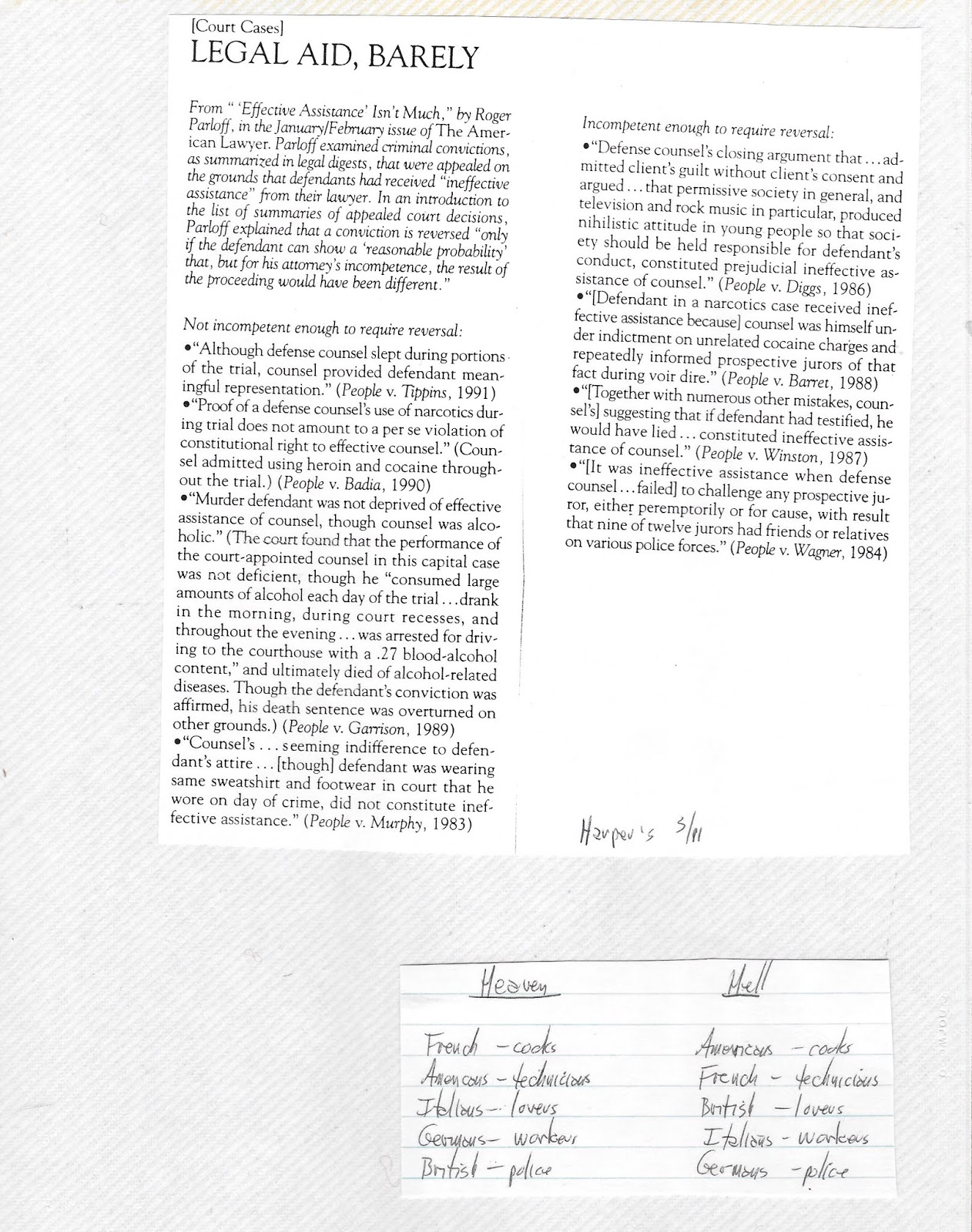
This is the sixth of what will eventually be ten weekly posts with material from my old "humor" scrapbook.  The content varies from priceless to junky (especially the case with humor, which often doesn't age well), but there's no time to sort things out or curate the content (which may include material from the 1970s that would be "politically incorrect" nowadays).

The text on "scrapbook" pages can be very difficult to read. One possible workaround is to right-click on a page to open it in a new tab, then zoom the image on that tab.

Movie theater in Minneapolis


Via.

Sweet


Recognize this crystal?  (answer in the comments). 

Image cropped for size from the original at the mildlyinteresting subreddit.

Her name is Campanula


In the movie Wallace and Gromit: The Curse of the Were-Rabbit, the character voiced by Helena Bonham-Carter is Campanula, which raised the question of how many other names are derived from flowers.

Apparently there are hundreds of them.  It's a broadly cross-cultural phenomenon.  Mostly for girls (Heather, Iris, Olive, Violet, Rose, Lily, Daisy ...), apparently few for boys.  I found a list for dogs (presumably female dogs), some unusual ones (Anemone - really??), and even baby names inspired by food (Kobe, Barack, Katniss, Colby, Brie, Ginger and various herbs and spices).

Image via.

The city of Manila, before and after quarantine


The comment thread at the mildlyinteresting subreddit indicates similar observations coming from California, India, Jakarta...

Reminds me of when I drove from Wisconsin to Ohio after 9/11 and saw no contrails in the sky.

If you have anosmia, isolate yourself immediately

A mother who was infected with the coronavirus couldn’t smell her baby’s full diaper. Cooks who can usually name every spice in a restaurant dish can’t smell curry or garlic, and food tastes bland. Others say they can’t pick up the sweet scent of shampoo or the foul odor of kitty litter.

Anosmia, the loss of sense of smell, and ageusia, an accompanying diminished sense of taste, have emerged as peculiar telltale signs of Covid-19, the disease caused by the coronavirus, and possible markers of infection.

On Friday, British ear, nose and throat doctors, citing reports from colleagues around the world, called on adults who lose their senses of smell to isolate themselves for seven days, even if they have no other symptoms, to slow the disease’s spread. The published data is limited, but doctors are concerned enough to raise warnings.

“We really want to raise awareness that this is a sign of infection and that anyone who develops loss of sense of smell should self-isolate,” Prof. Claire Hopkins, president of the British Rhinological Society, wrote in an email. “It could contribute to slowing transmission and save lives.”
Full article at The New York Times.

23 March 2020

The Idol stone


One of the amazing rock formations at Brimham Rocks.  Good thing it's not in the United States, because some Yahoo would have tipped it over by now.

Coronavirus in blue states and in red states

It has been interesting to me to note how the epicenters of the coronavirus epidemic have centered on what have traditionally been "blue states" (Washington, New York, California), for epidemiologic rather than political reasons.  Some have argued that the response (or non-response) of American politicians has been in part governed by that distribution.

Today an article at Bloomberg discusses Las Vegas and Orlando as targets for the economic devastation that the virus will bring - for obvious economic reasons.
The Great Coronavirus Shutdown of 2020 is hammering lots of industries, but leisure and hospitality is probably the hardest hit. This is a big deal because (until a week or so ago, at least), restaurants, bars, hotels, casinos, theaters, museums, gyms, sports teams and the rest employed 16.9 million people, or 11% of the U.S. nonfarm payroll workforce, up from 9% in 2000 and 7.4% in 1980. That’s more than manufacturing, construction and even health care (albeit just barely on that last one, and probably not for long).
They then present a national map showing the dependence of each state on leisure and travel industry:


Red states dominate the distribution.  Here's a county-by-county breakdown:


It will be interesting to see how the economic and political response to this pandemic plays out.

How American healthcare became tethered to employment

I found the answer at a Marketplace article:
“You’re coming out of the Depression and all of a sudden hiring ramps up,” said Sherry Glied, professor of public service at New York University. So many men are abroad that businesses are desperate for employees that “wages start to climb and prices start to climb. We start to see major inflation happening in the U.S. economy,” Glied said.

“We shall be compelled to stop workers from moving from one war job to another as a matter of personal preference; to stop employers from stealing labor from each other,” Roosevelt said.

That year, the National War Labor Board forbade employers from raising their workers’ salaries — a wage cap. If our employer-sponsored insurance system has an origin story, it is this.

Beyond the wage cap, the labor board also ruled health insurance was exempt from the cap, so employers began to dangle health insurance as a benefit to attract the best and brightest.

The cherry on top: The IRS decided employer contributions to health insurance premiums were tax free, which meant workers paid less out of their pocket.

By 1952, just a decade after Roosevelt’s fireside chat, the economy hummed along.

People wanted new Fords, the best medical care and shiny everything. Private employer-sponsored health insurance exploded.

“How many people have this important private health insurance? Only 8 million people in 1939. But in 1952, 92 million,” Oveta Culp Hobby said in a speech in the mid-1950s. Culp Hobby was President Dwight Eisenhower’s health secretary and just the second woman to hold a presidential cabinet post.

She pitched Eisenhower’s plan to provide national insurance to the 63 million uninsured Americans who lacked coverage either because they were too old, worked for employers who didn’t provide insurance or were out of work.

It was the third pass at getting some kind of national health plan in place since the end of the war and join most other Western nations in providing coverage for all.

Melissa Thomasson, a Miami University professor of economics, said each time there’s a push to expand coverage, doctors — through their lobbying group, the American Medical Association — launch scorched-earth campaigns. “Doctors have always worried that it would limit their ability to charge patients what they wanted,” she said. Physicians “say if health insurance is nationalized, it’s likely that government won’t stop there. They’ll start nationalizing other industries, too. So they use the fear factor to kill it,” Thomasson said.

That largely ended any serious attempt at national insurance. The employer-sponsored insurance became king.
With massive unemployment on the near-term horizon, revision of health care financing is going to rocket to the top of the public's concerns.

Tidbits from "The Thin Man"


While sheltering in place yesterday I watched a classic movie - The Thin Man, starring William Powell and Myrna Loy.   I was startled when Nick Charles spoke the above line, pronouncing the final word "susPECTS" (enPR: sÉ™s.pÄ•ktʹ, IPA(key): /sÉ™sˈpÉ›kt/).  Then in the next frame, Myrna Loy responds the same way:


She also pronounced it "susPECTS," which to the modern ear sounds like a verb.  I'm obviously not the first person to have noticed this.  After some Googling I found a book passage that said "In 1934, however, suspect had yet to fully make the transition from being only a verb... to having a noun form...", suggesting that Nick and Nora's pronunciation was standard at the time.  Perhaps some reader at home will have time to dive into the OED or some old pronunciation guides.

The other curious item was an apparently nonsensical phrase in the final scene of the movie.  As the offering of a box of chocolates was being politely declined, Nick Charles exclaims "Not a hip in a carload!" and the others laugh.  I found the explanation in a Turner Classic Movies discussion thread:
One that I did catch was the "Not a hip in a carload" comment made by William Powell (to some women worried that they would gain weight if they ate from a box of chocolates) in one of the Thin Man movies. He was referring to a popular cigarette advertisement of the time in which a railroad car packed with cartons of cigarettes was captioned "Not a cough in a carload" (to indicate how smooth and healthful the cigarettes were).
Here's one version of that ad:


A 2013 article in the Scottish Daily Mail commented on a similar phrase in Laurel and Hardy movies - "not a laugh in a carload" and "not a chirp in a carload."

You learn something every day.

Addendum:  Found this observation re Myrna Loy's striking outfits in the movie -
Myrna’s wardrobe is fabulous in my opinion and I am surprised that it has been so overlooked over time, just as the work of the designer responsible for it, Dolly Tree: England’s leading stage designer during the ’20s, the first woman to design for the Folies Bergere and one of Hollywood’s major screen designers. And she was one of the first designers to promote the strapless evening gown.
Related Posts Plugin for WordPress, Blogger...