17 April 2017

The "mamas" and the "papas"

"Before I knew anything about language acquisition, I assumed that babies making these utterances were referring to their parents. But this interpretation is backwards: mama/papa words just happen to be the easiest word-like sounds for babies to make.  The sounds came first – as experiments in vocalization – and parents adopted them as pet names for themselves."
Presented at Sentence First in a post introducing a new crowdsourced language project (details at the links).

Movie scenes filmed in Iceland


A surprising number of well-known movies.

Field trip, 1947

Post-War Field Trips

Minneapolis school children from Hay and Willard Elementary schools, as well as a South St. Paul group, wait at the Great Northern railroad station to board a train for St. Paul. Schools around the city have started taking field trips again after ceasing during war-time. As many as 450 children a day are touring farms, trains, zoos, industries, and historic sites.
-- Minneapolis Morning Tribune, April 25, 1947
From the Stuff About Minneapolis tumblr.

I have fond memories of field trips from my childhood, when a day spent touring a factory was deemed as important to education as a day in a classroom.  I think it's important for young children to see - in person, not on film - a working assembly line, an animal barn, a railroad train etc etc etc.

I don't know to what extent such trips are undertaken nowadays (readers...?).  I would concede that it must be a headache for a businessperson to host dozens of unrestrained fourth-graders, but I think if such ventures are not taken, a learning experience is omitted.

Are leggings trousers?


According to the Oxford Dictionaries, yes.
We define leggings as ‘tight-fitting stretch trousers, typically worn by women or girls’.

A key concept in a dictionary entry is the ‘genus term’ – the part of the definition which answers the question ‘what type of thing is it?’. The genus term is a broader category into which the word being defined fits, and can be used to place closely related words into groups, or semantic categories. Our entry for leggings, therefore, uses the genus term ‘trousers’, firmly placing them in that group alongside jeans, cords, and culottes. And they certainly seem to fit our definition of trousers: ‘an outer garment covering the body from the waist to the ankles, with a separate part for each leg’.

Some critics however, have an issue with leggings as an ‘outer garment’.... (more at the link)
Photo credit: American Eagle Outfitters.

Nope. Nope, nope, nope.


I'll meet you over at the Tilt-A-Whirl.

Image via No Brash Festivity.

"Dog-whistle editing" explained

For the English majors reading this blog...
English, in its superabundance, has many multiples of words and phrases that overlap contentiously in meaning. These confusables are the bread and butter of usage manuals: imply and infer, disinterested and uninterested, careen and career, defuse and diffuse, convince and persuade, militate and mitigate, refute and reject, and flaunt and flout.

Some of these pairs are worth distinguishing; others are not. Part of editing well – and writing well – is knowing which distinctions to preserve and which to disregard. Examining over versus more than, John E. McIntyre refers to dog-whistle editing: ‘the observance of nuances that only copy editors can hear, and thus a waste of time’.

Knowing the difference between flaunt and flout is not, for now, a waste of time. But the prospects are not promising. In a post at Language Log yesterday, Geoffrey Pullum says it ‘may be a lost cause’ – a gloomy diagnosis prompted by a BBC Radio 4 report that referred to politicians who were ‘supposed to impose party discipline, rather than flaunt it’. It should have been flout.

To recap: flaunt means to show off or display ostentatiously. One flaunts wealth or fancy clothes. Flout means to brazenly disobey or disregard. One flouts the law by openly ignoring it. The two are often confused: partly, we can assume, because they’re spelled similarly.
The discussion continues at Sentence First.

13 April 2017

A modern equivalent of death by crucifixion


This unfortunate lethal accident was reported in the Washington Post:
Judith Permar drove to a clothing drop-off box at about 2 a.m... According to police, she stood on the stepladder so she could reach the top of the box. She rummaged through the donated items, even taking some out... After allegedly removing several bags filled with clothes and shoes, she slipped as the stepladder collapsed, her arm catching in the door...

The fall broke her arms and wrists, which were trapped in the box. Her feet, meanwhile, didn’t quite touch the ground, leaving her hanging. There she dangled until 8:30 the next morning, when she was finally found. Bags were scattered around her, and the Hummer’s engine was still running.

The temperature had dropped to 21 degrees that night, according to Weather Underground. Permar was pronounced dead at the scene. The county coroner James F. Kelley listed the cause of death as blunt force trauma and hypothermia.
For practical purposes, the cause of death listed by the coroner is adequate, but the pathophysiology of this lady's death is considerably more interesting.  Neither minor fractures nor freezing temperatures would kill her in six hours.  For a deeper understanding we need to look at the cardiovascular and pulmonary implications of her situation.

EMTs are trained to recognize and treat suspension trauma, which typically happens to construction workers in harnesses.  The Journal of Emergency Medical Services and the United States Department of Labor webpages have detailed explanations of the cardiovascular aspects - intravascular fluid pooling in unsupported legs, leading to impaired cardiac output and cerebral hypoperfusion. Special harnesses that support one leg (as in the embedded image at right) may be lifesaving.

I'm going to focus instead on the pulmonary problems of unsupported suspension.  Notice the worker in the suspended harness has support at the pelvis; the abdominal viscera remain in approximately normal position, as does the diaphragm, and ventilatory gas exchange can proceed normally.

Now let's look at historic crucifixion.  This lady's death was not crucifixion, because there was no "crux" (cross), but her cause of death may well have been similar to that experienced by Christian martyrs.

Crucifixion was not principally designed as a method of execution; there are faster and simpler methods to achieve that end.  Rather it was intended to be slowly lethal, thus incorporating torture as punishment and shame as part of a prolonged public display.  The component of suffering is implicit in our modern use of the derived word "excruciating."


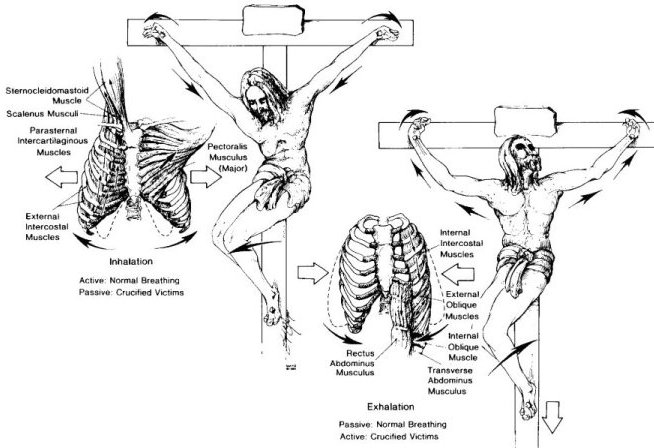
In a normal breathing cycle, inhalation requires active motion by the diaphragm, while exhalation is passive.  When a person is suspended, the dependence of the body moves the chest wall toward a full inspiratory position; exhalation then becomes an active rather than a passive process, requiring lifting the body by pushing with the feet and lifting with the arms, a process made more painful by
the nailing of the feet. 

To prolong the crucifixion for perhaps days until inanition and dehydration develop, support for the lower body needs to be supplied with a crude seat (a sedile or sedulum) affixed to the cross, and/or a small plaform to support the feet (nails through the feet would serve the same function).  This feature is evident in some artistic portrayals of crucifixion, where the knees are shown to be flexed (embed at the right: a crux simplex without crossbar).

If the authorities (or bystanders) wished to offer a modicum of mercy and effect a more rapid death to end the suffering, one means to do so was to deliver a blow that would break the legs below the knees (crurifragium or skelokopia).

There is a lot more to discuss regarding positional asphyxia.  It is relevant to deaths that occur during restraint by law enforcement officers, to deaths in nursing homes when elderly persons become entangled in bedclothes and bedrails, to "Santa Claus" deaths of burglars entrapped in chimneys, and to the deaths of beached whales and thousands of participants at the battle of Agincourt.   Later.
Grand mal seizure in a snake


The snake is a Black Racer, photographed in Naples, Florida by the sister of reader Ron Rizzo, who forwarded it to us to share. During the first half of this brief video the snake exhibits only some purposeless writhing on the side of a road.  Then it launches into full-blown grand mal seizure activity, which according to the photographer was a pre-terminal event.

Any animal with a brain is susceptible to motor seizures, which are a manifestation of uncontrolled electrical activity in the neurons.  If I had to guess at an etiology, the roadside occurrence would suggest to me that the snake had previously incurred head trauma from a passing vehicle, which eventually led to cerebral edema or intracranial bleeding.  Alternatively it may have encountered a poison or a neurotoxic venom.  In any case, it's a interesting activity to observe.

"Desert varnish" explained


Most readers are familiar with the existence of "desert varnish" - a hard encrustation that develops on rocks exposed to the elements in a dry desert.  I had always assumed that the process was a slow oxidation of surface minerals, so a hat tip to reader David Laidlaw for sending me a link that explains that the process is a microbiological one.
Desert varnish is a thin coating (patina) of manganese, iron and clays on the surface of sun-baked boulders. Its origin has intrigued naturalists since the time of Charles Darwin. According to the classic paper by Ronald I. Dorn and Theodore M. Oberlander (Science Volume 213, 1981), desert varnish is formed by colonies of... bacteria living on the rock surface for thousands of years. The bacteria absorb trace amounts of manganese and iron from the atmosphere and precipitate it as a black layer of manganese oxide or reddish iron oxide on the rock surfaces...

Several genera of bacteria are known to produce desert varnish, including [the extremophiles] Metallogenium and Pedomicrobium... the remarkable hardness of desert varnish, which is almost as hard as quartz (nearly 7 on the Mohs scale of mineral hardness)... perhaps 10,000 years are required for a complete varnish coating to form in the deserts of the southwestern United States... For thousands of years Native Americans have used desert varnish for their rock carvings.
Image via Wikipedia.

12 April 2017

Phototropism - updated


This past week I had the distinct pleasure of visiting Pope Farm Conservancy in Middleton, Wisconsin.
Pope Farm Conservancy is 105 acres that sits on top of three recessional moraines in the Town of Middleton, Wisconsin, where three different watersheds come together.

Six different Prairie Restoration projects and seven different crops including a field of sunflowers provide tremendous synergy that attracts wildlife to the conservancy. Forty interpretive signs follow the historical aspects of the land. They start with the Glaciers and land formation, followed by the Native Americans, settlers, the CCC project in the 1930’s, to today’s methods of erosion control.

All of this, combined with eight miles of walking trails and picnic areas provide the visitor with an unforgettable experience.
I chose to visit now because of the spectacular bloom a half a million sunflowers (and I wasn't the only one...).


I'll use this occasion to raise a question about phototropism.   These sunflowers were all facing east when I photographed them in mid-morning.  During the day they will track the sun as it moves across the sky.  But what happens during the night?  Are they programmed to turn back toward the east in anticipation of the next sunrise, or does it require the first beams of morning light to trigger them to swivel back toward the east again?

I could probably look this up, but I need to do something else now, and I suspect some reader with knowledge of plant biology will be able to supply the answer for us.

Addendum:  best answers so far are in the link offered by Kyle Michelli and in the video link provided by Zhoen in the comments.

Addendum #2:  Two tips of the blogging cap to readers Rob from Amersfoort and to Patty, both of whom back in August (I'm a bit behind in my blogging), provided links to the research of Stacy Harmer at UC Davis, who has studied phototropism in sunflowers.

As the plants grew from young seedlings into mature, yellow-headed adults, the researchers found that the sun-tracking movements of the plant became less and less noticeable, until they stopped altogether.

“A really common misconception is that mature sunflowers follow the sun. Actually, they do not,” Harmer said. “Mature sunflowers always face east.”...

Using a time-lapse camera, they were able to see that the east side of the stem grew longer during the day, turning the plant’s head to the west. At night, the reverse was true — the west side elongated, causing the plant to face the east...

The scientists report that even when the plants were grown under constant, fixed overhead lighting, they maintained the same head-turning rhythms they displayed in the field for several days... these results suggest that the sunflowers’ movements are regulated by something other than simple growth toward the sun. Some kind of circadian clock was also controlling the plants’ twists and turns...

The authors found that east-facing sunflowers attract up to five times the number of pollinators compared with those that were rotated in their pots so that they were facing west. Yet another experiment showed that this is almost certainly because east-facing sunflowers are more effectively warmed by the morning sun than sunflowers that are facing west.
More at the Los Angeles Times.  Fascinating research.

Tanks for the gold

As reported by Popular Mechanics:
A tank collector in the United Kingdom was in for a surprise when he and his mechanic opened one of his tank's diesel fuel tanks. Inside were gold bars totaling approximately $2.4 million dollars...

Mead found the tank, an ex-Iraqi Army Type 69, on sale on eBay and traded it for an Abbot self-propelled howitzer and a British Army truck...

The gold is thought to be Kuwaiti in origin—Iraqi forces engaged in widescale looting of the country after the August 1990 invasion of Kuwait.
Just another reminder (if one is needed) of the truth of General Smedley Butler's assertion that "War is a racket."

"The Nazi War on Cancer"


Those who are looking for something "different" to read might want to consider Robert Proctor's The Nazi War on Cancer (Princeton University Press, 1999).

Acknowledging the well-publicized atrocities of Nazi medicine, the author focuses instead on the party's systematic efforts to decrease the prevalence of cancer, especially through a campaign to ban smoking ("masturbation of the lungs").  Hitler was a nonsmoker, as were Mussolini and Franco (cf. Roosevelt, Stalin, and Churchill as enthusiastic public smokers).  Nazi researchers were among the first to recognize the link between smoking and lung cancer.  Smoking was known to cause cancer, but the link had been established only for mouth, lip, and nasopharyngeal cancers (related to smoking pipe tobacco).  It was not until the introduction of cigarettes allowed smoke to be inhaled deeply that the causation of lung cancer became detectable).

The cover (embedded above) includes a Nazi-era poster depicting a leather boot stomping on a cigarette, a cigar, and a pipe.  There were many such posters in a broad-ranging public campaign against smoking (embed at right - "You don't smoke it.  It smokes you.")  
Throughout this period, magazines like Genussgifte (Poisons of taste or habit), Auf der Wacht (On guard), and Reine Luft (Pure air) published a regular drumbeat against this "insidious poison," along with articles charting the unhealthful effects of alcohol, teenage dancing, cocaine, and other vices. Dozens of books and pamphlets denounced the "smoking slavery" or "cultural degeneration" feared from the growth of tobacco use. Tobacco was branded "the enemy of world peace," and there was even talk of "tobacco terror" and "tobacco capitalism." Karl Astel of Jena labeled tobacco "an enemy of the people" (Volksfeind), and at least one medical thesis--on tobacco addiction--characterized cigarettes as "coffin nails."  Hitler himself in 1941 denounced tobacco as "one of man's most dangerous poisons."

In the late 1930s and early 1940s, antitobacco activists called for increased tobacco taxes, for advertising bans, and for bans on unsupervised vending machines and on tobacco sales to youth and to women in their childbearing years. Activists called for a ban on smoking while driving and for an end to smoking in the workplace. The Hitler Youth and the League of German Girls both published antismoking propaganda, and the Association for the Struggle Against the Tobacco Danger organized counseling centers where the "tobacco ill" (Tabakkranke) could seek help. 
If you are interested in learning more, but can't find the book in your local library, Robert Proctor incorporated much of the information in an article in the Bulletin of the History of Medicine.  There is also a relevant page in Wikipedia.

(I'm not a newbie blogger.  I don't want to spend dozens of hours curating comments about Nazis, so I'm going to close comments for this post).

10 April 2017

"Am I in the Twilight Zone?"


In Louisville, a defendant was brought before the court not wearing any pants, and not having received any feminine hygiene products during her three-day incarceration.  This Reddit comment is appropriate:
That judge was amazing.

A good judge would have done what she did in terms of sentencing her to time served and releasing her.

This judge apologized on behalf of the correction system, and reprimanded the superiors of the people responsible, in front of the defendant.

When I think of what a judge should be, this woman is exactly that. An autonomous, unbiased, upholder of justice. Someone who after seeing thousands and thousands of real criminals, can still be outraged by injustice coming from the other side.

Look for this in your attic

Or in your grandmother's attic.
Tamerlane and Other Poems is the first published work by American writer Edgar Allan Poe. The short collection of poems was first published in 1827... The 40-page collection was called Tamerlane and Other Poems and did not include Poe's name...

It is believed only a dozen copies of the original printing of Tamerlane and Other Poems remain, making it one of the rarest of first editions in American literature. Ironically, the value of one copy today is more money than Poe ever made in his lifetime. Its rarity was recognized in 1925, when the Saturday Evening Post ran an article titled "Have You A Tamerlane in Your Attic"? After the article ran, a woman in Worcester, Massachusetts named Ada S. Dodd searched and found a copy, prompting others to search as well. Today, most of the surviving copies are owned by libraries and museums. Two copies, for example, were purchased by The Huntington Library in New York in 1915. One copy is on display as part of the collection at the Edgar Allan Poe Museum in Richmond, Virginia. Though copies do not circulate often, they command high prices when they do. One sold at auction for $125,000 and, later, another sold for $198,000. In December 2009, a copy from the William E. Self collection sold at Christie's, New York for $662,500, a record price paid for a work of American literature.

"Super-silk" produced by graphene-fed caterpillars

From Scientific American:
To make carbon-reinforced silk, Yingying Zhang and her colleagues at Tsinghua University fed the worms mulberry leaves sprayed with aqueous solutions containing 0.2% by weight of either carbon nanotubes or graphene and then collected the silk after the worms spun their cocoons, as is done in standard silk production. Treating already spun silk would require dissolving the nanomaterials in toxic chemical solvents and applying those to the silk, so the feeding method is simpler and more environmentally friendly.

In contrast to regular silk, the carbon-enhanced silks are twice as tough and can withstand at least 50% higher stress before breaking. The team heated the silk fibers at 1,050 °C to carbonize the silk protein and then studied their conductivity and structure. The modified silks conduct electricity, unlike regular silk. Raman spectroscopy and electron microscopy imaging showed that the carbon-enhanced silk fibers had a more ordered crystal structure due to the incorporated nanomaterials.
Related Posts Plugin for WordPress, Blogger...