
Via the CrappyDesign subreddit (where some argue that it's a brilliant design).

Democracy is other people, and the ignorance of the many has long galled the few, especially the few who consider themselves intellectuals. Plato, one of the earliest to see democracy as a problem, saw its typical citizen as shiftless and flighty... It would be much safer, Plato thought, to entrust power to carefully educated guardians...More at the link. The book is not in our local library. Perhaps some reader here can browse it and report back to the class.
In the United States, élites who feared the ignorance of poor immigrants tried to restrict ballots. In 1855, Connecticut introduced the first literacy test for American voters. Although a New York Democrat protested, in 1868, that “if a man is ignorant, he needs the ballot for his protection all the more,” in the next half century the tests spread to almost all parts of the country... Voter literacy tests weren’t permanently outlawed by Congress until 1975, years after the civil-rights movement had discredited them.
Still, democracy is far from perfect—“the worst form of government except all those other forms that have been tried from time to time,” as Churchill famously said. So, if we value its power to make good decisions, why not try a system that’s a little less fair but makes good decisions even more often? Jamming the stub of the Greek word for “knowledge” into the Greek word for “rule,” Estlund coined the word “epistocracy,” meaning “government by the knowledgeable.”...
In a new book, “Against Democracy” (Princeton), Jason Brennan, a political philosopher at Georgetown, has turned Estlund’s hedging inside out to create an uninhibited argument for epistocracy.

Here is the relevant infrastructure:Bullet Bra is a full-support bra with cups in the shape of a paraboloid with its axis perpendicular to the breast. The bullet bra usually features concentric circles or spirals of decorative stitching centred on the nipples.
Invented in the late-1940s, they became popular in the 1950s, and worn by the Sweater Girl, a busty and wholesome "girl next door" whose tight-fitting outergarments accentuated her artificially enhanced curves.


"When you see the new picture, the new image, it's a picture of diverse people. Black, white, Hispanic, Native American -- a little bit of everything -- Asian, and that's more of a representation of this country," said Shannon Lanier, the sixth great-grandson of President Thomas Jefferson.More information at CBS News, which featured this story in more detail on tonight's national broadcast.
Andrea Livingston is half Filipino. She recently learned she's the eighth great granddaughter of Philip Livingston.

Perhaps no aspect of the American founding is as politicized today as the role of religion. Be they atheists or deeply devout, liberals tend to see religious pluralism and equality as definitive American values, while the right-wing (Vice President Pence and Attorney General Jeff Sessions, for example) insists that the United States was founded as a Christian nation and that fostering the country’s Christian, or Judeo-Christian, identity is essential. Those with “a secular mind-set,” Sessions argued in opposing Sonia Sotomayor’s nomination to the Supreme Court, do not understand “who we are” and advance a worldview “directly contrary to the founding of our republic.”Continued at the link. Lots to think about...
It’s an old debate, as old as the United States itself. Yet, contrary to Pence, Sessions and other Christian nationalists, the range of views on what the role of religion in American life should be has actually grown narrower, and shallower, since the Revolutionary generation debated the matter. There are many reasons not to want to return to the politics of the 18th century, but they did hold a richer discussion about religion and society...
For Thomas Jefferson and James Madison, however, religion lay as the root cause of bloodshed and tyranny. They stood, in profound ways, closer to Martin Luther, and Galileo, than we do to them. Jefferson described his and Madison’s attempts in the 1780s to establish religious freedom in Virginia as “the severest contests in which I have ever been engaged.” Neither the Declaration of Independence nor the U.S. Constitution, the country’s charter documents, are partial to Christianity. The Declaration acknowledges the authority of “the Laws of Nature” and the deists’ beloved “Nature’s God.” Of the 27 grievances against the British Crown that the Declaration puts forward, not one concerns religion. Likewise, the Constitution merely recognizes “freedom of religion”; it doesn’t endorse Christianity — it doesn’t even mention it. These omissions present today’s Christian nationalists with a real awkwardness. It has forced advocates of the “Christian nation” or “Judeo-Christian nation” into strained textual exegeses attributing immense significance to the use of the Christian calendar for example, or elaborate justifications as to why a generation of men and women who said everything somehow left this important thing unsaid.
There was even prevalent, open hostility to Christianity, in the form of anti-Catholicism, in Revolutionary-era America. The American Colonies were deeply, profoundly anti-Catholic. Anti-Catholicism was one of the few things the diverse Colonies shared. Colonists were horrified when Britain, with the 1774 Quebec Act, recognized Quebec’s Catholics as deserving equal protection of the law. The Continental Congress protested, claiming that Catholicism as a religion that had “deluged” Britain in blood and “dispersed impiety, bigotry, persecution, murder and rebellion through every part of the world.”
Then, as now, most Christians in the world were Catholics. Claiming that people moved by deep prejudice against most of world’s Christians wanted to form a “Christian nation” makes no sense. The problem cannot be solved by simply devolving to “Protestant nation.” Britain was known as the sword and shield of Protestantism, set against a hostile Catholic Continent. In what form of Protestantism, exactly, did the United States rise up in rebellion against the 18th-century world’s standard-bearer of Protestantism?


"Instead of placing rocks into the soil berms (mounds of soil) from the side like stepping stones up the side of a hill, [the Czechs] use flat stones (such as pieces of flagstone or slate) that are pushed down into the soil vertically from the top. These vertical pieces are closely spaced leaving deep, narrow channels of soil...Additional information at High Country Gardens. I took the photo last week at the University of Wisconsin's Allen Centennial Gardens, a free public garden designed to demonstrate examples of gardening and landscape techniques.
Crevice gardens are especially good for growing cold hardy cacti, South African succulents and other xeric plants whose roots are sensitive to wet soil conditions. This is also a great way to grow larger growing xeric (low water plants) like Hummingbird Mint (Agastache), Lavender (Lavandula), Sundance Daisy (Hymenoxys), Beardtongue (Penstemon) and native Sage (Salvia) in moister climates. Just make a berm using a well drained soil mix. Bury some big flat rocks close together to create a vertical pocket crevice and plant."

"Fabio Silva defended his parking skills and branded other motorists “idiots” after pictures of his white car straddling four spaces circulated on social media.Found in The Telegraph.
He said his car was his "pride and joy" and didn't want other motorists to damage it, citing that as the reason he parked in the middle of those spaces...
Mr Silva wrote: "Nothing quite like parking and taking up four spaces. Start spending hundreds of pounds on your car and then you’ll understand where I’m coming from. Sorry for not wanting idiots ruining my pride and joy.”"

A straight corridor has 7 doors along one side. Behind one of the doors sits a cat. Your mission is to find the cat by opening the correct door. Each day you can open only one door. If the cat is there, you win. You are officially smarter than a cat. If the cat is not there, the door closes, and you must wait until the next day before you can open a door again.Clarifications at the link. The answer will be posted at The Guardian later today. Some reader here may be able to solve this.
If the cat was always to sit behind the same door, you would be able to find it in at most seven days, by opening each door in turn. But this mischievous moggy is restless. Every night it moves one door either to the left or to the right.
How many days do you now need to make sure you can catch the cat?

It is ... his own painfull study ... that manures and improves his ministeriall gifts. [Milton, 1641]
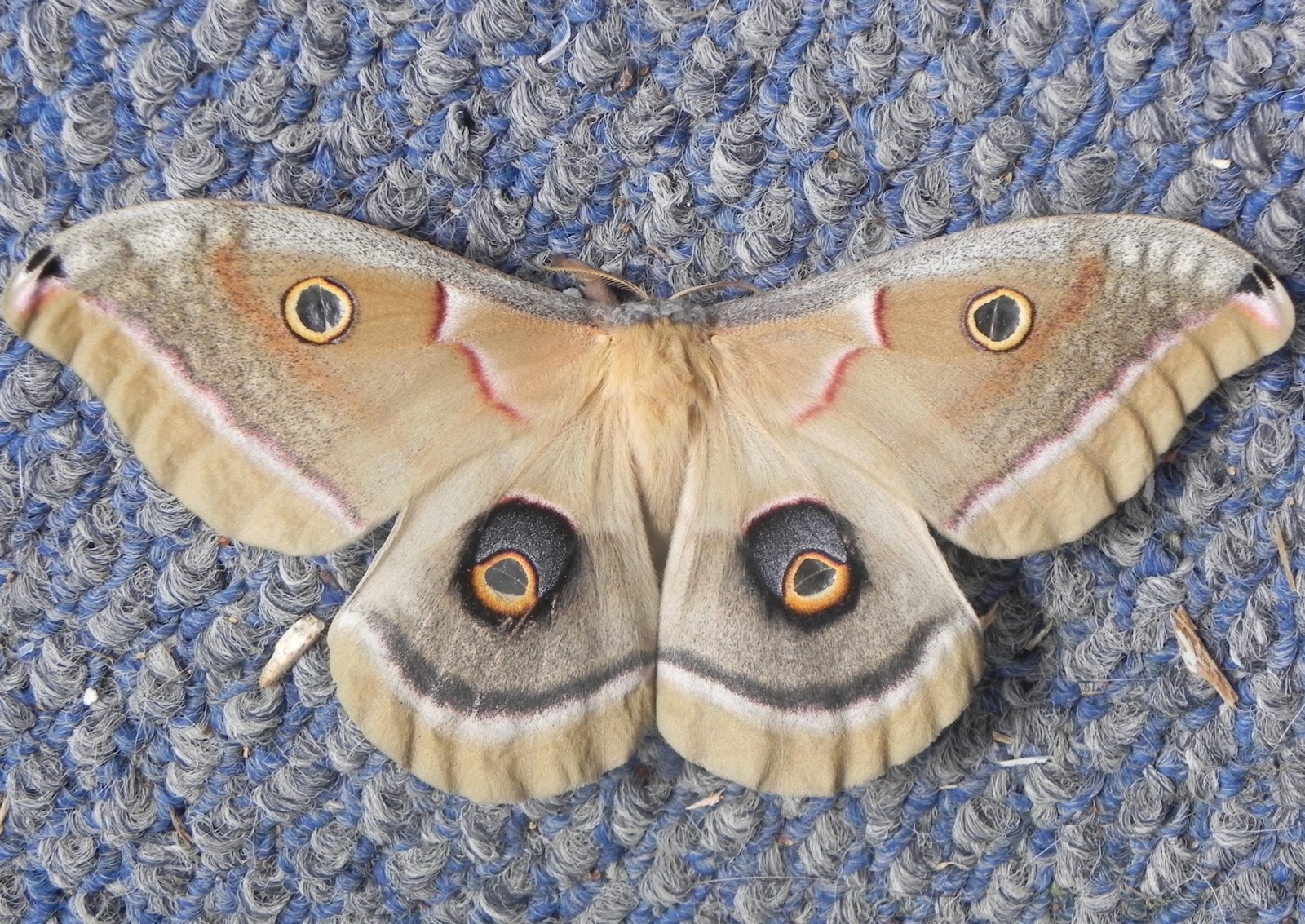
"There is a species of butterfly on the hind wing of which a large eyespot imitates a drop of liquid with such uncanny perfection that a line which crosses the wing is slightly displaced at the exact stretch were it passes through - or better say under - the spot: this part of the line seems shifted by refraction, as it would if a real globular drop had been there and we were looking through it at the pattern of the wing."----Vladimir Nabokov, from a lecture/essay published in Bulletin of the New England Modern Languages Association, January 1941


