Photo emailed to me today by an old high-school classmate. The hotel is the Explora Lodge in Patagonia National Park. The view is from the window in their room. Click image twice to embiggify.


"Vastly bigger than any river in Europe or Asia, the Amazon contains a fifth of the earth's above-ground fresh water. It has islands the size of countries and masses of floating vegetation the size of islands. Half a dozen of its tributaries would be world-famous rivers anywhere else. A thousand miles up from the Atlantic, the river is still so broad that at high water the other side is only a faint dark line on the horizon. Ferries take half an hour to make the crossing. Seagoing vessels travel all the way up to Iquitos, Peru, 2,300 miles from the river's mouth, the furthest inland deep-ocean port in the world...Like today's ecotourism brochures, the accounts of the great river basin in da Cunha's time celebrated its immensity but rarely dwelled on its extreme flatness - in the Amazon's first [last?] 2,900 miles the vertical drop is only 500 feet."


“Basically, it’s suds,” said Alison Pearce, deputy director for programs at Nature Forward, formerly the Audubon Naturalist Society in Chevy Chase, Md.She explained that dust, pollutants and other particulates floating around in the air settle on a tree. The tree also exudes its own chemicals. When it rains, all that material is mixed together and flows down the tree, from the leaves, along the branches and down the trunk.“It happens more often with trees that have deep channels in the bark,” Pearce said. These include oak, tulip poplar and hickory...It’s the result of what naturalists call stemflow mixing: the aerating rush of water down the tree.

In nature, Rhodotus palmatus is sometimes seen "bleeding" a red- or orange-colored liquid. A similar phenomenon has also been observed when it is grown in laboratory culture on a petri dish: the orange-colored drops that appear on the mat formed by fungal mycelia precede the initial appearance of fruit bodies.
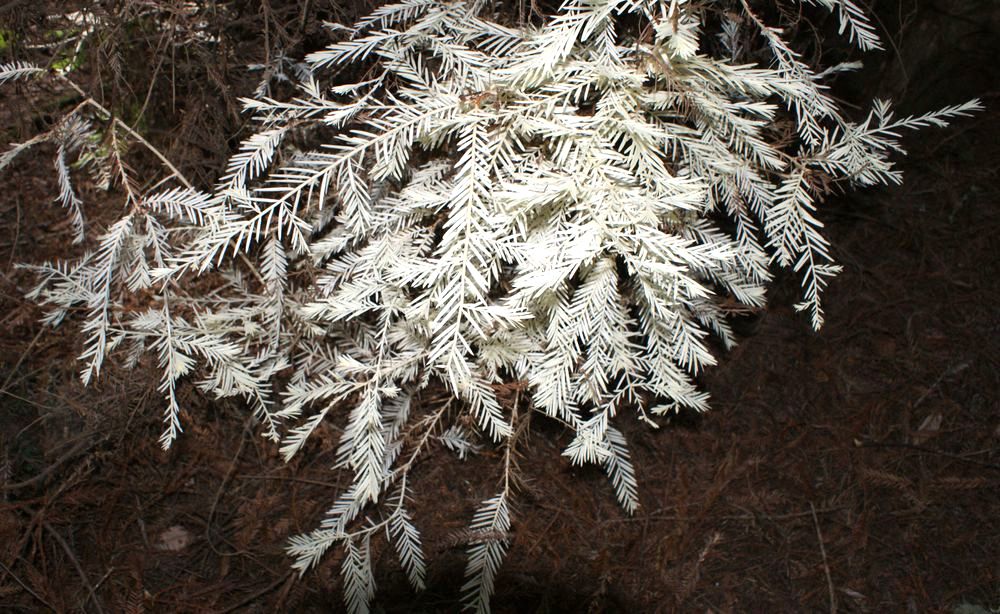
Albinism is rare in humans and animals, and it is rarer still in plants, where it manifests as the complete lack of chlorophyll. Because this green pigment is vital to the manufacture of food and thus the survival of plants, an albino plant typically die as seedlings.There is an exception, however... several albino redwoods in California that have managed to survive till adulthood by latching on to the parent redwood and leaching off nutrients from the host tree...New research have suggested that the albino redwood also helps the healthy redwood trees to survive by filtering out toxins from the soil. Albinos have defective stomata that causes them to lose more water through transpiration, forcing them to compensate by taking up more water through their roots. As a result they accumulate more metals in their bodies than normal trees do... The research led by Zane Moore, a doctoral student at the University of California Davis, found high levels of toxic heavy metals, including nickel, copper and cadmium. These heavy metals were at least twice as high in the albino redwoods compared to healthy redwood trees...It is believed that there are about 400 albino redwoods across California’s wilderness. Their locations are not advertised in order to prevent people from seeking them out and collecting souvenirs that would be harmful for the plant.


Anthidium manicatum, commonly called the European wool carder bee, is a species of bee in the family Megachilidae, the leaf-cutter bees or mason bees.I don't know whether the larvae in the photo are bee-related or parasites.
They get the name 'carder' from their behaviour of scraping hair from leaves such as lamb's ears (Stachys byzantina)... They scrape the hairs from the leaves and carry them back to their nests bundled beneath their bodies. There it is used as a lining for their nest cavities. Females tend to build their nests at high locations.


The most prevalent problem with bee houses is that when they’re not cared for properly, they can become breeding grounds for pests, mold, fungus, and disease...You learn something every day.
Pollen mites are one of the biggest threats to the habitability of bee houses located in humid environments or built of materials like bamboo that don’t dry easily. “If there’s no way for moisture to dissipate from the nest then the mites take over,” Purrington said...
Packing a bunch of [normally solitary] species together into one box is not only ecologically weird, it can make them targets, Mader said. “The cheek-to-cheek occupancy of bee houses helps predators (woodpeckers for example), parasites (including wasps, mites, and others), and diseases find a dense host-bee population to exploit.”..
... it’s bad for bees when a house is tied loosely to a tree or a post with a string rather than tightly secured in place... “The bees can’t land if it’s flapping around in the wind,” he said of mason bees. “They’re terrible at landing.”
...it’s a good idea to cover the houses with metal netting to keep the birds out, as woodpeckers and bluejays find bee houses to be great restaurants.

On Tuesday, Seattle became the first US city to ban caste-based discrimination after a vote by the local council. Ahead of the vote, several South Asians stood in line for hours to share their stories with council members...Academic Prem Pariyar was one of them. He says he fled to the US from Nepal in 2015 after his family was brutally attacked by a group of upper caste people for speaking up against atrocities.But that didn't stop the discrimination he faced because of his caste. Once, he says, he was invited to lunch at a friend's house in the San Francisco Bay Area in California."I was hesitant [to go] as caste dictates where you sit and eat, but I thought it will be different here as people are educated, in a country where human rights are valued," Mr Pariyar says.But just as he was about to serve food for himself, he was asked not to touch anything. Instead, someone else handed him a plate of food.The caste system is one of the oldest forms of surviving social discrimination in South Asian countries, including India and Nepal. In India, Dalits (formerly untouchables) and other lower castes are seen as historically disadvantaged groups and offered constitutional protections in the form of quotas and anti-discriminatory laws...Mr Pariyar says the incident at his friend's house reminded him of something from his childhood in Nepal: his teacher spat out the water he gave her after finding out he belonged to a lower caste...San Francisco Bay Area resident Bhim Narayan Bishwakarma says his attempt to rent a room fell through after the South Asian owner heard his full name - surnames are often indicators of caste. "I could see in his eyes that he really felt uncomfortable," Mr Bishwakarma says.After coming up with excuses to opt out of the deal, the landlord finally admitted that his other tenants had threatened to move out if a Dalit person was allowed to stay...But not everyone supports the legislation. Several Indian-American groups had strongly opposed the ordinance before it became a law, arguing that it singled out Indian and South Asian communities for unique legal scrutiny... But she adds that the new law sent a message "that our community, which makes up less than 2% of the population, is so uniquely bigoted that we need a special category under the law to police us, reinforcing xenophobic stereotypes we had hoped the US had moved beyond".

On Nantucket, 80-year-old Connie Congdon and I sat in her dim living room looking at the 120-year-old plaster dildo that a mason had found in her chimney...Much more at Literary Hub. Well worth the read for those interested in the subject matter.
In the box were the other antiques the mason had found with the dildo: six charred envelopes from the 1890s addressed to Captain James B. Coffin; letters from the same James B. Coffin to Grover Cleveland and Assistant Secretary of State Edwin Dehl; a dirty and frayed shirt collar; a pipe that still smelled of tobacco when I fit my nose in the bowl; and a green glass laudanum bottle. These items must have been hidden in the chimney by James’s wife, Martha “Mattie” Coffin, sometime between when the letters were dated and when she died in 1928. The fireplace was later sealed up, and a closet was built in front of it...
She unwrapped the stony phallus from its pink tissue paper and handed it to me. It was heavier than it looked. The head had been painted wild-berry red. The shaft was off-white and touched with light brown stains. Through the center was a hole no thicker than a straw, as if it had been skewered for drying. Saw marks streaked the cross section of the flat base, and it had been circumcised with whittling scrapes. “No mistaking what it is,” Connie said, as I turned it in my hand...
She bent at the waist, snapped on the flashlight, and peered up the chimney. “Up there,” she said, motioning me to kneel down beside her. “It was on the flue shelf.” I craned my neck. Her light swept over the chimney’s charred innards. The damper ledge where the dildo had been hidden was an arm’s length away...
Nantucket wives were dubbed “Cape Horn widows,” because their husbands might be gone for eight years. In Moby-Dick, Captain Ahab tells his first mate, Starbuck, that of the past forty years of “making war on the horrors of the deep” he’d only been ashore three, leaving only “one dent in [his] marriage pillow.” “[W]ife?” Ahab rages, “wife?—rather a widow with her husband alive!” The dildos, called “he’s-at-homes” in some books on the history of the Yankee whale fishery, were meant to be some insurance of fidelity for a husband who was rarely present.

Lot 475 is a Victorian-era sex toy – an uncannily lifelike-looking phallus, intricately carved from ivory. Sandwiched in the brochure between a pair of antique miniature portraits and a set of decanter labels, the item is described in the brochure as an “antique carved ivory ladies companion in scarlet lined leather upholstered carry box with inset bevelled glass panel”.Further details at Irish Times, via The Guardian.
“It is a beautiful piece, which comes from one of the well-known Anglo-Irish families,” says auctioneer Damien Matthews...“This was a very enlightened family, and this would have been a very loving gift from a husband to wife. You can see that because the level of detail is incredible, down to the folds of the skin. There’s a heart carved at the base of it, where her finger would have been, and a receptacle in which she could keep a lock of his hair.”...The man did return, and the box was subsequently custom-made in Ireland. “The leather box is Irish. She would have got the box carved for it – there’s a stamp on the lock with the name of an Irish locksmith,” Matthews says...Matthews says there has been considerable interest in the piece, and that it could go to a museum of erotica, to a collector of antique ivory or Victorian art. The guide price is set at €500-€800.
 Addendum: Found this report from 2005 in the BBC of an ancient phallic object that may have served as a sex toy:
A sculpted and polished phallus found in a German cave is among the earliest representations of male sexuality ever uncovered, researchers say.Reposted from 2017 to add this discovery at Vindolanda:
The 20cm-long, 3cm-wide stone object, which is dated to be about 28,000 years old, was buried in the famous Hohle Fels Cave near Ulm in the Swabian Jura. The prehistoric "tool" was reassembled from 14 fragments of siltstone.
Its life size suggests it may well have been used as a sex aid by its Ice Age makers, scientists report.
"In addition to being a symbolic representation of male genitalia, it was also at times used for knapping flints.

Archaeologists believe they may have found the only known lifesize Roman dildo, discovered in a ditch in what were the farthest northern fringes of the empire.If it was not used as a sexual implement then the 2,000-year-old object may have been an erect penis-shaped pestle, or it could have been a feature from a statue that people touched for good luck.What it definitely is not is what it was catalogued as after its discovery at the Roman fort of Vindolanda in Northumberland in 1992: a darning tool...The Vindolanda phallus is 16cm long but, researchers say, was probably larger because archaeological wood is prone to shrinkage and warping.

"The woods abound with acorns for feeding hogs and with venison. There is considerable fish in the rivers, good tillage land; here is, especially, free coming and going, without fear of the naked natives of the country..." Magnificent chestnut oaks, which these turkeys had wisely chosen as a roost, often rose sixty feet before there were any branches. So, while it’s easy to be impressed by the great tracts of forest carpeting the ridges and valleys of the Appalachians today, we should remember that these forests are nothing like the precolonial forests. Those first explorers found themselves walking through a natural cathedral whose green roof arched fifty or more feet above their heads…”Mann's point in 1491 is that this was not even remotely a "pristine" environment unmodified by humans. Instead, what the awe-struck Europeans found was a world that had been managed for millennia by Native Americas:
A principal tool was fire, used to keep down underbrush and create the open, grassy conditions favorable for game. Rather than domesticating animals for meat, Indians retooled whole ecosystems to grow bumper crops of elk, deer, and bison. The first white settlers in Ohio found forests as open as English parks—they could drive carriages through the woods. Along the Hudson River the annual fall burning lit up the banks for miles on end; so flashy was the show that the Dutch in New Amsterdam boated upriver to goggle at the blaze like children at fireworks. In North America, Indian torches had their biggest impact on the Midwestern prairie, much or most of which was created and maintained by fire. Millennia of exuberant burning shaped the plains into vast buffalo farms...The role of Native Americans was unappreciated because their numbers had been decimated (literally) by epidemic diseases such as smallpox and typhus.
"... fish fertilizer may not have been an age-old Indian custom, but a recent invention - if it was an Indian practice at all. So little evidence has emerged of Indians fertilizing with fish that some archaeologists believe that Tisquantum actually picked up the idea from European farmers... In his travels, Tisquantum stayed in places where Europeans used fish as fertilizer, a practice on the Continent since medieval times."British fishing vessels may have reached Newfoundland as early as the 1480s and areas to the south soon after. In 1501, just nine years after Columbus's first voyage, the Portuguese adventurer Gaspar Corte-Real abducted fifty-odd Indians from Maine. Examining the captives, Corte-Real found to his astonishment that two were wearing items from Venice: a broken sword and two silver rings... [he] probably was able to kidnap such a large number of people only because the Indians were already so comfortable dealing with Europeans that big groups willingly came aboard his ship."“In 1491 the Inka ruled the greatest empire on earth. Bigger than Ming Dynasty China, bigger than Ivan the Great’s expanding Russia, bigger than Songhay in the Sahel or powerful Great Zimbabwe in the West Africa tablelands, bigger than the cresting Ottoman Empire, bigger than the Triple Alliance (as the Aztec empire is more precisely known), bigger by far than any European state, the Inka dominion extended over a staggering thirty-two degrees of latitude—as if a single power held sway from St. Petersburg to Cairo. The empire encompassed every imaginable type of terrain, from the rainforest of upper Amazonia to the deserts of the Peruvian coast and the twenty thousand foot peaks of the Andes between. ‘If imperial potential is judged in terms of environmental adaptability,’ wrote the Oxford historian Felipe Fernández-Armesto, ‘the Inca were the most impressive empire builders of their day.’”"Ecologists postulate that the first large-scale human societies tended to arise where, as Jared Diamond of the University of California at Los Angeles put it, geography provided “a wide range of altitudes and topographies within a short distance.” One such place is the Fertile Crescent, where the mountains of western Iran and the Dead Sea, the lowest place on earth, bracket the Tigris and Euphrates river systems. Another is Peru. In the short traverse from mountain to ocean, travelers pass through twenty of the world’s thirty-four principal types of environment... Combining the fruits of many ecosystems, Andean cultures both enjoyed a better life than they could have wrested from any single place and spread out the risk from the area’s frequent natural catastrophes. Murra invented a name for this mode of existence: “vertical archipelagoes.”"The ground was too dirty to receive the Inka’s [ruler's] saliva so he always spat into the hand of a courtier. The courtier wiped the spittle with a special cloth and stored it for safekeeping. Once a year everything touched by the Inka—clothing, garbage, bedding, saliva—was ceremonially burned.... Wearing soft, loose clothing of vampire-bat wool, he swanned around his palaces with a bowl of palm wine..." [I read elsewhere that "hummingbird down" was also used for fine clothing]
"Europeans first encountered Tawantinsuyu in the form of an Inka ship sailing near the equator, three hundred miles from its home port, under a load of fine cotton sails. It had a crew of twenty and was easily the size of a Spanish caravelle."
"Their gene pool was correspondingly restricted, which meant that Indian biochemistry was an is unusually homogeneous. More than nine out of ten Native Americans - and almost all South American Indians - have type O blood, for example, whereas Europeans are more evenly split between types O and A... About one third of South American Indians... have identical or near-identical HLA profiles; for Africans the figure is one in two hundred."
"The second myth is that in its penchant for public slaughter the Triple Alliance was fundamentally different from Europe. Criminals beheaded in Palermo, heretics burned alive in Toledo, assassins drawn and quartered in Paris—Europeans flocked to every form of painful death imaginable, free entertainment that drew huge crowds. London, the historian Fernand Braudel tells us, held public executions eight times a year at Tyburn, just north of Hyde Park. (The diplomat Samuel Pepys paid a shilling for a good view of a Tyburn hanging in 1664; watching the victim beg for mercy, he wrote, was a crowd of “at least 12 or 14,000 people.”) In most if not all European nations, the bodies were impaled on city walls and strung along highways as warnings. “The corpses dangling from trees whose distant silhouettes stand out against the sky, in so many old paintings, are merely a realistic detail,” Braudel observed. “They were part of the landscape.” Between 1530 and 1630, according to Cambridge historian V. A. C. Gatrell, England executed seventy-five thousand people. At the time, its population was about three million, perhaps a tenth that of the Mexica empire. Arithmetic suggests that if England had been the size of the Triple Alliance, it would have executed, on average, about 7,500 people per year, roughly twice the number Cortés estimated for the empire. France and Spain were still more bloodthirsty than England, according to Braudel... In their penchant for ceremonial public slaughter, the Alliance and Europe were more alike than either side grasped."
“In what may have been the first large-scale compulsory education program in history, every male citizen of the Triple Alliance, no matter what his social class, had to attend one sort of school or another until the age of sixteen.”"Tenochtitlan dazzled its invaders—it was bigger than Paris, Europe’s greatest metropolis. The Spaniards gawped like yokels at the wide streets, ornately carved buildings, and markets bright with goods from hundreds of miles away. Boats flitted like butterflies around the three grand causeways that linked Tenochtitlan to the mainland. Long aqueducts conveyed water from the distant mountains across the lake and into the city. Even more astounding than the great temples and immense banners and colorful promenades were the botanical gardens—none existed in Europe."The poet-physician Oliver Wendell Holmes Sr. regarded the Indian as but “a sketch in red crayon of a rudimental manhood.” To the “problem of his relation to the white race,” Holmes said, there was one solution: “extermination.”"If time travelers from today were to visit North America in the late Pleistocene, they would see in the forests and plains an impossible bestiary of lumbering mastodon, armored rhinos, great dire wolves, sabertooth cats, and ten-foot-long glyptodonts like enormous armadillos. Beavers the size of armchairs; turtles that weighed almost as much as cars; sloths able to reach tree branches twenty feet high; huge, flightless, predatory birds like rapacious ostriches—the tally of Pleistocene monsters is long and alluring.At about the time of Clovis almost every one of these species vanished. So complete was the disaster that most of today’s big American mammals, such as caribou, moose, and brown bear, are immigrants from Asia. The die-off happened amazingly fast, much of it in the few centuries between 11,500 and 10,900 B.C. And when it was complete, naturalist Alfred Russell Wallace wrote, the Americas had become “a zoologically impoverished world, from which all of the hugest, and fiercest, and strangest forms [had] recently disappeared.”The extinctions permanently changed American landscapes and American history. Before the Pleistocene, the Americas had three species of horse and at least two camels that might have been ridden; other mammals could have been domesticated for meat and milk. Had they survived, the consequences would have been huge. Not only would domesticated animals have changed Indian societies, they might have created new zoonotic diseases. Absent the extinctions, the encounter between Europe and the Americas might have been equally deadly for both sides—a world in which both hemispheres experienced catastrophic depopulation."“Mesoamerica would deserve its place in the human pantheon if its inhabitants had only created maize, in terms of harvest weight the world’s most important crop. But the inhabitants of Mexico and northern Central America also developed tomatoes, now basic to Italian cuisine; peppers, essential to Thai and Indian food; all the world’s squashes (except for a few domesticated in the United States); and many of the beans on dinner plates around the world. One writer has estimated that Indians developed 3/5 of the crops now in cultivation, most of them in Mesoamerica."
Learning from local people that Tres Zapotes was only one of many mound sites in Veracruz, Stirling decided to return in 1940 to survey them all. The task was daunting even for a cigar-chomping, whisky-drinking, adventure addict like Stirling. Most of the mound centers were in the middle of trackless mangrove swamps or up narrow, unmapped rivers choked with water hyacinth. Ticks and mosquitoes were indefatigable and present in huge numbers; the ticks were worse than the mosquitoes, Stirling remarked, because they had to be dug out of the flesh with a knife. At one point Stirling and a colleague hitched a ride in a pepper truck to one of the smaller sites. After jolting down a road with deep ruts "designed to test the very souls of motorcars," the two men were let off in a nondescript meadow. Stirling went to talk with the driver."The ticks are not bad, are they?" I asked him hopefully, viewing the tall grass and underbrush between the road and the mounds. "No," said the driver, beaming. "When full, like grapes they fall off and no harm is done. There are millions of them here, however."
Every fall, he remembered, the Haudenosaunee set fire to “the woods, plains, and meadows,” to “thin out and clear the woods of all dead substances and grass, which grow better the ensuing spring.” At first the wildfire had scared him, but over time van der Donck had come to relish the spectacle of the yearly burning. “Such a fire is a splendid sight when one sails on the [Hudson and Mohawk] rivers at night while the forest is ablaze on both banks,” he recalled. With the forest burning to the right and the left, the colonists’ boats passed through a channel of fire, their passengers as goggle-eyed at the blaze as children at a video arcade. “Fire and flames are seen everywhere and on all sides…a delightful scene to look on from afar.”Fire is a dominating factor in many if not most terrestrial landscapes. It has two main sources: lightning and Homo sapiens. In North America, lightning fire is most common in the western mountains. Elsewhere, though, Indians controlled it—at least until contact, and in many places long after. In the Northeast, Indians always carried a deerskin pouch full of flints, Thomas Morton reported in 1637, which they used “to set fire of the country in all places where they come.” The flints ignited torches, which were as important to the hunt as bows and arrows. Deer in the Northeast; alligators in the Everglades; buffalo in the prairies; grasshoppers in the Great Basin; rabbits in California; moose in Alaska: all were pursued by fire. Native Americans made big rings of flame, Thomas Jefferson wrote, “by firing the leaves fallen on the ground, which, gradually forcing animals to the center, they there slaughter them with arrows, darts, and other missiles.” Not that Indians always used fire for strictly utilitarian purposes. At nightfall tribes in the Rocky Mountains entertained the explorers Meriwether Lewis and William Clark by applying torches to sap-dripping fir trees, which then exploded like Roman candles.Rather than domesticate animals for meat, Indians retooled ecosystems to encourage elk, deer, and bear. Constant burning of undergrowth increased the numbers of herbivores, the predators that fed on them, and the people who ate them both. Rather than the thick, unbroken, monumental snarl of trees imagined by Thoreau, the great eastern forest was an ecological kaleidoscope of garden plots, blackberry rambles, pine barrens, and spacious groves of chestnut, hickory, and oak. The first white settlers in Ohio found woodlands that resembled English parks—they could drive carriages through the trees. Fifteen miles from shore in Rhode Island, Giovanni da Verrazzano found trees so widely spaced that the forest “could be penetrated even by a large army.” John Smith claimed to have ridden through the Virginia forest at a gallop.