04 February 2020
Cap machine gun (1959)
Found on the inside back cover of a 1959 Walt Disney comic book. I have fond memories, not of the cap guns per se, but of the roll of caps. We used to get a strip of caps from the dime store, tear them into individual segments, pile them up probably 6-8 deep on the sidewalk, and them smash them with a hammer. It resulted in a much more satisfactory explosion than the little bang of a cap gun (and left a black star on the cement). And that wonderful smell...
Addendum: Found this photo today on the Pics subreddit:
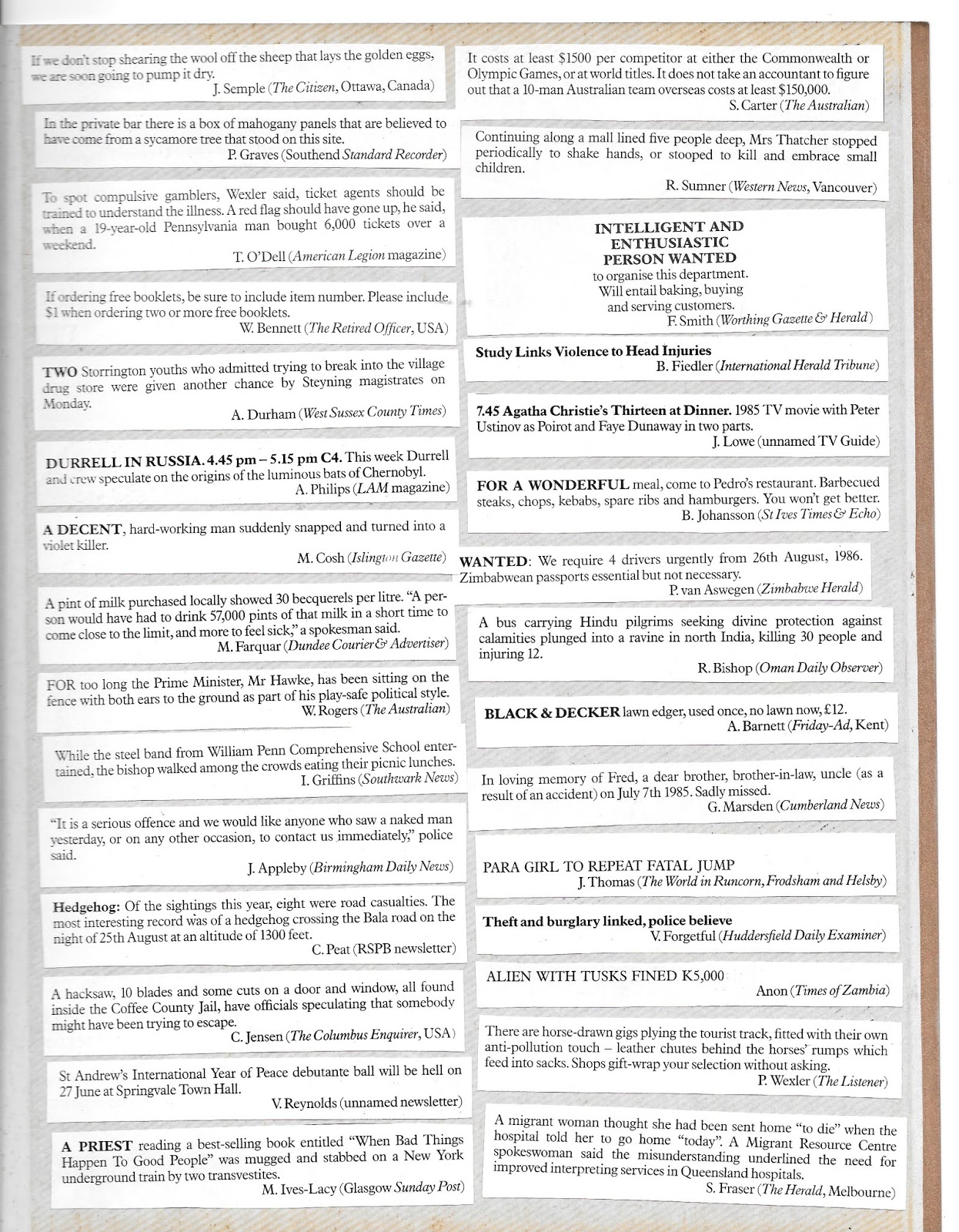
"Country Life" humor from Punch, part V
Over a period of many years I clipped out selections from the "Country Life" section of Punch magazine and stored them in a "humor" scrapbook. When I hosted parties at my apartment I would invite guests to sit down and try to read two pages while controlling their emotions and not smiling or laughing. I don't recall anyone successfully doing so. Now I'll try posting the pages here in the blog, a couple at a time. This is the final installment.
The text on these pages can be very difficult to read. One possible workaround is to right-click on a page to open it in a new tab, then zoom the image on that tab.
Next week I'll start posting the pages from the regular humor scrapbook.
The text on these pages can be very difficult to read. One possible workaround is to right-click on a page to open it in a new tab, then zoom the image on that tab.
Next week I'll start posting the pages from the regular humor scrapbook.
03 February 2020
Can someone identify this plant for me ?
I'm using the cold winter weather as a time to scan all my memorabilia photo albums to digital form to save space and facilitate sharing. One image has me puzzled a bit.
The photo was taken in 1968 in the family room of my old home in the western suburbs of Minneapolis. The print is dated January (and I think that's a Christmas poinsettia on the floor next to the tall plant). What impresses me in retrospect is that this plant was able to survive (and thrive) with the minimal light it would be afforded during short winter days at that latitude.
It may have been grown outdoors in the garden or patio and then moved in for the winter, rather than growing there in situ. I have no clue. Nothing important. Just curious.
Addendum:
Palm fronds and a feather
I understand the original act like this was performed at Cirque du Soleil. It's not magic, just acrobatics. Those in a hurry can skip the introductory hype by starting at the one-minute mark. The performance will end - dramatically - six minutes later.
She is mic'd up for sound, so her breathing is sometimes a bit intrusive, but that's part of the act. As is, I presume, her occasional hand tremor. But overall it is quite impressive.
Wisconsin viewed as the center of the presidential politics universe
Wisconsin is the only state listed as a toss-up by all three of the major national political prognosticators, Sabato’s Crystal Ball, Cook Political Report and Inside Elections.
“Wisconsin could be the decider,” said Larry Sabato, founder and director of the University of Virginia Center for Politics and Sabato’s Crystal Ball. “There are only a handful of states that are truly competitive and that switch sides with any regularity, and Wisconsin is one of them.”..
Trump beat Democratic candidate Hillary Clinton by about one point, or less than 23,000 votes, in 2016, becoming the first Republican to win the state [and its 10 electoral votes] since Ronald Reagan in 1984...
Barack Obama won Wisconsin handily with margins of 14% in 2008 and almost 7% in 2012, but those victories are looking more and more like outliers, as several presidential elections in recent years have been been extremely close. Despite winning nationally, Republican George W. Bush lost Wisconsin by margins of less than a quarter of a point in 2000 and about a third of a point in 2004...
Anthony Chergosky, UW-La Crosse assistant professor of political science, said polling seems to suggest a shift back toward slight Democratic leads in Michigan and Pennsylvania, but not Wisconsin, where the split appears to have remained even...
Democrats also will look to address the nearly 20% drop in turnout among black voters from 2012 to 2016. “Nonwhite voters in the state are an important thing for Democrats, but are a relatively small fraction of the total statewide vote because they — especially African Americans — vote overwhelmingly Democratic,” Franklin said. “Their turnout rate matters a lot.”..
With the stage set for potential record voter turnout this year, Sabato said neither party should have much difficulty in getting out the vote. He added that Trump could arguably be the biggest factor at play for both parties.
“Trump is that kind of president, he can activate both sides, which is rare,” Sabato said. “You either love him or you hate him, and pretty much everybody has made up their mind as to whether they love him or hate him.”More at the Wisconsin State Journal.
"So, how did the 1% do today?"
From Bloomberg (January 31, 2020):
On a day when the S&P 500 fell the most since October, the world’s richest person got $7.9 billion richer. Jeff Bezos’s fortune swelled to $124.2 billion Friday as shares of his Amazon.com Inc. surged 7.4%, a day after the largest U.S. e-commerce company stunned investors with a fourth-quarter profit that far exceeded Wall Street estimates. His net worth climbed $9.3 billion through the first month of the year, according to the Bloomberg Billionaires Index...
Bezos wasn’t the only tech titan whose net worth changed dramatically this week. Elon Musk’s swelled by $2.7 billion since Wednesday, after shares of his Tesla Inc. surged...
Mark Zuckerberg’s fortune tumbled $5.9 billion on the week after Facebook Inc. posted its slowest-ever quarterly sales growth.
That's a "stand" on the spatula - not a hook
"My utensils are like the one here, it is a stand. But most people who come over think it's to stop it sliding into the pot. However,
the centre of gravity is behind the stand to make it stand up. I can't
tell you how many times people have put it outside the pot like you
would and it falls out and flicks food everywhere..."
"The centre of gravity might be specifically designed to NOT allow it to sit in the pan. Spatulas
are safe to use to quickly stir or flip food, but will melt at high
heat if left in the pan."
ELI5 about passwords
I've often wondered how hackers bypass brute-force protection at login sites. This exchange addresses that question.
Request to "explain like I'm five":
"With 26 letters in the English alphabet, a password of 4 letters would have 264 possible combinations. And that is for 1 given username. That's a lot.Login forms could also have a brute-force protection that disables password guessing after about 10 attempts from a given IP or username.Still, websites often ask for 8 letters, lower/upper case, numbers, symbols, etc... It seems a bit of an over-kill, but this is very common. Can anyone explain?
Best reply:
While ~457,000 sounds like just an absolutely unfathomably large number to a human, that's actually child's play when it comes to computers. Kasperky Labs estimates that an average computer that's not even particularly specialized to password cracking can attempt roughly 7100 passwords every second. That means it could figure out a 4-letter single-case password in at most 65 seconds. I'm sure you can see why that's not very desirable.Even just stepping up to a six-character password where lower case, upper case, and numbers (but no symbols) are allowed slows down an average computer's brute force attack to 3.5 days. This can be sped up by using known tables of common passwords that people use over and over again, or even just using a dictionary attack since most people use a password that's a word or some variant thereof (e.g. they might use "acc1d3nt" instead of "accident," but a good dictionary attack can account for these variants too).And that's all to say nothing of the fact that people who make their living by cracking people's passwords are going to have specialized hardware that can crack passwords even faster. In 2012, ArsTechnica wrote an article about a then-new supercomputer that could guess up to 350 billion passwords every second (meaning the 6-character password from before could be cracked in a fraction of a second). And you can surely imagine that even more powerful hardware exists now, 8 years on.Most websites also have a brute-force protection that disables password guessing after about 10 attempts.This is true, but again people who make their living cracking passwords have ways of circumventing this. Explaining the exact specifics would probably make this explanation not ELI-5 anymore, but the basic gist is that they don't actually crack your password by going to the website and entering each potential password one at a time. Else, as you mentioned, they'd get locked out and that would make the process take a long long time.Rather, what they usually do is they get their hands on a master password list directly from the source. This can sometimes come from a leaker who works for a particular company, but most often it comes from hackers breaking into to the company's database and getting the master list file that way. Now thankfully, any company worth their salt encrypts said password list, but that turns out not to really be a problem for hackers.Most of the time hackers know what encryption algorithm a particular website uses to secure their passwords (e.g. the ArsTechnica article mentions that LinkedIn uses the SHA-1 algorithm. Obviously, this may no longer be the case today, but it was true as of 2012). Given this information, they can use their brute force password generator and run each one through the encryption algorithm until they find one that outputs the same string as one of the passwords in the list - they then know that user's password.In addition to all of that, sometimes companies utterly fail at security and don't follow the industry best practices for securely storing passwords...
More at the explainlikeimfive subreddit discussion thread.
01 February 2020
For grieving parents
Above: a request on the Pics subreddit. Here's one of the many responses, from Redditor funkybrewster:
Similar in principle to the services provided by Now I Lay Me Down To Sleep.
"Country Life" humor from Punch, part IV
Over a period of many years I clipped out selections from the "Country
Life" section of Punch magazine and stored them in a "humor" scrapbook.
When I hosted parties at my apartment I would invite guests to sit down
and try to read two pages while controlling their emotions and not
smiling or laughing. I don't recall anyone successfully doing so. Now
I'll try posting the pages here in the blog, a couple at a time. This is the next-to-last installment.
The text on these pages can be very difficult to read. One possible workaround is to right-click on a page to open it in a new tab, then zoom the image on that tab.
Tardigrades on the moon
The odds of finding life on the moon have suddenly rocketed skywards. But rather than elusive alien moonlings, the beings in question came from Earth and were spilled across the landscape when a spacecraft crashed into the surface.Details at The Guardian.
The Israeli Beresheet probe was meant to be the first private lander to touch down on the moon. And all was going smoothly until mission controllers lost contact in April as the robotic craft made its way down. Beyond all the technology that was lost in the crash, Beresheet had an unusual cargo: a few thousand tiny tardigrades, the toughest animals on Earth.
Reposted from last year in order to add this great photo of a tardigrade (probably a colorized scanning EM):
Nordstrom will begin selling used clothing
As reported by the Washington Post:
Nordstrom began selling secondhand apparel, shoes and accessories online and in its New York flagship store on Friday, the latest attempt by the 119-year-old company to appeal to changing consumer tastes and capitalize on one of the few bright spots in retail. It joins Macy’s, J.C. Penney and Madewell, among others, in carving out a place for used clothing, shoes and handbags alongside new ones.Secondhand sites such as ThredUp, Poshmark and the RealReal have become destinations as eco-friendly alternatives to fast fashion. As resale goes mainstream — the market is projected to triple in three years — department stores have become an unexpected next step to woo younger shoppers.“We want our customers to feel good not only about what they’re buying, but how they’re buying it,” said Olivia Kim, Nordstrom’s vice president of creative projects.The secondhand offerings take up space once filled with Burberry, a luxury British clothier, at the Manhattan store. Nordstrom also is buying back customers’ used clothing, shoes, jackets and accessories, which will be cleaned and repaired as needed before being sold. The company will pay as much as 60 percent of an item’s resale value, in the form of a gift card. The initiative, known as See You Tomorrow, also will accept merchandise by mail...It saves money... and more importantly, keeps clothing out of landfills. “There is such glut of cheap, disposable fashion out there,” she said. “The last thing I want to do is contribute more waste."
31 January 2020
Cancellations on Denmark's first postage stamps
This post will likely be of interest only to stamp collectors, but before discarding some old philatelic auction catalogues, I wanted to preserve a couple items for future reference.
Denmark's first postage stamps were issued in 1851 - a blue 2 Rigsbank skilling issue for local delivery in Copenhagen, and the more commonly encountered 4 Rigsbank skilling ("Fire R.B.S.") issues shown here.
Cancellations are used by postal authorities as a form of revenue protection (to prevent reuse of the stamps), and to a lesser extent for administrative purposes to document where letters originated and how they were transported. The first issues in Denmark were cancelled with four-ring "mute" cancels (with a dot in the center); clerks were instructed to center these on the stamp and did so with varying degrees of efficiency.
Shown in the top image is a philatelic rarity (prices shown in all the images are auction opening bids, expressed in IIRC Swedish or Danish kronor). The item shown is an intact cover, cancelled on the first day the stamp was issued (April 1, 1851). As the catalog entry notes, the cancel and the postmark are in blue ink, which was used in Copenhagen during that first week.
Full covers are rare because early collectors were interested only in the stamps, which were soaked or steamed off envelopes and mounted in albums. The second image shows some individual FIRE R.B.S. stamps from that auction. These have been "plated" by specialists, so they are identified by the plate from which the stamp was printed and even the position of the stamp on the plate. Note that the third example is offered at a higher opening bid because of the blue cancel, which marks it as having been mailed during that first week of issue.
Another group of cancels seen especially during the first year were "manuscript" cancels, where the obliteration was performed by the postmaster by hand using an ink pen (or, as in the first example ink and chalk). I believe these were more commonly done is smaller rural post offices, and were officially frowned upon (and eventually banned), so they also carry a premium in the modern marketplace.
The "mute" cancels were followed in October of 1852 by "numeral" cancels, still with obliterating rings, but now with numbers that corresponded to specific post offices or postal facilities. Reference books provide rarity values for each of the numbers (those from small villages being especially uncommon, and sought by collectors). Even rarer than the small town ones are the two shown above: the "183" used only when the king was in residence at his castle, and the "230" used briefly before a German invasion (these examples on 4-skilling stamps with wavy spandrels issued in 1863).
And one final uncommon item. A few Fire R.B.S. stamps received "rebellion" cancels ("oprørsstempel" - think "uproar") from the Schleswig-Holstein rebellion of 1848-51. The "first Schleswig war" ended about the time that adhesive postal stamps were introduced, but I think what happened was that some of the cancellers were retained and used by Danish postoffices after the conflict ended. The opening bid shows how uncommon good examples are.
Subscribe to:
Posts (Atom)