Showing posts sorted by date for query swallowtail. Sort by relevance Show all posts

17 February 2025

"Fracture pruning" (coronet cuts) explained


Last summer a favorite tree in the woods behind my house "broke" (left photo).  It was not an optimally configured tree because it was positioned at the edge of the woods and therefore "leaned out" to maximize its sun exposure, and the limbs on the south side were more heavily leafed.  The fracture occurred near the location of a woodpecker hole and could have been related to that or to some intrinsic rot.  I cleaned up the crown that fell to the ground, then debated what to do with the trunk.  

The black cherry (Prunus serotina) is one of the food plants for Tiger Swallowtails, and I was pleased to see that before its demise, this tree had generated a seedling near its base, which was blooming last spring (and where it will be log powers easier to find Tiger Swallowtail caterpillars than up in the inaccessible canopy.

But what to do with the fragmented residuum?  I did nothing last summer or fall because the broken trunk was a magnet for woodpeckers, who had enhanced access to various beetle larvae.  The visuals from the dining area window and back deck were irrelevant because it's a natural development, so no need to "clean it up" in that regard.  Then this past week I saw this photo (cropped for emphasis) and question:

"My town has done some cleaning up in a nearby forest but a few trees were cut like this. What is the purpose of cutting them like this?  The lowest ones were at about 2-3 meters above the ground."
The answer was in the marijuanaenthusiasts [tree-lovers] subreddit thread: "It's called a coronet cut. It's supposed to mimic a natural break and encourages natural decay to create wildlife habitats."  A couple more clicks took me to Dr. Stump:
When limb failure occurs naturally, these new features create a micro habitat for microorganisms and successive species- wood louse, earwigs, etc. These in turn, support birds and bats’ and other organisms with food and shelter.

Coronet cuts are designed to promote decay and therefore benefit microorganisms that live off the decaying wood. Whilst good for the local ecology, generally, this isn’t good for the tree. It prevents the branch sealing the wound and preventing pathogens from entering...  we tend to only employ fracture pruning on trees earmarked for monolith, veteranisation or severe decline. This allows colonisation of the tree by the local fauna to encourage improved biodiversity of the area – a feeding ground and bat/bird hotel.

If the tree is over a road/ bus stop, play area or near a dwelling, we may look to remove the tree for safety reasons. However, in parkland with low footfall, woodland or reserve, where risks to public health are much lower, this technique is a valuable tool in creating habitat for the wildlife.

I haven't figured out the "monolith" part (probably some reader will know) ("veteranisation" here) (and "coronet" probably because it's a "little crown") but my problem is solved.  The fractured black cherry stays upright.  

You learn something every day.

A tip of the blogging cap to reader Alexander, who realized that "veteranisation" is an active process of creating veteran-like trees.

01 April 2023

Batesian mimicry


Posted on April 1 - not to fool you, but to demonstrate how Nature fools Nature.
The strategy of pretending to be something other than what you really are is of course common, and not just for humans. In my backyard in Connecticut, for instance, the caterpillar of the swallowtail butterfly Papilio troilus does a brilliant imitation of bird poop, to avoid being eaten by birds. Later in its development, it turns green and produces eyespots so it can pretend to be a snake.

In Malaysia, a spectacular adult moth, Macrocilix maia, one-ups the poop mimics by mimicking bird poop on its body, and two flies feeding on the poop on its wings... All this is just Batesian mimicry. We’re not even going to talk about Müllerian, Wasmannian or Bakerian mimicry.
More at The Grand Animal Costume Party.  Photo credit: Gerry Images/Flickr RF

Not to be confused with crypsis, BTW.

15 July 2021

Newest addition to our family - updated


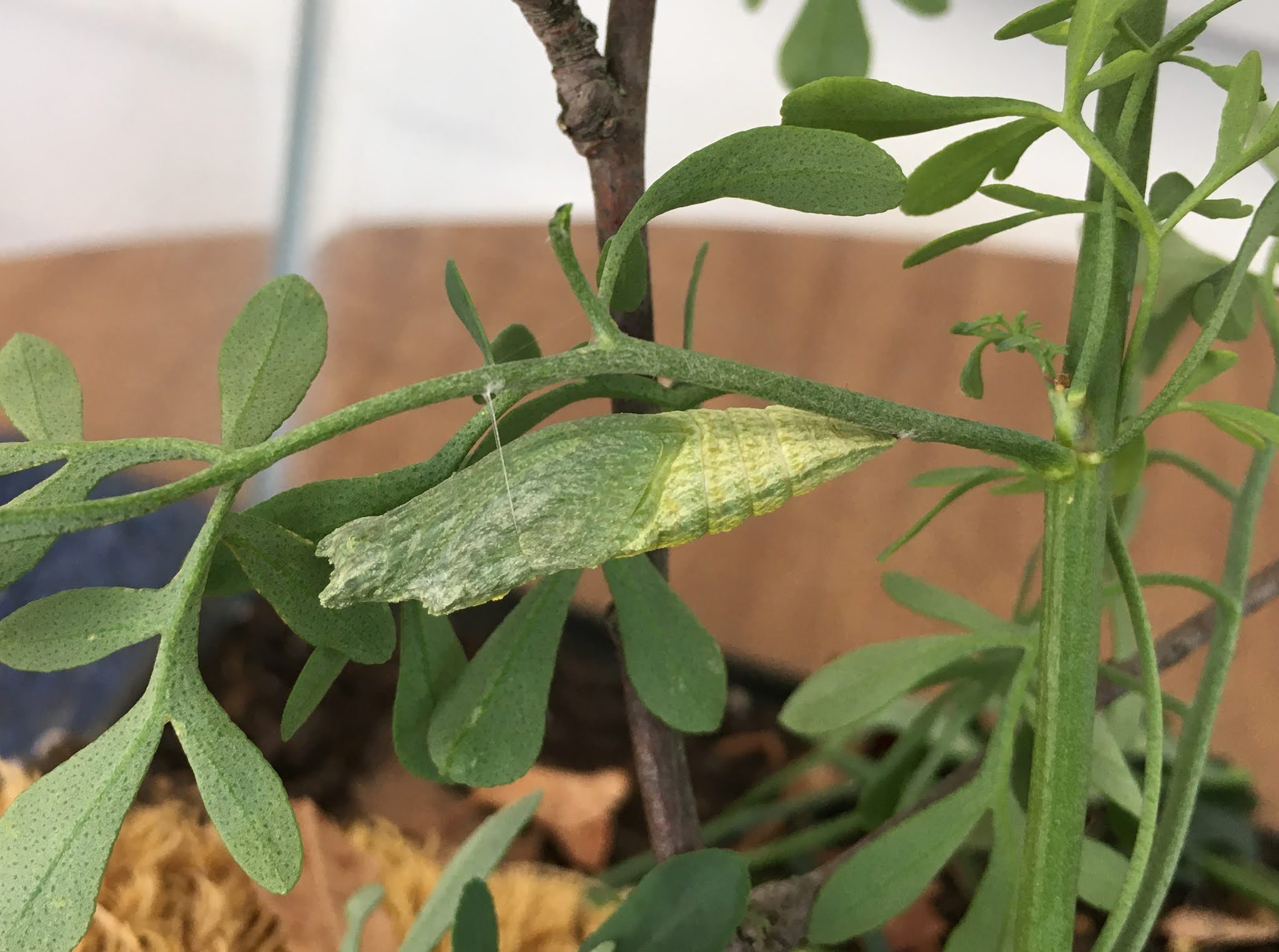
Found this big fellow crawling on the rue by our mailbox.  Brought him in to a terrarium on the screen porch for protection against wasps.  Within a few days it had transformed into a chrysalis:


Now we wait, and after a while we should have a Black Swallowtail butterfly.

Reposted from July 6 to show the adult (click pic to make it bigger than your monitor):


He eclosed yesterday just as a line of severe thunderstorms was rolling into town, so I kept him on our screen porch overnight, so this morning he was eager to start searching for females.

Fortunately when I took him out and placed him on a coneflower to see if he wanted some nectar, he laid those wings down absolutely flat and held them like that for several minutes, soaking in some solar power.  So I had time to get my phone out and got the best pic I've ever had of the dorsum of BST wings (the overcast cloudy conditions also muted the brightness range and took away shadows and glares).

For those interested, this link from the University of Wisconsin Ag School is the best brief summary of information on Black Swallowtails I know of.

04 May 2021

The Night Visitor


Working at my desk in my man-cave late at night when something FLUTTERS across my field of view.  Momentary anxiety that we are harboring an unusually bold family of clothes moths.  Relief to see it on the wall and recognize a Cabbage White butterfly, which apparently rode into my room unnoticed on a hyacinth blossom earlier in the day. 

Another sign of spring is emerging in the patch of plants around our mailbox:


The "shrubby" plants toward the back are perennial rue that serve as a food plant for Black Swallowtail butterflies.  Toward the front are spikes of milkweed that scoff disdainfully at puny human efforts to suppress weeds with a thick layer of hardwood mulch.  I'm now checking them daily when I retrieve the mail, expecting to see Monarch butterfly eggs on them later this month.  According to the Journey North map, a Monarch was seen on the Illinois/Wisconsin border 3 days ago.  

20 January 2021

How butterflies survive the impact of raindrops

 
An interesting brief video.  Insect wings (and other natural objects such as bird feathers and plant leaves) are superhydrophobic.
In analyzing the film, they found that when a drop hits the surface, it ripples and spreads. A nanoscale wax layer repels the water, while larger microscale bumps on the surface creates holes in the spreading raindrop.

“Consider the micro-bumps as needles,” Jung said. If one dropped a balloon onto these needles, he said, “then this balloon would break into smaller pieces. So the same thing happens as the raindrop hits and spreads.”

This shattering action reduces the amount of time the drop is in contact with the surface, which limits momentum and lowers the impact force on a delicate wing or leaf. It also reduces heat transfer from a cold drop. This is important because the muscles of an insect wing, for example, need to be warm enough to fly.
Reference: “How a Raindrop Gets Shattered on Biological Surfaces” by Seungho Kim, Zixuan Wu, Ehsan Esmaili, Jason J. Dombroskie and Sunghwan Jung, 8 June 2020, Proceedings of the National Academy of Sciences.

The high-speed film clip at the end of the video showing  the swallowtail launching is absolutely beautiful.  I'll just add that the butterfly depicted earlier in the video appears to be one of my all-time favorites - an Olympia Marble.  Here's one I was able to photograph back in 2014:

14 August 2019

"Wing pollination" of azaleas by swallowtails


The most interesting thing I've read about butterflies this year was a study by Mary Jane Epps, an assistant professor of biology at Mary Baldwin College who examined the reproduction of flame azaleas, publishing her results last August in The American Naturalist.  Here's the abstract:
Although many angiosperms are serviced by flying pollinators, reports of wings as pollen vectors are rare. Flame azalea (Rhododendron calendulaceum) is visited by diverse insects, yet previous observations suggested that only butterfly wings may transfer pollen to stigmas. We used an experimental approach to determine whether butterfly wings are the primary vehicle of pollination in flame azalea. Over two seasons of observations, only butterflies (Papilio glaucus and Speyeria cybele) contacted both anthers and stigmas, yet because of differences in wing-flapping behavior, P. glaucus transferred pollen most efficiently. In contrast, bee species specialized either on pollen or nectar but did not contact both anthers and stigmas. A field experiment revealed that flowers excluding butterflies experienced almost complete fruit failure, whereas fruit set in open flowers did not differ from those that were hand pollinated. Additionally, butterflies had 56-fold more azalea pollen on their wings than bodies, while azalea stigmas bore both pollen and wing scales. These results suggest that plants with many visitors contacting reproductive organs may still specialize on a single guild of visitors for pollination and that wing-borne pollen transfer is a key mode of flame azalea pollination.
Every reader of this blog will be familiar with mechanisms of pollination by bees and similar small insects, which transfer pollen on their bodies and feet.  This becomes a problem when the blossoms are large:
“In order for a plant to reproduce, a pollinator – usually an insect – has to spread the pollen from the anther to the stigma,” Epps says. “In the case of the flame azalea, the distance between these two structures meant that it was unlikely for a bee or other small pollinator to come into contact with both anther and stigma during a visit.”

The researchers discovered something else interesting – the pollen was most likely being transferred by the butterflies’ wings, instead of their bodies. “We observed two species of butterfly that frequented these flowers: the eastern tiger swallowtail and the great spangled fritillary. However, the majority of the butterflies were the swallowtails, who differ from the fritillaries because they tend to keep moving their wings even when gathering nectar from a flower,” Epps says. “The constant fanning motion gives the wings a number of contacts with both anther and stigma, making the swallowtails more efficient at pollination.”
I've noticed this behavior in our back yard, when Tiger Swallowtails and Giant Swallowtails constantly flutter their wings while visiting large blossoms (not azaleas at our latitude).  In the past I considered this wing motion a nuisance because it frustrated my attempts to get good photographic images, but I assumed it was done to achieve aerodynamic stability (though it doesn't occur with almost-as-big fritillaries, who hold their wings quite still).

Here's one additional relevant photo, of Spicebush swallowtails on azalea, by Jim McCormac:


Top photo: Great Spangled Fritillary on a flame azalea, by Suzanne Allison, via NC State University College of Sciences News.

Reposted from 2016 to append this photo of a Tiger Swallowtail (Papilio glaucus) nectaring on Monarda ("bee balm") in our front yard yesterday.


A surprisingly sharp image.  This fellow was so eager for the nectar that he let me get an inch away with my cellphone.  The Monarda (and the phlox behind it) was very busy with bees and butterflies (also a Monarch, two Painted Ladies, and a Silver-spotted Skipper).

15 July 2019

Grass in bloom


It's easy to forget that grasses have flowers, because the blooms are so tiny.  I believe this is Indian grass (Sorghastrum nutans) but there are hundreds of grasses in Wisconsin, and I can't guarantee the identity.  It's an attractive plant and one component of the traditional tall-grass prairie.

Photographed by my wife a couple days ago during a hike on the grounds of the Holy Wisdom Monastery in Middleton, Wisconsin.


"Holy Wisdom Monastery is home to a diverse ecosystem spread across more than 130 acres of restored prairie, woodlands, wetlands, gardens, orchards and more. Nurturing partnerships with Dane County, Madison Community Foundation and others who value caring for the earth has always been important to us.

In September 2012, we acquired a 53-acre cornfield which we are committed to integrating and restoring to native prairie and oak savanna to help improve the water quality in Lake Mendota. In March 2015, we successfully met our goal of raising $1.9 million to cover the acquisition and initial management costs..."
Here's one more photo from that hike:  (Tiger Swallowtail on Bull Thistle)


Reposted from 2017 to add this photo demonstrating the root system of wild grasses:

Via

31 May 2019

Starting a new phase of life


Here's the newest addition to our neighborhood - a gorgeous female Black Swallowtail (Papilio polyxenes).

I photographed her shortly after she eclosed from her chrysalis a couple days ago.   She began her life in an egg laid on a rue plant out by our mailbox last summer.  As a caterpillar she stayed hidden in that foliage, undergoing several molts until early autumn, when she emerged on the top of the plants, looking for a stick to pupate on.


Because there were no vertical sticks in that flowerbed, and because she was at risk of predation from local wasps, I elected to bring her (and a few of her siblings) in to our screen porch for the winter. 


As demonstrated in the photo above, she wasted no time once offered a stick, spinning a silken "sling" to suspend herself for the metamorphosis.   The photo below shows another black swallowtail caterpillar whose chrysalis is fully mature (and remarkably stick-like in appearance).  That is how she stayed from late autumn until this spring, outwardly static but changing inside.


Remember the weather this past winter?  Here is south-central Wisconsin the temperature fell below freezing on January 18, and stayed below freezing for two weeks until February 2, bottoming out at 26 below zero Fahrenheit on January 30 and 31.  During that time this lady spent her days and nights outdoors on an unheated screen porch.

Butterfly chrysalises are at risk for dehydration over the winter if they are located away from any precipitation, so I placed the terrarium in a corner where it would get snowed on.


I saw her hanging from the chrysalis last week.  She had emerged on a cloudy, cool (50s) day and she was clearly too weak to fly.   Her wings were perfectly formed, but too floppy to function aerodynamically, so I brought her inside to 70-degree temps and offered her some sugar-water (which she mostly ignored).  I returned her to the screen porch when temps warmed up, but it took one more day before her wings fully hardened and she flew away.  The photos below show the subtle sexual dimorphism of the species.  The top photo is a male who eclosed the following day, with prominent yellow spots in two rows, just a hint of blue, and then the pair of false eyespots near the tail.  Below that is the photo of this lady just before she flew off: yellow spots in the same pattern, but smaller, and the blue markedly enhanced in a pair of arcs that are sometimes hard to see because the forewings often cover part of the hindwing (she held them out for this portrait).  She also has the eyespots to lure predatory birds to her disposable rear wingtips.


Everything about this process fascinates me - the metamorphosis of course, but even moreso the remarkable resilience of a creature often portrayed as fragile and ephemeral.  The ability to fly upwind when you have the weight and shape of a Kleenex.  The adaptability to spend months as a crawling caterpillar, and then after dissolving and reshaping oneself to be able to fly away over a rooftop.  This is what fifty million years of evolution can produce.  Awesome.

19 September 2018

'Tis the season for Black Swallowtail caterpillars


The rather unimpressive greenery around our mailbox is a confluent group of rue (Ruta graveolens).  Most homeowners opt for mailbox plantings that are a bit more colorful and showy.  We like the rue because this shrubby perennial tolerates poor soil in hot dry conditions (next to an asphalt road and concrete driveway) and because it is a primary food plant for the caterpillars of the Black Swallowtail (Papilio polyxenes).

Earlier in the season the plants are covered with tiny yellow blossoms...


... which, while unspectacular to the human eye, are complex clusters of five-petaled flowers that are very attractive to bees.  We seldom see Black Swallowtail butterflies on the rue (they tend to nectar on larger flowers elsewhere in the garden), but we know females have visited the rue and oviposited there because in September the caterpillars start appearing on the upper outer branches.

What we see are the late-stage instars, mature caterpillars that are starting to look for a place to form a chrysalis.  They seem to know that the greenery of the rue will die back in the winter, leaving only the woody central stems, and they need a secure place for the chrysalis if they are to live through a Wisconsin winter.


When we find the caterpillars, we bring them to our screen porch, which offers them protection from predatory wasps, ants, spiders, etc., and we give them some clippings of the rue for a final snack, and more importantly a variety of sticks they can use for pupation.  In the above photo the two caterpillars have chosen a stick from a birch tree, and the one on the right has already formed its "J", with a silk harness going from the stick around behind its "shoulders."


Several days later (the larger cat having moved on), the caterpillar is now fully pupated, attached at the bottom with some glued adhesive [higher on the stick is a remnant from a prior year's successful sequence], and supported by that amazing little silk sling.

We have eight of these now on the screen porch.  The terrarium will be placed where the chrysalises can be snowed on (I think they might need some moisture in the winter to avoid desiccation), and they will live through sub-zero temperatures, will freeze and thaw (perhaps several times), and in the spring...


... magic.

I've seen metamorphosis countless times, and it never fails to fascinate me.  And the beauty of these creatures up close in just incredible.  Here's a view of the underside of the wings -


And then follows the to-me-incredible event when a creature that in its entire previous life crawled around in a small plant, now lets go of a stick and "knows" how to fly.  And eyes that have never before focused more than millimeters away can now locate food and mates at dozens of meters.

You don't have to be a child to retain a sense of wonder with regard to the natural world.

07 September 2016

Finally, a Black Swallowtail caterpillar


This summer I seeded my plot in our local community garden with an abundance of food plants for Black Swallowtail butterflies, but my plans for raising a bunch of them were foiled by some freakish weather.  I thought this year would be a total loss in regard to Black Swallowtails.

Imagine my surprise a couple days ago when I went to the mailbox and saw this colorful fellow resting on a twig.  He/she had apparently wandered away from the clump of rue (another BST foodplant) we have planted by the mailbox.

I brought him in to a container on our screen porch, provided some rue and carrot tops, and then after two days of eating and producing frass, I found him like this this morning:


The caterpillar ignored the twigs I placed in the container and chose instead to create its mat of silk on the wall, and has suspended itself via a silken harness (which wraps behind the nonexistent "shoulders" of the cat).  The next step will be to convert that caterpillar body into a brownish pupa.

Addendum:  The chrysalis was fully formed by September 11 -


As of October 6 there have been no external apparent changes; looks like this butterfly is going to overwinter in the chrysalis.

14 July 2016

Badger Prairie Community Garden in midsummer


For a view of the gardens in spring, see my previous post in May.  Here's how some of the plots look now.  There are as many ways to garden as there are gardeners:


My own plot has met with what might charitably be called "mixed success."  On the back row the "Flint corn" ("Indian corn") has tasseled.  Underneath the corn I interplanted squash in the style of Native Americans.  It is growing vigorously, so I'm going to have to do something to keep it out of my neighbor's plot.

On the next row in, the dill is up nicely, but the other half of the row was fennel, and it never germinated; I've just replanted some, rather late in the season.  The carrots in the next row are doing well, but in the row proximal to that the parsley is having trouble competing with native weeds.  The tomatoes (outside the image) have been cropped on top by passing deer who probably laughed at the feeble fence (and they nipped some of the carrot tops for dessert).

No sign yet of Black Swallowtail eggs or caterpillars on the dill, carrots, or parsley.

22 May 2016

Reaching out


Last year I planted pipevine (Aristolochia macrophylla) in our back yard.  My goal was to attract the fabulously beautiful but rarely-seen (at our latitude) Pipevine Swallowtail to the garden, hopefully to deposit eggs on the pipevine. 
In the Summer 2001 issue of American Butterflies, an article called “The Pipe-dream Project” suggests that planting pipevines could help in increasing the distribution and abundance of this species, in a similar manner in which Bluebird houses have aided that species. Since the host plants do not grow here naturally, plantings of acceptable cultivated varieties of pipevines might be useful. (via)
Our local garden supply company had only three plants in stock; I obtained two of them, placed them in a sheltered location on the west side of tall arborvitae, and put an inexpensive trellis behind them.   The plants thrived during the summer and covered the 6-foot trellis; for the winter I just covered the base with mulch and hoped for the best.  To my delight the vine survived our winter.  This morning as I walked by to work in the woods, I noticed the vines were reaching out, looking for new purchase on some structure.

Looks like I should name the plant Audrey.

06 May 2016

This "area 51" will be a butterfly garden


For as long as I can remember I've been an enthusiastic fan of community gardens, but this year for the first time I applied for, and was granted, a plot here in a Madison suburb.  I have plot #51 in the Badger Prairie Community Garden.

Those unfamiliar with community gardening can read typical guidelines here.  All participants at our garden are expected to perform six hours of community service; I'll be working with the compost group on Tuesday evenings.

We are well past the last frost date, so it's time to get to work.  First, there are some weeds from last year to remove...


My neighbors clearly had a head start preparing their gardens, and I didn't want my plot to become a seed bank for unwanted vegetation for them, so this afternoon I hand-tilled and hand-dug about two wheelbarrowsful of weeds, which cleared about two-thirds of the 20' x 20' plot (photo taken earlier in the process); hope to finish tomorrow.

Next I'll need to determine the planting areas and walking access, and start seeding.  This past Christmas my stocking was stuffed with seed packets for dill, fennel, parsley, and carrot - all favored by the Black Swallowtail.  This garden is located near a lot of undeveloped prairie and fields, so I'm hoping that swallowtails will find this cornucopia of food plants and oviposit, and that I can find the eggs or early instars before the birds and wasps do.

I'll post some followups as the summer progresses.

Addendum:


Weeding finished (I left a few of what I think are nonagressive daisy-like wildflowers), and about six wheelbarrowloads of compost hand-tilled into the area.  Now I need to put a layer of woodchips down where I want to have my walking areas, then I'll be ready to plant the seeds.  Lots of work so far, but this is the hard part; the rest will be less labor-intensive and more enjoyable.
Related Posts Plugin for WordPress, Blogger...