Also works nicely in the optical illusions category of the blog, since none of the dots actually move continuously (they just wiggle back and forth).
02 March 2024


Harvesting the blood of horseshoe crabs

One may wonder why the horseshoe crab is sensitive to endotoxin and, furthermore, how does the crab benefit from this phenomenon? As we know, seawater is a virtual "bacterial soup". Typical near-shore areas that form the prime habitat of the horseshoe crab can easily contain over one billion Gram-negative bacteria per milliliter of seawater. Thus, the horseshoe crab is constantly threatened with infection. Unlike mammals, including humans, the horseshoe crab lacks an immune system; it cannot develop antibodies to fight infection. However, the horseshoe crab does contain a number of compounds that will bind to and inactivate bacteria, fungi, and viruses. The components of LAL are part of this primitive "immune" system. The components in LAL, for example, not only bind and inactivate bacterial endotoxin, but the clot formed as a result of activation by endotoxin provides wound control by preventing bleeding and forming a physical barrier against additional bacterial entry and infection. It is one of the marvels of evolution that the horseshoe crab uses endotoxin as a signal for wound occurrence and as an extremely effective defense against infection.Photo via Fresh Photons, but to read about this, I recommend the Horseshoecrab.org website.
Addendum: A related story in the Washington Post in May 2012 reports at least an apparent temporary recovery in crab numbers.
Reposted from 2011 to add this update:
Conservationists fear that horseshoe crabs, a 450-million-year-old living fossil, will be pushed to the brink of extinction because of the value of their blood to the pharmaceutical industry. Horseshoe crab blood provides a natural source of limulus amebocyte lysate (LAL) which is used to test vaccines, drugs, and medical devices to ensure that they aren’t contaminated with dangerous bacterial toxins called endotoxins. With hundreds of thousands of horseshoe crabs captured and bled of their milky-blue blood each year, conservation groups are now stepping up their advocacy efforts and taking legal action to help save horseshoe crabs and the other species that rely on them.Fortunately, there’s already an alternative to horseshoe crab blood: in the late 1990s, biologists at the University of Singapore created a synthetic version of the LAL called recombinant Factor C (rFC). Multiple studies show that rFC is just as effective as horseshoe crab-derived LAL, and it is currently commercially available...In the Delaware Bay, home to the largest population in the US, horseshoe crab numbers have declined from 1.24 million in 1990 to less than 334,000 in 2002. Although the population appears to have stabilized, conservationists worry that increased demand for American horseshoe crab blood by the pharmaceutical industry could force it to go the way of the Asian horseshoe crab, Tachypleus tridentatus, which is rapidly disappearing in China and which the International Union for Conservation of Nature (IUCN) lists as endangered. Currently, the American horseshoe crab is listed as a vulnerable species.The debate is particularly critical today; the COVID-19 pandemic has fueled a huge surge of research into vaccines and potential COVID-19 treatments which rely on the use of LAL to ensure product safety. As demand for vaccines and other medical products increases, conservationists worry that without a rapid switch to rFC, strain on the American horseshoe crab and the other creatures that rely on them will only get worse.

Addendum 2024: A report in The Guardian about declining populations of horseshoe crabs, the spillover effect on migratory birds, and the availability of alternatives to horseshoe crab blood.
28 February 2024
Fake

As reported by The Guardian:
Generations of palaeontologists have marvelled over a 280m-year-old fossilised lizard-like reptile, Tridentinosaurus antiquus, discovered in the Italian Alps in 1931.Thought to be one of the best-preserved specimens of the species, palaeontologists believed there were even traces of carbonised skin on the surface. Now modern imaging techniques have revealed that this treasured fossil is, in fact, a carving covered in black paint.Dr Valentina Rossi, from University College Cork, in Ireland, and her team used ultraviolet photography to look beneath the paint. Instead of finding the hoped-for soft tissues, they found an elaborate fake. Although exactly when it was made and who crafted it remains unknown, Tridentinosaurus joins a long list of fossil fakes, including the Piltdown Man and Archaeoraptor, to name just two. Ancient woodlice-like sea creatures known as trilobites were a particular favourite for faking, and natural history museums around the world are increasingly discovering counterfeits in their collections.
Examples of "noun piles"
"Ministers mull volcano ash cloud flight chaos measures" was a headline at the BBC; the last six words constitute a "noun pile." A longer example is ""Profit distribution plan share buyback offer acceptance notice."
These are explained and discussed at Language Log.
These are explained and discussed at Language Log.
Reposted from 2010 because the subject came up today in The New York Times:
The first thing that Grant Barrett, the chief lexicographer for Dictionary.com, wanted to emphasize was that the explosion of compound phrases like mob wife aesethetic, bookshelf wealth and goblin mode on TikTok and other social media platforms had been happening for centuries.“It is incredibly common in English, and goes as far back as Proto-Indo-European,” Mr. Barrett said, noting that linguists liked to playfully refer to these strings of attributive nouns as “noun piles.” He gave me an example of how far noun piling could be extended by offering the single yet six-word-long noun “station wagon car seat installation instructions.”
The article discusses other linguistic developments, including "cranberry morphemes" -"parts of words that look like they should exist independently, but don’t. The suffixes -aholic, -flation and -tastic have been the beneficiaries of similar trends through the years."
My German ancestors would like to remind everyone that you don't have to put spaces between the words. According to Berlitz...
Here are the top 3 longest words in the German dictionary in all their glory - along with their English meaning:3. RindfleischetikettierungsüberwachungsaufgabenübertragungsgesetzLetters: 63English meaning: Delegation transfer law for the labeling of beef in order to monitor task transfers.2. GrundstücksverkehrsgenehmigungszuständigkeitsübertragungsverordnungLetters: 67English meaning: Regulation on the delegation of authority concerning land conveyance permissions.1. RinderkennzeichnungsfleischetikettierungsüberwachungsaufgabenübertragungsgesetzLetters: 79English meaning: Delegation transfer law for cattle labeling and beef labeling supervision duties.
26 February 2024
Weaver bird nests

Sociable weaver (Philetairus socius) nest in a quiver tree (Aloe dichotoma), Fish River Canyon, Namibia. Sociable weavers construct the largest nests of any bird, housing hundreds of individuals spanning many generations.Very impressive! Credit here, via Electric Orchids.
Reposted from 2011 to add this photo of weaver bird nests in India -

- and this video of a weaver bird at work:
I will never cease to amazed at how birds can do this.
Gruesome

A schematic drawing of the position in which an amateur cave explorer was trapped for 27 hours (until he died).
The full incident report is recorded at the National Speological Society News of October 2011 (scroll down to page 15 re John Jones at Nutty Putty Cave).
On the evening of November 24th, John Jones (26) and ten of hisfamily members including children entered Nutty Putty Caveand toured the entrance area. After a short time, most of thegroup left while John and others including his brother Joshcontinued to explore. They proceeded to a tight, nasty, passageknown as Bob’s Push. This passage is mostly belly-crawl sizeand undulates up and down before taking a decisive turn to theleft and downward. The remainder of the passage to its dead-endis very tight and slopes downward at about a 60-degree angle.John entered the passage head-first and continued head-first atleast 30 feet down the steep, tight section. At some point, herealized he could not back out against the force of gravity. Johnsent the others out of the passage and continued downward,hoping to find a place to turn around...
Death by positional asphyxia can occur from prolonged inversion without any other injuries (cf. Saint Peter). There are multiple documentary videos about this incident, including this one (hat tip to reader drabkikker, who located it). The embedded schematic is a screencap from this one.
A "quilted" maple tree


There was very little useful discussion at the Reddit source for the tree photo, or at the Wikipedia entry where I found the guitar photo (cropped for size). There is some discussion at The Wood Database. The process reminds me of tree burls, which are also prized by woodworkers.
21 February 2024
The world is full of good people

I fully believe what I wrote in the title. Here's one example:
The child, a first-grader named Levi, was in tears as he climbed aboard the school bus.“I asked him, ‘Hey, buddy, what’s wrong?’ and he told me he didn’t have any pajamas for pajama day,” Farrish said. “His school was having a special day where kids could wear their pajamas all day.”...After he dropped off Levi and about 40 other students at Engelhard Elementary School, Farrish decided to run a quick errand. He drove to a nearby Family Dollar store to pick out some new pajamas for Levi...Farrish took the pajamas over to the school and went into the front office to explain to an office assistant that he was Levi’s bus driver, and what had happened that morning.“She called for Levi [to come to the office] and when he came down the hallway and saw me, his face lit up,” he said. “He said, ‘Hey, you’re my bus driver!’”...“He was just glowing, he was so happy,” he said. “He gave me a hug, then he walked back to class, hugging those pajamas. I was in tears.”..“I don’t have kids, so I enjoy interacting with Levi and the other kids on the bus and hearing about what’s going on in their day,” he said. “My job is to get them to school safe, but I also hope I have a small impact on their lives.”
I also believe that most people are honest and that most people can be trusted. Those sentiments are probably also not widely shared.
20 February 2024
The Bayeux Travesty

Front and back covers of the Harvard Lampoon issue of December 1966, depicting the Harvard-Yale football game.
The Bayeux Travesty is meticulously faithful to the original in colors, design, and its Romanesque style. “His calligraphy was letter-perfect,” says historian Ted Widmer ’84, Ph.D. ’93, a Lampoon alumnus like Rayman. “Among many other things, David was a medievalist who loved illuminated manuscripts.” The artist’s wicked wit also inspired dog-Latin inscriptions that smuggled outright obscenities onto the magazine cover without a single peep of reader protest.
More information about the artist and his tragic death by defenestration at Harvard Magazine.
19 February 2024
Judith beheading Holofernes

The account of the beheading of Holofernes by Judith is given in the deuterocanonical Book of Judith, and is the subject of more than 114 paintings and sculptures. In the story, Judith, a beautiful widow, is able to enter the tent of Holofernes because of his desire for her. Holofernes was an Assyrian general who was about to destroy Judith's home, the city of Bethulia, though the story is emphatic that no "defilement" takes place. Overcome with drink, he passes out and is decapitated by Judith; his head is taken away in a basket (often depicted as carried by an elderly female servant).Text and images from Wikipedia.
Early Renaissance images of Judith tend to depict her as fully dressed and desexualized; besides Donatello's sculpture, this is the Judith seen in Sandro Botticelli's The Return of Judith to Bethulia (1470-1472), Andrea Mantegna's Judith and Holofernes (1495, with a detached head), and in the corner of Michelangelo's Sistine chapel (1508-1512). Later Renaissance artists, notably Lucas Cranach the Elder, who with his workshop painted at least eight Judiths, showed a more sexualized Judith, a "seducer-assassin"...
Judith remained popular in the Baroque period, but around 1600 images of Judith began to take on a more violent character, "and Judith became a threatening character to artist and viewer [the top embed is a Caravaggio]...
Modern paintings of the scene often cast Judith nude, as was signalled already by Klimt. Franz Stuck's 1928 Judith [right] has "the deliverer of her people" standing naked and holding a sword besides the couch on which Holofernes, half-covered by blue sheets—where the text portrays her as god-fearing and chaste, "Franz von Stuck's Judith becomes, in dazzling nudity, the epitome of depraved seduction".
Reposted from 2014 to add some information about tomato sauces:

Middle Earth Organics opted for a traditional look in their labels by incorporating images of women from classic works of art. The first is obviously from Botticelli's The Birth of Venus. (Since she is arising from a scallop shell, wouldn't her image be more appropriate on a vongole rather than a tomato-based one?)
Don't know the second. DaVinci's Lady with an Ermine is the third. But it's the fourth one that has stirred up the most amusement on the internet. The lady is Judith, and she is in the process of beheading Holofernes, in the image embedded at the top of this post. The association with tomato sauce was unintentional, and striking.
The Films of Tim Burton
This morning, Neatorama provided a link to an article about a maker of movie montages. Paul Proulx, who posts on YouTube under the name Barringer 82, creates video "mashups" - montages of short segments from movies. Most people are familiar with these from watching the Oscar ceremonies on television. Several mainstream movies are montages of, for example, dance scenes, musical scenes, or highlights of the films of a particular studio.
Proulx's creations are tributes to individual directors. The one embedded above features the work of director Tim Burton (Batman, Beetlejuice, Edward Scissorhands, Mars Attacks, Sleepy Hollow, Corpse Bride, Sweeny Todd...) It is exceptionally well done - scenes coordinated with music and with one another rather than just randomly aggregated. I invite you to start the video; it's seven minutes long, but I doubt you will stop before the end, and it will probably make you want to see the movies you haven't seen. Trust me on this.
Proulx's creations are tributes to individual directors. The one embedded above features the work of director Tim Burton (Batman, Beetlejuice, Edward Scissorhands, Mars Attacks, Sleepy Hollow, Corpse Bride, Sweeny Todd...) It is exceptionally well done - scenes coordinated with music and with one another rather than just randomly aggregated. I invite you to start the video; it's seven minutes long, but I doubt you will stop before the end, and it will probably make you want to see the movies you haven't seen. Trust me on this.
Reposted from 2008 (back when I had to explain what a mashup was) because a Screen Rant post raised the question as to whether these two Beetlejuice characters were murdered:

Concise explanation at Neatorama; photo via LiveJournal.
Caitlyn Clark's remarkable statistics

This week Iowa's Caitlyn Clark set a new NCAA women's basketball career scoring record.
Clark is a threat pretty much anywhere on the floor. Consider that she entered Thursday as a career-42.4 percent shooter on right wing 3s — the national average from there last season was 30.6 percent, according to CBB Analytics — while also shooting nearly 40 percent on left baseline 2s — just under 10 percent above the national average in 2023. Even around the rim, she’s more prolific than her peers, shooting 66.1 percent in her career heading into Iowa’s most recent victory, compared to the 57.1 percent Division I mark a year ago.
Here is the record-breaking shot - not just a three, but a logo three:
A blue tit displays structural colors

Photo cropped for size from the original at the BBC, where the article discusses the fortuitous circumstances that allowed the photographer to capture these non-pigment colors on a normal blue tit.
Traditional corn braid
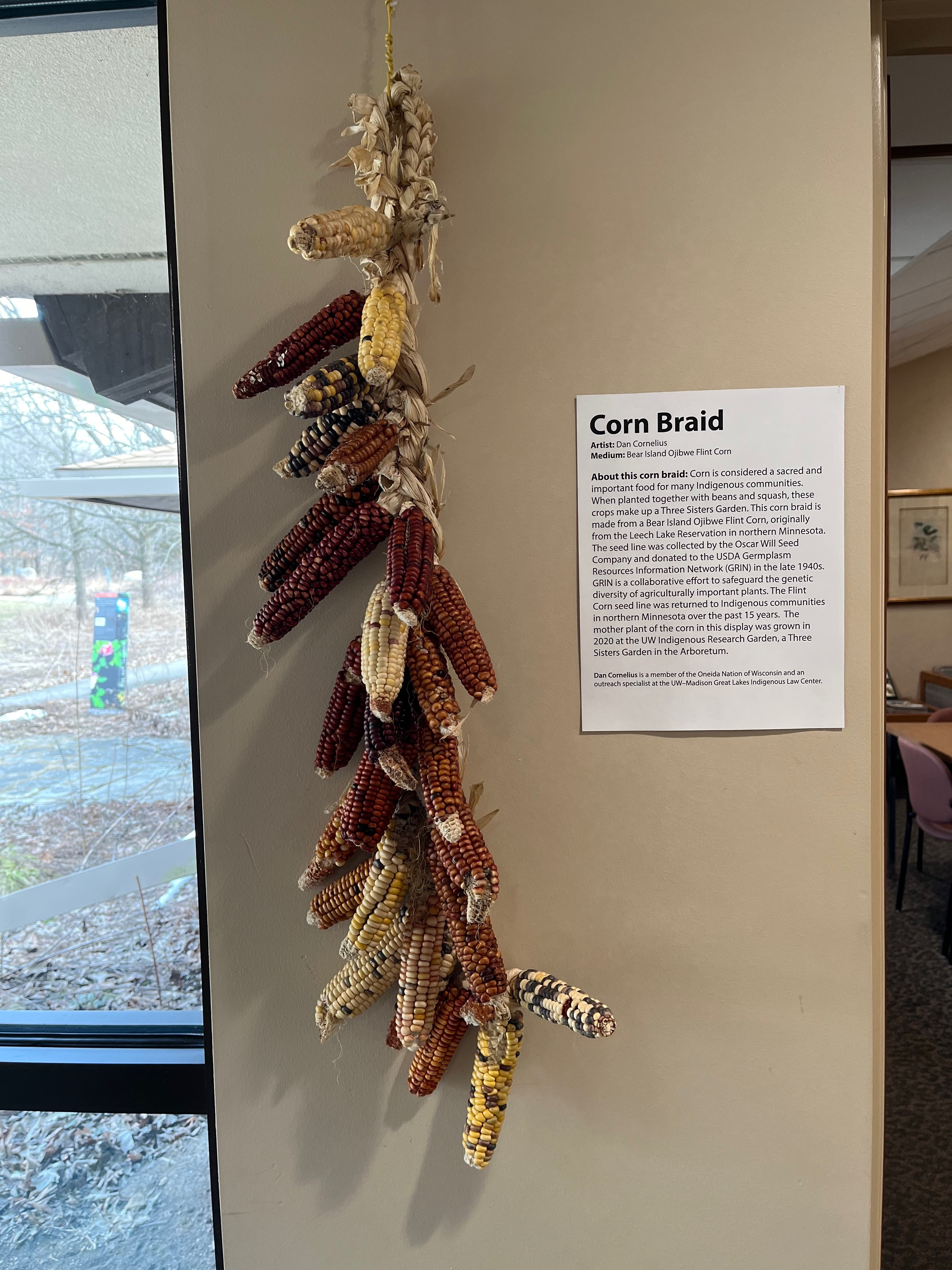
I was at our arboretum this past week for a winter enrichment symposium and noticed that they had a corn braid on display. Here is the accompanying text:

The component flint corn originally came from Bear Island at my favorite northern Minnesota lake - Leech Lake. It has been stored in a seed bank and is now being redistributed to indigenous communities. I found this "how-to" video online (there is another one at Vimeo).
If you want to research this subject, search for braiding "cornhusks", not braiding corn; the latter terms will steer you to hundreds of videos/articles re human hairdos.
14 February 2024
YouTube 10th anniversary video compilation
I'm not officially "back" at the blogging desk, but I wanted to post this brief compilation of excerpts from approximately 200 videos to keep you busy until I do come back.
The best feature is this playlist, which not only lists the videos, but supplements them with thumbnails. And... if you play one of the videos in the playlist, it will automatically segue to the next video in the compilation - probably about 500 minutes of watching if you start at the first one and cycle all the way through.
It's almost scary how many of these are instantly recognizable from just a 1-second clip. Use the playlist link to watch any of the videos in toto.
Reposted from nine years ago.
Subscribe to:
Posts (Atom)
