You probably know the difference between these two elevator buttons, but which is which? (not that it matters - they probably don't work anyway).
Answer: the one with the line is for the front.
The amount of energy needed to refute bullshit is an order of magnitude bigger than to produce it.


In the spring of 2011, Cherron Marie Phillips, a real estate agent in Chicago, decided to take revenge on twelve government officials who had been involved in prosecuting her brother Devon for drug trafficking. Phillips went to the office of her local recorder of deeds, where she filed a series of liens against the judges, prosecutors, law enforcement agents, and court staff who had taken part in his case... Phillips claimed that Fitzgerald owed her brother $100 billion...
Such tactics have become known as paper terrorism, defined by Mark Pitcavage, a senior research fellow with the Anti-Defamation League, as “the use of bogus legal documents and filings, or the misuse of legitimate ones, to intimidate, harass, threaten, or retaliate against public officials, law enforcement officers, or private citizens.” Liens are simple and inexpensive for paper terrorists to file but difficult for victims to scrub away. Even when the claims are obviously fake—alleging debts of outlandish magnitude—the supposed debtors can be forced to spend thousands of dollars in legal fees to clear the titles to their homes or to restore their credit ratings...
Recently, current and former inmates, who were introduced to paper terrorism by incarcerated sovereign citizens, have been employing its tactics in nothing-to-lose gambits and harassment campaigns. Since the sovereign citizen movement tends to attract followers during economic downturns, the next one, which seems cyclically due, may bring with it a surge in phony filings. Similarly, Pitcavage warns that if the Democrats return to power—or if Trump is impeached—there will be a wave of anti-government anger on the right, and sovereign citizens will get swept up in it. “Anytime there is a surge in sovereign citizen activity,” he says, “you will see an increase in paper terrorism.”

This image shows a portion of 67P/C-G as viewed by Rosetta on 22 September 2014, only one and a half months after the spacecraft had made its rendezvous with the comet. At the time, the spacecraft was 28.2 km from the comet centre (around 26.2 km from the surface). Amateur astronomer Jacint Roger Perez, from Spain, selected and processed this view by combining three images taken in different wavelengths by the OSIRIS narrow-angle camera on Rosetta.More at the ESA website.
Seen in the centre and left of the frame is Seth, one of the geological regions on the larger of the two comet lobes, which declines towards the smoother Hapi region on the comet’s ‘neck’ that connects the two lobes. The landscape in the background reveals hints of the Babi and Aker regions, both located on the large lobe of 67P/C-G. For a wider image of this region in the overall context of the comet see here.
The sharp profile in the lower part of the image shows the Aswan cliff, a 134 m-high scarp separating the Seth and Hapi regions. Observations performed by Rosetta not long before the comet’s perihelion, which took place on 13 August 2015, revealed that a chunk of this cliff had collapsed – a consequence of increased activity as the comet drew closer to the Sun along its orbit.
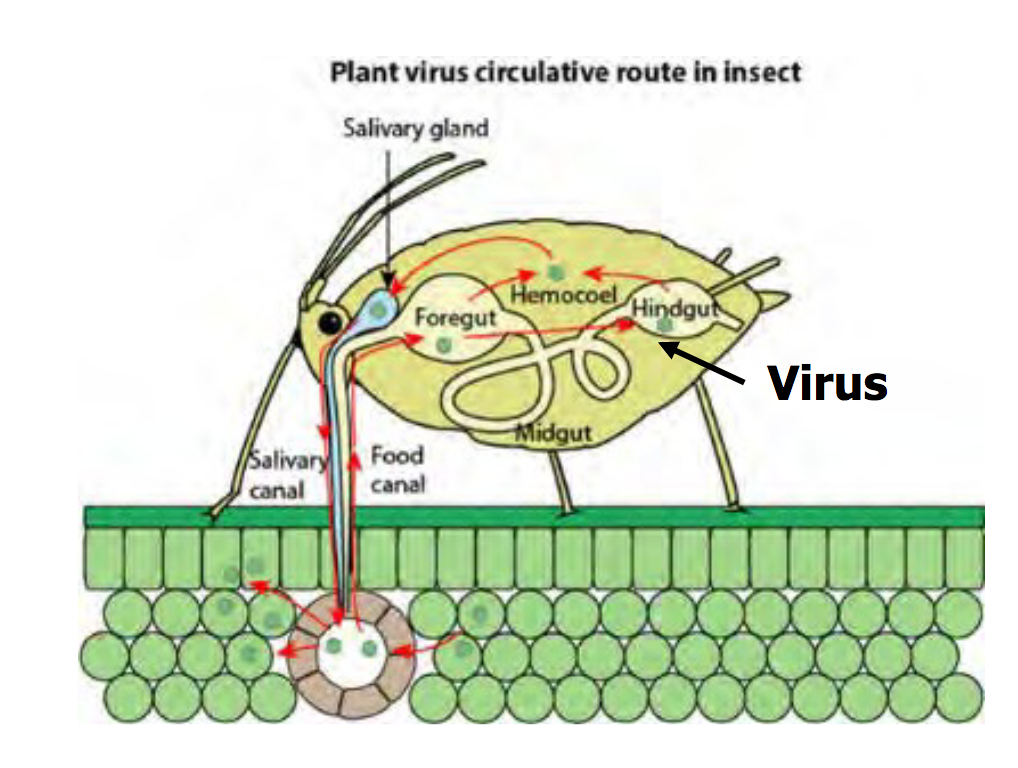
Government-backed researchers in America are aiming to use virus-carrying insects to genetically engineer crops – raising fears the technology could be used for biological weapons.You be the judge. More information at the Guardian link above, and at Vice's Motherboard. Embedded image via DARPA.
A new article in the journal Science explores the shadowy program funded by the US Defense Advanced Research Projects Agency (Darpa). The program aims to disperse infectious, genetically modified viruses that have been engineered to alter the
chromosomes of crops – using insects to spread the viruses to the plants.
Researchers have budgeted more than $45m to pursue the genetic engineering scheme, in a program dubbed Insect Allies.
The agency describes the research as a way to improve crop security: bugs like aphids, leafhoppers and whiteflies will be used to spread a virus to plants including corn and tomatoes, which will then impart beneficial genes making the plants resistant to disease or drought.
But in the Science article, an international team of scientists and lawyers warn that the technology could be put to more nefarious purposes, including military applications.
“It is our opinion that the knowledge to be gained from this program appears very limited in its capacity to enhance US agriculture or respond to natural emergencies,” they write. “As a result, the program may be widely perceived as an effort to develop biological agents for hostile purposes and their means of delivery.”..
“We have viruses which can genetically modify a plant, or even a mouse,” Reeves said. “But no one’s ever proposed dispersing them into the environment. That’s the thing that makes Insect Allies unique.”..
At the same time, the spread of virus-carrying insects could be hard to control...
Darpa says there is nothing to fear from the program.


Loving Vincent is a 2017 experimental animated biographical drama film about the life of painter Vincent van Gogh, and in particular, the circumstances of his death. It is the first fully painted animated feature film.The painting-on-glass technique employed for Loving Vincent reminded me of The Old Man and the Sea (1999) - embedded full-length here (plus a "making of" video):
Each of the film's 65,000 frames is an oil painting on canvas, using the same technique as Van Gogh, created by a team of over 100 painters. The film premiered at the 2017 Annecy International Animated Film Festival. It won Best Animated Feature Film Award at the 30th European Film Awards in Berlin and was nominated for Best Animated Feature at the 90th Academy Awards.


Carlsberg beer cans are to be stuck together with glue as it becomes one of the first brewers to abandon plastic rings.
The Danish firm said the move, which has been heralded as a world-first, to attach its multi-packs with adhesive will reduce the use of plastic to package products by 75 per cent.
After a three-year development process, Carlsberg insists the dots of glue bonding its new "Snap Packs" are strong enough to withstand journeys from shelves to homes, yet sufficiently brittle to break when twisted.