10 April 2017

Movie villain dermatology


As reported in JAMA Dermatology:
Dichotomous dermatologic depictions between heroes and villains date back to the silent film age and have been used to visually illustrate the contrasting morality between these character types. Classic dermatologic features of villainous characters include facial scars, alopecia, deep rhytides, periorbital hyperpigmentation, rhinophyma, verruca vulgaris, extensive tattoos, large facial nevi, poliosis, and albinism or gray-hued complexions. These visual cues evoke in the audience apprehension or fear of the unfamiliar and provide a perceptible parallel to the villainous character’s inward corruption...

These portrayals have ignited the formation of advocacy groups aimed at diminishing the perpetuation of existing discrimination by discouraging the use of degrading stereotypes in film. Notably, the National Organization for Albinism and Hypopigmentation (NOAH) has protested the portrayal of people with albinism as villains, although with limited success...
The all-time top 10 American film villains and heroes were obtained from the American Film Institute 100 Greatest Heroes and Villains List.
Six of the all-time top 10 American film villains (60%) have dermatologic findings, all of which are located on the face and scalp and are persistent in presentation. Dermatologic findings include cosmetically significant (Norwood-Hamilton stage ≥3) alopecia (30%), periorbital hyperpigmentation (30%), deep rhytides on the face (20%), multiple scars on the face (20%), verruca vulgaris on the face (20%), and rhinophyma (10%). Three of the villains (30%) have gray-hued complexions or unnatural skin color. Excluding cosmetically insignificant androgenic alopecia (Norwood-Hamilton stage ≤2), single facial scars, and transient lacerations or ecchymoses, none of the all-time top 10 American film heroes have significant dermatologic findings. All heroes have natural, non–gray-hued complexions. The top 10 villains have a higher incidence of significant dermatologic findings than the top 10 heroes (60% vs 0%; P = .03). Two villains (20%) and 2 heroes (20%) have red hair.
Detailed discussion at the link.   And a related article at The Guardian ("Disfigured heroes like Deadpool help people like me fight prejudice."

Rhytides clarified.

07 April 2017

Who you gonna call ?


Image cropped for emphasis from the one found here.

Butterfly poacher apprehended


From The Guardian:
An insect enthusiast who illegally captured and killed specimens of Britain’s rarest butterfly, the Large Blue, has been given a six-month suspended prison sentence...

Police later raided his terraced home in Cadbury Heath, near Bristol, and found a large number of mounted butterflies, including two large blues...

Michael Hartnell, defending, said: “He accepts the enormity of what he has done. He only had one from each site, but he accepts that if everybody did that they would die out.  [N.B. I am so delighted to see someone using the word "enormity" in the proper context.]
Here's one reason it's endangered:
In Victorian times the large blue was highly prized by collectors because of its wonderful colour and its rarity, as its unusual life circle means it cannot be bred in captivity.
The remarkable life cycle of the large blue means it can only thrive in very particular habitats. Eggs are laid on the flower buds of wild thyme or marjoram. The larvae burrow into the flower heads and when they are about 4mm long drop to the ground and wait to be found by foraging red ants, attracting them with sweet secretions from a “honey” gland. The ants place them in their brood chamber and the larvae feed on ant grubs. They turn into butterflies, crawl above ground, and fly in midsummer. 
Pugh said there was a market still for butterfly specimens. “People buy up old labels and cases and add in newly killed specimens.” The magistrates who sat at Cullen’s trial were told large blues can fetch £300 each.
The morphology and the life cycle of the Large Blue are very similar to the Karner Blue, found in the United States.

06 April 2017

The butterfly effect


This small white butterfly was found pressed between the pages of an eighteenth-century book.

It could - in theory - be the reason Donald Trump was elected President of the United States.

Bejeweled skeletons


As reported by Smithsonian:
On May 31, 1578, local vineyard workers discovered that a hollow along Rome’s Via Salaria, a road traversing the boot of Italy, led to a catacomb. The subterranean chamber proved to be full of countless skeletal remains, presumably dating back to the first three centuries following Christianity’s emergence, when thousands were persecuted for practicing the still-outlawed religion. An estimated 500,000 to 750,000 souls—mostly Christians but including some pagans and Jews—found a final resting place in the sprawling Roman catacombs...
The Catholic Church quickly learned of the discovery and believed it was a godsend, since many of the skeletons must have belonged to early Christian martyrs...

The holy bodies became wildly sought-after treasures. Every Catholic church, no matter how small, wanted to have at least one, if not ten...

Nuns were often renowned for their achievements in clothmaking. They spun fine mesh gauze, which they used to delicately wrap each bone. This prevented dust from settling on the fragile material and created a medium for attaching decorations. Local nobles often donated personal garments, which the nuns would lovingly slip onto the corpse and then cut out peepholes so people could see the bones beneath. Likewise, jewels and gold were often donated or paid for by a private enterprise. To add a personal touch, some sisters slipped their own rings onto a skeleton’s fingers. 
Much more at the link.

Desalination using a sieve


A sieve that will entrap molecules of salt, letting water through:
Reporting their results in the journal Nature Nanotechnology, scientists from the University of Manchester, led by Dr Rahul Nair, show how they solved some of the challenges by using a chemical derivative called graphene oxide.

Isolated and characterised by a University of Manchester-led team in 2004, graphene comprises a single layer of carbon atoms arranged in a hexagonal lattice. Its unusual properties, such as extraordinary tensile strength and electrical conductivity, have earmarked it as one of the most promising materials for future applications...

When common salts are dissolved in water, they always form a "shell" of water molecules around the salt molecules. This allows the tiny capillaries of the graphene-oxide membranes to block the salt from flowing through along with the water.

"Water molecules can go through individually, but sodium chloride cannot. It always needs the help of the water molecules. The size of the shell of water around the salt is larger than the channel size, so it cannot go through," said Dr Nair.

Urbanization on steroids


I'll save you the counting.  That's approximately 50 lanes of cars narrowing down to 25 tollbooths, and then funneling into a smaller highway thereafter. 

Photo via a Guardian article reporting that China plans to build a new city de novo that will be three times the size of New York City.

03 April 2017

It's April, and it's raining...


Conflation sources here and here for the culturally deprived.

From the archives of The New Yorker.

Balsam bough and birch tree thieves

One of the classic sensual pleasures of the holiday season is the scent of balsam permeating a home or place of business. Balsam trees, wreaths, and swags are used to decorate living rooms, doors, windows, and mantelpieces. In doing so, we probably never question where the balsam comes from; if we give it any thought, we assume it is harvested from commercial tree farms or represents a reuse of forestry waste products.

This fall I visited a lot (in a platted subdivision) where I’ve been clearing brush in preparation for building, and encountered two young men with a pickup truck. I thought they were hunters, but when I greeted them and saw no guns they told me they were searching for “balsam balls” (which I interpreted as “witches brooms”). I told them they were on private property, and cordially suggested that in the future they make use of a plat book to ascertain which properties were public and private. They indicated that they would continue searching, but wouldn’t disturb anything near the driveway, and they headed into the woods.

When I returned the next day I was shocked by the devastation they had wrought on the property. About a dozen balsam trees - all within a few yards of the driveway - had been stripped of branches. After a moment’s reflection I realized that they had been hunting “balsam boughs” for the holiday decoration trade.

Perhaps more disappointing than the theft itself was the technique they had used:


This wasn’t a matter of pruning a few branches from each tree; rather, the trunks had been stripped bare to the height reachable by a grown man wielding a lopper. Each of these trees is now essentially standing deadwood. And this from two young men whose heritage should reflect a deep respect for the natural environment.

The Minnesota DNR reported in 2004 that approximately 4000 tons of balsam boughs are harvested annually from our forests, each ton yielding roughly 400 wreaths; the state’s balsam bough industry had annual retail sales in 2004 topping $20 million. The vast majority of this trade is managed well, with bough-collecting permits obtained at state, tribal or county offices, depending on where the worker plans to gather material. As my experience shows, there are at least a few “rogue” workers who respect neither private property rights nor the environment.

(This is a repost of an item I originally wrote for this blog in December of 2007. With the holiday season approaching again and the economy even worse, property owners should be aware that trees are $$$ in some people's eyes. And not just evergreens - a mature walnut or other hardwood can yield a lucrative return for someone willing to work a few hours with a chainsaw...)

Reposted to alert readers that thieves are now stealing young birch trees:
Thieves are illegally cutting down thousands of birch trees in northern Minnesota and Wisconsin to make a quick buck off city dwellers who love the paper-white logs, limbs and twigs in their home decor...

Birch items are “kind of a hot item in home decor in both contemporary and traditional spaces,” said Scott Endres, co-owner of Tangletown Gardens in Minneapolis. “Folks in urban areas appreciate the beauty of it and like to have a little of the North Woods showing up in their outdoor containers, as well as their indoor decor. Interior designers use it a lot.”
The trees being targeted are generally young — 10 to 15 years old, about 2 to 4 inches in diameter and about 10 to 18 feet high, often growing in secluded areas... “It doesn’t matter if it’s state-owned or county-owned or privately owned,” he said. “If there are birch trees there, they cut them.”

Richter figures “unsophisticated, small-time thieves” who have a daily drug habit to support are responsible for most of the clear-cutting. Many of them formerly relied on stealing scrap metal. “They’re grabbing and stealing anything they can convert into money,” he said...

Richter said once the sap starts running, the birch trees may be less marketable because the paper bark is more susceptible to peeling off. “But once it freezes again, it’s going to be back on,” Richter said. “And it could be a bigger problem next year.”
Birch vandalism credit Washburn County Sheriff's Office.

"Inverted aquarium"


This is a recent video, but the concept of a "fish tower" is not new.  I first bookmarked a German link for a "Fish Loft" many years ago, thinking it would be a nice thing to put in the pond if I ever have a shack in the north woods.

Most of the images and videos of similar devices suggest using a wet vacuum to exhaust the air from the tower, but all that would need to be done would be to hold the tower underwater until it is full, then invert it on a stand (it would need to be secured because it would be very tippy, especially after the local raccoons find it).

01 April 2017

Victorian mourning ring


Incorporating a glass eye from the deceased. 

Via The Soul is Bone.

He's so excited by his first period


And this...


Both typos posted at the legendary Bad Newspaper (images cropped for emphasis).

Have you lost a cow?

Better look in your local badger sett.
Camera traps documented 2 solitary American badgers (Taxidea taxus) independently caching juvenile domestic cow (Bos taurus) carcasses during late winter 2016 in the Great Basin Desert of Utah. One carcass was partially buried and the other was entirely buried. Both badgers constructed dens alongside their cache, where they slept, fed, and spent up to 11 days continuously underground. They abandoned the sites 41 and 52 days after initial discovery. While badgers are known to scavenge and to cache small food items underground, this is the first evidence of an American badger caching an animal carcass larger than itself.
Video (time-compressed gif) here.  And more about setts.

0.99999999... is equal to 1.000000

This is true.  0.99999.... repeating to infinity is not really really really close to 1.0.  It equals 1.0.
0.9…, or in a variety of other variants such as 0.9, 0.(9)... denotes a real number that can be shown to be the number one. In other words, the symbols "0.999…" and "1" represent the same number. Proofs of this equality have been formulated with varying degrees of mathematical rigor, taking into account preferred development of the real numbers, background assumptions, historical context, and target audience.
There are a variety of ways to demonstrate this to nonbelievers.
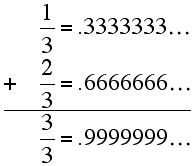
The most easily understood is to revert to other familiar repeating digits.  Everyone knows that 1/3 is 0.333... and that 2/3 is 0.666...  If you add them together, you get 3/3, which is one.

But now note that the sum of the decimals on the right side of the equation is 0.999...

Therefore, one is equal to (not close to) .999...

You don't agree?  Then try this.  Subtract .999... from one.  What you have is 0.000...  An infinitely long string of zeroes, which can only be equal to zero.  And if the subtraction of .999... from one leaves zero, then the .999... must be one.  But, you say, there's a one at the end that string of zeroes.  No, there isn't, because the string of 9s doesn't end.
Other proofs are offered at the Wikipedia entry.

Dragon risk of the anthropocene

"Emerging evidence indicates that dragons can no longer be dismissed as creatures of legend and fantasy, and that anthropogenic effects on the world’s climate may inadvertently be paving the way for the resurgence of these beasts."
Published online in Nature, April 1, 2015.
Related Posts Plugin for WordPress, Blogger...