Showing posts with label Shakespeare. Show all posts

29 May 2026

A cartoon for English majors - updated


This one was "over my head."  I'll post now for other English majors to ponder, and update after the weekend with some relevant details and links.

Addendum: As I was preparing this series of memorial posts about George Booth, one of the library books included some biographical material.  They indicated that Booth did not tend to use "gag writers" to provide the captions accompanying his cartoons, but that when he did encounter a potentially useful phrase, he saved it up until an appropriate cartoon came to mind.  Two examples were cited.

The cartoon above has text based on the play Cymbeline (in Act III, Scene 6 "Wales.  Before the cave of Belarius"), when they spot Imogen (dressed as a boy) in the cave:
BELARIUS
[Looking into the cave]
Stay; come not in.
But that it eats our victuals, I should think
Here were a fairy.
GUIDERIUS
What's the matter, sir?
BELARIUS
By Jupiter, an angel! or, if not,
An earthly paragon! Behold divineness
No elder than a boy! 

Re-enter IMOGEN

IMOGEN
Good masters, harm me not:
Before I enter'd here, I call'd; and thought
To have begg'd or bought what I have took:
good troth,
I have stol'n nought, nor would not, though I had found
Gold strew'd i' the floor. Here's money for my meat...
The scene has been illustrated for various publications of the play, as in this example (a reproduction from the Dallas Museum of Art):


and again here:


and yet again here:


So the scene appears to be well recognized by artists and thespians.  But the phrase "By Jupiter, an angel..." was totally unfamiliar to me (in my defense I would suggest that Cymbeline is one of Shakespeare/deVere's lesser-performed works).  It wasn't until I read the Booth biography and the cartoon at the top was discussed that I was prompted to search Google for the true source of the quotation.

Interestingly, the biography went on to offer one more cartoon based on a quotation from someone.  The caption in this cartoon -


- was credited to "Hank Martin."  I spent a lot of time fruitlessly Googling that name before finally deciding that the reference must be to Henry Martin, who like Booth was a longtime New Yorker cartoonist.

But... to what is the text of the caption referring???  I have been unable to find a primary source for the "lone grape" sentences (searches typically lead to cartoon compilations that include both Booth and Martin).  Perhaps the excitement on the bus was something spoken to Booth by Martin privately, or perhaps it exists in some correspondence or book.  For now it remains a mystery unless some reader of this blog can suss it out.


Resposted from 2022 to accompany a new post about humor for English majors.

26 November 2025

A concise summary of the Oxfordian narrative

I have excerpted the following from the Summer 2025 issue of the Shakespeare Oxford Newsletter:
"Where do you begin when, at a dinner party, someone says to you, “What’s this authorship nonsense all about? Who is this Oxford anyway?” Have you ever wished for a conversational aid; a simple statement to which you could refer that succinctly describes why you are an Oxfordian? The Shakespeare Authorship Question (SAQ) is horrifically complicated and requires real commitment, deep reading and thoughtful analysis to have a full appreciation of the issues. It’s difficult to explain quickly to people unfamiliar with the topic.

What if we could consolidate and summarize “The Case for Oxford?” What if we tried to winnow down all the research, wisdom and weight of circumstantial evidence accumulated over the past hundred years into a clear set of statements? Is it even possible to declare what all Oxfordians agree on? This spring, a group of Oxfordians in England, the United States and around the world attempted to do just that... 

The Oxfordian Narrative was deliberately kept to one page with six statements. This core principles section is supported by a few Frequently Asked Questions, all composed from information available in more detail on the SOF and DVS websites...

The following set of statements has been compiled to provide speaking and written prompts for Oxfordians engaging externally with the media and more widely. The core principles are concise, positive and authoritative, and are supported by a section of Frequently Asked Questions. They form the basis of the Oxfordian narrative and represent the common ground that is respectful of the many differing views held by our members."

08 November 2023

"Shakespeare Was a Woman and Other Heresies"


Several years ago I offered a recommendation for the best book about the Shakespeare authorship controversy.  Elizabeth Winkler is not the first to suggest that perhaps Shakespeare was a woman or that there were multiple authors of "Shakespearean" works.  What she does do is offer very well-informed presentations of all the candidates, incorporating her own interviews with conventional Stratfordian and modern "heretic" advocates.

The chapters that I found most interesting were the ones presenting the case for Christopher Marlowe as the author of many of the plays.  He had all of the necessary intellectual, educational, and social attributes, and in addition was deeply involved in the administration of Queen Elizabeth's governance.  Many modern scholars believe Marlowe was a spy for her.  The Marlovian theory of Shakespeare authorship notes that his death came after a supposedly drunken brawl which involved two other persons now considered to have been spies for Elizabeth.  The supposedly fatal blow was from being stabbed in the eye by a knife - an injury that might have disguised the actual identity of the body, which was examined not by a public coroner, but by one of Elizabeth's appointees.  After this public "death" (and the pardon of the supposed murderers!), Marlowe is suspected to have then traveled anonymously to the continent, where he could continue his spying under an assumed identity.  Curiously, just 13 days after Marlowe's "death" the first works of "Shakespeare" began appearing.  See the links for more details regarding Marlowe as the author - a suggestion that is repellant to "Stratfordians" and unappealing to "Oxfordians," but which is interesting to ponder.

Honorificabilitudinitatibus

Honorificabilitudinitatibus is the ablative plural of the medieval Latin word honorificabilitudinitas, which can be translated as "the state of being able to achieve honours". It is mentioned by the character Costard in Act V, Scene I of William Shakespeare's Love's Labour's Lost.  As it appears only once in Shakespeare's works, it is a hapax legomenon in the Shakespeare canon. It is also the longest word in the English language featuring alternating consonants and vowels.

The earliest use listed in the Oxford English Dictionary is 1599, by Thomas Nashe: "Physitions deafen our eares with the Honorificabilitudinitatibus of their heauenly Panachaea, their soueraign Guiacum." 
Here is the Shakespeare [Oxford] quotation:
"O, they have lived long on the alms-basket of words.
I marvel thy master hath not eaten thee for a word;
for thou art not long by the head as
honorificabilitudinitatibus: thou art easier
swallowed than a flap-dragon."
- Costard, Love's Labour's Lost, Act V, Scene 1

Reposted from 2010.

26 April 2023

Dating the plays attributed to William Shakespeare


Thirteen minutes too long?  Short version: "Nobody knows when the plays were written."


Cartoon credit: Conde Nast

28 February 2022

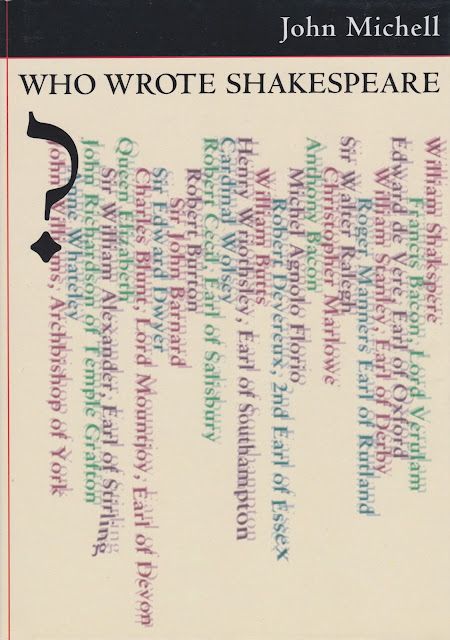
The best book about the Shakespeare authorship controversy


In the Shakespeare section of TWYKIWDBI, I've alluded several times to my belief that the true author of "Shakespeare's" works is not the man from Stratford, but rather Edward deVere, the 17th Earl of Oxford.  I came to that conclusion decades ago after attending a lecture on the authorship question.
Shakespeare's authorship was first questioned in the middle of the 19th century, when adulation of Shakespeare as the greatest writer of all time had become widespread. Shakespeare's biography, particularly his humble origins and obscure life, seemed incompatible with his poetic eminence and his reputation for genius, arousing suspicion that Shakespeare might not have written the works attributed to him. The controversy has since spawned a vast body of literature, and more than 80 authorship candidates have been proposed, the most popular being Sir Francis Bacon; Edward de Vere, 17th Earl of Oxford; Christopher Marlowe; and William Stanley, 6th Earl of Derby.
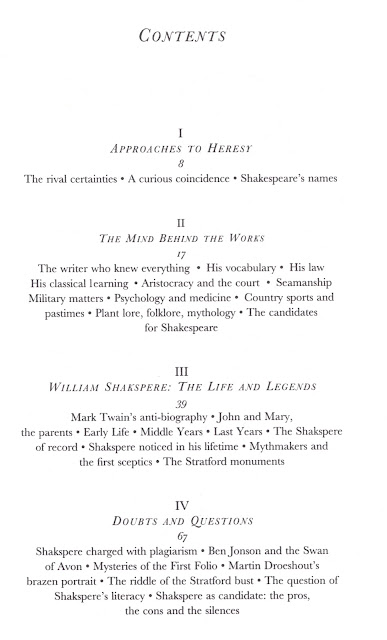
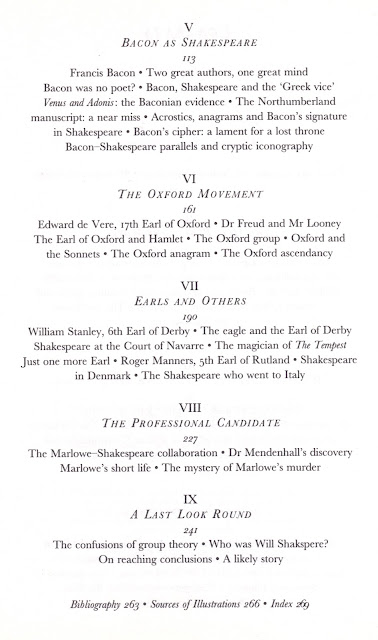
Since then I've done quite a bit of reading on the subject.  At the top of this post I've embedded a scan of the cover of what I consider to be the best and most objective treatment of the subject.  I was disappointed that the author was not an "Oxfordian."  On the contrary, he approaches the controversy methodically and thoroughly, as one can see from this table of contents:


I'll offer some excerpts from the book in the months ahead when I have more time.  For now I'll just present this info on the book for those with an interest in the subject.  It should be available in your local library.

30 September 2021

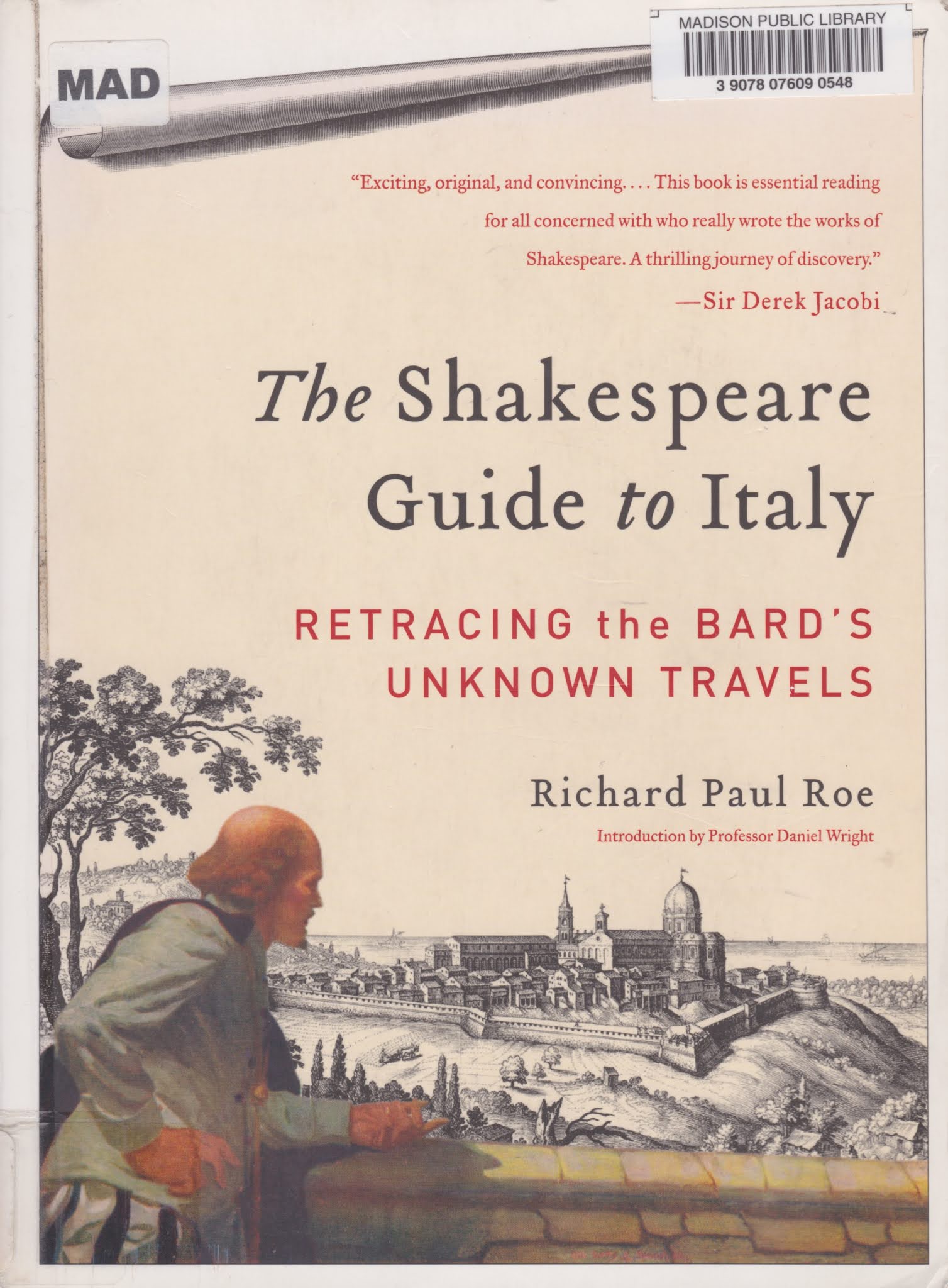
Shakespeare in Italy


This is a fascinating book, which will be appreciated by any serious reader of the plays, but will be of extra interest to those familiar with the Shakespeare authorship question.  The author of this book does not express an opinion on the authorship question, but what he does do is to delve in intricate detail into Shakespeare's knowledge of Italian geography, history, and social relations - all of which are relevant to the authorship puzzle.  He did this by traveling around Italy to see in person the locations described in the plays.

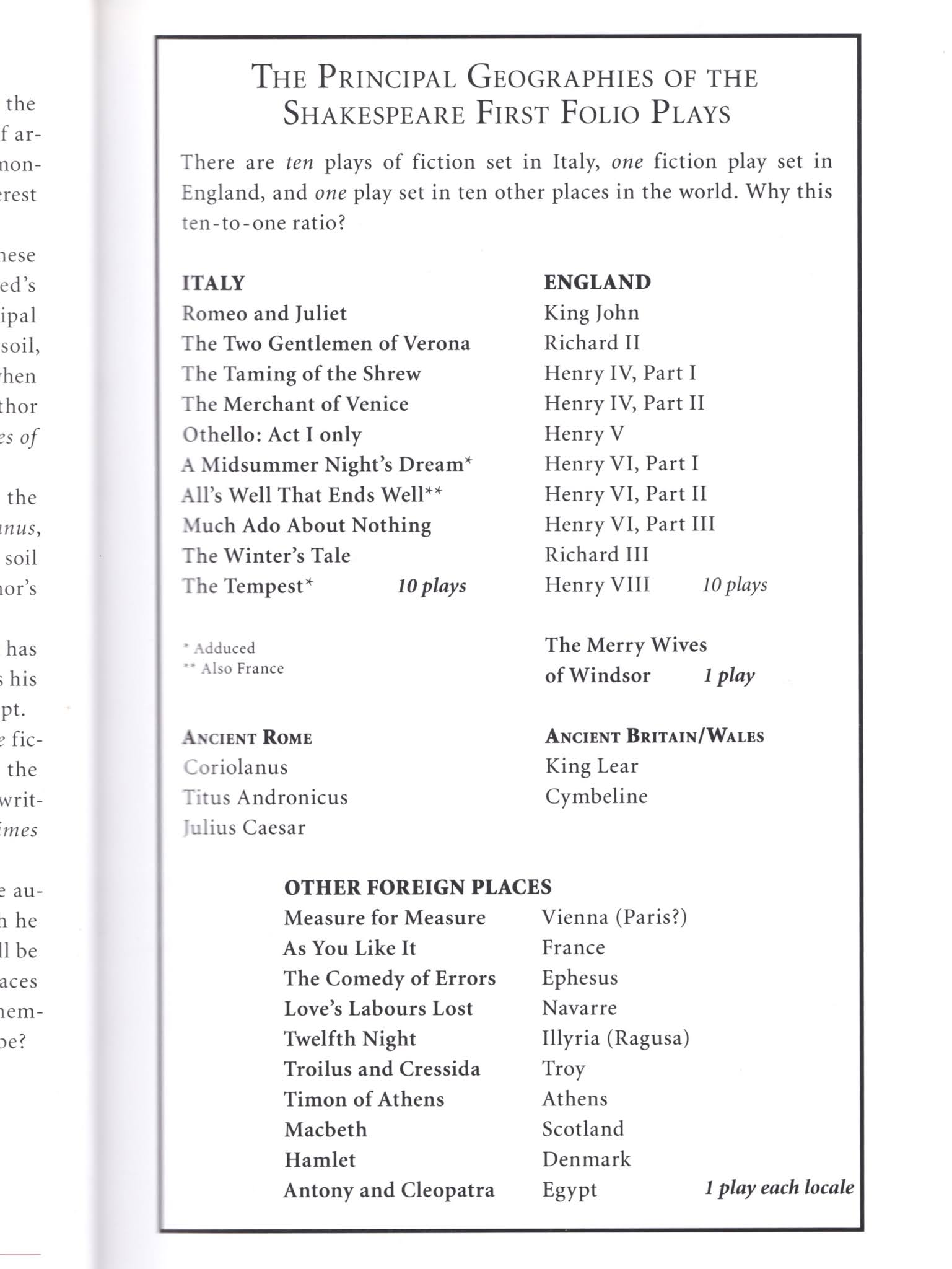
Casual readers of Shakespeare may not realize to what extent Shakespeare focused on Italy.  It really is quite remarkable, and I didn't appreciate it myself until I encountered this table in the book:


Note that of all the plays that are not historical, only one is set in England (Merry Wives) and only one most other places - but ten are set in Italy.

Some are obvious from the titles (Verona, Venice), some from the text (Romeo, Othello) and two by implication (The Tempest set on an island that matches Vulcano next to Sicily, and the "Duke's Oak" referenced in the A Midsummer Night's Dream is not a tree, but rather a passageway well-known in the sixteenth century in the Porta della Vittoria in Sabbioneta.)

So, how extensive was Shakespeare's knowledge about Italy?

Consider Romeo and Juliet.  The plot is not original to Shakespeare.  It was already an old tale back in the 1530s before Shakespeare was born; it was published in 1535, then rewritten by other Italian authors.  In the first act of the first scene of the version in the First Folio, Romeo's mother asks where her son is, and the reply is "... underneath the grove of sycamore/ That westward rooteth from the city's [Verona's] side..."  This detail is unique to the First Folio text ("there and nowhere else, not in any other Italian or French or English version - has it been set down that at Verona, just outside its western walls, was a grove of sycamore trees.")  And it is true.  To this day there are still sycamores in that exact location.  And Shakespeare knew that.

Also to be found in Shakespeare's version of Romeo and Juliet (and not in any previous versions) is reference to St. Peter's church in Verona - which does exist and is located in the same neighborhood described in the play.  

The Two Gentlemen of Verona "is the play with the most, and most highly varied, descriptions of and allusions to things Italian in the entire Shakespeare canon.  Indeed, if critics were to choose one single Italian Play to criticize, this is that play.  Critics say it has an absurd Italy, with seacoasts and harbors that never existed, and historical events that never happened...."  Chapter 2 of this book documents in detail that everything described by Shakespeare about Verona and about Italy is in fact correct (or was in fact correct in the 16th century).  
"The Riverside Shakespeare is not alone when it footnotes "road" as meaning a "seaport," which any mariner would know is exactly what a road is not... Along rivers the world over, there are wide places for ships to anchor called "roads."
Ports are on seacoasts, and are not synonymous with roads (or roadsteads), "and nowhere in The Two Gentlemen of Verona did Shakespeare write that there was a port of seaport at Verona, nor at Milan either." (as is often claimed).

Shakespeare has been lambasted by modern critics for placing a "sail-maker" in the city of Bergamo (Taming of the Shrew) because Bergamo is in the Alps, not on the coast, which is "claimed as proof of the author's ignorance of Italy's geography."  What these critics blithely ignore (or didn't know) is that "Bergamo is a city, from medieval times until now, devoted to the manufacture of textiles, which... has included velvet, silk, woolk, broadcloth... and always sailcloth, that ever-needed fabric made from hemp... The playwright knew that Bergamo was the principal source of sails for the Mediterranean world, and knew that Tranio's father could, indeed, have been a sailmaker there."  Sails were made close to the source of the textile; one didn't ship raw materials to a seaport to make the sails there.

In The Merchant of Venice, Shakespeare exhibits extensive knowledge about the Jewish community in Venice and about Jewish customs, kosher food, and clothing ("hardly everyday knowledge for an Englishman who'd never been beyond his native shores, or met a known Jew.") (Jews had been banned from England by the Edict of Expulsion in the 13th century and not allowed formal return until 1655).

Also interesting:  Of the 36 plays in the First Folio, 35 have men with swords.  "Only one Shakespeare play has no sword whatsoever: The Merchant of Venice."  When Portia dresses as a man, she wears a dagger instead.  Why?  Because "A sword was considered a weapon of aggression: while a dagger was ore often thoguht of as defensive.  Carrying a sword in the City of Venice was strictly against the law."  Shakespeare knew this.  Few people in sword-happy England would have.

And finally consider Othello.  
"For the plot of Othello the playwright drew upon one of a collection of stories by the Italian scholar and writer, Giovanni Battista Geraldi, called "Cinthio" (1504-1573)... published in Venice in 1565...  No English translation of Cinthio's work appeared before 1753, resulting in speculation over the years about how the playwright got hold of Cinthio's story.  Here, with my emphases added, is an extract from Appendix 3 of the Arden Shakespeare Third Edition of Othello:
A French translation by G. Chappuys appeared in 1583, and the first extant English translation not until 1753.  Chappuys kept close to the Italian version except for a few details, and Shakespeare could have read one or the other, or perhaps a lost English translation... Yet a lost English version, one that perhaps made use of both the Italian and the French texts, cannot be ruled out."
"This "lost English translation" proposition pervades nearly all analyses of the Italian Plays when the analyst cannot find an English version of the Italian, or Latin, source materials... the Arden continues:
"... whether we consider Cinthio or Chappuys or a lost English version as Shakespeare's original, a surprising number of verbal parallels found their way into the play from Cinthio, with or without intermediaries..."
The Riverside Shakespeare in its commentary says:
"Such verbal evidence as can be found tends to show that he looked at Cinthio's Italian.""
If one applies Occam's Razor, the most logical explanation of all this is that Shakespeare not only traveled to Italy, but also could read Italian.  

17 August 2020

Perhaps "Shakespeare" was a woman


There are lots of reasons to doubt that "the Stratford man" was the poet and author of the Shakespeare canon.   Old-time readers here know that I favor Edward deVere, the sixteenth Earl of Oxford, as the "true author," but this week I read a very interesting article in The Atlantic presenting evidence in favor of a woman.  Herewith some excerpts:
“One would think that he had been Metamorphosed from a Man to a Woman,” wrote Margaret Cavendish, the 17th-century philosopher and playwright. The critic John Ruskin said, “Shakespeare has no heroes—he has only heroines.” A striking number of those heroines refuse to obey rules. At least 10 defy their fathers, bucking betrothals they don’t like to find their own paths to love. Eight disguise themselves as men, outwitting patriarchal controls—more gender-swapping than can be found in the work of any previous English playwright. Six lead armies...

A tantalizing nudge lies buried in the writings of Gabriel Harvey, a well-known Elizabethan literary critic. In 1593, he referred cryptically to an “excellent Gentlewoman” who had written three sonnets and a comedy. “I dare not Particularise her Description,” he wrote, even as he heaped praise on her.
All her conceits are illuminate with the light of Reason; all her speeches beautified with the grace of Affability … In her mind there appeareth a certain heavenly Logic; in her tongue & pen a divine Rhetoric … I dare undertake with warrant, whatsoever she writeth must needs remain an immortal work, and will leave, in the activest world, an eternal memory of the silliest vermin that she should vouchsafe to grace with her beautiful and allective style, as ingenious as elegant.
Who was this woman writing “immortal work” in the same year that Shakespeare’s name first appeared in print, on the poem “Venus and Adonis,” a scandalous parody of masculine seduction tales (in which the woman forces herself on the man)? Harvey’s tribute is extraordinary, yet orthodox Shakespeareans and anti-Stratfordians alike have almost entirely ignored it...

Their doubt is rooted in an empirical conundrum. Shakespeare’s life is remarkably well documented, by the standards of the period—yet no records from his lifetime identify him unequivocally as a writer. The more than 70 documents that exist show him as an actor, a shareholder in a theater company, a moneylender, and a property investor. They show that he dodged taxes, was fined for hoarding grain during a shortage, pursued petty lawsuits, and was subject to a restraining order. The profile is remarkably coherent, adding up to a mercenary impresario of the Renaissance entertainment industry. What’s missing is any sign that he wrote.  No such void exists for other major writers of the period...

By contrast, more than a few of Shakespeare’s contemporaries are on record suggesting that his name got affixed to work that wasn’t his...

The authorship puzzles don’t end there. How did the man born in Stratford acquire the wide-ranging knowledge on display in the plays—of the Elizabethan court, as well as of multiple languages, the law, astronomy, music, the military, and foreign lands, especially northern Italian cities? The author’s linguistic brilliance shines in words and sayings imported from foreign vocabularies, but Shakespeare wasn’t educated past the age of 13. Perhaps he traveled, joined the army, worked as a tutor, or all three, scholars have proposed. Yet no proof exists of any of those experiences, despite, as the Oxford historian Hugh Trevor-Roper pointed out in an essay, “the greatest battery of organized research that has ever been directed upon a single person.”..

Hudson first learned of Bassano from A. L. Rowse, who discovered mention of her in the notebooks of an Elizabethan physician and astrologer named Simon Forman. In her teens, she became the mistress of Henry Carey, Lord Hunsdon, the master of court entertainment and patron of Shakespeare’s acting company. And that is only the start. Whether or not Bassano was Shakespeare’s lover (scholars now dismiss Rowse’s claim), the discernible contours of her biography supply what the available material about Shakespeare’s life doesn’t: circumstantial evidence of opportunities to acquire an impressive expanse of knowledge.

Bassano lived, Hudson points out, “an existence on the boundaries of many different social worlds,” encompassing the breadth of the Shakespeare canon: its coarse, low-class references and its intimate knowledge of the court; its Italian sources and its Jewish allusions; its music and its feminism. And her imprint, as Hudson reads the plays, extends over a long period. He notes the many uses of her name, citing several early on—for instance, an Emilia in The Comedy of Errors. (Emilia, the most common female name in the plays alongside Katherine, wasn’t used in the 16th century by any other English playwright in an original work.***) Titus Andronicus features a character named Bassianus, which was the original Roman name of Bassano del Grappa, her family’s hometown before their move to Venice. Later, in The Merchant of Venice, the romantic hero is a Venetian named Bassanio, an indication that the author perhaps knew of the Bassanos’ connection to Venice. (Bassanio is a spelling of their name in some records.)

Further on, in Othello, another Emilia appears—Iago’s wife. Her famous speech against abusive husbands, Hudson notes, doesn’t show up until 1623, in the First Folio, included among lines that hadn’t appeared in an earlier version (lines that Stratfordians assume—without any proof—were written before Shakespeare’s death). Bassano was still alive, and by then had known her share of hardship at the hands of men. More to the point, she had already spoken out, in her 1611 book of poetry, against men who “do like vipers deface the wombs wherein they were bred.”..

Prodded by Hudson, you can discern traces of Bassano’s own life trajectory in particular works across the canon. In All’s Well That Ends Well, a lowborn girl lives with a dowager countess and a general named Bertram. When Bassano’s father, Baptista, died in 1576, Emilia, then 7, was taken in by Susan Bertie, the dowager countess of Kent. The countess’s brother, Peregrine Bertie, was—like the fictional Bertram—a celebrated general. In the play, the countess tells how a father “famous … in his profession” left “his sole child … bequeathed to my overlooking. I have those hopes of her good that her education promises.” Bassano received a remarkable humanist education with the countess. In her book of poetry, she praised her guardian as “the Mistris of my youth, / The noble guide of my ungovern’d dayes.”

As for the celebrated general, Hudson seizes on the possibility that Bassano’s ears, and perhaps eyes, were opened by Peregrine Bertie as well. In 1582, Bertie was named ambassador to Denmark by the queen and sent to the court at Elsinore—the setting of Hamlet. Records show that the trip included state dinners with Rosencrantz and Guildenstern, whose names appear in the play. Because emissaries from the same two families later visited the English court, the trip isn’t decisive, but another encounter is telling: Bertie met with the Danish astronomer Tycho Brahe, whose astronomical theories influenced the play. Was Bassano (then just entering her teens) on the trip? Bertie was accompanied by a “whole traine,” but only the names of important gentlemen are recorded. In any case, Hudson argues, she would have heard tales on his return.

Later, as the mistress of Henry Carey (43 years her senior), Bassano gained access to more than the theater world. Carey, the queen’s cousin, held various legal and military positions. Bassano was “favoured much of her Majesty and of many noblemen,” the physician Forman noted, indicating the kind of extensive aristocratic associations that only vague guesswork can accord to Shakespeare. His company didn’t perform at court until Christmas of 1594, after several of the plays informed by courtly life had already been written. Shakespeare’s history plays, concerned as they are with the interactions of the governing class, presume an insider perspective on aristocratic life. Yet mere court performances wouldn’t have enabled such familiarity, and no trace exists of Shakespeare’s presence in any upper-class household.
I'm always reluctant to copy too much from primary sources, but my intention is to prompt you to read more at the original.

01 March 2019

Another source for Shakespeare's writing


As reported by the New York Times:
For years scholars have debated what inspired William Shakespeare’s writings. Now, with the help of software typically used by professors to nab cheating students, two writers have discovered an unpublished manuscript they believe the Bard of Avon consulted to write “King Lear,” “Macbeth,” “Richard III,” “Henry V” and seven other plays.

The news has caused Shakespeareans to sit up and take notice. “If it proves to be what they say it is, it is a once-in-a-generation — or several generations — find,” said Michael Witmore, director of the Folger Shakespeare Library in Washington.

The findings were made by Dennis McCarthy and June Schlueter, who describe them in a book to be published next week by the academic press D. S. Brewer and the British Library. The authors are not suggesting that Shakespeare plagiarized but rather that he read and was inspired by a manuscript titled “A Brief Discourse of Rebellion and Rebels,” written in the late 1500s by George North, a minor figure in the court of Queen Elizabeth, who served as an ambassador to Sweden...

The book contends that Shakespeare not only uses the same words as North, but often uses them in scenes about similar themes, and even the same historical characters. In another passage, North uses six terms for dogs, from the noble mastiff to the lowly cur and “trundle-tail,” to argue that just as dogs exist in a natural hierarchy, so do humans. Shakespeare uses essentially the same list of dogs to make similar points in “King Lear” and “Macbeth.”..

In 1576, North was living at Kirtling Hall near Cambridge, England, the estate of Baron Roger North. It was here, Mr. McCarthy says, that he wrote his manuscript, at the same time Thomas North was there possibly working on his translation of Plutarch.

The manuscript is a diatribe against rebels, arguing that all rebellions against a monarch are unjust and doomed to fail. While Shakespeare had a more ambiguous position on rebellion, Mr. McCarthy said he clearly mined North’s treatise for themes and characters.
I think it's essential to note that George North's writings were not published and thus would not have been available to Shakespeare from a public library.  This was a handwritten manuscript


kept in an aristocratic household of someone in Queen Elizabeth's court.  It's hard to imagine the manuscript getting into the hands of a Stratfordian son of a glovemaker and farmer's daughter.  It would not, however, have been inaccessible to Edward de Vere, the 17th Earl of Oxford.

01 August 2018

"Nothing" was a Shakespearean euphemism for female genitalia

Explained at The Telegraph:
The familiarity of the phrase 'much ado about nothing’ belies its complexity. In Shakespeare’s day 'nothing’ was pronounced the same as 'noting’, and the play contains numerous punning references to 'noting’, both in the sense of observation and in the sense of 'notes’ or messages. A third meaning of 'noting’ – musical notation – is also played upon (eg in Balthazar’s speech 'Note this before my notes/There’s not a note of mine that’s worth the noting.’) However it is a fourth use of the homonym – this time as 'nothing’ – that is the most controversial element of the title. 'Nothing’ was Elizabethan slang for the vagina (a vacancy, 'no-thing’ or 'O thing’). Virginity – a state of potentiality rather than actuality – is also much discussed in the play, and it is these twin absences – the vagina and virginity – that lead, in plot terms, to the 'much ado’ of the title. 
This was not something that came up in my high school or college course discussions.  More info at the TodayILearned subreddit, where the example of an "innuendo-laden" dialogue between Hamlet and Ophelia is cited -
Hamlet: Lady, shall I lie in your lap?
Ophelia: No, my lord.
Hamlet: I mean, my head upon your lap?
Ophelia: Ay, my lord.
Hamlet: Do you think I meant country matters?
Ophelia: I think nothing, my lord.
Hamlet: That's a fair thought to lie between maids' legs.
Ophelia: What is, my lord?
Hamlet: Nothing.
- where the word "country" also offers a obvious salacious innuendo.

More discussion at the link, with other Shakespearean citations.  Perhaps I should rewrite the title of my 2010 post Proving that "pussy" jokes are nothing new.

20 May 2015

Claims for "the face of Shakespeare" in the frontispiece of a botany book - updated


Excerpts from an interesting report in The Guardian:
The botanist and historian Mark Griffiths on Tuesday claimed that he had discovered what he firmly believes is the only demonstrably authentic portrait of Shakespeare made in his lifetime.

He argues that an engraving on the title page of a 400-year-old book about plants contains four identifiable figures - one of whom is the Bard aged 33 looking very different from the round-faced bald man we know from the First Folio of his collected works...

The work by William Rogers, England’s first great exponent of copperplate engraving, is on the title page of a groundbreaking 1598 book, The Herball or Generall Historie of Plantes, by the horticulturist John Gerard.

It is full of elaborate decorative devices, flowers and symbols which surround four male figures, who had generally been assumed to be allegorical.

Griffiths, in the course of writing a book about Gerard, decided to discover who the men might be. He had to crack an elaborate Tudor code of rebuses, ciphers, heraldic motifs and symbolic flowers, which were all clues pointing to the men’s identities.

The relatively easy ones were Gerard himself, the renowned Flemish botanist Rembert Dodoens and Queen Elizabeth’s chief minister and closest adviser Lord Burghley, who was Gerard’s patron. That left the tricky fourth man, bottom right...
This claim has been disputed and childishly mocked ("So apparently Shakespeare went around in fancy dress holding a fritillary in one hand and a cob of corn in the other.") by various Shakespeare scholars.

What fascinates me is the juxtaposition of the images of Shakespeare and Lord Burghley:
Griffiths believes Shakespeare was given his literary start by Burghley, the most powerful man in the country and that he became almost a political propagandist for him.

If you accept that theory, then Shakespeare would have moved in the same circles as Gerard, as both men had Burghley to thank for their careers.

Griffiths said his theory was that Shakespeare helped Gerard with Greek and Latin translations in the book and acted as a kind of script doctor. So the four men are the writer himself, his patron, his inspiration (Dodoens) and his literary adviser.
"...the identification of Gerard, Burghley and Dodoens was straightforward because they look like existing portraits."
Lord Burghley was William Cecil, the chief advisor and spymaster for Queen Elizabeth, inarguably one of the most prominent, educated, and influential men of his time.  He was known as a book-lover, and his home contained one of the premier private libraries of Elizabethan England.  In 1562 John de Vere, the 16th Earl of Oxford died; his son became a royal ward of the Queen and was placed in the household of William Cecil.  That 12-year-old boy was Edward de Vere, who would have been in his 30s when this herbal was published.

Addendum:  Here is the rebus under the figure in the frontispiece reputed to be Shakespeare:


From the full herbal, which can be viewed fulltext online at The Folger Shakespeare Library.  As noted at the Guardian link, Griffiths read the rebus as "In Elizabethan times, people would have used the Latin word “quater” as a slang term for a four in dice and cards. Put an e on the end and it becomes quatere, which is the infinitive of the Latin verb quatior, meaning shake."

Addendum:  Just for fun, I made a mashup of the face in the herbal with the "Hilliard miniature," previously claimed to be a portrait of Shakespeare:


I flipped the latter left-right to facilitate comparison.  Note also that the laurel wreath on the head of the left figure is a traditional item designating a poet.

I note that an article in The Spectator suggests that the face in the herbal could represent Sir Walter Raleigh.

02 May 2013

Multiple authors of "Shakespearean" works?

For the birthday anniversary of the Stratford man, a Guardian columnist detailed one variation on the authorship controversy - that the corpus is the work of several authors.
The Shakespeare Birthplace Trust – the guardian of Shakespeare's global image – will publish a book of some 20 academic essays that sets out to prove definitively that Shakespeare wrote the plays and poems attributed to him. Shakespeare Beyond Doubt marks a radical development in the Shakespeare Authorship Question, for it is the first time that the "establishment" has felt the need to acknowledge its existence and importance.

In the past, they have dismissed this question as only of interest to fantasists.. This is the first time that the subject is being taken seriously as "an intriguing cultural phenomenon". Why are they so worried?..

One reason is the publication in paperback of Shakespeare's Unorthodox Biography by American scholar, Diana Price, in which she analyses every piece of evidence in existence concerning Shakespeare and concludes that the case for Shakespeare writing all of the works attributed to him is quite weak. As with my own research, Price does not argue for an alternative author but rather shows how the case for Shakespeare is built on mis-readings, mythologising and, often wilful deception...

A number of plays that appeared in the first collected works (the First Folio, printed in 1623, seven years after Shakespeare's death) have been shown to be works of more than one writer. I would argue that many more than this are collaborations and that some of the plays in that collection were not written by Shakespeare. For example, one record attributes Romeo and Juliet to Samuel Daniel, a contemporary of Shakespeare; Hamlet was being performed on stage 10 years before Shakespeare is supposed to have written it. These are just two of many such examples...

I receive hate mail on a regular basis and have been advised to "drop it now" if I wish to get published ever again. Yet I do not argue for an alternative author and do not suggest that any other individual wrote the plays and poems. I simply do not believe that Shakespeare wrote all of the plays and poems attributed to him and evidence seems to suggest I am right.
More details (and many comments) at The Guardian.

24 December 2012

Snap-dragon on Christmas Eve

Snap-dragon (also known as Flap-dragon) was a parlour game popular from about the 16th to 19th centuries. It was played during the winter, particularly on Christmas Eve. Brandy was heated and placed in a wide shallow bowl; raisins were placed in the brandy which was then set alight. Typically, lights were extinguished or dimmed to increase the eerie effect of the blue flames playing across the liquor. The aim of the game was to pluck the raisins out of the burning brandy and eat them, at the risk of being burnt...

Other treats could also be used. Of these, almonds were the most common alternative or addition, but currants, candied fruit, figs, grapes, and plums also featured... The low bowl was typically placed in the middle of a table to prevent damage from the inevitable splashes of burning brandy. In one variation a Christmas pudding is placed in the centre of the bowl with raisins around it...

The first printed references to snap-dragons or flap-dragons are in Shakespeare's Love's Labour's Lost (1594): "Thou art easier swallowed than a flapdragon."

By the mid-19th century Snap-dragon was firmly entrenched as a Christmas parlour game, and it is in this sense that it is referenced in 1836, in Charles Dickens' The Pickwick Papers and in 1861, in Anthony Trollope's novel Orley Farm.  Lewis Carroll, in Through the Looking-Glass, and What Alice Found There (1871) describes "A snap-dragon-fly. Its body is made of plum pudding, its wings of holly-leaves, and its head is a raisin burning in brandy."

Agatha Christie's book Hallowe'en Party describes a children's party )during which a child's murder causes Hercule Poirot to be brought in to solve the case) at which Snap-dragon is played at the end of the evening...

Michael Faraday, in his essay The Chemical History of a Candle (1860), suggested that the raisins in Snap-dragon act like miniature wicks. The concept is similar to that of burning brandy on top of Christmas puddings – the brandy is burning, but is not burning at a high enough temperature to consume the raisins.  Nevertheless, children often burnt their hands or mouths playing this game, which may have led to the practice mostly dying out in the early 20th century.
I think the game should be restarted at Christmas, even at the risk of burning hands.  (Reposted from 2010)

07 March 2012

"Wherefore art thou Romeo?"


Retailers in the U.K. are being criticized for placing on sale the t-shirt above. 
Anybody who buys it will not only look really, really silly, but will be trying to make people think they know about Shakespeare. Because it’s cool. Shakespeare is cool without having to put it on a tshirt. And if you didn’t see the error, you don’t deserve to use his words to make a fashion statement.
The man from Avon actually spelled his name in a variety of ways on legal documents through this life.  There are six surviving signatures by him, as follows:
Willm Shakp
William Shaksper
Wm Shakspe
William Shakspere
Willm Shakspere
By me William Shakspeare
As noted at Wikipedia this is not as ominous as it appears:
Most of these are abbreviated versions of the name, using breviographic conventions of the time. This was common practice. For example Edmund Spenser sometimes wrote his name out in full (spelling his first name Edmund or Edmond), but often used the abbreviated forms "Ed: speser" or "Edm: speser". 
We'll come back to the Stratford man's name some other time.  To finish with the t-shirt, we note that it is now sold in a "cropped" version:


The pricing has not been reduced by a third, however.

The reason I posted the shirt was because it gives me an excuse for a rant that is familiar to many (?most) English majors.  Students and amateur theatrical groups almost invariably butcher the line by declaiming "Romeo, Romeo, wherefore ART thou, Romeo?"  They interpret "wherefore" as an archaic version of "where," and confusedly assume that Juliet is unable to locate Romeo standing below her balcony.

For the Elizabethans, "wherefore" meant "why," as in this Biblical verse: "Even all nations shall say Wherefore hath the LORD done thus?"  The proper emphasis on the Shakespearean verse is therefore "Romeo, Romeo, wherefore art thou ROMEO?" as she wonders why he had to be a Montague.


Enough.  Most of you know this already.  But it bugs me when I hear it done incorrectly.

05 December 2011

The shady side of the Stratford man

The 1596 writ charging Shakespeare with making death threats, discovered in Britain's National Archives by the Canadian scholar Leslie Hotson in 1931. The second of the four entries is the one relating to the playwright.

Excerpts from an interesting article about the Stratford man from an article in The Smithsonian:
There is not the least shred of evidence that anybody, in the early years of the Shakespeare cult, bothered to travel to Warwickshire to interview those in Stratford who had known the playwright, even though Shakespeare’s daughter Judith did not die until 1662 and his granddaughter was still alive in 1670. The information that we do have lacks credibility, and some of it appears to be untrue...

But this only makes it all the more remarkable that scholars of Shakespeare have chosen to pretty much ignore one of the very few new documents to emerge from the National Archives over the last century. It is an obscure legal paper, unearthed from a set of ancient sheets of vellum known as “sureties of the peace”, and it not only names Shakespeare but lists a number of his close associates. The document portrays the “gentle Shakespeare” that we met in high school English class as a dangerous thug; indeed, it has been plausibly suggested that it proves he was heavily involved in organized crime...

"Be it known," the Latin text begins,
that William Wayte craves sureties [guarantees] of the peace against William Shakspere, Francis Langley, Dorothy Soer wife of John Soer, and Anne Lee, for fear of death, and so forth. Writ of attachment issued by the sheriff of Surrey, returnable on the eighteenth of St Martin [November 29, 1596].
The scholar who unearthed the document—an indefatigable Canadian by the name of Leslie Hotson, best remembered today as the man who first stumbled across the records of the inquest into the highly mysterious murder of Shakespeare’s fellow playwright, Christopher Marlowe—uncovered a squalid tale of gangland rivalries in the theatrical underworld of Queen Elizabeth’s day...

Shakespeare was obliged to begin his career on a lowly rung, working for disreputable theater people—which, at that time, was generally regarded as akin to working in a brothel... Most biographers suggest his first employer was Philip Henslowe, who became wealthy as much from his work as a brothel landlord as he did as a theatrical impresario. Nor was the playwright’s next boss, Langley, much of a step up. Langley, as Hotson’s minutely careful research shows, had made much of his fortune by crooked means, and was the subject of a lengthy charge sheet that included allegations of violence and extortion... Langley’s most dangerous opponent was William Wayte, the man who accused Shakespeare of threatening him...

Biographers who have made mention of the writ’s discovery since Hotson made it in 1931 have tended to dismiss it. Shakespeare must simply have got caught up in some quarrel as a friend of Langley’s, they suggest–on very little evidence, but with the certainty that the author of Hamlet could never have been some sort of criminal... This seems almost willful distortion of the evidence, which seems fairly unambiguously to show that the playwright—who is named first in the writ–was directly involved in the dispute....

There is plenty of evidence elsewhere that Shakespeare was somewhat less than a sensitive poet and entirely honest citizen. Legal records show that him dodging from rented room to rented room while defaulting on a few shillings’ worth of tax payments in 1596, 1598 and 1599... That Will Shakespeare was somehow involved in the low-life rackets of Southwark seems, from Hotson’s evidence, reasonably certain... It is tempting to speculate, however, whether the profits that paid for such an opulent residence came from Will’s writing–or from a sideline as strong-arm man to an extortionist.
More at the Smithsonian, where the relevant sources are listed.  And this sentence: "There is not the least shred of evidence that anybody, in the early years of the Shakespeare cult, bothered to travel to Warwickshire to interview those in Stratford who had known the playwright" is worth discussing in detaiil in a blogpost separately at some future time.

05 October 2011

The "signature" of Judith Quiney, nee Shakespeare

Excerpts from her biography page in Wikipedia:
Judith Quiney (baptised 2 February 1585 – buried 9 February 1662), née Shakespeare, was the youngest daughter of William Shakespeare and Anne Hathaway. She married Thomas Quiney, a vintner of Stratford-upon-Avon...

She was the younger sister of Susanna and the twin sister of Hamnet. Hamnet however, died at the age of eleven. Her baptism on 2 February 1585 was recorded by the vicar, Richard Barton of Coventry, in the parish register for Holy Trinity Church, Stratford-upon-Avon...

Judith Shakespeare was probably illiterate. In 1611 she was asked to witness a deed of sale for a house belonging to her sister-in-law, Elizabeth Quiney, and to Elizabeth's son Adrian. Judith signed twice with a mark instead of her name... 
Note her "signature" is the pigtail-shaped mark at the left.  The surname was appended by a court scribe.

26 September 2011

Anonymous (the movie)

A hat tip to Bub for alerting me to the upcoming (October 28) release of the movie "Anonymous." Those of you who are long-time readers of this blog may remember or have surmised that I am a proponent of the proposition that Edward de Vere was the true author of the works attributed to the "shakspere" guy in Stratford.

The movie is directed by Roland Emmerich (Stargate, Independence Day, The Day After Tomorrow, 2012), who has said this re its development:
It's three characters. It's like Ben Jonson, who was a playwright then. William Shakespeare who was an actor. It's like the 17th Earl of Oxford who is the true author of all these plays. We see how, through these three people, it happens that all of these plays get credited to Shakespeare. I kind of found it as too much like Amadeus to me. It was about jealousy, about genius against end, so I proposed to make this a movie about political things, which is about succession. Succession, the monarchy, was absolute monarchy, and the most important political thing was who would be the next king. Then we incorporated that idea into that story line. It has all the elements of a Shakespeare play. It's about kings, queens, and princes. It's about illegitimate children, it's about incest, it's about all of these elements which Shakespeare plays have. And it's overall a tragedy. 
I suspect it will be a little "over the top," but perhaps it will introduce more of the general public to the doubts surrounding the Stratford man's authorship.

More about the Shakespeare authorship question some other time. Those who are interested in literature and history will be well rewarded by scanning this Wikipedia article on the Oxfordian theory, and then visiting the website of the Shakespeare-Oxford Society.

14 January 2011

The Elizabethan ruff

One of my Christmas gifts this year was the book shown above, about the Shakespeare-Oxford connection. I'll review it later this winter, but by coincidence I encountered a nice post this week at A Polar Bear's Tale which featured five paintings of seventeenth-century ladies wearing similar collars, including this "Portrait of a Woman" (1628) by Michiel Jansz van Miereveldt:
Was there any practical purpose for such an elaborate collar?  Inquiring minds want to know.  First stop: Wikipedia -
The ruff which was worn by men, women and children, evolved from the small fabric ruffle at the drawstring neck of the shirt or chemise. They served as changeable pieces of cloth that could themselves be laundered while keeping the wearer's doublet from becoming soiled at the neckline.

The discovery of starch allowed ruffs to be made wider without losing their shape. Later ruffs were separate garments that could be washed, starched, and set into elaborate figure-of-eight folds by the use of heated cone-shaped goffering irons. Ruffs were often coloured during starching, vegetable dyes were used to give the ruff a yellow, pink or mauve tint. A pale blue colour could also be obtained via the use of smalt, though for an unknown reason Elizabeth I took against this colour and issued a Royal Prerogative "Her Majesty's pleasure is that no blue starch shall be used or worn by any of her Majesty's subjects."

At their most extreme, ruffs were a foot or more wide; these cartwheel ruffs... required a wire frame called a supportasse or underpropper to hold them at the fashionable angle...
I suppose in an era when washing-up was not very meticulous, the removable collar did protect other clothing from stains.  For "goffering irons" I had to retreat to the OED: to flute or crimp, from the French gaufrer "to stamp figures on cloth."  And "smalt" is also of French derivation (ultimately related to the smelting of ores), and refers to a deep blue glass colored by cobalt oxides.

For those interested, the starching process is explained in detail, with pix, at Elizabethan Costume.  Detailed instructions on how to actually make the ruff are explained here.

"The ruffs, or collars, framed the face and dictated the hairstyles of the age which were generally short for men and swept up look was required for women."

12 August 2009

Creating "lightning" on the Elizabethan stage


As I promised last week while reviewing a blog about "unfarming," I've just finished a reread of an old Edwin Way Teale book - A Naturalist Buys an Old Farm. It's a book that will delight those who take pleasure in learning about the natural world. But the passage that most intrigued me this time taught me something about stagecraft of the 17th century:
“The fastest-burning material I have ever thrown into our fireplace was a handful of the infinitesimally small spores of the club moss, Lycopodium complanatum. When I tossed this living yellow dust, gathered in the woods, among the flames, it ignited in an almost instantaneous flash of brilliant light. This same light, produced in a similar way, stabbed across the stage in Shakespeare’s day when lycopodium powder was ignited to simulate lightning.”
Pictures of the moss here; it's apparently native to the Upper Midwest, but I don't recall having seen any. Will need to keep my eyes open.

24 January 2009

More thoughts re Tycho Brahe and ... Hamlet


Last week I blogged an entry postulating that 16th century Danish astronomer Tycho Brahe was murdered by mercury poisoning. In other coverage of that theory, the TimesOnline offered this interesting morsel:
A new theory by Danish scholars claims that Brahe was poisoned with mercury on the orders of Christian IV, the King of Denmark, because the astronomer had an affair with his mother. It is even suggested that Shakespeare used the alleged liaison as an inspiration for Hamlet.
That prompted me to track down the relationship between Tycho Brahe and Hamlet. There are several interesting aspects to this.

In the portrait above, Tycho Brahe is surrounded by the coats of arms of his ancestors. Note that two of those are Rosenkrans and Gyldenstern, names that appear (as Rosencrantz & Guildenstern) in the Tragedy of Hamlet, prince of Denmark, written in 1601, the year Brahe died. The characters in Hamlet were more likely modeled after contemporary members of the same families, who came with the Danish legation to England in 1592.

It doesn't end there. In November 1572 a spectacular supernova exploded. It was so bright that it could be seen in the daytime. Tycho Brahe observed it...
During the 16 months that it blazed in the sky, Tycho wrote a book about the apparition, called ''De Nova Stella'' - of the new star.
...and it has subsequently been named after him as "Tycho's Supernova." In 1998 it was proposed that this supernova is specifically referenced in the opening scene of Hamlet:
Bernardo: Last night of all, When yond same star that's westward from the pole Had made his course to illume that part of heaven Where now it burns, Marcellus and myself, The bell then beating one, - [enter Ghost]
Apparently the time of night and the location of the skies are consistent with Tycho's Supernova. The event is central to the meaning of the play, in that the heavens are supposed to be constant, so that changes in them are viewed as portending "fierce events" on earth.

There's one more aspect of this worth mentioning. The supernova occurred in 1572. At the time William "Shakspere" was the 8 year old son of a provincial wool dealer in rural Stratford. Edward de Vere, the 17th Earl of Oxford, has been born in 1550, so was 22 years old, and his father-in-law, Lord Burghley, was asked by Queen Elizabeth to investigate the new heavenly development. And, not only that...
Edward de Vere's brother-in-law Peregrine Bertie visited Elsinore in 1582 on a royal embassy to the King of Denmark, a visit that included a dinner [with] Rosenkrantz and Guildenstern. The King brought Bertie out to Tycho's observatory to meet the fabled astrologer.
Which might also explain this...
Conventional scholars have long wondered how the author of Hamlet could have known about peculiar details of Danish royal culture, including King Claudius's bizarre drinking ritual involving firing cannon blasts with every downed shot of liquor, a true-to-life drinking game of the convivial Danish king at the time, Frederick II.
Enough for now. Tycho Brahe tightly linked to Hamlet in several ways. The links provide indirect support for the hypothesis that Edward deVere, the 17th Earl of Oxford was the actual author of the works commonly attributed to "William Shakspere" of Stratford. More on that some other time.

(Image credit to the Escutcheons of Science website - impressive index here - and a hat tip to Dr. Michon for proofreading this post).
Related Posts Plugin for WordPress, Blogger...