Showing posts with label Civilian Conservation Corps. Show all posts

15 July 2022

A fire lookout station as an overnight campsite


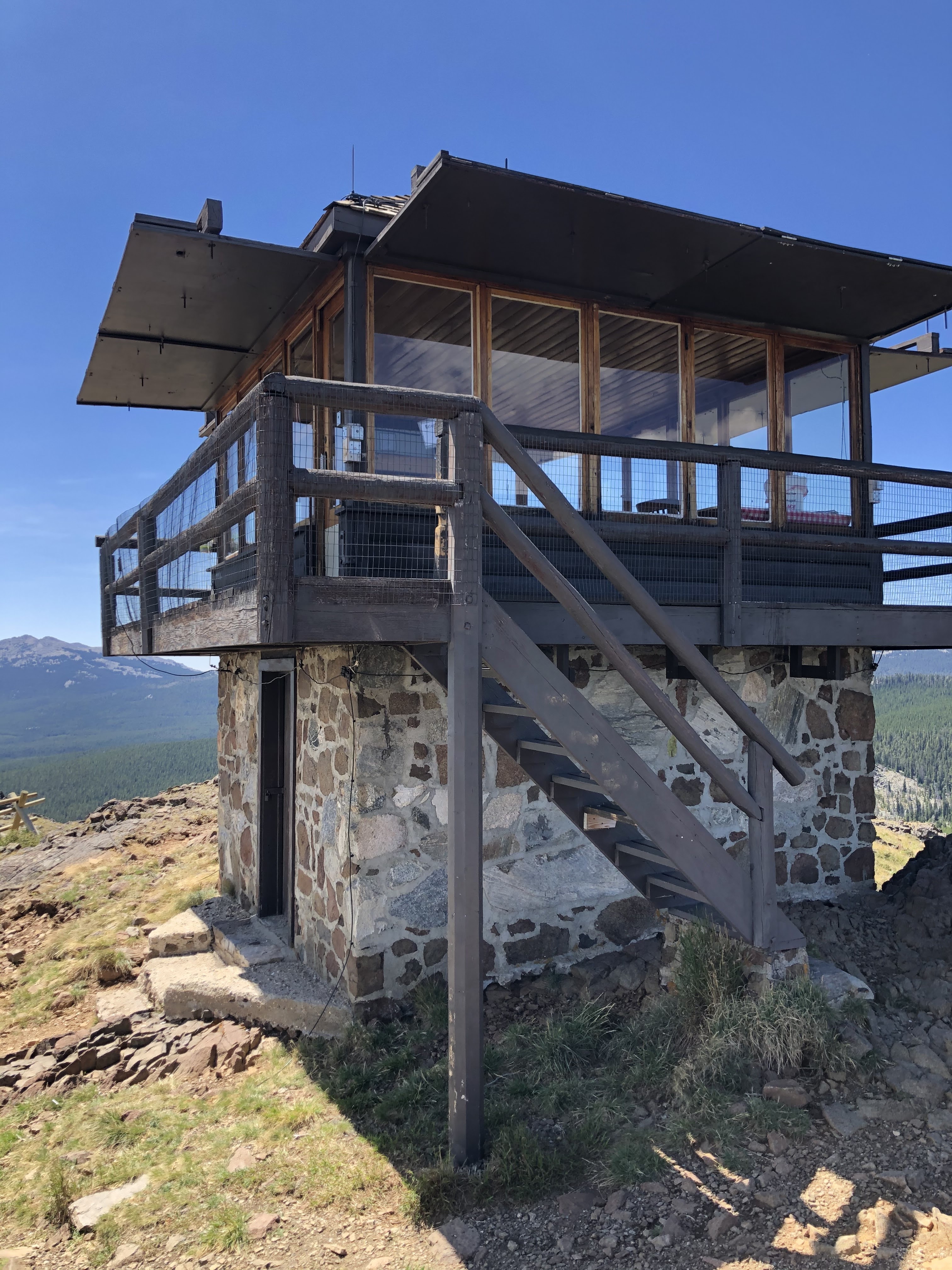
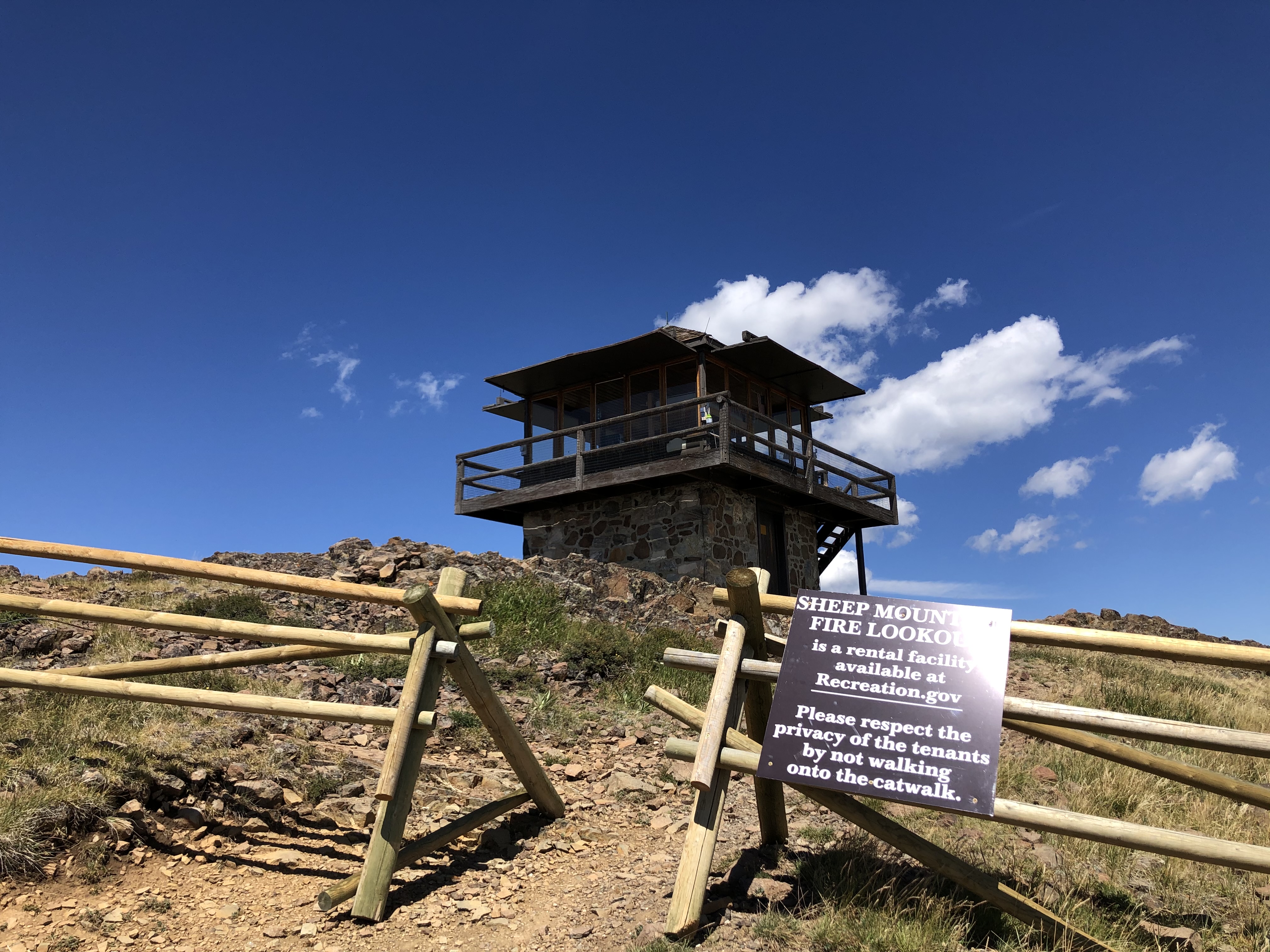
This Wyoming fire lookout station is available to the public for overnight camping.  
Perched atop a forested mountain, the historic Sheep Mountain Fire Lookout offers a unique recreation experience -- one of few fire lookouts in the region available for overnight rental. Constructed in 1950 by the Civilian Conservation Corps (CCC) atop Sheep Mountain at an elevation of 9,600 feet, the lookout was historically occupied as a fire lookout until the early 1970s. The lookout is available for rental from June 15 through October 20; however, access to the facility may be limited depending on snow accumulation. Guests are advised to call ahead to confirm access to the facility. Limited amenities are provided; please be prepared to pack in supplies and gear for a comfortable stay. Visitors are advised that this facility has always been a popular destination for recreational visitors to come and enjoy the views and historical nature of the area, therefore, solitude from other forest users may not be an option at this facility.
The facilities are "rustic" -
This facility is primitive in nature. While a single vault toilet and one set of bunk beds are available, there is no running water, indoor plumbing or electricity. Basically, what is available are four sturdy walls, sound roof, no neighbors and commanding views from the lower quadrant of the Bighorn Mountains all the way out to South Dakota's forests. It is recommended that guests bring all their water and accommodations needed for overnight camping. This is a "pack-it-in, pack-it-out" facility; guests will need to carry out all trash and clean the facility prior to leaving.
But the view is...


... spectacular.  And not mentioned in the official blurb is that this location in rural Wyoming should offer a relatively dark sky and the opportunity for outstanding stargazing.

These photos were sent to me by my neighbor Eric, who is aware of my interest in the stonework of the Civilian Constuction Corps.  To that end, he added this photo of the base of the fire tower:


Very characteristic of the CCC program, utilizing local material - not brick or concrete blocks.  The mortar is rather thick compared to the more snugly-nested stones seen at some other sites, perhaps reflecting the youth and inexperience of the participants, or the absence of a local expert.  I note this structure was completed in 1950, well after the bulk of CCC projects and near the end of the program.  

29 September 2021

Remembering the Dust Bowl


Excerpts from an article in Harper's:
By the 1930s, five sixths of the original indigenous animal population that existed in the United States when the Europeans arrived had been wiped out. Seven eighths of the original woodlands had been cleared. One sixth of the topsoil in the United States would shortly blow away in the ecological disaster of the Dust Bowl.

The dust storms were very much a man-made disaster, the result of the heedless booms and busts that had succeeded one another for decades on the High Plains...

Unlike the dirt-poor farmers of the Tennessee Valley, the plowmen of the High Plains were able to obtain the latest motorized combines and tractors, thanks mostly to cheap bank loans, and during the wheat booms of the 1920s they used their machines to tear apart the fragile ecosystem of the land around them. As prices kept declining due to the glut of crops they kept producing, they ripped into even more marginal lands, still funded by the local, undercapitalized banks that forked over loans with low interest rates on almost no collateral...

“The tractors had done what no hailstorm, no blizzard, no tornado, no drought, no epic siege of frost, no prairie fire, nothing in the natural history of the southern plains had ever done,” Egan noted.
They had removed the native prairie grass, a web of perennial species evolved over twenty thousand years or more, so completely that by the end of 1931 it was a different land—thirty-three million acres stripped bare on the southern plains.
Before long, the dust began to blow. There were 14 dust storms in 1932, another 38 the next year, a record 134 in 1937...

A fresh storm blew up on May 9, 1934, this one out of the freshly turned earth of Montana and Wyoming, an estimated 350 million tons of dirt suddenly airborne. It dropped more than 12 million tons of grit on Chicago, then covered the East Coast from Boston to Savannah. In New York City, it cut the sunlight of a lovely spring day in half for five hours. Nor did it stop there, since there was nothing to stop it. The duster did not dissipate until it had blown over three hundred miles out over the Atlantic Ocean, startling sailors when it rained dirt on the decks of their ships...

When birds and snakes all but disappeared from the Dust Bowl, they were replaced by a biblical plague of locusts, unseen in the West for decades, with as many as 14 million of the ravenous grasshoppers to a mile. At least one state government responded by sending out the National Guard to coat the land with up to 175 tons of insecticide per acre, thereby finishing off any life the drifting dirt or the grasshoppers might have left behind...

Along with the men from the Agriculture and Interior departments, the federal government sent out boys from the Civilian Conservation Corps (CCC)—a huge new program created to absorb the thousands of destitute, homeless young men who had previously been riding the rails, living in hobo camps, and idling in cities, with nowhere else to go.

Many criticized this and other New Deal programs as socialist or fascist, but the CCC paid the three million young men it employed over the years thirty dollars a month (twenty-five of which they were required to send home to their families) and provided them with decent meals, a good place to sleep, education, exercise, and some training in woodcraft. In return, they planted thousands of acres of new buffalo grass and other, experimental drought-resistant grasses garnered from around the world. Before the program ended with World War II, they had also constructed more than eight hundred state parks and planted nearly three billion trees, many of them in the shelterbelts FDR had insisted upon, to tie down the soil. Together with Bennett’s experiments they had restored more than half of the damaged land by the time the war began.
Much more at the link.  And I highly recommend the series of programs presented on American Experience regarding the Dust Bowl, and Ken Burns' documentary on the subject.

30 August 2021

Custer Peak Fire Lookout Tower (Black Hills, SD)


Because of self-imposed covid-related travel restrictions it has been several years since I've added new material to the Civilian Conservation Corps category of posts in TYWKIWDBI.  But friends, family, readers, and neighbors have kindly sent me photos, including this set from Custer State Park in South Dakota (from my next-door neighbor Eric - thank you!)


The stonework here is emblematic of the principles established for these projects across the country - stone rather than brick or concrete, and stone locally sourced rather than purchased from a commercial quarry.  The work would have been completed by teenagers and young men from around the country, under the supervision of a professional stonemason.

Hill City, South Dakota is the site of the CCC Museum of South Dakota, which is devoted to preserving the memory of the CCC.
The goal was two-fold: conservation of our natural resources and the salvage of our young men. The work of America's young men dramatically changed the future. More than 30,000 men contributed to the many significant projects in South Dakota and were able to help support their families back home.
The objective of the CCs in Camps Pine Creek, Doran, Lodge, and Narrows (Robber's Roost) was not to improve on nature but to make it more enjoyable and accessible to the nature-loving public and to aid wildlife (1937)...

CCs developed recreation areas at Horsethief Lake, Stockade Lake, Center Lake, and Grizzly Bear camp ground and along French Creek near Blue Bell. They built the state museum, 17 cabins at Sylvan Lake, most of the buildings at the resort area of Blue Bell, and the custodian's 5-room log cabin and barn; installed sewer and water systems at Sylvan Lake, Blue Bell, Game Lodge and the Custodian's house; built the lookout tower and developed the scenic viewing area on Mount Coolidge; constructed bridges at Sunday and Palmer Gulches, the double arch bridge across French creek, and a pigtail bridge on Iron Mountain Road.

In addition, the CCs cleaned and landscaped many miles of park road, built the park telephone system , developed other scenic points, foot trails, and bridle paths and did considerable work at the zoo and state farm. They erected over 50 informational signs, exterminated bark beetles on thousands of acres, built many fire trails, and extinguished numerous forest fires.
A visit to South Dakota is on my bucket list.

25 September 2017

CCC spillway at Pope Farm Conservancy (Wisconsin)


The first seventeen entries in my ongoing series of posts about the stonework of the Civilian Conservation Corps featured structures situated in state and national parks - bridges, ramparts, towers, stairways and other substantial achievements.  Stonework of that type has been well preserved because of the locations and ongoing usefulness of the structures.

But the boys in the CCC also did an immense amount of work in fire prevention (fire breaks, lookout towers), reforestation, water control (dams, reservoirs) and soil conservation.   The structure in the photo above is one of probably thousands of such water/soil conservation measures that have been generally forgotten (and in most cases left to fall into disrepair).

I encountered this stonework while hiking at the Pope Farm Conservancy, a working farm with restored natural areas located in the western suburbs of Madison, Wisconsin.  I had visited there last year to photograph and blog the remarkable display of sunflowers.

On my recent visit I explored a different part of the property, where hiking trails had been carved out of restored short-grass prairie:


Without a panorama image it's hard to depict the rolling contour in this area created by deposition of sand during the terminal phase of the last glaciation.  The hill in front of me (above) is a recessional moraine.  To the right of the photo the land slopes downward, then back up again to a broad "bowl" currently covered by cropland and native prairie.


Prior to the arrival of European immigrants, a basin like this would have been covered with either long grasses or short grasses -


Prairie grasses evolved immense root systems that enabled them to regrow after intensive grazing by massive herds of bison, or after wildfires or drought.  What they couldn't survive was the introduction of intensive farming, and especially the cutting power of steam- or gasoline-powered tractors.  I don't need to repeat here the familiar sequence of stripping vegetation to plant crops, followed by topsoil erosion by wind and water.

By the 1930s a basin such as the one above would have been deeply gullied by rainwater and snowmelt and the runoff would have been choking local streams with sediment.  Teams of CCC boys were mobilized to correct these problems on a farm-by-farm basis.

All you see now at the base of the "bowl" is this concrete structure:


This is a simple, but perfectly adequate spillway.
"This dam design, called a head flume, was suggested by UW-Madison soils and agriculture professor Otto Zeasman.  It was simple because the intent was merely to slow the flow of water during times of heavy rain and runoff."
To the left and right of the downsloping segment are short concrete walls and then earthen berns, which direct water to the center:


The chute prevents ground erosion as it conducts the water down the steepest part of the slope.  At the base of the chute (hard to see with summer vegetation overgrowth) is a triangular concrete "velocity check" structure, and behind that a pile of large boulders in the "stilling basin":


These components of the spillway absorb the kinetic energy of the falling water, which then proceeds down the ravine in the background with much less erosive force (cutting the velocity in half reduces erosion by a factor of 64 according to the information on a local informational placard).  Another placard notes:
"Construction of the dam began in late summer 1938.  A CCC crew of about a dozen young men needed about 2-3 weeks to finish the project.  Other "soil saving" dams of the Great Depression era are quietly deteriorating in farm fields all over Wisconsin.  Still others have been removed.  This structure on the Pope Farm Conservancy site is the only one in south-central Wisconsin (and perhaps the entire state) that is being protected as an historic landmark."
Kudos to the Pope Farm Conservancy for their stewardship of the land and the preservation of this example of a simple structure that helped rural farms recover from the devastating effects of the Great Depression and the Dustbowl.

13 June 2016

CCC stonework at Interstate Park, Wisconsin


I recently had the pleasure of visiting Wisconsin's Interstate Park, located along the shoreline of the St. Croix River which separates Wisconsin and Minnesota (a corresponding Interstate Park on the opposite bank of the river is part of the Minnesota state park system).

I had finished walking a wooded trail and was driving out of the park when I glanced off to the side and spotted the chimney in the photo above.  That stopped me in my tracks, and I pulled off the road to investigate.  I parked in an empty lot serving two buildings that are apparently just used for storage.  Here's the awesome front of the other building:


It was immediately apparent to me that I had stumbled upon yet another example of the Civilian Conservation Corps stonework that I have featured in fifteen previous posts in this blog.  Here is the side of this building:


Delighted by this unplanned discovery, I proceeded on to the ranger station, and was fortunate to have the opportunity to speak to Julie Fox, a Naturalist and the park's resident historian.  She affirmed that the stonework was indeed a product of the CCC (and later the WPA), which had been instrumental in the improvement of the park as a public resource.

There is other stonework in a variety of locations in the park.  Some of it, such as the wall along this road, has been subject to a lot of wear and has required updating for safety reasons, so that what currently exists may not represent original CCC craftsmanship.


The same principal applies at other locations such as stairways and ramparts at viewpoints over the Dalles of the St. Croix River.  This one that I photographed at the end of the Pothole Trail is new construction completed within the past decade; the masons were asked to emulate the style of the CCC workers.


Ms. Fox directed me to a location I would not otherwise have found - a shelter at a picnic ground well back in the woods away from the current parking area. 


Structures like this are standard features on innumerable state and national parks, designed to offer shelter to picknickers and campers during inclement weather, and providing in this case two fireplaces for cooking.


What was unusual to my eye was the squared-off faces of the structural stones.  Even the finest craftsmen couldn't achieve this degree of regularity with hand tools, so I suspect the crew working on this building had access to some type of stone or masonry saw.


It's tidy and perfectly functional, but in my view lacks the charm and raw beauty of the rough stone used in the old park headquarters buildings, so I returned there for a closer look at the stonework:


One of the mandates of the CCC projects was the preferential utilization of local resources.  Julie Fox confirmed that the stone used at Interstate Park was the same basalt that forms the striking landscape of the park, and that it was in fact quarried within the boundaries of the park, using a methodology that dates back to prehistoric times (heating the rock with fire, then dousing it with cold water to fracture it into workable sizes.)

My eye is always drawn to the mortar as a reflection of the skills and experience of the builders.  The CCC gave employment (and taught skills) to a generation of young men from a depression-ravaged nation, taking them from city slums and rural towns where they most likely had never had relevant work experiences.

The CCC hired local stonemasons to guide (and train) the young men.  In the 1920s the building of stone walls and buildings was a respected profession, and I can sense in much of the CCC work the "eyes" and pride of lifelong stoneworkers in selecting colorful and interesting stones that are beautiful rather than just functional (see the stonework at Gooseberry Falls for an excellent example).


I'll be back to this park again the next time I travel to west central Wisconsin.  There's more stonework to find there (stairways for example) and some park buildings that I missed on my quick visit this week.  I hope to repost an addendum later this summer.

More information about Interstate Park in this video.

(As a reminder to readers, fully half the posts in the CCC category of this blog contain photos (from Alaska, Florida, New Mexico, New York) credited not to me, but to readers.  If you find good examples during your summer travels, snap some images and send them along).

Addendum: Forest Army has a report on the CCC work at Interstate Park, including the excavation of a bison skull (currently on display in the park's new headquarters building).  The post incorporates this image (apparently a contemporary postcard) -


- depicting the stonework along the roadside of the park (mortared at the dropoff, drywall on the right).
02 September 2015

CCC stonework in Alaska


It's been over a year since I've added any posts to the Civilian Conservation Corps category of this blog, in part because family circumstances have prevented me from doing the requisite exploration and photography.

Today I'm pleased to offer some photos submitted by reader AnneF, who on a trip to the Tongass National Forest in Juneau, Alaska, noted that the Skater's Cabin there was constructed by the CCC.
Skater’s Cabin Picnic Shelter is located on the shore of the southwest corner of Mendenhall Lake, near the Mendenhall Glacier. It is accessible from the Mendenhall Loop Road, approximately 6 miles from the Auke Bay Ferry Terminal, or approximately 13 miles from downtown Juneau. The cabin was constructed in 1936 by the Civilian Conservation Corps and is made with natural stone.
The amount of mortar between the stones would suggest that the young men doing the work were relatively inexperienced, or perhaps that the available local stone was granitic and not amenable to shaping to fit.  But the end result fits pleasingly into the natural landscape and has provided a welcome amenity to visitors for several generations already.

Thanks Anne!

26 June 2014

CCC-constructed stone "Kiwanis Cabin" in New Mexico


Summer is the time for travel, and thus the opportunity for me and the readers of this blog to visit CCC-constructed stonework projects around the country.  These photos come to us courtesy of reader Christopher, who recently traveled to Albuquerque, and found this stone structure at an altitude of 10,000+ feet along the Sandia Crest Road.


A plaque embedded in the stone confirms the provenance of the structure.  It is classic CCC work in that it makes use exclusively of local stone.  The style obviously does not involve tight junctions, and the overall appearance of a partially-collapsed "ruin" is clearly an artistic endeavor.  I found this explanation online:
The trail starts out along the crest and then wanders into the woods for a while, before skirting the edge of Kiwanis Meadow and winds its way back towards the crest and to the Kiwanis rock house. In the 1920's the Kiwanis Club of Albuquerque built a log cabin on the site which was destroyed by fire a couple of years later. A second log cabin was destroyed by high winds. In the 1930's the Kiwanis Club asked the Civilian Conservation Corps to build them a new cabin, which they did in the summer of 1936. The CCC constructed the cabin out of local limestone, and in the style known as "Rustic Aesthetic."

Inside, the structure seems to follow the general pattern of other state- and national-park CCC buildings, serving as a shelter from inclement weather, with a basic fireplace? for cooking.

The Albuquerque Journal had this additional information in 2007:
To clean a year's worth of graffiti off the Kiwanis Cabin at Sandia Crest, it takes three archaeologists, a truck with a pressure washer, someone to drive the truck and someone to use the washer in a way that doesn't damage the cabin...
 
The cabin had windows on three sides, a fireplace and a door, but the fireplace was sealed and the windows and door were removed.  "Beginning in the '40s the windows started being broken," Hudson said.
So sad to hear about the graffiti and vandalism performed by mindless cretins.

A quick search this morning produced a detailied pdf about the role of the CCC in the New Mexico park system.  I also found these notes about the CCC in New Mexico in the Forestry Service's website:
In the span of eight years, from 1933 to 1941, 54,585 Civilian Conservation Corps enrollees in New Mexico built hundreds of roads and rails, 795 bridges, 472 lookout towers large dams and reservoirs, installed millions of rods of fences and planted millions of trees for reforestation and to prevent gully erosion.  When these New Mexico men joined the corps, along with 3.5 million other Americans, the country was in desperate straits. Close to 25 percent of the population was unemployed. Hunger and despair had become a way of life.  A group of local corps alumni want to see a memorial CCC museum of national stature built on the site where CCC Camp 814 F-8-N Sandia Park once stood on a piece of land just off NM 536, the Sandia Crest Road. They want people to know what they accomplished in youthful days during the Great Depression. And they want today’s youth to know that youth are a major asset to this country, just as the CCC men were when they were boys. The CCC was the greatest-ever conservation effort in American history.
I have a variety of pleasant memories of the Sandias, dating from the time I lived in Dallas and visited family in Grants and friends in Albuquerque.  But despite hiking and playing frisbee in the mountains, I don't remember ever having encountered this cabin.

Again, a hat tip to reader Christopher for sending me the photos; if readers in the Albuquerque region have photos of other stonework along the Sandia Crest Trail (bridges, stairways), please feel free to send them along.

05 January 2014

CCC stonework at Highlands Hammock State Park (Florida)


The fourteenth entry in our series on the stonework of the Civilian Conservation Corps (and the fifth to be "outsourced" to a reader of the blog), comes from Highlands Hammock State Park in Sebring, Florida, which was recently visited by reader Kay Shapiro, who posted these photos in her blog Soapbox by Kay.

The philosophy of the CCC and the economic realities of the Great Depression mandated that construction be done with locally-sourced materials, which obviously would have presented some difficulties for stonework in the state of Florida.  Kay notes that the stone in the structures she found was not as intrincially beautiful as that used for projects at Gooseberry Falls, Yellowstone, or Watkins Glen.

It's also likely that the young men assigned to the Florida camps would have had less experience working with stone than those in the Northeast or western states, and there may have been fewer professional stonemasons available to hire to supervise them.  As evidence of this I would point to the fireplace at the park's museum building:


I use the distance between the stones as a rough index of the skill and experience of the stonemason - the finest in the world, in my view, being the dry stone walls of the Inca, as this one at Cuzco:


Here is Kay's photo of the fireplace as seen from the inside of the museum:


The comparison is of course unfair, since the Inca had slave labor and endless time and resources.  I would suspect also that the stone available in Florida at the time was probably of a sedimentary type that would have been more friable and thus less amenable to shaping before placement in a strucure compared to that used in Minnesota.

What I like about the stonework at Highlands Hammock State Park is exemplified by the  bridge in the top photo.  It's not merely a utilitarian structure.  It serves its function to traverse a waterway, but the builders also curved the walls out at the ends, then recurved the abutment (detail photo at right) to allow the placement of native plants - extra time, work, and scarce resources expended for a visually-pleasing esthetic effect.

At the park there is a statue commemorating the work of the men and boys of the Civilian Conservation Corps.  The bronze figure looks identical to the one at Gooseberry Falls State Park in Minnesota, but the text on the memorial plaque is a bit more poignant.


It is dedicated to the memory of Civilian Conservation Corps enrollees who were disabled or lost their lives in the performance of their work - noting in particular the ones who perished at three camps in the Upper Florida Keys when their workplaces were devastated by a hurricane.

Kay also photographed a map at the park showing the locations of CCC projects around the United States:


There's probably one near you.  When the temperature gets above freezing, consider going for a visit.  And take your camera.

01 November 2013

CCC stonework at Robert H. Treman State Park


Today's tour of the Robert H. Treman State Park (Ithaca, N.Y.) features photography by reader Flask Ehrlenmeyer, who was a contributor to the Watkins Glen post last month.

The Friends of the park provide this description of the Civilian Conservation Corps' activities:
"Company 1265, Camp SP-6, Robert H. Treman State Park, Enfield, NY was started up in May of 1933 with tents on platforms. By winter all structures were wooden, Army-style barracks and subsidiary buildings (garage, storage/supply bldg., officers' quarters and HQ bldg., latrine, shower house, infirmary, mess hall, recreation hall, pumphouse...and a covered boxing ring."
"During its first year Camp SP-6, Company 1265 won first place in inspection competition in NY State. It accommodated up to 200 young men, and had sports teams and evening educational programs. Men here did wonderful and still attractive work building bridges and trails in Enfield Glen, Taughannock Falls, and Buttermilk Falls State Parks, and took out flagstones from the creek bed above Taughannock Falls for use in stonework projects in many of the Finger Lakes State Parks of New York State. Some of the men stayed at Enfield Glen (now Robert H. Treman) State Park, while others were taken by truck to the other two parks mentioned above, for the day's work."
"Projects included building stone and timber bridges and retaining walls, constructing scenic foot trails, improving roads in the parks, grading, seeding, and planting trees"
"The Camp was the last to be disestablished in upstate New York, in 1941... The buildings were all sold and removed by the new owners, the land was deeded over to Robert H. Treman State Park, and the site is now an overgrown jungle with a concrete platform here and there under the vegetation, plus the circle of white-painted stones, mostly obscured, that surrounded the flagpole."

For once I'll just hush up and let Flask's photos speak for themselves.  There are dozens more photos in the Flickr photoset.


Wow, what a gorgeous park and awesome stonework.  For those who like me now have an insane desire to hike the park but live too far away from the Finger Lakes region to make a visit practicable, here is Flask's video tour of the stonework:


Flask is a long-time reader and commenter here at TYWKIWDBI.  Her award-winning blog is at Forever, Flask. 

31 October 2013

CCC stonework at Riverside State Park [Washington]


Reader Lloyd Stanley recently visited Riverside State Park (northwest of Spokane) to photograph some of the CCC legacy there.
I was interested in comparing the CCC's work at Riverside State Park to those that you have featured in your blogs, so I made a recent visit to the park. This park is located about six miles west of Spokane, WA and borders the fast moving Spokane River. The river flows from Lake Coeur d' Alene in Coeur d' Alene, ID and empties into the Columbia River miles above Grand Coulee Dam.

Obvious from these photographs, there is a stark difference in the construction techniques used here as compared to those used at Gooseberry Falls and others that you have presented in the past. Also, a lack of grounds grooming at Riverside somewhat troubles me, perhaps management prefers the appearance of a natural environment however.
Lloyd's point about the variation in techniques is quite valid.  My understanding is that there was little in the way of central governance of the individual projects except perhaps for the standard residence buildings a the camps.  For the stonework I believe he CCC hired local stonemasons as supervisors/teachers, so likely the style differences reflect those regional (or personal) variations.

The wall at this building -


and in this picnic shelter -


- appear to be almost mortarless, but true mortarless construction requires consummate skill probably beyond that to be expected of the CCC enrollees, and I believe would not likely be used for load-bearing walls like the one above (typical mortarless walls would be simple property-boundary fences such as are seen throughout New England).

By contrast, the photo at right of the two-sided cookstove in the shelter shows mortar that has been slathered on with more enthusiasm than skill - almost certainly a modern repair of a deteriorating structure, applied with a desire for efficacy rather than aesthetics.

Finally, Lloyd's photo of the iconic pedestrian bridge at the state park serves as a reminder that Civilian Conservation Corps participants did much more than stonework, creating a wide variety of projects designed to improve the park experience for generations to come.


Thank you Mr. Stanley.  Next week Flask is going to give us a tour of the stonework at Robert H. Treman State Park in Ithaca.
Related Posts Plugin for WordPress, Blogger...