Showing posts with label mathematics. Show all posts

12 July 2026

Math puzzle


I found this on Facebook without an answer posted there.  I've put my answer in the comments but am not sure about it.  Would appreciate insight from readers.

23 May 2026

Pythagorean tiling


The painting is Street Musicians at the Doorway of a House, by Jacob Ochtervelt (1665).  The pattern on the floor is an example of "Pythagorean tiling."
In geometry, the Pythagorean tiling or two squares tessellation is a tessellation of the plane by squares of two different sizes, in which each square touches four squares of the other size on its four sides. A tiling of this type may be formed by squares of any two different sizes.  It also is commonly used as a pattern for floor tiles; in this context it is also known as a hopscotch pattern...

This tiling is called the Pythagorean tiling because it has been used as the basis of proofs of the Pythagorean theorem by the ninth-century Arabic mathematicians Al-Nayrizi and Thābit ibn Qurra, and by the 19th-century British amateur mathematician Henry Perigal. If the sides of the two squares forming the tiling are the numbers a and b, then the closest distance between corresponding points on congruent squares is c, where c is the length of the hypotenuse of a right triangle having sides a and b. For instance, in the illustration the two squares in the Pythagorean tiling have side lengths 5 and 12 units long, and the side length of the tiles in the overlaying square tiling is 13, based on the Pythagorean triple... By overlaying a square grid of side length c onto the Pythagorean tiling, it may be used to generate a five-piece dissection of two unequal squares of sides a and b into a single square of side c, showing that the two smaller squares have the same area as the larger one.

Reposted from 2012 to accompany a related post. 

Tessellated pavement tiles in Granada


It just absolutely fascinates me that each of these hexagonal tiles has the same pattern, but that the resultant overall result can be so variable.

Tessellation longread in Wikipedia.

30 April 2026

7 + 2 = x + 6. Can you solve for "x" ?

Certainly you can.  Probably in less than 5 seconds, or you wouldn't be reading this blog.

But... one-fourth of incoming University of California San Diego freshmen taking a placement exam last year failed to solve for the x.

And... 3/5 of them failed to round 374,518 to the nearest hundred.

I found those numbers in the May 2026 Harper's Index, attributed to Akos Rona-Tas, University of California, San Diego.  A Google search led me to confirmatory editorial commentary in the San Diego Union Tribune.
"... it is so jarring to read a lengthy new report from UCSD’s Senate-Administration Working Group on Admissions that says many students can’t answer simple math questions. “Between 2020 and 2025, the number of students whose math skills fall below middle-school level increased nearly 30-fold, reaching roughly one in eight members of the entering cohort,” it stated.

Some 25% of students in need of remedial math training couldn’t figure out the answer to this equation — 7 + 2 = blank + 6 — the sort of problem that California first-graders are expected to master. And 61% were unable to round the number 374,518 to the nearest hundred — a basic task third-graders are drilled on..."
From what I've read elsewhere, it appears that UCSD students take the placement exam in order to assess what level courses they should enroll in in the STEM programs.  So the low numbers would seem to reflect science-interested students, not necessarily the liberal arts-focused students.

A number of potential causes are cited, including grade inflation during high school:
But the last cause on that list — high school grade inflation — is something that UCSD can’t fix. It is part of a far-reaching educational crisis that demands a much broader response.

The report said even the students admitted in 2024 who were most in need of remedial support had high school math grade point averages of better than 3.6 — and the difference in such GPAs between the least and most prepared entering students was very small.

If you're interested, here is one Math Placement Exam from UCSD, which you can take at home privately and for free.  It seems to start easy and get harder as you go along.  I didn't see these particular questions on this particular placement exam. 

Related:  Over the years I have hired a number of bright young neighborhood high schoolers to help me with yard and garden chores, and I sometimes challenge them with math and geometry puzzles from the mathematics category of this blog to ponder while they walk in diminishing circles behind a mower, or to take home to work out.  Last year I messaged a new puzzle to a high-school junior.  The correct answer came back in a few hours.  I told him I was impressed.  He said he and his friends couldn't figure it out, so they plugged it into ChatGPT...

12 February 2026

Pondering these icicles - updated

Lots of these photos on the internet today, for obvious reasons (this one from The Atlantic).  Am I correct in assuming that the lengths of the icicles on the lower power line would form a normal distribution (a bell-shaped curve without any skew?)  Eyeballing it seems to suggest this, but is it fair to assume the shape of the distribution?  I obviously don't have time to make the measurements...

Addendum:  A tip of the blogging cap to reader Kniffler, who had ChatGPT analyse the image:

19 November 2025

Sorting pennies in the dark


I am recurrently amazed at the wonderful logic and math puzzles posted at Futility Closet.   
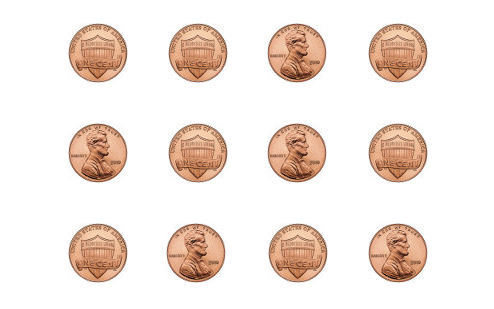
"You’re in a pitch-dark room. On a table before you are 12 pennies. You know that 5 are heads up and 7 are tails up, but you don’t know which are which. By moving and flipping the coins you must produce two piles with an equal number of heads in each pile. How can you do this without seeing the coins?"
I was not able to solve this on my own and had to peek at the answer.  Even after seeing the answer, it took me a long time to comprehend why it works.

Reposted from 2010 because I found it while looking for something else and still couldn't solve it on my own.

16 October 2025

Trump offers medications at 654% discount


Ponder for a moment the widespread extent of abysmal ignorance that went into this public presentation.  Someone assembled those data, then calculated multiple discounts over 100%.  Then someone with graphic design skills created the poster.  Someone sets the poster on the easel.  Camera crews gather around.  And then this "very stable genius" says (and believes) he is offering a 654% discount FFS.  Isn't there anybody in the chain of command with the brains (or the balls) to say "this isn't possible."*  It's embarassing.  Makes me ashamed to be an American.

The TrumpRx website is of course a Potemkin village, giving no details and promising results in 2026.

Images from The Guardian.

*addendum - what I should asked was whether there was anyone willing to tell the emperor the truth about his new (or absent) clothes.  I'll blog that fairy tale separately, after this weekend's football games.

22 September 2025

Introducing Euler's number (e)


I saw this math quiz question today on the theydidthemath subreddit.  Pi is obviously slightly bigger than 3.14, but I didn't know whether a higher power is more important than a higher base.  

Turns out the answer is "sometimes" - depending on whether the number in question is larger or smaller than Euler's number.  Explanation at the link is way over my head.  Posted for those who enjoy such things.

24 May 2025

Pondering infinite monkeys


We've all heard the old adage about monkeys at typewriters, sometimes expressed as a million monkeys (as above, via Savage Chickens), or as infinte monkeys, or as a monkey for infinite years.  Recently, Australian mathematicians have reconsidered the Finite Monkeys Theorem, and calculated that "given the expected time until the heat death of the universe, we demonstrate that the widely-accepted conclusion from the Infinite Monkeys Theorem is, in fact, misleading in our finite universe."  Their data as applied to various works of literature -


- is available online at Science Direct.

Sadly, I have lost my favorite cartoon on the subject.  It depicts a monkey turning in his paper to the teacher, who reads "To be, or not to be, that is the glbiftza" and tells the monkey "Sorry, try again."  Bob Newhart worked the same joke into one of his standup monologues.

A tip of the blogging cap to John Farrier at Neatorama for the via.

Reposted from last year to add one more cartoon variation on the joke:


12 April 2025

Geometry puzzle


I wasn't able to do it, but this is solvable using only simple geometry without trigonometry.  The answer is in this video.  Via the SmartPuzzles subreddit.

04 March 2025

Some "15" puzzles are unsolvable


The example shown, posted on the puzzles subreddit, is on a watch.  What I remember are the old "analog" versions with small sliding wooden pieces in a frame.  I used to get great satisfaction as a child by solving scrambled puzzles.  What I learned this morning is that the puzzles date back way before my time:
The puzzle was "invented" by Noyes Palmer Chapman, a postmaster in Canastota, New York, who is said to have shown friends, as early as 1874, a precursor puzzle consisting of 16 numbered blocks that were to be put together in rows of four, each summing to 34 (see magic square)... The game became a craze in the U.S. in 1880...

Some later interest was fueled by [Sam] Loyd's offer of a $1,000 prize (equivalent to $34,996 in 2024) to anyone who could provide a solution for achieving a particular combination specified by Loyd, namely reversing the 14 and 15, which Loyd called the 14-15 puzzle. This is impossible, as had been shown over a decade earlier by Johnson & Story (1879), because it requires a transformation from an even to an odd permutation.

The Reddit thread confirms that the one illustrated is unsolvable, which is confirmed at the Wikipedia entry.  In fact, half of all initial states of the puzzle will be mathematically impossible to resolve.  To guarantee solvability, a puzzle would need to be manufactured with the pieces "solved" and then scrambled before distribution (or by asking the end-user to do so).  I'm glad all my childhood versions were solvable.

20 February 2025

Geometry puzzle


The diagram is NOT drawn to scale, so don't put a ruler on line x to measure the distance.  Figure it out in your head using simple logic and math.

01 February 2025

What is the missing number?


The circular arrangement is just a design feature, not part of the math.  The puzzle could also have been written out 2,3,4,5,6,8,12...?

25 November 2024

21 October 2024

Belphegor's Prime


I had briefly mentioned Belphegor's Prime in a linkdump seven years ago, then found it again today while looking for something else, and decided it was worth reposting.
Belphegor's prime is the palindromic prime number 1000000000000066600000000000001, a number which reads the same both backwards and forwards and is only divisible by itself and one...

The number itself contains superstitious elements that have given it its name: the number 666 at the heart of Belphegor's prime is widely associated as being the number of the beast... This number is surrounded on either side by thirteen zeroes and is 31 digits in length (thirteen reversed)...

In the short scale, this number would be named "one nonillion, sixty-six quadrillion, six hundred trillion one".
Useful information for filling in any awkward conversation gaps during Halloween parties.  The symbol for it is an inverted pi.

Addendum:  just realized I also posted about Belphegor's prime back in 2012, with an image of the guy.

13 September 2024

10 August 2024

How do you slice a pie... chart?


I have never seen a pie chart sliced like this one (describing the sexual and racial composition of the American population).  I don't see any advantage over radial wedges, unless its to enable placement of the segment labels within the diagram, and I find it hard to compare the size of irregular polyhedrons.

A quick search led me to "11 pie chart alternatives and when to use them," which didn't include this pattern exactly, unless its a type of Voronai diagram.

Posting this because the readership here has a huge range of knowledge and skills, so perhaps someone can offer an informed comment.

If nothing else, the search at least led me to this old Dilbert cartoon:

26 July 2024

Ideal "launch angle" for hitting home runs


In theory an object travels the longest horizontal distance when it is launched at a 45 degree angle.  But very few home runs come off the bat at a 45 degree angle (most such launches would result in a "pop-up."

There are multiple contributing factors (several discussed here), but the simplest to understand was provided in an ELI5 post:
It’s mainly because the air resistance increases in proportion to the square of the velocity. So if something is going twice as fast, it has 4x the air resistance.

The ball leaves the bat going very fast (up to 121 mph), so at the beginning of its flight it slows down quickly because the air resistance is much higher. If we want the ball to go far, it needs to cover more horizontal distance while it’s going fast, so it’s better for it to be moving at an angle shallower than 45 degrees during that time. If it leaves at a 45 degree angle, the horizontal velocity is lost more quickly (edit: more quickly in terms of how far the ball has moved horizontally over a period of time)

Addendum:  FWIW, I would have some doubts about the regression line in the graph.  I'm surprised the r^2 is that small given the scatter, but perhaps some dots represent multiple events. Anyway, the explanation is still valid.

18 July 2024

Proof that pi equals 4


Available at multiple places on the internet, where you can find discussions of varying quality.  It's basically a reminder that interesting things happen at infinity.
Related Posts Plugin for WordPress, Blogger...