Showing posts with label fashion. Show all posts

07 July 2026

A new fashion statement: the "divorce ring"

"Shimmering on Deb Marino's finger are diamonds set in an eye-catching gold ring.  "Of course it's a middle finger ring, because, why not?" the Florida-based blogger says on her Tiktok feed.

Getting rid of her engagement ring would have suggested a regret the 34-year-old doesn't feel - after all, her marriage brought her daughter. Even just not wearing it would have felt like a waste. "I didn't want it locked away in a box," she says. "Diamonds are precious."..

Deb is part of a rising trend promoted by jewellers around the world of women marking a new chapter in their life with a new statement piece: the divorce ring.

Deb had the diamond from her engagement ring set at one end of an open circle and added a new sapphire to represent her daughter to the other end. It cost $3,000 (£2,245). It's a sizeable sum to part with when divorces can be expensive.  Ring resale values tend to be only around 30% of the original price so for many the trend of giving their old jewellery a new life feels a better investment."
More details (and examples) at the BBC, whence the (cropped) embedded image.

13 June 2026

Cloche hats


Here's the Wiki:
The cloche hat is a fitted, bell-shaped hat that was popular during the 1920s. (Cloche is the French word for bell.) Caroline Reboux is the creator of the cloche hat.

Cloche hats were usually made of felt so that they conformed to the head. The hat was typically designed to be worn low on the forehead, with the wearer's eyes only slightly below the brim. By 1928-1929, it became fashionable to turn the brims on cloche hats upwards. This style remained prevalent throughout the early 1930s until the cloche hat became obsolete around 1933-1934.

Often, different styles of ribbons affixed to the hats indicated different messages about the wearer. Several popular messages included: An arrow-like ribbon which indicated a girl was single but had already given her heart to someone, a firm knot which signaled marriage or a flamboyant bow which indicated the wearer was single and interested in mingling...
Photo via the wonderfully-named My Ear-Trumpet Has Been Struck by Lightning.  Too bad it has now gone inactive (but still browseable).

Reposted from 2010 (!!) after watching Agatha Christie's Seven Dials miniseries last night and seeing Mia McKenna Bruce in the starring role of a 1925 character:


Personally I would be happy to see this hat style come back into fashion.  It looks very comfy and reasonably sensible in a world concerned about solar skin damage.

03 June 2026

Rhinestone jewelry can be valuable


The embedded image shows a demi-parure (matched set of earrings and necklace) created with Aurora Borealis rhinestones, which were popular in the 1950s-60s.  The image was posted in the Vintage Jewelry subreddit, where the discussion thread offers informed commentary.

26 May 2026

"Moral panic" over babydoll dresses


Let's start with a definition: 
A babydoll is a short, sleeveless, loose-fitting nightgown or negligee, intended as nightwear for women. It sometimes has formed cups called a bralette for cleavage with an attached, loose-fitting skirt falling in length usually around the upper thigh. The garment is often trimmed with lace, ruffles, appliques, marabou, bows, and ribbons, optionally with spaghetti straps. Sometimes it is made of sheer or translucent fabric such as nylon or chiffon or silk.
And an abbreviated history:
The creation of the super-short nightgown is attributed to the American lingerie designer Sylvia Pedlar, who produced them in 1942 in response to fabric shortages during World War II.  Although her designs became known as "babydolls", Pedlar disliked the name and did not use it... The name was popularized by the 1956 movie Baby Doll, starring Carroll Baker in the title role as a 19-year-old nymphet...

Babydolls became a prominent part of the "kinderwhore" look during the early-to-mid-1990s, due to the popularity of Riot Grrrl and grunge performers such as Courtney Love and Kat Bjelland.
I personally would have some doubts that it was fabric shortages that popularized this look, and "Kinderwhore" might be worth a separate post, but for now I'll focus on the Guardian article that drew my attention away from the war.
Online discourse [about pop stars wearing the style] immediately exploded, with many lodging accusations that she was dressing like a “sexy baby” and promoting “pedo core”, while others defended the singer, stating that she can wear whatever she wants. Among those defenders was Ertay Deger, co-founder of brand Generation78, who told the Guardian: “the babydoll silhouette was never conceived as infantilising. For us, it sits within a long history of fashion references tied to rebellion, performance, romance, and girlhood culture. The look felt knowingly performative rather than regressive”...

Rodrigo isn’t the only pop star embracing the baby doll aesthetic right now. Sabrina Carpenter has worn a sheer version, leaning towards a retro-lingerie aesthetic; Addison Rae posed coyly in an understated, plain white minidress on her Instagram – then there’s gen Z’s favourite indie-sleaze icon Alexa Chung who has worn these dresses for years...

So why all the fuss? Gen Z has often been characterised as notably puritanical compared to other generations. Indeed, we live in an era when the exposed horrors of child sexual exploitation are at the forefront of public consciousness. But this wave of outrage towards a perceived sartorial perversion is arguably a projection that serves to police the status quo of young women’s fashion, rather than a mark of genuine concern. 
You can also read more at Vogue Arabia:
Short, swingy, and deceptively playful, the babydoll dress is suddenly everywhere – from stadium stages to street style feeds. This isn’t just a trend. It’s a shift, and it’s unfolding in real time.... So why this dress, and why now?

According to Nyree Leckenby, founder of My Mum Made It, the label behind Rodrigo’s viral yellow look, the appeal is all about balance. “Babydoll dresses embody the ease and effortlessness we crave in summer,” she says. “The breezy silhouette keeps things light in the heat while still feeling styled and considered. From a design perspective, they strike the perfect mix of comfort and nostalgia without trying too hard. Celebrities love them because they photograph beautifully and carry a sense of romantic ease that still feels fashion–forward and unique.”
The babydoll’s comeback has been bubbling for a while, but Spring/Summer 2025 made it official. Designers like ChloĆ©, Loewe, Valentino, Emilia Wickstead, and Alberta Ferretti sent it down runways with fresh structure and quiet drama.
More photos and design suggestions at the Vogue Arabia link.

28 March 2026

Puffer jacket stuffed with pickles


The product is offered by the United Kingdom division of Kentucky Fried Chicken to promote their marketing of pickle-enhanced foods (Pepsi, french fries).  Personally, I'd prefer stuffing my half of my jacket with olives, but everyone has different tastes.  

Image cropped for size from the original at the Neatorama via.

22 February 2026

Seeking help from my readers


Lots of stories this week about Olympic skater Alysa Liu, including a feature article in The Atlantic on "The Alysa Liu Effect."  The article focuses on her hairstyle ("raccoon head") and clothing, but didn't mention her teeth (photo cropped from a source somewhere else).

This old guy wonders what's going on here, because these look like dental implants rather then stick-on ornaments.  I'm quite aware that children getting braces can now have their braces painted, or can use colored rubber bands, as a cosmetic compensation for what is otherwise perceived by their schoolmates as unattractive (similar to "pimple patches" I suppose).  

So is this a new body modification that will become more common?  Do the arrows represent something from comics or a meme I haven't seen?  I'm turning to my readership for answers because it will be faster than looking this up.  Thanks in advance.

(Well, that didn't take long.  A dozen replies within an hour.  Thanks again.)

Question answered.  Comments now closed.

06 November 2025

Wasp nests for home decor


Here's one way I'm well ahead of the curve on fashion and design.  I've been bringing wasp nests and other natural curiosities into my apartments and home all of my adult life.   The New York Times reports that items like the above now retail for "up to $250 per specimen."  Several photos at the link.

05 October 2025

Introducing Claire McCardell


Some readers may be quite familiar with this lady, but a recent article in The Atlantic was my introduction to her.
Claire McCardell hated being uncomfortable. This was true long before she became one of America’s most famous fashion designers in the 1950s, her influence felt in every woman’s wardrobe, her face on the cover of Time magazine.

As a young girl growing up in Maryland, she hated wearing a dress when climbing trees, and didn’t understand why she couldn’t wear pants with pockets like her brothers—she had nowhere to put the apples she picked. At summer camp, she loathed swimming in the cumbersome full-length stockings women were expected to wear, so she ditched hers and went bare-legged in the lake, even though she knew she’d get in trouble. When she was just starting out as a fashion designer, in the 1930s, she went on a ski trip to New Hampshire and one evening saw a woman shivering in a thin satin dress. Why, McCardell wondered, couldn’t an evening gown be made out of something warmer, so a woman could actually enjoy herself?

McCardell made a career out of asking such questions, and helped transform American fashion in the process, as Elizabeth Evitts Dickinson details in her lively and psychologically astute biography, Claire McCardell: The Designer Who Set Women Free. The young designer who came home from New Hampshire and devised a blue wool evening dress was often dismissed by her bosses for her “crazy” ideas—wool was for coats, not parties! She was told to keep copying the latest looks from Paris, as was customary in the American garment trade at the time. In those early years, McCardell didn’t have the clout to design apparel her way. But she had a core conviction, and she never abandoned it: Women deserve to be comfortable—in their clothes, and in the world...

McCardell insisted on putting pockets in women’s clothing; previously, pockets were reserved almost exclusively for men... She put fasteners on the side of her clothes rather than the back, so women could get dressed without a husband or a maid. She partnered with Capezio to popularize the ballet flat—and the idea that women didn’t always have to wear heels. When air travel became possible, and steamer trunks were replaced with slim suitcases, McCardell developed separates: tops and bottoms you could mix and match so that you didn’t have to bring a bulky parade of dresses for every occasion. She patented the wrap dress, mainstreamed the leotard, stripped linings out of swimsuits so that women didn’t have to sit sodden and cold on the beach. Ever worn denim? McCardell is the one who ignored its provenance as a humble workingman’s textile and brought it to women’s wear.
More at the link.  I don't plan to read the book and won't be reviewing it here, but I'm introducing her and the book because I'm sure this is the type of fashion designer my pragmatic mother would have loved.

30 September 2025

Beard

"Participant Andreas Pelowski from Germany poses during the European Beard Championship in Leogang, Austria, on September 20, 2025"  Credit Johann Groder / APA / EXPA / AFP / Getty.
I thought it was a mustache until I looked more closely.  One of the Photos of the Week at The Atlantic.

17 September 2025

Words for the day: "shoulder pal" and "kidult"


When I clicked on the link I thought it said "My weird week of wearing shoulder pads," so the "shoulder pals" was a bit of a surprise.  
"There was a time when adults who owned collections of stuffed toys were relatively uncommon, weird even. All that has changed recently: the rise in popularity of toys such as Squishmallows and Jellycat Amuseables has been linked to the growing “kidult” market (adults buying toys for themselves) which accounted for almost 30% of toy sales last year. On the whole, cuddly toys are something people keep at home, on their beds or on display shelves. But that’s changing too – plush toy keyrings such as Labubus are now everywhere. And some “Disney adults” (self-professed grown up Disney fans who might, for example, go to the theme parks without taking children with them) have gone one step further: attaching toys not just to their bags, but to themselves.

“Shoulder pals” (variously known as “shoulder plushies”, “shoulder toys” and “shoulder sitters”) are small toys made in the likeness of Disney characters. They have magnetic bases and come with a flat metal plate designed to be placed under your shirt, so the toy perches on your shoulder. Since the first one, baby Groot from Guardians of the Galaxy, was brought out in 2018, these toys have become a common accessory at the Disney theme parks."
The source article at The Guardian goes on to describe the experiences of a person who wears the shoulder pads not at Disneyland, but in the "real world." I sometimes mock fashion innovations and marketing ploys, but I rather like the concept of "kidult" if the trend can bring just a few moments of levity into otherwise stressful lives.
"I’m relieved when I finally take Remy off. I’ve never felt fully relaxed while wearing a shoulder pal – partly out of self-consciousness, and partly out of concern that it might fall off. But I can’t deny that the responses I’ve had to Remy and his friends have been much more positive than I thought they were going to be. Wearing something so silly and unexpected has invited conversations with strangers, made my friends laugh and created, as Potten puts it, “a little bit of joy in a hard world.
Image cropped for size from the original at the source, credit David Levene/The Guardian.

10 July 2025

The cartoon equivalent of a "dad joke"

"The muumuu /ˈmuːmuː/ or muŹ»umuŹ»u (Hawaiian pronunciation: [ˈmuŹ”uˈmuŹ”u]) is a loose dress of Hawaiian origin. It is related to the Mother Hubbard dress, introduced by Christian missionaries in Polynesia to "civilize" those whom they considered half-naked savages. Within the category of fashion known as aloha wear, the muumuu, like the aloha shirt, are often brilliantly colored with floral patterns of Polynesian motifs. In HawaiŹ»i, muumuus are no longer as widely worn as an aloha shirt, but continue to be a popular dress for social gatherings, church, and festivals such as the Merrie Monarch hula competition.

The word muʻumuʻu means "cut off" in Hawaiian. The dress, which was originally used as an undergarment or chemise for the holokū, lacked a yoke and may have featured short sleeves or no sleeves at all. The muumuu was made of lightweight solid white cotton fabric and, in addition to being an undergarment, served Hawaiian women as a housedress, nightgown, and swimsuit. Holokū was the original name for the Mother Hubbard dress introduced by Protestant missionaries to Hawaii in the 1820s. In contrast to the muumuu, the holokū featured long sleeves and a floor-length unfitted dress falling from a high-necked yoke which was worn by the aliʻi as well as the common people. By the 1870s, the holokū of the aliʻi took on a more fitted waist and often a train seven or eight yards in length for the evening, and included ruffles, flounces and trimmings, while the modest loose-fitting train-less holokū continued to be widely worn by women of all classes as their daily dress. In time, upon the introduction of printed fabrics to Hawai'i, the muumuu, essentially a shortened and more comfortable version of the holokū, gained popularity for everyday wear."

13 January 2025

Why does this exist ? - updated with some answers


At Target recently I saw a display for holders for lip gloss that attach to the back of one's cellphone.

I don't use lip gloss but I understand that some people do, and that in some professions it may need to be reapplied frequently.  What I don't understand is why it would be stored on the back of a phone.  Perhaps for influencers taking selfies?  It seems distinctly odd, but it's not my generation, so perhaps someone can explain.

Addendum:  reader Nuray found an entire iPhone case with a lip gloss holder incorporated into it:


The one at Target is a glue-on, like a PopSocket.  I found an article at Vox that discusses the trend in lip gloss:
By all accounts, it seems like lip products have become more than just cheap, everyday essentials to mindlessly throw into your purse. In the post-pandemic era, where our mouths are unmasked most of the time, they’ve evolved into miniature status symbols for influencers and casual “makeup girlies” alike...

Lee notes another important selling point for lip augmentations: “Fuller lips are not only a feature of beauty; they’re also a sign of youth.”... Right now, Gen Z seems to be experiencing a collective crisis over looking old, which has resulted in an interest in so-called anti-aging skincare for many tweens. That said, it’s not a surprise that young people are running to lip products that offer color and a sheen but promise dermatological benefits...

Aside from the skincare aspect, there seems to be excitement among people on social media who collect these lip products in large numbers. MacKenzi Nelson, art director at beauty PR company Helen + Gertrude, says this current hoarding of lip gloss represents a pre-existing consumer trend....

Additionally, Nelson says that the “sensory” element of these products has a lot to do with their popularity, as they provide “a moment of ritualistic self-care, comfort, and play.” Li agrees with this sentiment, stating that the lip products are “definitely habit-forming.”...

Other brands, like Topicals, include their lip glosses alongside other items you would find in a wealthy person’s bag, like a Louis Vuitton wallet and a roll of cash, on their Instagram... Chanel’s foundation can range from $55 to almost $80, while its Rouge Coco Gloss retails at $40. Non-drugstore but not-exactly high-end brands like Rhode and Summer Fridays offer lip balms and oils are under $30...

In a moment of economic downturn and general doom about the world, it’s comforting to know that we can impulsively spend money on the latest it-girl item and delight in the same vain activities as Kylie Jenner or Hailey Bieber.

16 December 2024

Beautiful clothes for school


I am in awe of the gorgeous clothing worn by these Palestinian girls attending the opening of a school in Khan Younis, Gaza.  I looked for additional information and images, including in a large gallery by Getty Images, but could find no other details.  The designs must be traditional, and perhaps are ceremonial to some extent.

Photo (cropped for size) credit to Bashar Taleb/AFP/Getty Images, via The Guardian's "Week around the world in 20 pictures."

10 September 2024

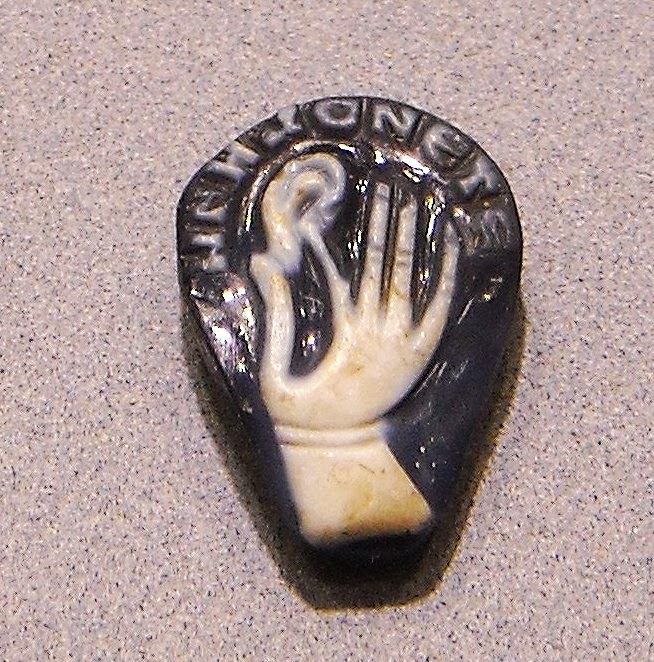
What's the significance of a hand pulling an ear? - updated


(Other than as a sign of otitis media in a child.)  The item at the top comes from the collections of the British Museum (via A London Salmagundi), where it is described succinctly as -
Plain gold box-setting from a finger-ring containing an oval sard intaglio: hand pulling ear; inscribed.
- and filed as probably Roman, of 1st-3rd century.  I had to look up "sard" (carnelian)*, but when I searched the web for further information, what I found was another hand pulling another ear in the Naples Archaeology Museum (via this Flickr user):


 I don't have time to dig more deeply.   Someone out there must know the answer.

*According to Pliny the Elder, sard derives its name from the city of Sardis in Lydia, but it more likely comes from the Persian word Ų³Ų±ŲÆ sered, meaning yellowish-red.

Addendum:  In keeping with a long-standing tradition at TYWKIWDBI, no question that I ask goes unanswered by the readership.

Reader Pearce O'Leary found a reference to this behavior in A Popular Handbook to the Greek and Roman Antiquities in the British Museum:


Nolandda noted that the inscription reads "ĪœĪĪ—ĪœĪŸĪĪ•Ī„Ī• (a.k.a. ĪœĪ½Ī·Ī¼ĪæĪ½ĪµĻ…Īµ or μνημονευε) : I remember, hold in remembrance, make mention of."

Others found a similar ring offered at Christies and a cameo in the same style in the collections of the J. Paul Getty Museum:
On this cameo, a hand pinches an earlobe between the thumb and forefinger; above, there is another object, perhaps a knotted scarf or a diadem. Surrounding the imagery, a long inscription in Greek, comprising a sentimental message that addresses a man: "Remember me, your dear sweetheart, and fare well, Sophronios."

In Roman art and literature, the ear-tweaking hand is a common motif, signifying a request for attention. Gems such as this were mementos of love, and were probably given as gifts. The knotted object is not common, but very likely it, too, was a symbol of remembrance, its purpose perhaps similar to the modern custom of tying a knot in a handkerchief so as not to forget something important.
And finally:
I remember doing this a lot as a kid, when we had my favorite dishes for lunch or dinner.

In Brazil, pinching the earlobe means "very good, excellent."
The gesture usually comes with the slang expression "daqui, ó" (which would mean literally "from here"). I can definitely see a connection between this gesture and the "don't forget" connotation explained above.

Very possibly, this gesture came from the Portuguese, Spanish or Italian colonies in Brazil.
One additional observation, from one of the "anons" here:
Interestingly enough, the earlobe is a pressure point in the Ayurvedic pressure-point system of massage. And pinching or massaging the earlobe is said to stimulate brain circulation and generally improve memory, learn better, etc. In India, bad schoolwork or behaviour will result in having the ear pinched quite strongly by teacher or parent. A common school punishment is to hold the earlobe and stand in a corner or hold the lobes and do squats. Also apologies (especially for forgetting something important) maybe rendered with the ear lobe holding gesture.
Thanks to all of my great readers!

Reposted from 2014 because this popped up when I searched TYWKIWBI for ear + corn.

09 August 2024

Green-tinted wraparound glasses. In 1837 !!

"All we know is that the spectacles were designed to protect Olds’s eyes from the intensity of Argand lamps... Argand lamps, which were widely used for indoor illumination in the early 1800s, burned whale oil. People worried that the light from the flames might be harmful to their eyes."
Image cropped from the original in The Washington Post.

Addendum:  reader Drabkikker found this video about Victorian skincare which features similar glasses.

13 July 2024

Pimple patches as fashion statements

For a few years now, pimple patches — opaque, whimsically shaped, in conspicuously nonhuman hues such as bright yellow, jet black, magenta and even rainbow — have been showing up on more and more faces in workout classes, in classrooms, at workplaces and online. Many are medicated with hydrocolloid or salicylic acid; they treat pimples while also covering them up, protecting them from both idle fingers and strangers’ stares. As a skin-care tool, pimple patches, which gained traction in the late 2010s, were a game-changing development in skin-care technology. But they’ve also become a fashion trend. And although their proliferation heralds a shift in attitudes toward acne — one of the most universal discomforts of being a human — they’ve also begun to act as a social signifier.

The first generation of pimple patches arrived in the late 2010s. Hero’s Mighty Patch hydrocolloid dots, for example, debuted in 2017, and Peace Out began offering flesh-toned and translucent versions of the same concept around the same time.

Then, in 2019, came Starface, whose pentagram-shaped Hydro-Star patches would eventually be available in a full spectrum of opaque, vibrant colors. Decorative and spunky, they were a sensation almost immediately. Hailey and Justin Bieber were photographed sporting them around in their daily lives and, crucially, showed up wearing them in photos on social media. So did Florence Pugh, Willow Smith and Nicola Peltz Beckham, and the brand even debuted its first black version of the product on models in a 2022 Puppets and Puppets fashion show...

Cadence Lawson, 12, just finished sixth grade in Bowling Green, Ky., and can confirm: She and her classmates trade their Starface pimple patches not just for other Starface colors, but also for higher-value goods. “It’s mainly at lunch,” she says. “For ice cream, or something like that.”

“They’re the new PokĆ©mon cards,” cracks Cadence’s dad, Daniel, 34...

When Starface patches are on a jawline or chin, Annie says, she assumes they’re being used to treat actual zits. On a cheek, though, or in that alluring Marilyn Monroe mole position, above the lip? That’s just fashion, baby...

Tiny silk patches in the shapes of “stars, crescent moons, diamonds, all those sorts of things” were often affixed to the faces of well-to-do young people in 17th-century Western Europe. The trend originated in the French royal court, where the patches were initially used to cover up the scars and skin damage from diseases such as smallpox and syphilis, “but they eventually became quite popular. Where they were worn on the face could signify ‘I’m married’ or ‘I’m not married,’ or ‘I’m available’ or ‘not available.’ Or, alternatively, ‘I support this political party or that political party,’” Stewart says. The type or placement may have also indicated astrological signs, she adds, or even religious beliefs. (So Edouard’s workout classmate may not have been totally clueless — just off by a few hundred years.)
I should have bought some of these after my recent visit to a dermatologist who zapped a bunch of my facial SKs.  Then I wouldn't have looked like a plague victim while shopping at Target.

More information at the Washington Post (when the embed, cropped for size)

03 July 2024

"Dressing pretty" is over

"...I'm a messy eater,” admits Isaiah Lat, a 20-year-old student, DJ and stylist from Chicago, “I used to wipe away stains but now I don’t mind a little oil or a little spaghetti on my shorts. I think it’s chic.”

He does not believe that a term has yet been coined for the way he likes to dress. “It’s probably this dystopian, Mad Max, pirate, Steam Punk, mythological vibe,” he says, big on thrift and DIY; he likes skinny jeans, Capri pants and visor-like sunglasses. He doesn’t pile on the pasta sauce before he leaves the house but says he does like his clothes to be “somewhat stained”.

There’s a new mood in fashion: aesthetically varied, but its disparate elements – camouflage, combat shorts and grungey plaid; goth-inspired make-up and stomper boots; silhouettes and garments inspired by 2010s indie sleaze; T-shirts emblazoned with slogans inspired by nihilistic internet humour – project a common mood. Daniel Rodgers, digital fashion writer at British Vogue, says that much of it stems from the rebellious energy of kids “born in 2000 trying to reclaim the things millennials wrote off as loserish”. It is often a bit grotty, a bit greasy and crumpled and raw.

It’s a big leap away from the homogeneous looks that have dominated visual culture for a decade, including sleek, mass-produced athleisure and the ubiquitous “clean girl” trend, which problematically centres influencers who either are – or look like – Hailey Bieber, with white, gently blushing skin and huge fluffy eyebrows...

It is an intentional rejection of the mainstream. “We are sick of late-stage capitalist fashion,” he says. “In the aftermath of Trump’s presidency, with the conservative supreme court and our rights being stripped away, we want to dance and look hot – and this is our way of showing the government and corporations that we don’t need them.” [you might consider voting...]

Still, there is something particularly nihilistic about what is happening now, says Rodgers. The way people are “dipping into looks from the past 15 years of mainstream culture and putting them all together in a wild bonfire heap” and sampling from subcultures without the “lifestyle obligations” that used to be part of wearing those clothes. He says that when micro-trends come into style at the moment, they stay in: “So everything is trending at once. Everything is porous and blurred; it’s kind of a free for all.”..

Even Hailey Bieber, the ultimate icon for the “clean girl” look, is dressing a bit more chaotically, points out Rodgers, and is “in some way mirroring what’s happening on the street. She’ll wear a football shirt with some tailored trousers and cowboy boots or a poet sleeved shirt with Fila shorts and a Mary Jane, like someone’s kind of sifted through a lost property box on sports day.”
More (with photos) at The Guardian.

Your biodegradable, renewable, sustainable T-shirt may start in an old-growth forest

"You might think that wearing a top made from wood pulp would give instant eco-credentials – it is renewable, biodegradable, and, having once been a tree, it has soaked up some carbon along the way. What’s more, it’s not plastic. This is why many brands are opting for viscose, Lycocell, acetate and modal – soft, silky, semi-synthetic fabrics made from tree-pulp – as an apparently more sustainable option... Except that the chances are that your wood-pulp top may not be so green...

In total, about 300m trees are logged globally each year to make viscose, sustainably or otherwise. These fabrics go by the rather geeky term, “man-made cellulosic fibres”, or MMCFs. Demand for viscose, the third most used fabric in fashion (after polyester and cotton), is expected to double over the next eight years, says Rycroft: “Many brands are looking for a substitute for polyester or virgin cotton, but it’s trading one environmental disaster for another.”

“Significant amounts” of viscose come from endangered forests in Brazil, Canada and Indonesia, says Rycroft. “We’ve also noted old-growth forests in Australia – koala habitats – disappearing into the viscose supply-chain. 
More information at The Guardian.
Related Posts Plugin for WordPress, Blogger...