Showing posts with label sleep paralysis. Show all posts

09 November 2024

Sleep paralysis in testimony during the Salem witchcraft trials

From "The Tryal of Bridget Bishop, Alias Oliver, at the Court of Oyer and Terminer, Held at Salem, June 2, 1692" - 
"Samuel Gray testified that about fourteen years ago he waked on a night and saw the room where he lay full of light and that he then saw plainly a woman between the cradle and the bedside which looked upon him. He rose and it vanished, though he found the doors all fast..."

"Richard Coman testified, that Eight Years ago, as he lay awake in his Bed, with a light burning in the Room, he was annoyed with the Apparition of this Bishop, and of two more that were strangers to him; who came and oppressed him, so that he could neither stir himself, nor wake any one else: and that he was the Night after molested again in the like manner; the said Bishop taking him by the Throat, and pulling him almost out of the Bed. His Kinsman offered for this cause to lodge with him; and that night, as they were awake discoursing together, this Coman was once more visited by the Guests which had formerly been so troublesome, his Kinsman being at the same time struck speechless, and unable to move hand or foot. He had laid his Sword by him; which those unhappy Spectres, did strive much to wrest from him, only he held too fast for them. He then grew able to call the People of his house; but altho they heard him, yet they had not power to speak or stir, until at last, one of the People crying out, What's the matter! the Spectres all vanished  ."

"John Louder testified, that upon some little controversie with Bishop about her Fowls, going well to bed, he did awake in the Night by Moonlight, and did see clearly the likeness of this Woman grievously oppressing him. In which miserable condition she held him unable to help himself, till near day.  He told Bishop of this; but she utterly denied it, and threatned him very much  ."
From "The Tryal of Susanna Martin at the Court of Oyer and Terminer, Held at Adjournment at Salem, June 29, 1692" 
"Bernard Peache testified, that being in Bed, on a Lords Day Night, he heard a scrabbling at the Window, whereat he then saw Susanna Martin come in, and jump down upon the floor. She took hold of this Deponents Feet, and drawing his body up into an heap, she lay upon him near two hours; in all which time he could neither speak nor stir..."

"Robert Downer testified, that this Prisoner being some years ago prosecuted at Court for a Witch, he then said unto her, He believed she was a Witch. Whereat she being dissatisfied, said, That some she Devil would shortly fetch him away; which words were heard by others, as well as himself; the night following, as he lay in his Bed, there came in at the Window, the likeness of a Cat, which flew upon him, and took fast hold of his Throat, lay on him a considerable while, and almost killed him; at length he remembred what Susanna Martin had threatned the Day before, and with much striving, he cried out, Avoid thou she Devil, In the name of God the Father, the Son, and the Holy Ghost, Avoid: Whereupon it left him, leaped on the Floor, and flew out at the Window..."

"Jervis Ring testified, that about Seven Years ago, he was oftentimes and grievously oppressed in the Night; but saw not who troubled him; until at last he Lying perfectly Awake, plainly saw Susanna Martin approach him. She came to him, and forcibly bit him by the Finger; so that the Print of the bite is now, so long after, to be seen upon him..."
Excerpts [some spelling modernized] from Cotton Mather on Witchcraft: A first-hand Story of the Salem Witch-Trials; With Discourses on: Why the Devil picked New England for his Work: the Usual Temptations offered to become a Witch: the best Means of discovering Witches: and the best Ways to foil the Temptations of the Evil Powers. [Dorset Press, 1991]

20 December 2022

Sleep paralysis in the Connecticut witchcraft trials


Three excerpts:
"After this Thomas Bracy giuing out some words, that he suspected Katherin Gooddy Harrison of witchcraft, Katherin Harrison mett Thomas Bracy and threatned Thomas telling him that shee would be euen with him. After that Thomas Bracy aforesaide, being well in his sences & health and perfectly awake, his brothers in bed with him, Thomas aforesaid saw the saide James Wakely and the saide Katherin Harrison stand by his bed side, consultinge to kill him the said Thomas, James Wakely said he would cut his throate, but Katherin counselled to strangle him, presently the said Katherin seised on Thomas striuinge to strangle him, and pulled or pinched him so as if his flesh had been pulled from his bones, theirefore Thomas groaned. At length his father Marten heard and spake, then Thomas left groninge and lay quiet a little, and then Katherin fell againe to afflictinge and pinching, Thomas againe groninge Mr. Marten heard and arose and came to Thomas whoe could not speake till Mr. Marten laid his hands on Thomas, then James and Katherin aforesaid went to the beds feete, his father Marten and his mother stayed watchinge by Thomas all that night after, and the next day Mr. Marten and his wife saw the mark of the saide afflictinge and pinchinge." 
"Dated 13th of August one thousand six hundred sixtie and eight. Hadley. Taken upon oath before us. HENRY CLARKE. SAMUELL SMITH."

"That about the latter end of November, being the 29th day, 1668, the said Mary Hale lying in her bed, a good fire giving such light that one might see all over that room where the said Mary then was, the said Mary heard a noise, & presently something fell on her legs with such violence that she feared it would have broken her legs, and then it came upon her stomach and oppressed her so as if it would have pressed the breath out of her body. Then appeared an ugly shaped thing like a dog, having a head such that I clearly and distinctly knew to be the head of Katherine Harrison, who was lately imprisoned upon suspicion of witchcraft. Mary saw it walk to & fro in the chamber and went to her father's bedside then came back and disappeared. That day seven night next after, lying in her bed something came upon her in like manner as is formerly related, first on her legs & feet & then on her stomach, crushing & oppressing her very sore. She put forth her hand to feel (because there was no light in the room so as clearly to discern). Mary aforesaid felt a face, which she judged to be a woman's face, presently then she had a great blow on her fingers which pained her 2 days after, which she complained of to her father & mother, & made her fingers black and blue.

During the former passages Mary called to her father & mother but could not wake them till it was gone. After this, the day of December in the night, (the night being very windy) something came again and spoke thus to her, saying to Mary aforesaid, You said that I would not come again, but are you not afraid of me. Mary said, No. The voice replied I will make you afraid before I have done with you; and then presently Mary was crushed & oppressed very much. Then Mary called often to her father and mother, they lying very near. Then the voice said, Though you do call they shall not hear till I am gone. Then the voice said, You said that I preserved my cart to carry me to the gallows, but I will make it a dear cart to you (which said words Mary remembered she had only spoke in private to her sister a little before & to no other.) Mary replied she feared her not, because God had kept her & would keep her still. The voice said she had a commission to kill her. Mary asked, Who gave you the commission? The voice replied God gave me the commission. Mary replied, The Devil is a liar from the beginning for God will not give commission to murder, therefore it must be from the devil. Then Mary was again pressed very much. Then the voice said, You will make known these things abroad when I am gone, but if you will promise me to keep these aforesaid matters secret I will come no more to afflict you. Mary replied I will tell it abroad. Whereas the said Mary mentions divers times in this former writing that she heard a voice, this said Mary affirmeth that she did & doth know that it was the voice of Katherine Harrison aforesaid; and Mary aforesaid affirmeth that the substance of the whole relation is truth." 
"Sworn in Court May 25, 1669. Attest John Allyn, Sec'y."

"John Barlow eaged 24 years or thairabout saieth and sd testifieth that soumtime this last year that as I was in bedd in the hous that Mead Jesuop then liuied in that Marsey Desbory came to me and layed hold on my fett and pinshed them (and) looked wishley in my feass and I strouff to rise and cold not and too speek and cold not. All the time that she was with me it was light as day as it semed to me--but when shee uanicht it was darck and I arose and hade a paine in my feet and leags some time after an our or too it remained. Sometime before this aforesd Marcey and I had a falling out and shee sayed that if shee had but strength shee would teer me in peses."  
"Sworn in court Septr 19, 92. Attests John Allyn."
This is not one of my recommended books; I'm just storing the excerpts here so that I now the book can find a new home via eBay.  These three excerpts (boldface added) present classic examples of sleep paralysis, nocturnal dyspnea, and hypnagogic hallucinations being misinterpreted as witchcraft.  These events in Connecticut obviously parallel the ones occurring in Salem, Massachusetts.  For further context, see the sleep paralysis section of TYKWIWDBI.  Much more on the Salem events to come in future posts - I have 14 relevant books on my shelf.

Taylor, John M. The Witchcraft Delusion in Colonial Connecticut 1647-1697. Baltimore, MD: Grafton Press, 1908.  Online version here.

20 April 2021

"Why the puck...?"

"Will you tell - yes or no - is my cousin in the coach?" screamed the plump young lady, stamping her stout black boot, in a momentary lull.

Yes, I was there, sure.

"And why the puck don't you let her out, you stupe, you?"

"Run down, Giblets, you never do nout without driving, and let Cousin Maud out.  You are very welcome to Bartram."
I was slogging my way through a disappointingly tedious read of Sheridan Le Fanu's Uncle Silas: A Tale of Bartram-Haugh when I was gobsmacked to encounter this sentence.  A Google search of "why the puck" was contaminated by references to the physics of ice hockey, and after subtracting -hockey I could find no relevant information.

The novel is from the Victorian era, so I turned my attention to the OED.  "Puck/pook/pooka etc" as a noun typically refers to an evil malicious spirit, goblin, mischievous child, or the ice-hockey and bandy "ball" - none of which seems relevant to the usage here.  And I can't see it being related to "pukka" (genuine) as in "pukka sahib."  So I'm left without an explanation, unless this is a Bowlderisation of "why the fuck," since the f-word dates back centuries before the Victorians, and would be used here as an intensifier (or "vexation interrogative") for the question.  I would be delighted to see any informed commentary from readers.

I was disappointed not to find any descriptions in the book of the phenomenon of sleep paralysis since Le Fanu was said to be haunted by persistent dreams of a crumbling old mansion that was threatening to fall and crush him ("This unrelenting nightmare had become painful, and he often struggled and screamed in his sleep.")  He died with an expression of horror on his face and his personal doctor said "I feared this - that house fell at last."

I only skimmed the book, so I found only two other interesting word usages.  "Sometimes, when the curate calls, he has me up - for he's as religious as six, he is..." presumably means as religious as six normal people (?).  And "... we got at last into a picturesque dingle: the grey rocks peeped from among the ferns and wildflowers..." ("a deep dell or hollow, esp closely wooded").

21 September 2020

Sleep paralysis misinterpreted as encounters with ghosts

Excerpts from Between Two Worlds: True Ghost Stories of the British Isles (D.A. MacManus, Colin Smythe Ltd., 1977) -

"All this time the sense of something that was loathsome beyond words to express became more and more intense and she waited with bated breath for the next move.  She had not long to wait for in a few moments she clearly heard the soft slur of a heavy, shapeless body moving slowly but steadily across the carpet towards her bed.  She remained motionless, her mind so numbed that it had not the power to command action.  After what seemed an eternity of waiting, the awful 'thing' reached the side of her bed.  Then came the ultimate horror, for it began to climb upon the bed.  She felt its weight upon her, a heavy weight, and next it seemed to stretch itself out and it seized each of her hands in a grasp of iron.  Its hands or paws, were icy, hard and boney and the strength of their cold vice-like grip was such that she felt her own bones might break.  Relentlessly it climbed further and further on to the bed until her legs were being crushed by its weight.  In another moment the Thing would have been right on top of her but, at last, the sheer horror it it all broke the spell and her mind and will leapt into action." [Killeaden, 1926]

"Eventually, from sheer emotional exhaustion [the maid] dropped off to sleep, only to be awakened panting for breath as if in her sleep something heavy had been pressing upon her chest and neck, crushing the breath out of her.  She lit her candle and looked round the room.  All was just as it had been...

So the next night saw her again in bed in that eerie room... she awoke from a sound sleep to feel, very definitely this time, something heavy upon her, pressing on her chest and throat as if to choke her.  It was the same sensation as she had experienced the night before, but now it was more pronounced and frightening.  It was with considerable difficulty that she struggled clear of this unseen weight, but she managed to do so and at once lit her candle...

[the next night] But this doze was nearly fatal to her for she awoke to find again the awful unseen body upon her, pressing down on her and slowly, relentlessly strangling her as it squeezed upon her throat... She was unable to cry out because of the pressure on her throat and at first she was so numbed with horror that she was unable to move at all; then fortunately blind panic seized her and gave her the strength to fight fiercely for her life.  Eventually she managed to push the awful Thing away from her sufficiently to be able to turn on the side and feel for the matches...

[the next night the lady of the house sleeps in the same room]  Then she fell asleep also and slept soundly for some hours, but suddenly awoke to feel something upon her, trying to strangle her.  She fought hard to wriggle away from under this unseen body which was lying on her and pressing upon her throat...

[she tells her husband, who mocks her, so she returns to that room the next night]  But, sure enough, an hour or two later she awoke with a start to find the usual heavy uncanny body lying on top of her and pressing tightly against her face and neck, strangling her inexorably.  Then the awful fear of imminent death overcame all other fear and inspired her to fight for her life as she had never fought before, violently using every muscle in her body in a desperate struggle for survival.  For some time she could make ho headway, but at last she managed to struggle free and frantically strike a light.  The evil 'presence' then ceased to manifest itself and she sank back on her pillow quite exhausted.

[the next night her husband sleeps in the room, taking "his tough bulldog" with him]  This was about eleven o'clock and he was undisturbed for some time, but shortly after two o'clock he woke up struggling and panting for breath.  As he shook off his sleep and gained full consciousness he found that there was something heavy lying upon his body and a soft but very tangible 'Thing' was pressing so hard upon his neck that as he painfully gasped for breath he felt that he was getting black in the face from strangulation.  Just as with his wife, the awful fear of coming death spurred him to frantic physical effort and after a few desperate surges he forced away from himself the unseen 'Thing' for a few moments..."  [ten months later the family moved out] [south of Dublin, 1904]

"One night as Mrs. Shephard lay in bed she felt a heavy weight climb upon her.  It was soft though heavy and frantic with fear, she struggled to free herself but was unable to move, it pinned her down so firmly.  After some time, which seemed to her to be an age, it became progressively lighter and eventually disappeared altogether.  She was not alone in this for her maid, a trusted and intelligent servant, had the same experience shortly afterwards.  It happened to them both a number of times after that and later, when Mrs. Shephard's mother came to stay, she also suffered it.  It should be noticed that in this house no one was able to struggle clear of this weight, but had to wait till it left of its own accord."  [Ulster, 1944]

Excepts from The Ghostly Register: a Guide to Haunted America (Arthur Myers, Dorset Press, NY 1986), which contains 64 "true" stories of ghosts in American houses - eight of which are probably sleep paralysis:

"I've seen John Wayne's ghost twice and have felt his spirit nearby many times.  I was sleeping in The Duke's stateroom.  I remember waking up with a start in the middle of the night. . . As my eyes got used to the dark I suddenly became aware of someone standing by the door to the port gangway.  I froze because I was alone on the boat.  Then I leaped out of bed - and the figure vanished into thin air!" (an incident involving The Wild Goose, John Wayne's yacht in Newport, CA)

"At one time, Virginia says, she felt an invisible hand choking her in bed.  She prayed, and the hands released their grip." (rented house, Simsbury, Connecticut)

"Mrs. Hollingsworth began seeing a woman with long hair, wearing a long, white gown that seemed to date from the past century. . . "My husband saw her one night... standing by the side of my bed staring down at me.  He said it scared him so badly that he couldn't move.  He says she just stood there for a while, then turned and walked away toward the living room." (house in Statesboro, GA)

"Their daughter, Sarah, however, a college student, has had more explicit experiences.  At night in her bedroom she would hear rustling.  When she turned the light on, nobody would be there.  Once she heard a voice whisper her name.  "One night," she says, "I turned the light out and felt something some down on top of me.  I couldn't move my arms or legs, as though somebody was holding them down.  I tried to speak, but something came down over my mouth.  I just prayed that it would go away, and after about ten minutes it did." (Witch Hollow Farm, Boxford, MA)

"The incident sounds very melodramatic.  I was awakened in the middle of the night by a presence in the room -- a feeling that some unknown being was in the midst.  As I opened my eyes, I saw a grayish figure at the side of my bed, to the left, about four feet away.  It was not a distinct person, but a shadowy mass in the shape of a standing figure.  It remained still for a moment, then slowly floated to the foot of the bed, in front of the fireplace.  After pausing a few seconds, the apparition slowly "melted" away.  It was a terrifying experience.  I was so frightened I could not scream.  I was frozen to the spot." (The Colonial Inn, Concord, MA)

"So I went back to bed.  Sometime after, I was aware of a large figure standing next to the bed, a tall human being's figure, dressed in a kind of cloak with a hood on it, open in the front but closed down enough so that you couldn't see any face within it.  I felt at some level that it was antagonistic to me.  It took me what seemed like a full ten minutes of struggle to actually raise myself.  I felt it was trying to press me back down on the bed.  When I finally did overcome it and get myself to a seated position, it was gone.  It dissolved."  (The mansion of Edith Wharton, Lenox, MA)

"When I woke up I had what I can only describe as the most tremendous feeling of fear and panic, for no apparent reason that I was aware of.  I felt almost as though there were some evil presence that was there and was holding me down - almost, I guess, trying to possess me."  (house in Weymouth, MA)

" . . . he was sleeping in the house's addition.  "All of a sudden I felt something grab me on the shoulder.  I tried rolling over to see what it was, but the thing put more pressure on me, and I couldn't turn to see what it was.  I couldn't even say anything; I couldn't get words out of my mouth. . . I could see the moon outside the window, and I was certain I wasn't dreaming; I was awake.  After a while the pressure released, and I started to turn, and all I saw was just possibly a black image, for just a second."  (cabin in Hancock, WI)

31 August 2020

Sleep paralysis in an Ernest Hemingway story


In "The Snows of Kilimanjaro," Ernest Hemingway describes the impending death of a hunter suffering from a gangrenous leg (boldface emphasis mine):
Because, just then, death had come and rested its head on the foot of the cot and he could smell its breath.

"Never believe any of that about a scythe and a skull," he told her. "It can be two bicycle policemen as easily, or be a bird. Or it can have a wide snout like a hyena."

It had moved up on him now, but it had no shape any more. It simply occupied space.

"Tell it to go away."

It did not go away but moved a little closer.

"You've got a hell of a breath," he told it. "You stinking bastard."

It moved up closer to him still and now he could not speak to it, and when it saw he could not speak it came a little closer, and now he tried to send it away without speaking, but it moved in on him so its weight was all upon his chest, and while it crouched there and he could not move or speak, he heard the woman say, "Bwana is asleep now. Take the cot up very gently and carry it into the tent."

He could not speak to tell her to make it go away and it crouched now, heavier, so he could not breathe. And then, while they lifted the cot, suddenly it was all right and the weight went from his chest.
This is a superb description of the phenomenon of sleep paralysis (the paralysis, the muteness, the chest pressure, the dyspnea, and the cessation when the victim is touched or moved), so vivid and precise that I have no doubt that Hemingway must have experienced it himself (his lifestyle would have been compatible with a high risk for the syndrome).

Back when I was active in academia, I developed a special interest and expertise in sleep paralysis, and had visions of someday publishing a book on its portrayal in literature and folklore.  That seems unlikely now, but since I have file boxes full of information, perhaps I can incorporate some of that material into posts for this blog.

Fulltext of Hemingway's story.

Reposted from 2013 (has it really been that long?) to add some new information about Hemingway.  In a recently-published book, a psychiatrist argues that Hemingway may have suffered from chronic traumatic enchephalopathy - the disorder that has been in the news because of its association with professional football and other contact sports.
The psychiatrist from High Point University in North Carolina wrote of nine serious blows to Hemingway's head — from explosions to a plane crash — that were a prelude to his decline into abusive rages, "paranoia with specific and elaborate delusions" and his suicide in 1961.

Hemingway's bizarre behavior in his latter years (he rehearsed his death by gunshot in front of dinner guests, for example) has been blamed on iron deficiency, bipolar disorder, attention-seeking and any number of other problems.

After researching the writer's letters, books and hospital visits, Farah said he is convinced that Hemingway had dementia — made worse by alcoholism and other maladies, but dominated by CTE, the improper treatment of which likely hastened his death. "He truly is a textbook case," Farah said.
Farah dates Hemingway's first known concussion to World War I, several years before he wrote his short story, "The Battler." A bomb exploded about three feet from his teenage frame.

Another likely concussion came in 1928, when Hemingway yanked what he thought was a toilet chain and brought a skylight crashing down on him.

Then came a car accident in London — then more injuries as a reporter during World War II, when an antitank gun blew Hemingway into a ditch.
The rest of the story is at the StarTribune.

Image harvested from the 1936 Esquire publication of the story.

Reposted form 2017 to add this photo of Dendrosenecio kilimanjari, a giant groundsel that grows atop Mt. Kilimanjaro:

18 October 2018

René Descartes and the "Exploding Head Syndrome"

Excerpts from an article in the Journal of Clinical Sleep Medicine:
René Descartes (1596–1650), “the Father of Modern Philosophy” and advocate of mind-body dualism, had three successive dreams on November 10, 1619 that changed the trajectory of his life and the trajectory of human thought... I propose that Descartes' second dream was not a dream at all; rather, it was an episode of exploding head syndrome; a benign and relatively common parasomnia.

Baillet recounts that Descartes laid awake for 2 hours pondering “the blessings and evils of this world” after his first dream on the night of November 10, 1619. Just as Descartes fell asleep again:

“…immediately he had a new dream in which he believed he heard a sharp and shattering noise, which he took for a clap of thunder. The fright it gave him woke him directly, and after opening his eyes he perceived many sparkling lights scattered about the room. The same thing had often happened to him at other times…”
Descartes' experience following his first dream meets the International Classification of Sleep Disorders, Third Edition (ICSD-3) diagnostic criteria for EHS: (1) a sudden loud noise in the head at the wake-sleep transition; (2) causing abrupt awakening and sense of fright; and (3) not associated with significant complaints of pain.

Recent case reports indicate that EHS is often concomitant with another sleep disorder, most notably sleep paralysis, and it may also be more common in undergraduate students... Because EHS is a benign and self-limiting condition, patient education and reassurance is usually all that is required...

The pathophysiology of EHS is unknown. One theory postulates that EHS is the result of a momentary disinhibition of the brainstem reticular formation, occurring during the transition from wakefulness to sleep. A resulting paroxysm of neuronal activity in auditory and visual regions would explain the sudden perception of a loud noise and flash of light. If so, EHS may represent a sensory variant of hypnic jerks.
Much more at the link.  You learn something every day.

29 July 2017

Lewis Carroll describes sleep paralysis


This past week I've been reading The Humorous Verse of Lewis Carroll (Dover, 1933), where I found the following in Canto V of Phantasmagoria:
"Who's the Knight-Mayor?" I cried.  Instead
       of answering my question,
"Well, if you don't know that," he said,
"Either you never go to bed,
Or you've a grand digestion!"
The following verse is above, under the illustration by Arthur B. Frost.  I shouldn't need to point out that "Knight-Mayor" is a pun on "nightmare."

The phenomenon is also alluded to in this early poem by Carroll:
       Horrors  
(from The Rectory Magazine, 1850)

Methought I walked a dismal place
Dim horrors all around;
The air was thick with many a face,
And black as night the ground.

I saw a monster come with speed,
Its face of grimmliest green,
On human beings used to feed,
Most dreadful to be seen.

I could not speak, I could not fly,
I fell down in that place,
I saw the monster's horrid eye
Come leering in my face!

Amidst my scarcely-stifled groans,
Amidst my moanings deep,
I heard a voice,"Wake! Mr. Jones,
You're screaming in your sleep!"
I won't review the entire book, which I am not adding to the blog category of recommended books (because it's exhaustively comprehensive rather than selective), but I will excerpt a few tidbits:

An uncommon word:
"That's plain, said I, as Tare and Tret..."

Tare is familiar to anyone who has worked a balance in a chemistry lab.  Tret is related:
Tare and Tret, commercial terms, are deductions usually made from the gross weight of goods. Tare is the weight of the case or covering, box, or such-like, containing the goods; deducting this the net weight is left. Tret is a further allowance (not now so commonly deducted) made at the rate of 4 lb. for every 104 lb. for waste through dust, sand, etc. 
What looks like an umlaut over an e...
Sadly, sadly he crossed the floor
And tirlëd at the pin:
Sadly went he through the door
Where sadly he cam' in.
... I found explained at Mental Floss:
The mark that prevents two adjacent vowels from combining into one syllable is called a “diaeresis” or “trema.” You see it in French (naïve, Chloë, Noël) and in the pages of the New Yorker (coöperate, reëlection).
Although it doesn't separate two vowels here, I presume it serves the same function for the poet, indicating a pronunciation of two syllables as tirl-led, rather than mashed together as "turld."

And the word "tirl" defined: "To make a rattling or clattering sound by twirling or shaking (to tirl at the pin, or latch, of a door.")

 Apostrophe usage in The Hunting of the Snark perhaps also for indicating a rhythm?:
When the verdict was called for, the Jury declined,
As the word was so puzzling to spell;
But they vetured to hope that the Snark wouldn't mind
Undertaking that duty as we'l.
And finally, what I interpret as a touching allusion to aging and death:
"We are but older children, dear,
Who fret to find our bedtime near."
Related: other TYWKIWDBI posts about sleep paralysis.

Addendum:  More on the use of diacritics (in this case by Tokien) to indicate pronunciation:
English uses the the diaeresis too, but it has mostly been dropped -- I think chiefly because English typewriters didn't have one. If you look in old books, you will occasionally see words like coöperate, skiïng and naïve. As cooperate was at one point a new word... people used the diaeresis to make it clear how it was supposed to be pronounced.
With a hat tip to reader Drabkikker for the link. 

07 July 2014

Sleep paralysis in a science fiction story

"Gorged, yet strangely empty, Starfinder sinks into a fitful sleep.  During it, he dreams an atavistic dream that he has dreamed increasingly often of late.  In the dream he is a Cro-Magnon savage walking weaponless across a starlit plain.  Just ahead of him and to his right is a small shadow-filled copse... As he comes abreast of the copse a huge saber-toothed tiger leaps out of the shadows and bears him to the ground.  It crouches above him, its massive forelegs resting on his chest, shutting off his breath, its horrible tusked face grinning down into his own...

Starfinder knows that in a moment he will be dead, and yet he canot move.  This, far more than the tiger, constitutes the nightmarish quality of the dream.  This numbing paralysis that grips him, that makes it impossible for him even to try to save himself.  His arms lie like lead at his sides.  He cannot so much as lift a single finger.  All he can do is lie there helplessly and wait for those gaping jaws to complete their relentless journey, and close.

He wills his arms to rise; he wills his fingers to sink into the tiger's tawny throat.  But his arms do not stir; his fingers do not even tremble... He wakes sweating.
From Starscape with Frieze of Dreams, by Robert F. Young (published in Orbit 8, 1970).

A clinically accurate description, incorporating not only the paralysis, but also the dyspnea and the autonomic response.

20 January 2014

Sleep paralysis in the works of Edgar Allan Poe


The modern convention seems to be to celebrate Poe on his death day (October 7), but that seems to me to be unnecessarily morbid, so I'm going to use his 205th birthday for a special tribute here at TYWKIWDBI.

I was an English major in college, then moved on to a career in the biological sciences.  Those interests dovetailed for me in the 1980s when, as a faculty member at the University of Kentucky, I took an adult education course on Poe given by James Cagey at Lexington Community College.  The course material covered a variety of works I had not previously encountered, and I went on to read Poe's complete works.

As I did so, I encountered in Poe's writings an inordinate number of references consistent with the phenomenon of sleep paralysis, a disorder which I had personally experienced on a distressing number of occasions.  During the next decade I used my free time to do a lot of library research (but no bench research) on sleep paralysis.  Then in 1997 I crafted a manuscript about manifestations of sleep paralysis in Poe's writings, but for a variety of reasons (those in the academic world will understand that there is never enough time to pursue one's personal interests), I never submitted it for publication.

Here it is, in near-final-draft form.  There is one citation that needs to be filled in, and the source materials are not presented in sufficient detail for publication (but will be adequate for this cyberversion). 
 
******************************************************

Between Wakefulness and Sleep:
A study of sleep paralysis in the 
life and works of Edgar Allan Poe

 
Introduction
            Persons unfamiliar with the bulk of Edgar Allan Poe's writings tend to think of him only in association with his most famous tales of horror.  Behind those works lie poems, essays, literary criticism, and a single novel, The Narrative of Arthur Gordon Pym of Nantucket.  There is of course no single clearly-identifiable theme which runs through that mass of work, but readers with a medical background are apt to be especially aware of the inordinately frequent inclusion of descriptions of cataplexy.  Cataplexy, defined now as partial or complete loss of muscle tone during wakefulness, usually occurs in response to strong emotion, classically laughter or anger; this condition forms a prominent part of the most notable horror stories, including "The Fall of the House of Usher", "The Premature Burial", "The Oblong Box", and "Berenice".  Often associated with cataplexy, but frequently described independently, is the sensation of breathlessness of suffocation, most vividly portrayed during depictions of living inhumation.
            What is the source of this preoccupation with paralysis and suffocation?  Many commentators have noted that Poe's father and the three women he loved most - his mother Anna, his foster mother Mrs. Allan, and his wife  - each died of respiratory failure, accompanied by hemoptysis and likely representing the terminal stages of tuberculosis or bronchiectasis (Hoffman p 28).   Others have suggested that Poe's own notorious inability to handle liquor entered into his writings; Levin has stated that if DeQuincy's writing came from drugs, then Poe's came from the bottle. 
            It is also possible - and, medically speaking, more likely - that Poe was describing the entity now known as sleep paralysis, and that the paralysis and breathlessness that so fascinated him may reflect his personal experience with this disorder.
 
Sleep Disorders in Poe's Writings
            Throughout his life, Poe expressed a fascination with the borderline state which separates sleep from wakefulness and the one which separates death from life.  The protagonist in his "The Pit and the Pendulum" describes this state as follows:
"In the return to life from the swoon there are two stages; first, that of the sense of mental or spiritual; secondly that of the sense of physical, existence."
This character awakens supine in the blackness of a dungeon, to which he has been committed by the Inquisition.  His first sensations upon awakening are
" . . . the tumultuous motion of the heart...  Then the mere consciousness of existence, without thought...  then, very suddenly, thought, and shuddering terror...  Then a rushing revival of soul and a successful effort to move."
            A virtually complete description of the phenomenon of sleep paralysis occurs in The Narrative of Arthur Gordon Pym of Nantucket, in which the protagonist, awakening from sleep in the stifling darkness of a ship hold, imagines a creature is sitting on his chest:
"I fell, in spite of every exertion to the contrary, into a state of profound sleep, or rather stupor.  My dreams were of the most terrific description...  Among other miseries, I was smothered to death between huge pillows, by demons of the most ghastly and ferocious aspect.  Immense serpents held me in their embrace, and looked earnestly in my face with their fearfully shining eyes... [and upon awakening]...  The paws of some huge and real monster were pressing heavily upon my bosom - his hot breath was in my ear - and his white and ghastly fangs were gleaming upon me through the gloom.  Had a thousand lives hung upon the movement of a limb or the utterance of a syllable, I could neither have stirred nor spoken." (pp 65-66)
            Poe frequently likened the state of sleep to that of death, and conversely in his little-known tale, "The Colloquy of Monos and Una," he has a dead person liken his condition to that of sleep, including a description of the aforementioned sleep paralysis:
"There came upon me...  a breathless and motionless torpor; and this was termed death by those who stood around me...  My condition did not deprive me of sentience.  It appeared to me not greatly dissimilar to the extreme quiescence of him, who, having slumbered long and profoundly, lying motionless and fully prostrate in a midsummer noon, begins to steal slowly back into consciousness...  Volition had not departed, but was powerless."
            In Poe's time, cataplexy - defined as temporary paralysis while awake - was part of lay medical knowledge and was an affliction of several of Poe's most notable characters.  The central figure in "The Premature Burial" describes himself as cataplectic:
"My own case differed in no important particular from those mentioned in medical books.  Sometimes, without any apparent cause, I sank, little by little, into a condition of semi-syncope, or half swoon; and, in this condition, without pain, without ability to stir, or, strictly speaking, to think, but with a dull lethargic consciousness of life and of the presence of those who surrounded my bed, I remained, until the crisis of the disease restored me, suddenly, to perfect sensation... however, my general health appeared to be good... [except] awakening from slumber, I could never gain, at once, thorough possession of my senses, and always remained, for many minutes, in much bewilderment and perplexity... " (p. 150)
Classic cataplexy is inducible by laughter, as described by Poe in "The Oblong Box":
"He began a loud and boisterous laugh, which, to my astonishment, he kept up, with gradually increasing vigor, for ten minutes or more.  In conclusion, he fell flat and heavily upon the deck.  When I ran to uplift him, to all appearances he was dead."  (p. 294)
            Similarly the lady Madeline in "The Fall of the House of Usher" is said to suffer from a "partially cataleptical character" which leads to her inhumation while alive, as did the central figure of "Some Words with a Mummy," who was not only buried but embalmed as well while in a cataleptic state.

The Phenomenon of Sleep Paralysis
            Sleep paralysis as a defined entity did not enter the medical literature until a quarter century after Poe's death in 1849.  It can generally be defined as a state of consciousness experienced either while waking or falling asleep, characterized by the inability to move.  Most commonly it is recognized as part of the tetrad of narcolepsy: sleep attacks, cataplexy, sleep paralysis, and hypnagogic hallucinations.
            Sleep paralysis can occur as an isolated phenomenon (Schenck, JAMA), or coupled with hallucinations in individuals not subject to the sleep attacks of a true narcoleptic.  It appears likely that the disorder has a physiological basis; muscular hypotonicity is an integral part of normal sleep, perhaps teleologically representing a protective mechanism preventing the sleeper's body from reacting dynamically to the emotional content of dreams.  Sleep paralysis then may be viewed as a transitory dissociation in the integrated activity of the reticular activating system and the motor system, in which the subject falling asleep experiences motor paralysis prior to the onset of loss of consciousness.  The same phenomenon may occur upon awakening if the subject regains consciousness and awareness of surroundings before regaining the use of voluntary muscles (Broughton, Can Pscyh).
            It is common for the subject experiencing sleep paralysis to have an accompanying sense of anxiety or dread, often with a concomitant tachycardia.  The final component of the disorder is a sensation of difficulty in breathing, often described as suffocation and likened to the sensation of having a great weight placed upon the chest or stomach.  If hallucinations occur, the subject may visualize a person or creature sitting upon his chest.  The experience terminates immediately if the subject is touched, or may be terminated by the subject when motor function returns.  

Potential Sources for Poe's Descriptions
            Poe has thus incorporated into his work descriptions of the entities of cataplexy, sleep paralysis, and hypnagogic hallucinations.  The question naturally arises as to whether he is transcribing accounts of personal experience or making use of material previously published on the subject.  Certainly there is substantial evidence for the latter choice; even a cursory glance at an annotated collection of Poe's work reveals his heavy indebtedness to works both ancient and contemporary.  It is also true that Poe was much in tune with the popular interests and trends of the time, for understandable monetary reasons; if the public expressed interest in mesmerism or Egyptology, he provided tales on the subject.  Cataplexy was public knowledge and might well have figured in numerous tales because of its exotic popular appear. 
            The combination of sleep paralysis and hypnagogic hallucinations has been recognized in folklore by the term "nightmare."  The classic description was written in 1753:
"The Night-mare generally seizes people who sleep on their backs, and often begins with frightful dreams, which are soon succeeded by a difficult respiration, a violent oppression on the breast, and a total privation of voluntary motion.  In this agony they sigh, groan, utter indistinct sounds, and remain in the jaws of death, till, by the utmost efforts of nature, or some external assistance, they escape out of their dreadful torpid state." (Bond)
The author then postulates mechanisms which are strikingly similar to our current knowledge:
". . . power over the Voluntary Muscles is some way suspended...  the Mind generally ascribes the immobility of the Body to some great weight laid on the Breast; whereas the cause is really internal...  Besides, in heavy or profound sleep, the voluntary motions are generally stop'd.  Hence, when people awake suddenly, they are for some time Paralytic, before the Animal Spirits obey the commands of the Mind, and actuate the Muscles in the usual manner." (Bond)
            The distinguishing features of the classic nightmare include 1) the feeling of agonizing dread, 2) a sense of weight on the chest which seems to interfere with respiration, and 3) the feeling of helpless paralysis (Liddon, quoting Jones).  Writing in 1916 in "A Treatise on the Incubus or Nightmare," Waller described a victim who
"... makes violent efforts to move his limbs, especially his arms, as if throwing off incumbent weight, but they will not obey the impulse of the will; he groans aloud, if he has the strength to do so, while every effort he makes seems to exhaust his remaining vigor."
Liddon has pointed out that the nightmare and sleep paralysis correspond in all defining characteristics, with victims unable to move, subject to great anxiety, and aware of a feeling of suffocation attributed to a weight on the chest.
            A comprehensive discussion of the phenomenon of the nightmare appeared in the medical literature in the American Journal of Medical Science in 1834, when Poe was 25 years old, written by a physician describing his person experience with the entity:
"It makes its attack on the system in that stage of sleep when the voluntary power is suspended, and the imagination is free from those restraints imposed upon it in the state of wakefulness...  through all he feels spell-bound and unable to help or defend himself: he struggles with all his power to be released...  until at last...  a sudden bound frees him from his condition...  as the first shades of sleep again descend upon him, he very perceptibly feels the approach of the disease a second time...  From a lack of energy to change his position and shake off the predisposition now formed, he remains quiet, perfectly conscious of the advancing symptoms which are gradually stealing over him, until the power of voluntary motion is again suspended...  there is the sensation of a load upon the chest, and some fancy it a monster attempting to suffocate them.  In these attacks many faculties of the mind are active...  This is displayed in the exertion to move one part of the body and then another alternately, knowing if we succeed relief will be obtained.  A person...  can see whatever comes directly in front of him...  is conscious of conversation when it takes place in his presence; he has the sense of touch...  he knows that he breathes but with much difficulty; he has the power of natural voice, but not of speech, and volition is perfect, but her  organs are not obedient to her mandates."  (Fosgate)
            In 1852, also writing in the American Journal of Medical Science, Rauch said of a nightmare victim that
"He had no power to move or speak, and the only effort he could make to arouse himself was that of loud and heavy breathing, and the exertions he made to throw off the incubus increased it."
            In addition to these printed sources, it has been suggested (Mabbott in Mod Libr intro) that Poe may have had an indebtedness to stories told to him by sailors and Negroes.  In American Negro folklore there is cultural evidence of a high incidence of sleep paralysis, with references to the experience "the witch is riding you."  (Bell, JNMA).  Poe would have had access to this folklore, and in fact referred to his Negro friend, Armistead Gordon, as the most interesting man he had ever talked to.

Did Poe experience Sleep Paralysis?
            It is interesting to speculate on the possibility that Poe may have had first-hand knowledge of the phenomena he describes.  First of all, the entity of sleep paralysis is a common disorder.  It has been detected by questionnaire in 6-15% of medical students, usually without associated narcolepsy (Penn; Goode; Everett).  Several epidemiologic studies (Bell; Fukuda) have detected isolated sleep paralysis in 40% of normal subjects.
            Sleep paralysis is also a cross-cultural phenomenon, having been reported with similar frequency in American blacks (Bell) and Japanese college students (Fukuda).  In the most comprehensive cultural study of the condition, Ness in 1978 examined the "Old Hag" phenomenon among residents of a community if Newfoundland.  Among 69 adults interviewed, 43 acknowledged experience with the Old Hag, described as occurring shortly after falling asleep and associated with an inability to move or speak.  During this paralysis the subjects often felt as though a heavy weight were pressing on their chest, and occasionally reported seeing the figure of an animal or human astride their chest.  The episode could be terminated by someone simply bending the victim's toe or finger.  The subjects considered the phenomenon to be normal and unrelated to overall health except that it was occasionally precipitated by strenuous work.  Their explanation that it is caused by "stagnation of the blood" echoes the explanation offered by Bond in 1753.
            This recognition that hard work might predispose to occurrences of sleep paralysis has been reported by others, with the suggestion that both physical and psychologic stress might be implicated in the genesis of the disorder, presumably through an interruption of the normal sleep-wake cycle leading to discoordinated sleep.  It is clear that Poe's daily life was such that psychologic stress was more the norm than the exception.
            Alcohol is also well recognized as being  disruptive to normal sleep architecture, decreasing latency to sleep, but fragmenting sleep with frequent awakenings and REM sleep deprivation (Lester).  Poe shared with his sister an apparently familial susceptibility to the effects of alcohol (Weiss, Home Life).
            It is unfortunate that Poe never wrote of the content of his dreams or the nature of his sleep; the bulk of his known correspondence consists of wearily repetitive appeals for financial support from his minimally supportive father and his long-suffering literary friends.  It is known, however, that Poe once said that the most horrible thing he could imagine as a boy was to feel an ice-cold hand laid upon his face in a pitch-dark room when alone at night; or to awaken in semi-darkness and see an evil face gazing close into his own; and that these fancies had so haunted him that he would often keep his head under the bed-covering until nearly suffocated" (Weiss, Home Life)  (cf. Premature Burial: "Methought I was immersed in a cataleptic trance of more than usual duration and profundity.  Suddenly there came an icy hand upon my forehead . . . ") (p. 156).  This brief anecdote has been interpreted as reflecting a "fear of the dark" (Mabbott p. 953, Piethmann p. 149).  In light of our current knowledge, it might, however, more appropriately reflect a childhood experience with the nightmare phenomenon. 
            There has been considerable disagreement regarding whether Poe wrote from life or whether the poems and tales are simply cleverly crafted works designed to appeal to the public.  Of the craft there is much evidence, exemplified by a detailed account by Poe of the techniques he used for the structure and content of "The Raven."  While such an account seems to dispel the notion of the poetic muse inspiring the author to heights of artistic creativity, there are also statements in Poe's work suggesting the importance of writing from life.  The most elaborate is in "How to Write a Blackwoods Article," a parody of literary journals of the time, in which he states that "Nothing so well assists the fancy, as an experimental knowledge of the matter in hand."  Baudelaire, who idolized Poe, was convinced that Poe wrote from life.
            Finally there is an intriguing discussion by Poe in his "Marginalia" which describes a state between wakefulness and sleep.  The "Marginalia," though purported by Poe to represent a collection of his spontaneous marginal notes, was in fact a vehicle he used to publish an assortment of opinions, literary critique, theories, and prejudices which could not be published in other formats.  In Marginalia #5 (written March, 1846), Poe describes personal experiences which he labels "fancies" which arise "at those mere points of time where the confines of the waking world blend with those of the world of dreams."  He claimed to be able to control the condition, experiencing the fancies while preventing the progression to full sleep, and to be able to force himself into wakefulness, transferring the fancies to conscious memory.  Finally he postulates that these fancies in the moments between wakefulness and sleep may be common to all mankind, but never previously recorded:  "In a word - should I ever write a paper on this topic, the world will be compelled to acknowledge that, at last, I have done an original thing." 

Sleep Paralysis in other American Fiction
            Other descriptions of the phenomenon of sleep paralysis have been identified in American literature published since Poe's death.  The earliest, written by Thomas Hardy, appeared in his Wessex Tales in 1896:
            [need to find and fill in]

            In Hemingway's "The Snows of Kilimanjaro" the protagonist, facing his impending death, experiences sleep paralysis with visual and olfactory hallucination:
"Death had come and rested its head on the foot of the cot and he could smell its breath...  It moved up closer to him still and now he could not speak to it...  it moved in on him so its weight was all upon his chest, and while it crouched there...  he could not move, or speak... He could not speak to tell her to make it go away and it crouched now, heavier, so he could not breathe.  And then, while they lifted the cot, suddenly it was all right and the weight went from his chest."
            It is not known whether Hemingway experienced sleep paralysis.  Schneck has found evidence, however, that F. Scott Fitzgerald may have experienced the phenomenon shortly before his death when his physician reported that Fitzgerald "had imagined himself to be paralysed in his half-asleep state."  Earlier, Fitzgerald had incorporated a description of sleep paralysis in his novel The Beautiful and Damned:
"She was in a state half-way between sleeping and waking, with neither condition predominant... and she was harassed by a desire to rid herself of a weight pressing down upon her breast.  She felt that if she could cry the weight would be lifted..  And this weight was pressing on her, pressing on her...  Some one had come to the door...  an indescribable and subtly menacing terror...  Yet her tired heart, beating until it shook her breasts, made her sure that there was still life in her...  Blood rushed back into her limbs, blood and life together.  With a start of energy she sat upright... " (Schneck, NY State J Med).
It must be clearly stated that there is no firm evidence that Poe ever personally experienced sleep paralysis or hypnagogic hallucinations.  There are, however, in his works sufficient references to such conditions to indicate familiarity with the phenomenon.  He provides some of the earliest and most graphic portrayals of these states, well before they were adequately defined in the medial literature. 

********************************************************

As I look at the manuscript now with older and wiser eyes, it's obvious that the final paragraph is a particularly weak ending, especially after straying away from Poe toward other authors.  I think I should have excised the references to Hardy, Hemingway, and Fitzgerald and used them for a separate manuscript rather than tossing them in here.

As I think back to that era, I remember that at this point I ventured into library research about sleep paralysis in ancient and modern folklore (from witchcraft to alien abductions), created a lecture that I took "on the road" to a variety of conferences and annual meetings, then never got back to the Poe paper.

I know a number of readers of this blog have experience as copyeditors and very likely as manuscript reviewers.  Please feel free to criticize freely in the Comments; perhaps with the resources of the internet at hand I can someday finish fleshing this out into a proper publication.

The "Hoffman" reference is to Poe Poe Poe Poe Poe Poe Poe, by Daniel Hoffman (Vintage Books paperback edition, 1972)

Image: A portrait of Edgar Allan Poe by Charles Hine (1855; oil on canvas, 16 3/4 x 14 1/2 inches, courtesy of the Cleveland Public Library), via The Edgar Allan Poe Society of Baltimore. Those wishing to learn more about Poe would be well served by starting their internet explorations at the society's home page.

Various Addenda - Being items noticed in books/articles that may or may not be relevant to the essay above, but I need to donate the books elsewhere and want to save the info here for some future time when I may have more time to work on editing the manuscript (if such a time ever comes):

Excerpts from Daniel Hoffman's awkwardly titled Poe Poe Poe Poe Poe Poe Poe (Vintage Books 1985/Random House 1972):
Poe, who had lost his three great loves - his mother, his foster-mother, his bride - all in the same way, all wasting on their sick-beds, all spitting blood, choking, all pathetically grasping and gasping for breath, while he, the infant son, the boy, the bridegroom, can but sit beside his beloveds in helpless anguish, watching them sink, sink, sink, and slip away until their pain-wracked seizures at last are stilled by their last, wakeless sleep. (p. 28)  [a bit overdramatized, Daniel]

He had been reading Byron and Milton... He had been reading Milton and Shelley and Tom Moore... For many reasons Edgar revelled in showing up the plagiarisms of others while concealing his own heavy debts to E.T.A. Hoffmann, Tieck, the anonymous authors of tales in Blackwood's, and, in his poems, his liberal borrowings from Hood, Shelley, Moore, Byron, Milton.

... all of the chief characters in these three stories [Mesmeric Revelations, A Tale of the Ragged Mountains, and The Facts in the Case of Monsieur Valdemar] are ravaged by phthisis, or congestion of the lungs...

Curiously, the mode of the murder's commission [in The Imp of the Perverse] was suffocation; he substituted for his victim's night-candle a poisonous candle of his own devising.  Curiously again, when apprehended, 'I turned - I gasped for breath.  For a moment I experienced all the pangs of suffocation...' Everything is doubled, as the punishment fits the crime.

There are no parents in the tales of Edgar Poe, nary a Mum nor a Dad.

Death by suffocation - this is a recrudescence of the favorite mode of dying everywhere else in Edgar Poe's tales of the dying, the dead, and the doomed.  Illness is invariably phthisis; what character draws untroubled breath?  Such sufferings seem inevitable to the imagination of a writer whose memory is blighted by the consumption which carried off the three women he most loved...  the inability to breathe is an equivalent of impotence, of sexual impotence...

Eureka... is scarcely ever read nowadays save by Poefessors, who have to read everything in order to write anything about Poe.

His one besetting vice was a total inability to hold his liquor.  Poe had an abnormal allergy to alcoholic toxicity.  When one considers the openhanded drinking characteristic of his time and place, and the fat that journalists and litterateurs were a convivial lot, the wonder is that he was able to function at all.
Excerpts from Kenneth Silverman's Edgar A. Poe: Mournful and Never-ending Remembrance (HarperCollilns 1991), a massive and frankly somewhat tedious biography: 
"[Poe's mother Eliza] was twenty-four: young to have been orphaned, widowed, remarried, and deserted; young to now be surrounded by her three children on her deathbed."  A rather evocative sentence for the opening of a biography.

"In the Allan house [Poe's adoptive family] liquor flowed freely, the family's bills for 1809-10 including payments for fifteen and a half gallons of brandy, twenty-two and a half gallons of rum, four and a half gallons of whisky, and a quart of gin." (p.14)

Quotation from his poem "Dreams": 'Twas once and only once and the wild hour/From my remembrance shall not pass - some power/or spell had bound me..."

Mrs. Elizabeth Ellet (courted by Poe) was 27 years old, married to a professor of chemistry at South Carolina College, was a professional writer, produced translations from French German, Spanish, and Italian, and "later became the first white female to make the hazardous northwest trip to Lake Minnetonka in Minnesota."
See also my previous post "What was in Edgar Allan Poe's head?" 

12 June 2010

Sleep paralysis depicted in Stephen King's "Cat's Eye"


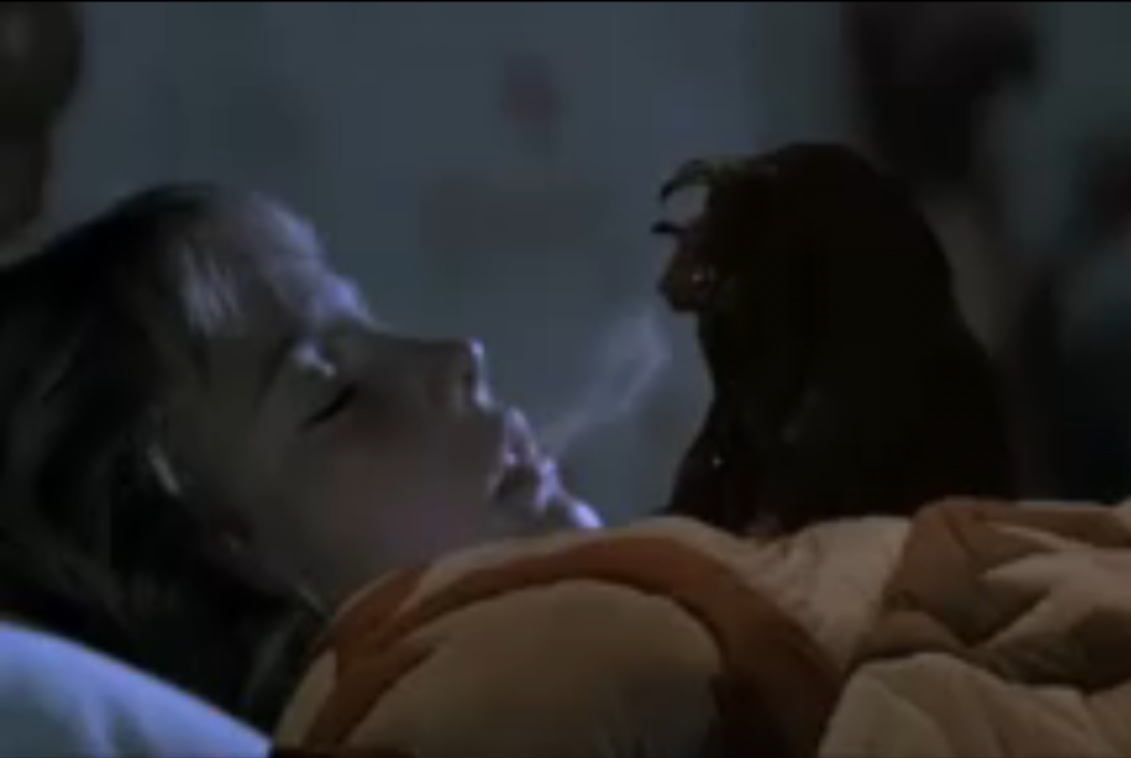
This is the scene in the movie where a troll hops up on the bed, sits on the sleeping Drew Barrymore's chest, and sucks the breath from her mouth.  I have no doubt that Stephen King was depicting the phenomenon known as the "incubus" or the "old hag."   The biologic basis for this parasomnia is sleep paralysis, which we don't have time to discuss right now.

Addendum:   The original YouTube video eventually underwent linkrot.  This is a newer, "re-edited," version of the event.

03 September 2009

Japan's first lady probably experienced sleep paralysis

Miyuki Hatoyama is being mocked in cyberspace for this comment:
"While my body was asleep, I think my soul rode on a triangular-shaped UFO and went to Venus," Miyuki Hatoyama, the wife of premier-in-waiting Yukio Hatoyama, wrote in a book published last year.

"It was a very beautiful place and it was really green."

I have not read her book ("Very Strange Things I've Encountered"), and I'll concede that she may be goofy, but out-of-body experiences and alien encounters are occasional manifestations of the very common parasomnia "sleep paralysis." I've thought of starting a separate blog for this topic, but for now will just note this instance in passing.

Related Posts Plugin for WordPress, Blogger...