Posted as memorabilia for me and a few friends and family members. This is not a "game for the ages" for anyone other than Minnesota Gopher fans. Highlights at 4:00, 6:25, and 6:50 for those curious and in a hurry.


26 November 2025
Thinking of refugees on Thanksgiving

If you have nothing else to be thankful for on this day, be thankful that you are not a refugee - political refugee, war refugee, climate refugee, whatever. I fully understand that some migrants are economic opportunists seeking to game the system, but the vast majority are helpless victims of circumstances beyond their control - from wildfires, floods, droughts, ethnic cleansing, national geopolitical policies, and wars.
The top embedded image is from the border between Poland and Belarus, where the migrants are political pawns in an autocrat's power struggle with the EU. They have been displaced from their homes, have only what they can carry, lack food and shelter and are facing an oncoming winter entirely at the mercy of strangers.
Here's an old photo of a Syrian refugee child:

“I was using a telephoto lens, and she thought it was a weapon,” photographer Osman Sağırlı told the BBC. “İ realized she was terrified after I took it, and looked at the picture, because she bit her lips and raised her hands. Normally kids run away, hide their faces or smile when they see a camera.”
It's tempting to succumb to "compassion fatigue" when reading about the never-ending world crises, or to consider oneself safe from geopolitical conflicts, ignoring the potential of becoming a climate refugee.

Reposted from 2021 to add a WTF development:
Foreigners seeking visas to live in the U.S. might be rejected if they have certain medical conditions, including diabetes or obesity, under a Thursday directive from the Trump administration.While assessing the health of potential immigrants has been part of the visa application process for years, including screening for communicable diseases like tuberculosis and obtaining vaccine history, experts said the new guidelines greatly expand the list of medical conditions to be considered and give visa officers more power to make decisions about immigration based on an applicant’s health status.
We (and other countries) have always in modern times screened immigration applicants for health status - especially communicable diseases - which is why Ellis Island exists. But extending those guidelines to chronic or potential disorders gives the immigration office a new method to exclude persons for unexpressed criteria, such as religion and race.
A concise summary of the Oxfordian narrative
I have excerpted the following from the Summer 2025 issue of the Shakespeare Oxford Newsletter:
"Where do you begin when, at a dinner party, someone says to you, “What’s this authorship nonsense all about? Who is this Oxford anyway?” Have you ever wished for a conversational aid; a simple statement to which you could refer that succinctly describes why you are an Oxfordian? The Shakespeare Authorship Question (SAQ) is horrifically complicated and requires real commitment, deep reading and thoughtful analysis to have a full appreciation of the issues. It’s difficult to explain quickly to people unfamiliar with the topic.What if we could consolidate and summarize “The Case for Oxford?” What if we tried to winnow down all the research, wisdom and weight of circumstantial evidence accumulated over the past hundred years into a clear set of statements? Is it even possible to declare what all Oxfordians agree on? This spring, a group of Oxfordians in England, the United States and around the world attempted to do just that...The Oxfordian Narrative was deliberately kept to one page with six statements. This core principles section is supported by a few Frequently Asked Questions, all composed from information available in more detail on the SOF and DVS websites...The following set of statements has been compiled to provide speaking and written prompts for Oxfordians engaging externally with the media and more widely. The core principles are concise, positive and authoritative, and are supported by a section of Frequently Asked Questions. They form the basis of the Oxfordian narrative and represent the common ground that is respectful of the many differing views held by our members."


A new existential threat to lemurs
"...in their native Madagascar, the endangered animals are facing a growing threat: City-dwellers with cash to spare love to eat them. They say that the meat from fruit-eating lemur species tastes sweet and that consuming these primates promotes strength and good health. The meat from these tree-dwellers is valued for its cleanliness and “purity.” The startling revelation comes from the first-ever assessment of Madagascar’s urban lemur trade. Conducted over the past four years, it concludes that more than 10,000 lemurs were sold for pricey dishes across 17 cities in the country...
Though dining on wild species from African forests often evokes people trying to survive hunger in desperate situations, this new work suggests that people from a wealthier rung of society in Madagascar, those making perhaps thousands of U.S. dollars a year, are a distinct threat to these endangered primates...
All buyers and sellers included in the survey reported they were aware of the illegality of the trade and feared being caught, jailed or fined. But the economic benefits motivated their actions. They were also aware of how rare the animals were becoming. More than half of the interviewees said they expected to have fewer lemurs to trade in the future because of declining populations..."
"Porgy and Bess" - the American folk opera
"Porgy and Bess was first performed in Boston on September 30, 1935, before it moved to Broadway in New York City. It featured a cast of classically trained African-American singers—a daring artistic choice at the time. A 1976 Houston Grand Opera production gained it a renewed popularity, and it is now one of the best known and most frequently performed operas.The libretto of Porgy and Bess tells the story of Porgy, a disabled black street beggar living in the slums of Charleston. It deals with his attempts to rescue Bess from the clutches of Crown, her violent and possessive lover, and Sportin' Life, her drug dealer. The opera plot generally follows the stage play.In the years following Gershwin's death, Porgy and Bess was adapted for smaller-scale performances. It was adapted as a film in 1959. Some of the songs in the opera, such as "Summertime", became popular and are frequently recorded. In the late 20th and early 21st centuries, the trend has been toward productions with greater fidelity to Gershwin's original intentions, though smaller-scale productions also continue to be mounted..."
The "American folk opera" term derives from the fact that the musical score combines gospel, jazz, and blues influences and some vocals are of operatic quality, including this one.
24 November 2025
Word for the day: mews

I have encountered the word "mews" many hundreds of times while reading British literature, sussed out that it was an arrangement of buildings, but never looked it up. This week The Guardian featured "Mews-style homes for sale in England," so it was time to dig deeper. One click at Wikipedia did the trick:
A mews is a row or courtyard of stables and carriage houses with living quarters above them, built behind large city houses before motor vehicles replaced horses in the early twentieth century. Mews are usually located in desirable residential areas, having been built to cater for the horses, coachmen and stable-servants of prosperous residents.The word mews comes from the Royal Mews in London, England, a set of royal stables built 500 years ago on a former royal hawk mews. The term is now commonly used in English-speaking countries for city housing of a similar design....Mews derives from the French muer, 'to moult', reflecting its original function to confine a hawk to a mews while it moulted. William Shakespeare deploys to mew up to mean confine, coop up, or shut up in The Taming of the Shrew: "What, will you mew her up, Signor Baptista?" and also Richard III: "This day should Clarence closely be mewed up".
The rather modest-appearing one embedded at the top is listed at £8,950,000 because of its prime location in Marylebone and its surprisingly spacious interior.
Addendum: This is the image from the listing depicting one of the bathrooms:

Reader Tom239 noticed that the view is into a mirror and the camera is not evident.
Clever mashup of 150+ movie titles
The sad slow death of the CDC
"A Centers for Disease Control and Prevention website that previously said that vaccines do not cause autism walked back that statement, contradicting the agency’s previous efforts to fight misinformation about a connection between the two.The agency’s webpage on vaccines and autism, updated on Wednesday, now repeats the skepticism that Health Secretary Robert F. Kennedy Jr. has voiced about the safety of vaccines, though dozens of scientific studies have failed to find evidence of a link.A previous version of the webpage said that studies had shown “no link between receiving vaccines and developing autism spectrum disorder.” It cited a 2012 National Academy of Medicine review of scientific papers and a C.D.C. study from 2013.On Thursday, the live version of the page stated: “The claim ‘vaccines do not cause autism’ is not an evidence-based claim because studies have not ruled out the possibility that infant vaccines cause autism.”"
How the tariffs have affected me

There has been a boatload of analysis, commentary, criticism, and speculation about the effects the new tariffs may or may not be having on the U.S. economy. I thought I'd throw some actual data into the mix.
One of my retirement activities has been orchestrating the disposal of all the "stuff" I've accumulated during the past 7 decades. This is what might reasonably be termed a "first world problem."
Books went years ago; Agatha Christie and John Dickson Carr collections to eBay, various fiction, history, and science books to the library. Clothes to Goodwill. Rocks, minerals, crystals etc to neighborhood children. High school and collegiate memorabilia to classmates. Now I'm working on collectibles - stamps, comic books, baseball cards etc. For these latter items, eBay is an excellent venue.
This summer I noticed a significant change in how the eBay sales were processing, and I began to track numbers. For the first 125 lots I sold this year, these were the shipping destinations:
United States 72United Kingdom 26Australia/NZ 10Canada 8Others 9 (Estonia, Czech Repub, Sweden, Norway, Sri Lanka, Singapore)
The next 125 exhibited a markedly different pattern:
United States 114United Kingdom 5Canada 2Others 4
At the end of July, sales to foreign buyers evaporated. Instead of 40% going abroad, quite suddenly it was fewer than 10%. The reason became apparent when I looked at the invoices eBay was sending to the foreign buyers (example embedded at top). On a $35 purchase, but winning bidder was asked for $27 in shipping, tariffs, and taxes. The VAT had always been there [this lot going to the UK], but in previous years and at the start of this year I was able to ship small lots of stamps in regular mailing envelopes for USD $1.75 and my sales (typically less than $40) were not subject to tariffs. It was on July 30 of this year that the Trump-imposed tariffs were applied to "de minimus" items of modest monetary value. And I presume what the buyers of my items are seeing are reciprocal tariffs imposed by their home countries?
I have corresponded with some of my (former) buyers in Scotland and elsewhere. They are still interested in my material, but when they have to factor in the new "shipping" costs, my lots become unattractive.
I'm not suffering financially because for me this is discretionary hobby activity and basically a housecleaning operation, not a business. But I will bet you there are lots of small businesses (especially home businesses and side hustles) in the U.S. who are seeing a similar phenomenon be more impactful on their bottom line. I totally dismiss the claims of politicians that the U.S. economy is strong. The stock market does continue to approach new all-time highs, but that's because of an irrational enthusiasm regarding the "magnificent severn" stocks (AAPL, GOOGL, TSLA, NVDA, META, MSFT, AMZN). I will bet you a dollar to a dime that the weakness will show up not in the Dow or NASDAQ, but in the broad-based Russel 2000 index.
And this recent quote I find particularly baffling:
"The Federal Reserve is facing a difficult situation as the US economy shows strong growth and high productivity, yet hiring has significantly slowed... This divergence complicates decisions on whether to cool or boost the economy [via interest rates], with concerns about a potential jobless expansion despite investments in AI..."
Rising unemployment DESPITE AI? Correct me if I'm wrong (please. I'm no expert on such matters), but my understanding was that one of the major powers of AI was to improve efficiency by having the bots do the work formerly done by humans. I would think increased unemployment would be expected, not a surprise.
Those who understand these sorts of things, please chime in with comments.
Related: A recent Bloomberg article is entitled Boomers Are Passing Down Fortunes — And Way, Way Too Much Stuff. "As the $90 trillion Great Wealth Transfer begins, millennials and Gen X aren’t just inheriting money. They’re being buried under an avalanche of baseball cards, fine china and collections of all sorts..." True that.
23 November 2025

19 November 2025
About those pennies... (updated) (again)

Just to clarify the details regarding the cost and savings:
"Mint operations are funded through the Mint Public Enterprise Fund (PEF), 31 U.S.C. § 5136. The Mint generates revenue through the sale of circulating coins to the Federal Reserve Banks (FRB), numismatic products to the public, and bullion coins to authorized purchasers. All circulating and numismatic operating expenses, along with capital investments incurred for the Mint’s operations and programs, are paid out of the PEF. By law, all funds in the PEF are available without fiscal year limitation. Revenues determined to be in excess of the amount required by the PEF are transferred to the United States Treasury General Fund."
The mint makes money (both literally and figuratively). Any current losses from producing pennies are overshadowed by profits from paper dollars, commemorative coins, proof sets, etc.
The embedded image is of a penny on the planet Mars.
Reposted to add some new information from Bloomberg:
Portland Mint, sells old pennies in bulk — 40,000 pounds (18,100 kilograms) at a time — to investors angling to profit on the copper that makes up 95% of the coins minted before 1983. A cache of one-cent pieces from Portland Mint with a face value of roughly $60,000 sells for about $120,000.The wager is that those older pennies contain copper that would be worth about $180,000 at current prices. One snag: It’s illegal to melt a mass of Lincoln cents to harvest the metal. But penny hoarders gained fresh hope that their bets will one day pay off when President Donald Trump said this week that he ordered the Treasury secretary to stop minting the coins...“Collectors and investors speculate the value of copper will go up,” said Ted Ancher, director of numismatics at Apmex, a precious metals dealer in Oklahoma City that has been selling copper pennies for years. “That is the primary reason they buy copper cents.”Customers favor “the ’82 and earlier stuff,” said Dennis Steinmetz, founder of Steinmetz Coins & Currency in Lancaster, Pennsylvania. The company offers 5,000 pennies – with a $50 face value – for $79.“As you may know you may not currently melt these,” Steinmetz’s website says. “However if the government authorizes melting you will be way ahead.”

Reposted from earlier this year to add some excerpts from a sometimes-humorous article in The Atlantic:
What is the United States going to do with all the pennies—all the pennies in take-a-penny-leave-a-penny trays, and cash registers, and couch cushions, and the coin purses of children, and Big Gulp cups full of pennies; all the pennies that are just lying around wherever—following the abrupt announcement that the country is no longer in the penny game and will stop minting them, effective immediately?The answer appears to be nothing at all. There is no plan...It is my miserable fate to possess more miscellaneous information about U.S. one-cent coins than, possibly, any other person on this planet. This is not a boast. The information I command is data no one without a neurodevelopmental disorder would ever yearn to know; it is a body of knowledge with no practical use for anyone. I contracted this condition last year, as I spent several months attempting to ascertain why, in the year 2024, one out of every two coins minted in the United States was a one-cent piece, even though virtually no one-cent pieces were ever spent in the nationwide conduction of commerce, and, on top of that, each cost more than three cents apiece to manufacture...Another thing I learned daily over the course of my reporting: No one cares about pennies... There were logical reasons not to care: 300 billion pennies—all of them still and indefinitely legal currency—constitute approximately zero percent of the total money supply of the United States (0.0 percent if rounding to one decimal place). The millions of dollars the government loses by paying more than three cents to manufacture one-cent coins represents an infinitesimal fraction of 1 percent of the government’s several-trillion-dollar budget...Most pennies produced by the U.S. Mint are given out as change but never spent; this creates an incessant demand for new pennies to replace them, so that cash transactions that necessitate pennies (i.e., any concluding with a sum whose final digit is 1, 2, 3, 4, 6, 7, 8 or 9) can be settled. Because these replacement pennies will themselves not be spent, they will need to be replaced with new pennies that will also not be spent, and so will have to be replaced with new pennies that will not be spent, which will have to be replaced by new pennies (that will not be spent, and so will have to be replaced). In other words, we keep minting pennies because no one uses the pennies we mint.Effectively, they are trash—trash that Americans pay the government (via taxes) to manufacture, at a loss, and then foist back on us..Then I realized they weren’t going to do anything about the vaults, because there was no plan at all to do anything except stop making pennies... This isn’t how it usually works when a smoothly running country elects to retire some portion of its currency... To date, the Canadian Mint has recycled more than 15,000 tons of pennies, redeemed by the public for their face value. Recycling the metal from Canadian pennies (mainly copper and steel) helped offset the cost of trucking billions of unwanted pennies across the nation. And, of course, it kept the coins out of landfills...But it’s unclear if anyone would bother recycling U.S. pennies, which, although copper-plated, are made mostly of zinc. Recycled zinc is worth only about a quarter of recycled copper; nearly 1 million tons of copper are recycled in the U.S. each year, versus only about 165,000 tons of zinc. On top of this, a Canadian Mint official told me, copper and zinc are “very hard” to separate.
Personally I hadn't realized the impracticality or impossibility of recycling a copper/zinc mixture. But the older copper pennies will still have "melt value" (assuming it's now legal to melt them).
When a penny was "... thirty nine ninetieths of a Dollar"


The full phrase, as I encountered it* read as follows:
He sent in his expense account: "for himself & Servant, totaling one hundred and ten dollars and thirty nine ninetieths of a Dollar."The expense account was by a Lieutenant Armstrong, who led an exploration westward to the Mississippi in 1790.
But why "ninetieths" of a dollar? I thought I knew early American coinage reasonably well, but I had never encountered this type of accounting. I reached for an old copy of Yeoman's Red Book to review the early pennies and large cents and could find nothing relevant, nor was there anything in the continental currency section about cents or pence being 90 to the dollar.
So, back to the web, which promptly yielded the images above, which are of course not coins, but rather -
...small change bills of credit payable in specie issued by the Bank of North America in Philadelphia. This was one of several fractional currencies printed to carry on commerce during the "Copper panic" when the price of copper dropped dramatically and copper half penny coins were either not accepted by merchants or only accepted at far below their denominated value. The notes were printed by Benjamin Bache in Philadelphia on paper supplied by Benjamin Franklin that had a marbled border along the top of the sheet.But why a 90:1 ratio rather than 100 pennies to the dollar? I found part of the answer at the West Jersey History Project:
Mr. Adams, in his report on the subject of weights and measures, made in 1820, remarks: "It is now nearly thirty years since our new moneys of account, our coins and our mint, have been established. The dollar, under its new stamp, has preserved it name and circulation. The cent has become tolerably familiarized to the tongue, wherever it has been made, by circulation, familiar to the hand. But ask a tradesman or shopkeeper in any of our cities what is a dime, or a mill, and the chances are four in five that he will not understand your question. But go to New York and offer in payment the Spanish coin, the unit of the Spanish piece of eight, and the shop or market man will take it for a shilling. Carry it to Boston or Richmond, and you shall be told that it is not a shilling but a ninepence. Bring it to Philadelphia, Baltimore, or the city of Washington, and you shall find it recognized for an eleven penny bit, and if you ask how that can be, you shall learn that the dollar being of ninety pence, the eighth part of it is nearer to eleven than any other number; and pursuing still further the arithmetic of popular denominations, you will find that half of eleven is five, or at least, that half of the eleven penny bit is the fipenny bit, which fipenny bit at Richmond, shrinks to four pence half penny, and at New York swells to six pence."Here is the topic mentioned in The Bankers Magazine, via Google Books during a discussion of the history of the word "dollar":

So, at the time Lieutenant Armstrong submitted his expense account to the government, "the dollar in Pennsylvania equalled seven shillings and sixpence, and the penny was the one-ninetieth of a dollar."
For those who want to pursue this more fully, I think the best discussion I found this morning is in this pdf file entitled State "Currencies" and the Transition to the U.S. Dollar", but it's over 50 pages long and football games are starting shortly, so all I can offer is this screencap:

What a mess it must have been for the early colonists and Americans to cope with currencies and money.
* in Undaunted Courage; Meriwether Lewis, Thomas Jefferson, and the Opening of the American West, by Stephen Ambrose (an excellent book, btw, of which I've only read a couple chapters and on which I'll have more to say later.)
Reposted from 2012
Sorting pennies in the dark
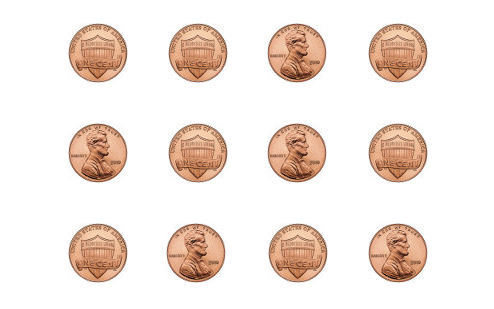
"You’re in a pitch-dark room. On a table before you are 12 pennies. You know that 5 are heads up and 7 are tails up, but you don’t know which are which. By moving and flipping the coins you must produce two piles with an equal number of heads in each pile. How can you do this without seeing the coins?"I was not able to solve this on my own and had to peek at the answer. Even after seeing the answer, it took me a long time to comprehend why it works.
Reposted from 2010 because I found it while looking for something else and still couldn't solve it on my own.
16 November 2025
Arm of man who fell off a bicycle

Note that not only are the radius and ulna broken, but the metal plates inside the bones (from repair of previous fractures) are bent at a 90 degree angle. The victim explains:
Was on a nice leisurely bike ride - shoe laces got stuck on my bike pedal and wrapped around multiple times over. Fell off as I was braking to get them unstuck. I never want to get on a bike again 😫
United Airlines claims a "window seat" does not necessarily need to have a window
"In August, United and Delta Air Lines were sued by passengers in two separate but similar suits. Both airlines were accused of unfairly charging extra for some window seats without warning that there wasn't actually a window there.
United filed a motion to dismiss the case on Monday.
"The use of the word 'window' in reference to a particular seat cannot reasonably be interpreted as a promise that the seat will have an exterior window view," the airline's lawyers wrote.
"Rather, the word 'window' identifies the position of the seat—i.e., next to the wall of the main body of the aircraft," they added.
I'll defer any commentary on this absurdity.
Introducing Torx screws

I may be introducing the subject only to myself if this item is well-known. I encountered it in a reasonably concise Wirecutter article:
"Pros swear by Torx-head screws, an all-around better alternative to the formerly ubiquitous but flawed, finicky Phillips head... The cross-headed design of the Phillips screw is notoriously slippery and easy to damage. That’s why most of the rest of the world moved on from Phillips screws years ago, if they even adopted this miserable standard in the first place.This isn’t a problem with Torx because the star-shaped head provides much better grip and stability... And all that extra contact between the screw and the drill bit makes it much less likely that you’ll strip the head (or ruin your bit) even if you’re blasting your tools at full speed... [the embed shows a Torx compared to a Phillips with a stripped center]... there aren’t many credible technical or legal excuses to keep using Phillips screws. The patents on Torx (and other Phillips-beating standards, including square drive) expired decades ago, so anyone can manufacture the bits and screws...An impact driver looks like a stubby drill, but it sinks screws into wood and other materials at breathtaking speed. (Even basic power tool starter packs usually come with one now.) That tool’s efficiency is often wasted on wobbly, damage-prone Phillips screws, so it makes sense to pair an impact driver’s extra power with a snugger standard like Torx.
For those interested in greater detail, the Wikipedia entry has information on the Torx' history, physics, and subtypes.
13 November 2025
Excellent advice not to "future-trip"

There is a very interesting article in the September issue of The Atlantic. "My Father, Guitar Guru to the Rock Gods" is written by the daughter of Fred Walecki, who crafted instruments and provided advice to the greatest musicians of 1960s California. Here are the introductory paragraphs:
In August 2000, when I was 2 years old, my mother put me in a maroon velvet dress and stuck foam earplugs in my ears. She carried me through the backstage corridors of the Santa Monica Civic Auditorium... My mother remembers the night in flashes. David Crosby—walrus mustache, smiling eyes—telling jokes. Bonnie Raitt’s aura of red hair. In the distance, the sound of Linda Ronstadt warming up. Sitting in a dressing room with Michael McKean and Christopher Guest, already in costume as Spinal Tap’s front men.That night, the auditorium was hosting the Friends of Fred Walecki benefit concert. These friends included Crosby, Raitt, and Ronstadt. Also Jackson Browne, Graham Nash, Emmylou Harris, and Warren Zevon. Three of the four original Eagles, who in this room in 1973 had performed their new album, Desperado, were there too.One of the Eagles, Bernie Leadon, had helped put the event together. He had known Fred Walecki, my father, since they were teenagers, when Leadon started coming into Westwood Music, Dad’s musical-instrument shop in Los Angeles....
I'm not posting this for the music of the 1960s, which I love (please go to the link to continue reading, if you share that interest). I'm posting this to share one bit of advice that Fred Walecki offered his grown-up daughter:
"When I was 18, I got a bad concussion that took me out of college for my first semester. My doctor didn’t want me to fly home for a while, so I called Dad one night from the other side of the country, panicked that my brain would never return to normal.“What are you looking at right now?” he asked. Pine trees, I said. Some shrubs. I’m sitting on a bench outside. “What’s the temperature like where you are?” It’s nice. Cool but not cold. It was early fall in the Northeast, a new sensation for a Californian. “What does the air smell like?” Wood chips.“I know it’s hard, but your only job right now is to stay in this moment and not future-trip. In this moment right now, the one God is giving you, the air smells nice, the temperature is good, you’re somewhere beautiful.”"
Excellent advice, in my opinion, and worth sharing via the blog.
10 November 2025
Word for the day: lagniappe

“We picked up one excellent word – a word worth traveling to New Orleans to get; a nice limber, expressive, handy word – ‘Lagniappe.’ They pronounce it lanny-yap. […] When a child or a servant buys something in a shop – or even the mayor or governor, for aught I know – he finishes the operation by saying, – ‘Give me something for lagniappe.’ The shopman always responds; gives the child a bit of liquorice-root; […]”: Mark Twain, Life on the Mississippi (1883)
I recently sent an incidental small gift to a friend in New Orleans. He replied with thanks for the "lagniappe," so of course I had to look that up. Here are the essentials, courtesy of Wiktionary:
Definition: (chiefly Louisiana, Mississippi, Trinidad and Tobago) An extra or unexpected gift or benefit, such as that given to customers when they purchase something.Synonyms: (chiefly Southern US) brotus, (South Africa) pasella, (Ireland) tillyEtymology: From Cajun French lagniappe, from Spanish la ñapa, a variant of yapa (“small gift or additional quantity given to a valued customer”), from Quechua yapa (“addition, increase, supplement; lagniappe”), yapay (“to add, to increase”).
I thought that might be my first English word of Quechua origin, but a quick check reveals there are many more, including ayahuasca, cocaine, guano, jerk/jerky, pampas, pique, poncho, puma, quinine, quinoa, vicuna, and the place names Andes, Chile, Cuzco, Machu Picchu, and Peru.
A video review of the butterflies of Wisconsin
Wisconsin Butterflies is the definitive online resource for reporting sightings across the state.
Last year's video is here.
The Wreck of the Edmund Fitzgerald


Three more examples are illustrated here.
Reposted for the third time to add this video recording of a similar ship (a Ukranian freighter) actually splitting in the Black Sea:
The relevant action occurs in the first minute; there is a second segment showing the ship sinking.
Addendum: PBS Wisconsin has a video presentation of a public lecture on The Storm that sank the Edmund Fitzgerald.
And reposted for the final time because today marks the 50th anniversary of the sinking. Somewhere I hae seen a discussion of the phrase "The lake, it is said, never gives up her dead" being scientifically true because at depth the water is too cold for bacteria to generate decomposition gases to lift the corpse and/or because the hydrostatic pressure at depth prevents the bubble formation.
And I'll add a link to the lyrics, because they are hard to discern in the embedded video.
07 November 2025
Holes in the pillars of this bridge

I saw this image in the WhatIsIt subreddit, where readers were asked to provide an explanation for their intended function. I thought perhaps they were for stringing communication etc cables across the river and was delighted to read this postulated explanation, which rendered the image blogworthy:
"To plant explosives. In some countries bridges are designed to be easily blown up in case of war. Don't know if this is the case."
It wasn't long before the true explanation was provided, which I'll put "below the fold" so you can ponder for a moment...
06 November 2025
Brazilian sand dunes

"In a land still soaked from the rainy season, a river stained with tannin from a nearby forest marbles the sand."
From a set of ten photos at National Geographic, via La Muse Verte. I have previously written a post about the remarkable Lençóis Maranhenses National Park.
Reposted from ten years ago to add this recent photo of flooded sand dunes at this location, via.

Reposted from 2021 to add this rather nice PBS video on the subject:
Wasp nests for home decor

Here's one way I'm well ahead of the curve on fashion and design. I've been bringing wasp nests and other natural curiosities into my apartments and home all of my adult life. The New York Times reports that items like the above now retail for "up to $250 per specimen." Several photos at the link.
I don't believe inflation is "under control" in the U.S.


All of the recently published charts, and most of the headlines, indicate that monetary inflation is "not a problem" at time in the United States. Based on personal experience and our family finances and my doomscrolling of the internet, I flat out don't believe those data.
There is some justification to being skeptical, because the federal entities that monitor and report such data have been subject to the government shutdown. This opinion from a NYT article:
The United States is a month into a government shutdown that has hobbled the nation’s statistical agencies and created the longest economic data blackout in history. The normally steady flow of government data on hiring, spending, wages, prices and other areas has slowed to a trickle, leaving economists to try to fill in the gaps using anecdotes and a mélange of incomplete and often contradictory indicators from private sources.There is no good time to go without reliable data. But this might be a uniquely bad one. Job growth slowed sharply over the summer, leading to fears that the labor market could be taking a rapid turn for the worse. Such a development would most likely draw a swift response from officials at the Federal Reserve, who are responsible for maximizing employment while keeping inflation stable. But policymakers have no reliable way of knowing whether those trends continued into the fall, or perhaps reversed.Tara Sinclair, an economist at George Washington University, likened the situation to driving down a road in a heavy fog... But the fog will get thicker from here. The statistical agency was able to release the September inflation report because the underlying data had been collected before the government shut down on Oct. 1. But it hasn’t collected any new data since then. The White House said last week that the government might not be able to release an October inflation report at all. Reports on the job market, consumer spending, manufacturing and other topics are also in jeopardy.
I can see no rational justification for the equity markets to be consistently hitting new all-time highs, largely based on expectations that artificial intelligence is going to supercharge the profitability of major corporations (NYSE chart; NASDAQ not dissimilar).

Full disclosure: I tend to be a "perma-bear" skeptical of rosy scenarios. I have moved the majority of my savings out of equities into CDs etc, but that in part also reflects my advanced age. YMMV.
04 November 2025
James Garfield - president for only 200 days

I have a new favorite president. Before reading this book, literally the only things I knew about James Garfield were that he was featured on the 20c prexie stamp (because he was the 20th president) and that he was assassinated while in office. Now I can add the following...
He grew up in Ohio in abject poverty – a one-room log cabin with a plank floor and windowpanes made of oiled paper. When he was two years old, his father died at age 33, leaving his mother with four children to feed. She farmed the land with the aid of his 11-year-old brother and saved money so that by age four James was able to get a pair of shoes. At age sixteen he began working on the Erie and Ohio Canal, but returned home after contracting malaria. By then his mother had saved $17, which was used to send him to Western Reserve Eclectic Institute, a one-building prep school. During his first year he worked as a janitor in exchange for receiving an education.
So vigorously did Garfield apply himself during his first year at the Eclectic that, by his second year, the school had promoted him from janitor to assistant professor. Along with the subjects he was taking as a student, he was given a full roster of classes to teach, including literature, mathematics, and ancient languages. He taught six classes, which were so popular that he was asked to add two more – one on penmanship and the other on Virgil. (p. 23)From there he moved to Williams College in Massachusetts and graduated in two years. He entered state politics in Ohio, then served in the Civil War in the Union Army, after which he was elected to Congress. He did NOT want to be president. He attended a nominating convention which was hopelessly deadlocked. On the 34th ballot, some electors voted for him. He rose to protest and was told to sit down. On the 36th ballot, he became the Republican nominee – against his will. He was described as shocked, sickened, and pale as death during the proceedings. (pp 40-46).
He never participated in the campaign which was conducted on his behalf, preferring to work and receive visitors on his 160-acre farm.
His campaign platform as a Republican emphasized civil rights and the welfare of the freed slaves, in which endeavor he was supported by Frederick Douglass. Voter turnout for the election was 78%, and he was elected by a narrow margin.He built a barn, moved a large shed, planted an orchard, and even shopped for curtains for the house…. he added an entire story, a front porch, and a library. Even with the new library, Garfield’s books filled every room. “You can go nowhere in the general’s home without coming face to face with books,” one reporter marveled. “They confront you in the hall when you enter, in the parlor and the sitting room, in the dining-room and even in the bath-room…” (p. 58)

In the days that followed… Garfield could not shake the feeling that the presidency would bring hi only loneliness and sorrow. As he watched everything he treasured – his time with his children, his books, and his farm – abruptly disappear, he understood that the life he had known was gone. The presidency seemed to him not a great accomplishment but a “bleak mountain” that he was obliged to ascend. (p. 64)The assassin, Charles Guiteau, was a religious fanatic who was delusional to the point of frank psychosis. He borrowed $10 to buy a gun, used it to shoot the president not for any political or philosophical reason, but because he believed God wanted him to do it.
His first and primary defense was “Insanity, in that it was God’s act and not mine. The Divine pressure on me to remove the president was so enormous that it destroyed my free agency and therefore I am not legally responsible for my act.” (p. 237)The “insanity defense” was well established at the time. Interestingly, everyone at the time agreed that Guiteau was insane and that insane people were not liable for their actions. Everyone on the jury knew this also, but they were so angry that they basically said “he’s guilty – hang him anyway.”
Other interesting tidbits from the book: After Garfield was shot, the second physician who responded to the event was Charles Purvis, surgeon in chief of the Freedmen’s Hospital, 39 years old, one of the first black men in the U.S. to receive medical training at a university, and obviously the first ever to treat a president. (p. 140)
The White House of that era was like a slum residence, perpetually damp with rotting wood and vermin-infested walls and the odor of raw untreated sewage, situated next to a malarial tidal marsh. (p. 176)
Garfield was a Republican who embodied the party’s enthusiasm for helping immigrants, freed slaves, and impoverished people. He believed the key to improving the country lay in educating those people. (182)
It has been said that Guiteau did not kill the President – he shot him, but the doctors killed him by repeatedly probing the wound with ungloved, unwashed fingers. Guiteau used this argument in his own futile defense (“General Garfield died from malpractice.”). The bullet had lodged on the left side of his body behind the pancreas, but the attempts to find it on the right side resulted in profound septic sequelae:
One cavity in particular, which began at the site of the wound, would eventually burrow a tunnel that stretched past Garfield’s right kidney, along the outer lining of his stomach, and down nearly to his groin. An enormous cavity, six inches by four inches, would form under his liver, filling with a greenish-yellow mixture of pus and bile. (p. 196)He apparently developed septic emboli:
Just two weeks after the surgery, another abscess formed, this one on Garfield’s right parotid gland… the abscess had become so filled with pus that it caused his eye and cheek to swell and paralyzed his face. Finally, it ruptured, flooding Garfield’s ear canal and mouth with so much pus… that it nearly drowned him. (p. 216)The woefully incompetent Dr. Bliss treating him [“Ignorance is Bliss”] tried to cope with the president's rapid cachexia by feeding him intrarectally. The eventual cause of death (determined by autopsy) was hypovolemic shock following a rupture of the splenic artery (probably from a septic aneurysm).
Garfield does not get credit for any particular legislative achievements, because his time in office was too brief. Rather, his legacy is reflected in how his illness and death united the people of the country during the fractious time in the aftermath of the Civil War. And since Guiteau’s act had arisen in connection with the corrupt “spoils system” for giving out lucrative government job contracts, the popular revolt after the death led to the establishment of the civil service system. After his death, Garfield’s widow assembled his books and papers in a wing of their farmhouse, establishing the nation’s first-ever presidential library.
The book is Destiny of the Republic. A Tale of Madness, Medicine and the Murder of a President, by Candice Millard, published by Doubleday in 2011. I'm pleased to add it to my list of recommended books.
Addendum 2016:
I am delighted to report that the superb television series American Experience has just released a program entitled "Murder of a President," about President Garfield; it is based on the book I reviewed above in 2012. The two-hour program is playing on PBS stations around the country, and it can be viewed online here.
Reposted from 2016 because of the upcoming Netflix series Death by Lightning, which is scheduled to drop later this year.
"Vertigo: The Rise and Fall of Weimar Germany"

This is an interesting longread about the Weimar Republic (Germany from the end of WWI until the mid-1930s). It is a richly detailed book, and thus TMI for my personal needs, so I alternately browsed and read in depth various sections.
After WWI Germany entered a state of turbulent politics and economics. There was civic turmoil because of internal dissension re the defeat in the war, combined with frankly chaotic economics leading to the famous hyperinflation. Yet during this period there were major developments in lifestyle, employment (invention of typists and secretaries), fashion, sexual mores, architecture, automobiles, and design (Bauhaus). This book tries to cover as much of that as possible. Herewith some excerpts and thoughts:
The Charleston dance was a life-changer for social interactions. "The fact that one could dance the Charleston alone had consequences for the self-empowerment of the individual; to be able to join in solo on the dancefloor was nothing less than revolutionary." (xvii) (discussed in depth in Chapter 7)Filmmaker Billy Wilder started his adult life as a gigolo in the dance halls of Berlin. (176) After the war ended, Germans were crazed with the need to dance:"Here and there two young girls dance together, sometimes even two young men; it's all the same to them. They do it to the exotic sounds of the gramophone, which is fitted with robust needles to make it as loud as possible, and it rings out its shimmies, foxtrots and one-steps, its double foxtrots, African shimmies, java dances and polka creolas..." (180)"The shimmy brought an unimagined freedom to the parquet. Now people danced almost on the spot to whipped-up rhythms without touching one another... Where in the old days it would have been unthinkable to step on a dance floor without having first taken dancing classes, the new dances could only be learned by imitation..." (180) [followed by several pages of discussion of the shimmy]"The rapturous experience of community in the ballroom grew even more intense in 1925 when the Charleston conquered the dance floors... The Charleston turned dancers into acrobatic marionettes... The gramophone allowed people to dance at home and in the countryside... The Charleston was an uplifting dance. It fired up the ego and inspired people to express their own emotions through dance.... The Charleston was particularly enjoyable for women. They didn't have to be led, and were usually the more active, exuberant participants..." (186)It was during this time period that "the weekend" was invented. Two days off from work was revolutionary.The cinema presented Charlie Chaplin and Marlene Dietrich, and was the top paid-for leisure activity. "In the early 1920s most people didn't go to see a particular film, they just went to the cinema. For that reason, many cinema owners didn't think it necessary to set a particular time for the screening to start. Films were just shown one after the other, in any order. People came and went... and watched for as long as they felt like it. If the projectionist wanted to go home early he just played the film speeded up; silent films can take that. More importantly there was no need for the audience to listen, so they made any amount of noise, chatted, applauded or commented bawdily on the action." (210)Several chapters in the book discuss the great depression of the 1930s, when the country owed "reparations" to the West. There were runs on the banks when hyperinflation went out of control. Unemployment reached 30 to 40 percent of the population. Then came the rise of the Nazis and of antisemitism. Also major rifts developed between urban and rural populations. There were calls for "an uprising by the countryside against the city..."...what one saw in the city was nothing but libertinism, women's emancipation, coarse language, and disrespectful irony... Until the beginning of the depression these ingredients had constituted the charm of the liberal-left-wing Berlin cultural and media scene... but since optimism had fled from public life, the modernity of Berlin's cultural life seemed to have become more exclusive. For those threatened by decline, the modern age felt less like freedom for all and more like pleasure for a few. That intensified into the delusional claim that the modern arts were the destructive work of a corrupt elite that wanted to drive the soul out of the people Hitler's campaign against 'degenerate art' would later be of prime importance for his success, because it included an assurance that the future volksstaat would be geared towards the taste of the people..." (316)"... listening and looking more closely one could discern the gulfs of silence dividing society. People liked to be among their own kind and held the rest in contempt, Given the muddled state of things, even fewer people than usual were in a position to take anything meaningful from a discussion with people of a different opinion. 'Unity' and 'unanimity' were yearning words on everyone's lips, although there were only two ways of achieving either: through determined silence or brutal violence." (330)Most Germans had never learned to argue constructively. They had been raised under the control of a Kaiser, and had done whatever they were told to do. "When they jumped into freedom, few understood what it meant to take responsibility for oneself and consult with others in the abstract framework of democratic representation." (330)"Opponents of the Berlin cultural scene had long asserted that it was indeed an island, but every milieu, every newspaper formed an island in itself, with its own opinion makers, whistleblowers and regular readers - an island where the opinions of outsiders were unwelcome. Every political trend, every little party, the tiniest intellectual village had its own newspaper.. A form of the infamous 'filter bubble' or 'echo chamber' through which people can become intellectually isolated on digital networks in the present day also existed in Weimar Germany. Reader and newspaper existed in a mutual relationship of confirmation bias; the newspaper wrote what the reader wanted to hear, and the reader stayed loyal as long as the paper didn't trouble him with unwelcome news." (332)Three weeks after the 1933 election the members of the new Reichstag held their second meeting. "On the agenda was Hitler's 'Law to Remedy the Distress of the People and Reich', also known as the Enabling Act. This was intended to give the government the right to make laws independent of parliament and without regard for the constitution and constitutional rights..." After a period of violence in the streets "the Enabling Act was passed with the necessary two-thirds majority, and democracy was abolished in an apparently democratic way." (372)
The parallels between Weimar Germany and modern America are uncanny and deeply disturbing. John Farrier, if you are on the acquisitions committee at your library, please advise them to consider this one.
02 November 2025
The surprising etymology of "giddy"
"Giddy" is a familiar word, typically used to convey that the speaker is "joyfully elated; overcome with excitement or happiness," but it began life meaning possessed by a demon. I'll let Wiktionary explain:
The adjective is derived from Middle English gidi, gedy, gydy (“demonically controlled or possessed; crazy, insane; foolish, idiotic, ridiculous, unwise; unsure; (rare) dizzy, shaky; (rare) of an animal: crazed, out of control; a fool”) [and other forms], from Old English gidiġ, gydiġ (“possessed by a demon or spirit, insane, mad”), from Proto-West Germanic *gudīg (“ghostly, spirited”, literally “possessed by a god or spirit”), from *god (“god”) + *-ig, *-g (suffix forming adjectives with the senses of being, doing, or having). The English word is analysable as god + -y (suffix meaning ‘having the quality of’, forming adjectives).
You learn something every day.
Tilted-room sketches by Shaun Micallef
A sketch from The Micallef P(r)ogram(me). And if you like that one, here's more:
Second repost (originally posted 2013) because after checking all the news online, I needed a laugh. And this never gets old.
Watching the World Series... from a hotel bed

"The only hotel in North America to be found in a major league sports and entertainment venue, the Toronto Marriott City Centre has 348 pet-friendly guest rooms, including 68 that look right out into the stadium."
A recent Bloomberg article offered some observations regarding the monetary aspects of baseball'w World Series:
Sam McDadi, a real estate agent and holder of three tickets behind home plate [will] attend Game 6 himself and bring two friends, despite receiving offers of as much as C$30,000 ($21,415) per seat. But he admitted to being tempted by that amount, especially when he bought his tickets for about C$3,000 each...For those with smaller budgets, the cheapest available ticket for Friday’s game on the resale site StubHub was around $1,280 as of late Thursday night Toronto time...Other businesses are also cashing in. The Blue Jays’ home stadium has an unusual feature: a Marriott hotel with 55 field-view rooms. Those went on sale Tuesday morning starting at C$8,500 per night for Games 6 and 7 and sold out immediately, according to a hotel executive. As of Thursday evening, Marriott’s booking site showed rooms available — because of canceled reservations — for around C$12,000 for Friday night......financial firms that have corporate boxes at the stadium will use access as a reward system. For anyone lucky enough to get an invitation, “it means you’re a good client, a good customer.”
There are all sorts of lines of commentary I could offer, depending on whether I'm wearing my sports-fan cap or my "elderly grumpy woke person" hat. With regard to both of those hats, I'll note that every player on the field is not only a millionaire, but earns several million dollars every year, and they are battling to decide who will become the bigger multimillionaires.
But the big transfer of wealth goes from the general public to the corporate overlords who control the business. It's generally agreed that everyone is entitled to spend their money any way they please, and if someone chooses the World Series rather than sending funds to World Central Kitchen, they can do so. But it feels oddly disturbing that this is what our world is evolving into.
Embedded mage and excerpted text from Adventures All Around, where there are more details about these rooms.
Subscribe to:
Comments (Atom)
