30 June 2015

Assassin bug - updated


I was out in our garden yesterday collecting Monarch butterfly eggs (found twelve of them).  The photo above shows the surprise I found under one leaf.  I came back later after she had finished to get this photo of the cluster of eggs: (click both images for fullscreen)


She appears to me to be from the group of true "bugs" but I don't know her precise identity.  I suppose I could search on BugGuide, but instead I'll leave it open for the readership to ponder.  Some reader out there will be knowledgeable enough to offer a proper name that I can put in the title.* 

*solved by readers bucaneer, Shrike, and William D. Richards, who recognized it as an assassin bug:
The most common assassin bugs in our area are members of the Zelus genus... They are slender, long-legged bugs that are usually found on leaves and flowers, where they hunt by ambush. Length is 10-15 mm. Zelus species can fly and will if frightened, but they usually stay put and rely on their camouflage to hide them from both predators and their prey. They capture prey with their front legs, which are coated with sticky hairs.

Zelus eggs are laid on leaves in a small cluster. They have white caps on top. When they hatch, the nymphs disperse very quickly, as they will eat their siblings if given the chance... 
I have seen slightly different (more robust) assassin bugs in our garden holding dead butterflies and moths.  Didn't know they preyed on caterpillars, but I'm not surprised.

Update:  I monitored the eggs every time I went to the mailbox.   Nothing happened until yesterday (July 16 - 18 days after they were deposited), when I saw the underside of the leaf was just boiling with a mass of baby assassins:


The photo quality is marginal, but o.k. for documentary if not artistic purposes.  I don't know why some of the nymphs are milky white while others are more translucent - whether this is a true dimorphism or whether some are older and their exoskeletons are maturing.

Piñata


Piñatas bearing the likeness of the billionaire mogul have begun popping up in Mexico, a response to controversial comments Trump made about Mexican immigrants.
“The U.S. has become a dumping ground for everybody else’s problems,” Trump said during his Presidential campaign announcement speech. “When Mexico sends its people, they’re not sending their best. They’re not sending you. They’re sending people that have lots of problems, and they’re bringing those problems with us. They’re bringing drugs. They’re bringing crime. They’re rapists. And some, I assume, are good people.”
It's not like Trump said this in a moment of levity at a party.  This was part and parcel of his public announcement that he wants to be POTUS.  Incredible.

Elementary information about the Sherlock Holmes canon


 They left out my favorite:
Matilda Briggs was not the name of a young woman, Watson, ... It was a ship which is associated with the giant rat of Sumatra, a story for which the world is not yet prepared.
The Guardian has more sixteen more infographics, at least one of which will have some fact you didn't already know.

29 June 2015

"He endured being called a girl..."


He endured being called a girl, playing sports with waist-length hair and attracting disapproving looks from adults — all for a child in need he's never met.

Eight-year-old Christian McPhilamy grew out his blond hair for more than two years so he could donate it to kids who have lost their locks.
More at the Today parenting column.

Three years without shampoo

"...you do the following instead of using shampoo: put baking soda in your hair, rinse it out, put apple-cider vinegar in your hair, rinse it out. Repeat once every 5–7 days, washing with just water in the meantime...

After about three years without shampoo, my hair is noticeably softer and fluffier than it used to be. I never use any product—I just blow-dry it with a finger diffuser and it stays in beautiful perfect waves all day...

Take a bottle and fill it with half baking soda, half water. Then take another bottle and fill it with half apple-cider vinegar, half water. Keep the bottles in your shower. This seems to be the optimal level of dilution—not too basic, not too acidic...

...my hair doesn’t smell like vinegar. It doesn’t smell like pomegranate rainwater or whatever, either. It just smells like nice, neutral, clean hair. People are always surprised, but seriously, diluted apple-cider vinegar is way less gross than your body. Shampoo, on the other hand, just makes you grosser. Quit it. I dare you.
More at The Hairpin.

If you enjoy mathematics, this video will be painful to watch

Music hath charms...

An article at Long+Short addresses the question "Can music offer the key to treating dementia?"
In most cases of dementia, regardless of whether or not people have had musical training, they retain their capacity to sing, play, whistle, tap, click, clap, drum and dance long after much of the rest of their cognitive apparatus is deeply compromised. Music is often the very last thing to go, especially the embodied memory of music to which people dance or tap out a rhythm. Music anchors patients, Sacks says, in a way that nothing else can, reconnecting them to that sense of self which is in danger of slipping through their fingers. So it can also connect them to other people from whom they often feel estranged.

This is because music is deeply ingrained in the way our brains have developed. Evolutionary psychologists, neuroscientists and experts in music cognition have not yet come up with an entirely convincing argument as to why human brains are so attuned to music. But a growing body of work, much of it only conducted over the last three decades using new techniques for seeing inside the brain while music is being played, suggests that our brains are fundamentally musical. That is why our capacity to play, enjoy and feel music can outlast the deterioration that dementia and other debilitating conditions bring with them...

As science writer Philip Ball argues in The Music Instinct, music is unlike language: it has no dedicated mental circuitry localised in a few areas. Making sense of music is a whole-brain activity: "No other activity seems to use so many parts of the brain at once, nor to promote their integration." When the brain is listening to music it engages the motor centres that govern movement; the primal emotion centres that govern feeling; the language modules that process syntax and semantics; and the cerebellum that helps to keep time. One of the reasons we are so drawn to music is that it is perfectly designed to allow us to make the fullest possible use of our brains...
More at the link.  My mother, who has advanced dementia, experiences special delight from hearing music.

27 June 2015

Divertimento


Awesome hair coloring.

A photo album of African Hero Rats - trained to detect landmines.  "The pouched rats are perfect for the job; intelligent with a keen sense of smell, they are small enough not to trigger mines and large enough to be easily identifiable in the field. No rat has been killed in a minefield."

An arctic hare filmed successfully crossing a moving avalanche.

"The catch-22 is people buy Bitcoins because they think the price will go to infinity and beyond once everybody uses them, but they don't spend their own Bitcoins because they think the price will go to infinity and beyond once everybody else uses them. And so nobody uses them. But if nobody uses them, then the price will stay stuck at something a lot less than infinity let alone beyond."

A long article about America's obsession with perfect teeth.  "Cosmetic dentistry now represents the largest nonsurgical beauty industry after makeup."

Why it would be nice for you to meet your UPS driver halfway before he/she walks up to your house/apartment.

Video of the world-record-holding limbo queen.

All about gin and tonic.

The Magna Carta Project - "Providing resources and commentary on Magna Carta and King John for scholars, schools, and the general public."

Augustinian theodicy "attempts to explain the probability of an omnipotent (all-powerful) and omnibenevolent (perfectly loving) God amid evidence of evil in the world... Evidence of evil can call into question God's nature or his existence – he is either not omnipotent, not benevolent, or does not exist. Theodicy is an attempt to reconcile the existence and nature of God with evidence of evil in the world by providing valid explanations for its occurrence."

Don't swim in this blue lagoon in a limestone quarry (the water of which has a pH of 11).

On the first anniversary of No Such Thing As A Fish, a collective biography of the QI elves (creators of my favorite podcast).

A video by the National Space Society about the anticipated encounter next month of the New Horizons spacecraft with Pluto.

From Krebs on Security: "LastPass, a company that offers users a way to centrally manage all of their passwords online with a single master password, disclosed Monday that intruders had broken into its databases and made off with user email addresses and password reminders, among other data."

The mass of a supermassive black hole measured in suns (gif).

"Germany agreed Thursday to turn more than 60 former military bases into nature preserves, with the aim of creating vast new green oases and sanctuaries for rare species of birds.  Environment Minister Barbara Hendricks said an ongoing overhaul of the German armed forces had made it possible to set aside more than 31,000 hectares (76,600 acres) of forests, marshes, meadows and moors."

An update on Kennewick Man.

If you get hacked or your identity stolen, there is a way to change your Social Security number.

Murders of white and blacks by whites and blacks, per capita, for 2013, graphed.

Review of a recent book on the history and practice of postmortem photography.

Photos by someone who walked the Great Wall of China beyond the touristy areas.

The geomythology of Great Flood legends - this article focusing on Tibetan history.

"For almost 350 years Bishop Peder Winstrup lay quietly in his coffin in the crypt of the magnificent cathedral at Lund in Sweden, concealing a secret: the body of a tiny baby, tucked in under his feet."  It's presumed that the explanation is not scandalous, but rather a (successful) attempt by someone to have the baby buried in hallowed ground.

The oldest human footprints in North America.

Really tight "skinny jeans" can cause medical problems (nerve compression and paralysis).

Video of water trapped between the panes of a double-pane window on a moving bus.

It is now believed that there was water flowing on Mars at a time when proto-humans first appeared on Earth.

An ELI5 on the TPP.

"A 'rough ride' is a tactic used by police to injure an arrestee without laying a hand on him or her. In the past 30 years victims have sued police departments for the abuse they have suffered in the back of police vans, but the practice dates back to the Reconstruction."

The biology of the ACHOO Syndrome (sunlight-induced sneezing).

Harmony

26 June 2015

The best state for business? High-tax Minnesota.

CNBC is the premier business channel on television.  Their views on public policy and national politics are predictable and emphatically expressed in online and televised editorials.  Each year they conduct a survey to determine the best (and worst) states for business.  This year, presumably to the surprise of many on the political right, the top-scoring state was Minnesota.
Minnesota, known for high taxes and for being sympathetic to labor unions, is the nation’s best state for conducting business in 2015, according to a new ranking from CNBC, the business news channel.

The state moved up from No. 6 last year and 15th in 2013.

Never since we began rating the states in 2007 has a high-tax, high-wage, union-friendly state made it to the top of our rankings,” CNBC said in a statement accompanying the rankings. “But Minnesota does so well in so many other areas — like education and quality of life — that its cost disadvantages fade away.”

The network’s study uses 60 measures of competitiveness, separated into 10 categories. The categories include workforce, economy, infrastructure and transportation, education, cost of living, cost of doing business, access to capital, innovation, business friendliness and quality of life...

CNBC also said Minnesota ranked third for quality of life, noting a low crime rate, clean air and water, and access to quality health care...
More details at the StarTribune.  I don't know whether these data will be publicized very widely, but they should be used in debates about tax policy to emphasize that taxes per se are not evil.  The pros and cons of taxes depend on how the tax money is used by the states (or country).  When used to improve the quality of life for the residents, the result can be good for everyone involved.

Public shaming


The malefactor parked his vehicle in a handicap spot in Brazil.

Most U.S. children under age 5 are minorities


Another chart showing race and ethnicity of this group is posted at Business Insider.

25 June 2015

Walmart has commissioned a new truck


Presumably the next step will be to make it driverless.  With a hat tip to my old classmate Wren.

24 June 2015

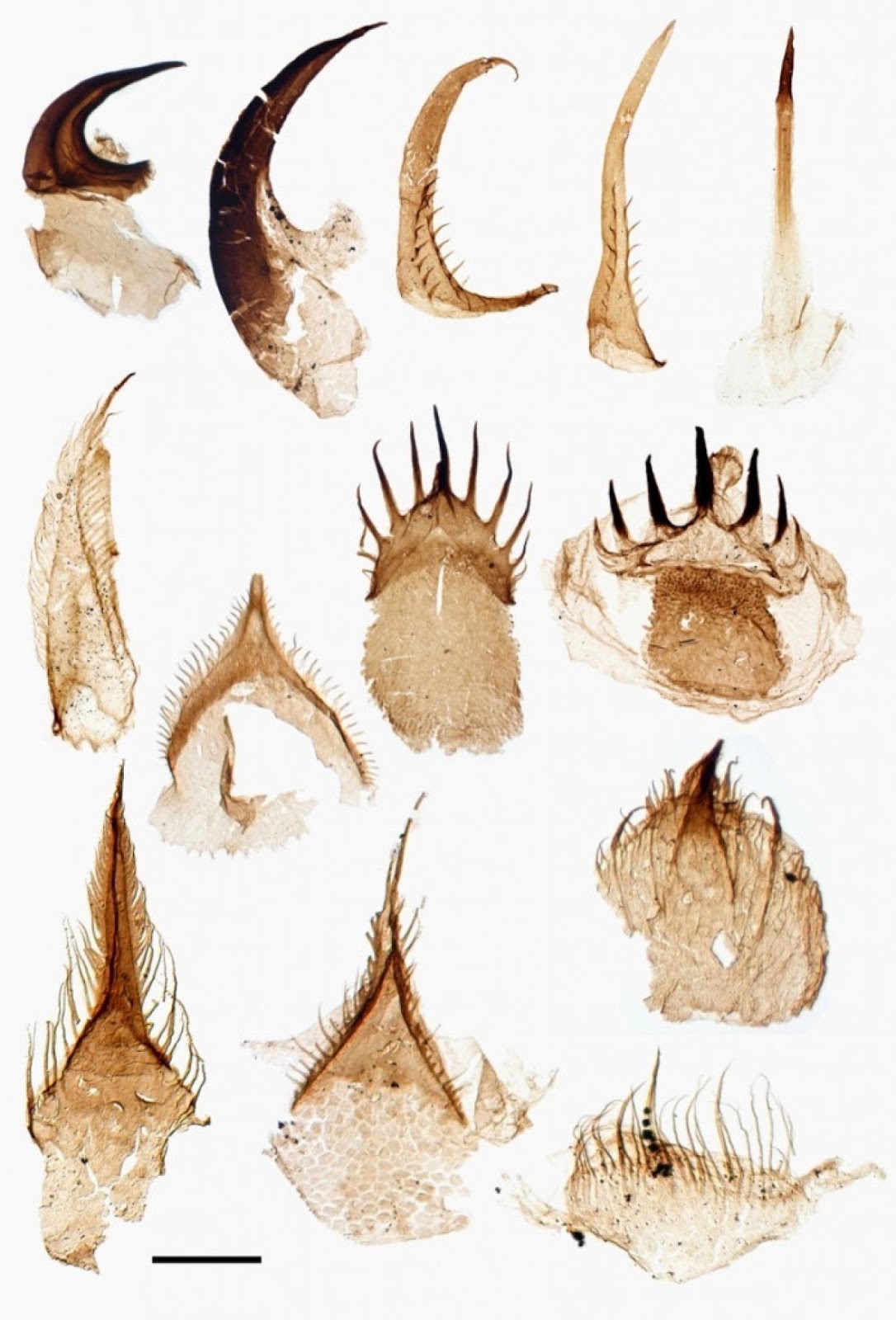
A guide to penis worm teeth


Palaeontology has published a detailed study of the teeth of priapulids in the Burgess Shale.
"As teeth are the most hardy and resilient parts of animals, they are much more common as fossils than whole soft-bodied specimens," he explained. "But when these teeth - which are only about a millimetre long - are found, they are easily misidentified as algal spores, rather than as parts of animals. Now that we understand the structure of these tiny fossils, we are much better placed to a wide suite of enigmatic fossils."
Not familiar with penis worms?  An article in Nature explains that understanding the anatomy of the priapulids is central to a proper understanding of evolution:
...a major step in evolution occurred when an embryonic ball of cells formed two indentations as opposed to one, giving way to a separate mouth and an anus rather than the single opening that creatures such as jellyfish and sea anemones have. In 1908, animals with a mouth and anus were divided into two groups. In the protostomes (from the Greek for ‘mouth first’), the mouth formed first, and the anus second. In the other, the deuterostomes (‘mouth second’), the mouth formed after the anus...

Today, the protostomes include priapulids and most other invertebrates. The deuterostomes include vertebrates such as humans and a few spineless animal lineages... Now, using molecular techniques to analyse gene expression, Hejnol and his team have revealed that a primitive protostome, the priapulid Priapus caudatus, develops like a deuterostome...
More details at the link, and at the Washington Post, where there is a video of a penis worm.  You learn something every day.

"Goldfish the size of dinner plates are multiplying like bunnies."

The Alberta government is launching a campaign this summer to stop people from flushing their aquariums down their toilets.

Goldfish the size of dinner plates are multiplying like bunnies from Lethbridge to Fort McMurray, the province says...

In one case, the municipality of Wood Buffalo pulled 40 of the domestic fish species from a stormwater pond.

"That's really scary because it means they're reproducing in the wild, they are getting quite large and they are surviving the winters that far north," said Wilson.
Further details at CBC News.   Photo credit Rebecca Baldwin / Alberta Environment and Parks.
Related Posts Plugin for WordPress, Blogger...