A collection of articles and other resources on the Coronavirus (Covid-19) outbreak,
including clinical reports, management guidelines, and commentary.
30 March 2020
Reliable medical science information on coronavirus
The New England Journal of Medicine has dropped its paywall for articles related to the pandemic:
Spooky
28 March 2020
A man who is "blessed by the red admiral"

Excerpts from a story in The Washington Post this week:
It all started on July 7, 2007, when a red admiral landed on my shirt collar as I walked along 19th Street NW near the office where I worked. This was a busy area of office buildings and automobiles, with little vegetation. It seemed an unlikely setting for a butterfly.Continued at the link. Hat tip to friend Tod.
To my amazement, day after day after that, if I returned home before dark, the butterfly, which I recognized by one tattered wing, would come out from the garden to greet me...When my little friend didn’t take off after a half-hour or so, I had my picture snapped with it at a photography shop and then took it across the street into a restaurant. I called my wife from the steakhouse to tell her that I was coming home early and that I was bringing a butterfly. On M Street NW, I managed to get into a cab without dislodging my passenger. The butterfly shifted from my collar to my necktie, and we headed out Canal Road to my home in Maryland.
Most remarkable perhaps is that red admirals have also visited me in Minnesota and New York. On July 4, 2010, two showed up at my mother-in-law’s 90th birthday celebration in St. Paul. They landed on no one but me. The same thing happened on the eve of my daughter’s wedding in Upstate New York...
But the problem with the chemical [attraction to sweat] explanation is that the butterflies seem to wait for me, on my car or a bush, while I’m more than 20 feet away looking at them through a window. At that point, I’m clearly not projecting anything chemical very far. As soon as I go outside, they tend to alight on me...
Top photo: Vanessa atalanta collecting solar energy on our deck railing.
Below: Partially camouflaged underside displayed while enjoying a rotten banana.
BTW, butterfly posts should resume in the near future. There have been four sightings already in Wisconsin - two Compton Tortoiseshells, and two Mourning Cloaks. If I work in the back garden near the woods on Monday, I wouldn't be surprised to encounter a Mourning Cloak.

Look at this amazing chart of Zoom Technologies

Because of the coronavirus pandemic, of course. But... the company is not involved in videoconferencing.
According to Yahoo finance "Zoom Technologies, Inc. does not have significant operations. Previously, it distributed wireless communication products in the United States. The company is headquartered in Beijing, China."
The chart shows the price action YTD, with shares trading at about $1 in January. That March 20 peak is a close at about $21 after reaching an intraday high of $60. The company is clearly being confused with Zoom Video Communications (ticker symbol ZM), which makes the networking app.
The FCC has suspended trading in ZOOM, citing "concerns about the adequacy and accuracy of publicly available information concerning ZOOM, including its financial condition and its operations, if any, in light of the absence of any public disclosure by the company since 2015" and because of confusion with ZM.
Sneaky
Lots of things are being done under the cover of coronavirus. Here's one example:
The Environmental Protection Agency (EPA) issued a sweeping suspension of its enforcement of environmental laws Thursday, telling companies they would not need to meet environmental standards during the coronavirus outbreak.The temporary policy, for which the EPA has set no end date, would allow any number of industries to skirt environmental laws, with the agency saying it will not “seek penalties for noncompliance with routine monitoring and reporting obligations.”..In a 10-page letter to the EPA earlier this week, the American Petroleum Institute (API) asked for a suspension of rules that require repairing leaky equipment as well as monitoring to make sure pollution doesn’t seep into nearby water...
"Coronavirus burger"

Created by a Vietnamese chef.
“We have this joke that if you are scared of something, you should eat it,” said Tung, at the Pizza Home takeaway shop in downtown Hanoi. “That’s why the coronavirus isn’t scary any more after you eat a burger in the shape of the virus itself. That way of thinking spreads joy to others during this pandemic... The shop has sold about 50 burgers a day... “This coronavirus is very dangerous. But if we eat a burger in its shape, in our minds its like we are already victorious,” Quy said. “If you want to beat it, you’ve got to eat it first”.Photo credit Reuters, via the South China Morning Post.
Intermittent fasting
The Johns Hopkins Medicine website has a concise article about the benefits of intermittent fasting.
Read up on it, and consult your physician (but don't bother her right now - she's probably exhausted trying to make order out of chaos).
Intermittent fasting diets, he says, fall generally into two categories: daily time-restricted feeding, which narrows eating times to 6–8 hours per day, and so-called 5:2 intermittent fasting, in which people limit themselves to one moderate-sized meal two days each week.I have had substantial success using 18-hour daily fasts to lose weight; I followed that regimen for two months starting at New Years', until finally switching to a standard diet incorporating nighttime comfort food for the coronavirus armageddon. It was amazing to me to realize how much my "hunger" manifested itself psychologically ("time to go eat") rather than with physical symptoms.
An array of animal and some human studies have shown that alternating between times of fasting and eating supports cellular health, probably by triggering an age-old adaptation to periods of food scarcity called metabolic switching. Such a switch occurs when cells use up their stores of rapidly accessible, sugar-based fuel, and begin converting fat into energy in a slower metabolic process.
Mattson says studies have shown that this switch improves blood sugar regulation, increases resistance to stress and suppresses inflammation for various periods of time. Because most Americans eat three meals plus snacks each day, they do not experience the switch, or the suggested benefits.
In the article, Mattson notes that four studies in both animals and people found intermittent fasting also decreased blood pressure, blood lipid levels and resting heart rates.
Read up on it, and consult your physician (but don't bother her right now - she's probably exhausted trying to make order out of chaos).
Words spoken today

I've tried to keep you-know-who off the blog as much as possible, but I just had to post these sentences:
"This whatever they want to call it. You call it a germ, you can call it a flu, you can call it a virus. You know, you can call it many different names. I'm not sure anybody even knows what it is, but the children do very well."This is real, spoken at a televised press briefing in reply when asked what he would say to students home from school that might be watching.
No. You can't just call things whatever you want to call them. For fox ache.
Extended text and video.


27 March 2020
The science of "rogue waves"

"Researchers have since determined that rogue waves probably claimed 22 supercarriers and more than 500 lives in the second half of the 20th century alone...More information at Quanta Magazine.
... two schools of thought surfaced regarding how monstrous waves could develop. The first is the simplest. It starts with the observation that swells travel at different speeds. When one overtakes another, the two are combined... Others, however, hold that the most extreme waves form from less straightforward behavior. In wave tanks, for instance, when one wave travels right next to another of similar length, energy leaks from one to the other. The individual swells affect one another in complicated nonlinear ways...
Standard arithmetic suffices for simple casino games, but this thinking captures the spirit of a branch of probability known as large deviation theory (LDT). It specializes in identifying instances of rare events that are much more common than the next most likely way they might play out. In the exceptional cases when LDT can be used, it allows calculations that are impossible with standard statistics, Vanden-Eijnden said, just as calculus can solve problems that are intractable in algebra.
The chaotic ocean, the group reasoned, should be the perfect arena to witness LDT in action..."

Interesting coronavirus graphs, including ?triage effect

Comparison of countries embedded above. State-by-state and other graphs at 91-DIVOC,
I'm also intrigued by this graph -

- and in particular by the steepness of the rise with advanced age. Obviously elderly patients have an increased prevalence of COPD and coronary artery disease and renal insufficiency etc, which render them more susceptible to the stresses of an acute respiratory distress syndrome. But I'd be surprised if the co-morbidities differences are that great. I suspect (though I've not seen it discussed anywhere) that what this graph is depicting is a "triage effect." You have two admissions to the hospital, one 84 years old, the other 54 years old. There is one ventilator available; the other patient will receive supplemental oxygen and supportive care. Your call. An enormous number of heart-wrenching decisions are being made every day, all across the world.

The final grievance in the Declaration of Independence
This is the 27th grievance against King George III:
He has excited domestic insurrections amongst us, and has endeavoured to bring on the inhabitants of our frontiers, the merciless Indian Savages, whose known rule of warfare, is an undistinguished destruction of all ages, sexes and conditions.The backstory for this grievance is discussed at length by a professor of history at the University of Oregon:
The 27th grievance raises two issues. The first, the king’s incitement of “domestic insurrections,” refers to slave revolts and reveals a hard truth recently brought to the public’s attention by The New York Times Magazine’s 1619 Project: Some of those who sought independence aimed to protect the institution of slavery. This was particularly true for Virginia slave owners, who were deeply disturbed by a proclamation issued in November 1775 by Virginia Governor Lord Dunmore, which promised enslaved people held by revolutionaries freedom in exchange for joining the British army. Virginians and other southerners feared that it would provoke widespread slave revolts...
Although the reference to the “merciless Indian savages” appealed to the “inhabitants of our frontiers,” Jefferson and others who signed the Declaration had their own reasons for detesting British policies relating to Native Americans and their lands... More than a decade earlier, in order to end a costly war to suppress an indigenous resistance movement led by the Ottawa war leader Pontiac, the king issued the Proclamation of 1763, which recognized indigenous ownership of lands west of the Appalachian mountains’ crest and prevented colonists from settling there... Jefferson’s denigration of “merciless Indian savages” signaled that the war for independence from Great Britain would also be a brutal war to seize indigenous lands.More at the interesting article in The Atlantic.
26 March 2020
Divertimento #176

"How a storm revealed a Welsh kingdom" (nice photoessay)
If you're videoconferencing from home with Zoom, remember to cover up the camera if you carry your laptop into the bathroom.
What's the best way to poach an egg? (various techniques compared).
"Lost world revealed by human, Neanderthal relics washed up on North Sea beaches" - with a large map of Doggerland.
Commentary on Deborah Birx' sartorial style and professional behavior (more at the link):
Birx doesn’t dress like a lady politician in jewel-tone suits and statement jewelry. She doesn’t wear power dresses, those sleek sheaths that are a critical part of House Speaker Nancy Pelosi’s professional wardrobe. She doesn’t turn up in a white coat as if she’s there to take the nation’s collective temperature. Birx’s style can be called classically feminine when she wears her shirtwaist dresses and knots silk scarves around her shoulders. She exudes academic wonkiness with her earth tones and tunics and mufflers double-wrapped around her neck. She never looks bland or nondescript. She doesn’t look like an automaton or someone who has lost herself in the data and computer models. And in doing so, she offers a subtle but important reminder to people that while this crisis is serious and meeting it is hard, we are still human.How the coronavirus is killing local news.
Rational logic indicates that the coronavirus did not escape from a bioweapons laboratory.
The best way to reheat pizza (nine methods compared).
Blighted bar slated for demolition discovered to be an antique log cabin from 1700s. Here is a 2018 Google Streetview.
Snowflake is a 2010s derogatory slang term for a person, implying that they have an inflated sense of uniqueness, an unwarranted sense of entitlement, or are overly-emotional, easily offended, and unable to deal with opposing opinions. (example)

The movies with the most F-bombs. "Funnily enough, not one but two Martin Scorsese's movies show up on the chart: "The Wolf of Wall Street" leads the pack with an astounding 569 uses of the word, while "Casino" is in fourth place with 422."

"Doctors warn parents not to sleep with their babies because of the risk of death by accidental suffocation. Still, mothers who've carried those infants inside them want to be nearby, which is only natural. Surely, modern technology can find a way to do that safely. One idea is the device... by BellyBelly. Years later, it is not widely used outside of the Netherlands."
How smart lightbulbs can be hacked ("... too many internet-of-things gadgets don’t come with automatic software updates").
"The results released by the Iowa Democratic Party on Wednesday were riddled with inconsistencies and other flaws. According to a New York Times analysis, more than 100 precincts reported results that were internally inconsistent, that were missing data or that were not possible under the complex rules of the Iowa caucuses."
Data regarding the Houston Astros' sign-stealing scandal.
Did you know horses can have mustaches? Males and females. Gallery of photos at the link, via Neatorama.
"Intuit [maker of TurboTax] and other tax software companies have spent millions lobbying to make sure that the IRS doesn’t offer its own tax preparation and filing service. In exchange, the companies have entered into an agreement with the IRS to offer a “Free File” product to most Americans — but good luck finding it."
In January, 37 mph winds blew over a portion of the border wall in California.
Three cake-baking tips from a state champion baker.
The do's and don'ts of eating and drinking on an airplane, from back in the days when people used to fly.
A simple three-card magic trick.
Some people make a reasonable income by owning vending machines. "Yeah, it’s a lot more simple than people think. You can buy a vending machine used from Craigslist, and you get your business license. You go to door-to-door talking to business owners and offering the service."
A new type of plastic brick allows ice skating rinks to be built anywhere.
A Nashville art school is going to purge all non-Christian faculty. “We do not hire people who are not Christian,” Thomas Burns, Belmont’s provost, clarified in a response to questions at a town hall on Wednesday. “So the ones who are not Christian will not be eligible to work at Belmont. That’s just part of who we are.”

Very simple illustration explains how a bill in Congress becomes law.

Trikafta is the latest breakthrough drug to treat cystic fibrosis. “My life is officially starting at 29 years old. I don’t really have a lot to show for it. I spent my whole life preparing to die young…I have all this open future, all this unknown. I just don’t know how to process it.”
"Wild swimming" is what used to be called "swimming."
A mother's children tell her "there's water coming from the laundry room. Looks like it starts at the washing machine." She runs downstairs to find this.
Erosion on the shores of the Great Lakes is a serious problem for landowners. Water levels are reaching historic high levels, probably because of climate change.
The Australian bushfires damaged aboriginal rock art. "Moore said an intense bushfire burned right up to the edge of the boulder, shearing off enormous slabs of granite. The shearing – known as spalling – was probably caused by a rapid temperature change rather than prolonged heat exposure, he said."
Pearls in North Macedonia are made from ground shells and an emulsion made from fish scales.
The eruption of Mount Vesuvius in AD79 turned the brains of one Herculaneum victim to glass. "Now Petrone and colleagues have revealed a number of substances within the glassy material, including proteins typically found in brain tissue. Crucially, these were not found in adjacent ash or elsewhere in the site. “The detection of glassy material from the victim’s head, of proteins expressed in human brain, and of fatty acids found in human hair indicates the thermally induced preservation of vitrified human brain tissue,” the team write."
A razor-wielding rooster in a cockfight killed a bystanding spectator.

"Despite being a couple of years old, José Manuel Ballester’s artworks feel eerily familiar in the time of COVID-19. The Spanish artist recreates classic paintings like Goya’s “The Third of May 1808,” Vermeer’s “The Allegory of Painting,” and Botticelli’s “The Birth of Venus,” except he leaves out one central aspect: humans." Via Colossal.
25 March 2020
Ochre

From an article at Colossal:
"Washington-based artist and researcher Heidi Gustafson forages, processes, and catalogs natural mineral samples for the Early Futures Ocher Archive. Ranging in color based on its elemental structure, ochre is crushed into a powder and used in various applications from art to medicine. With over 550 samples, Gustafson’s ever-growing archive has become a collaborative project with contributions from archaeologists, scientists, and creatives from around the world."

"As each sample enters the collection, it is labeled with a corresponding number. In a notebook, Gustafson records where the ochre is from, who sourced or collected it, any historic or contemporary uses, and other relevant information. Gustafson grinds the iron-rich ochre into pigments, which she sells to artists and also uses for her own work. Processed samples are added to glass vials and organized by region or dominate mineral type."

It's easy to see why such minerals were so valuable to early humans. There are additional interesting photos at the artist's Instagram site.
Addendum: This is a photo of the shoreline at Hormuz Island -

- where there are immense deposits of ochre. Look at this gif of the shoreline.
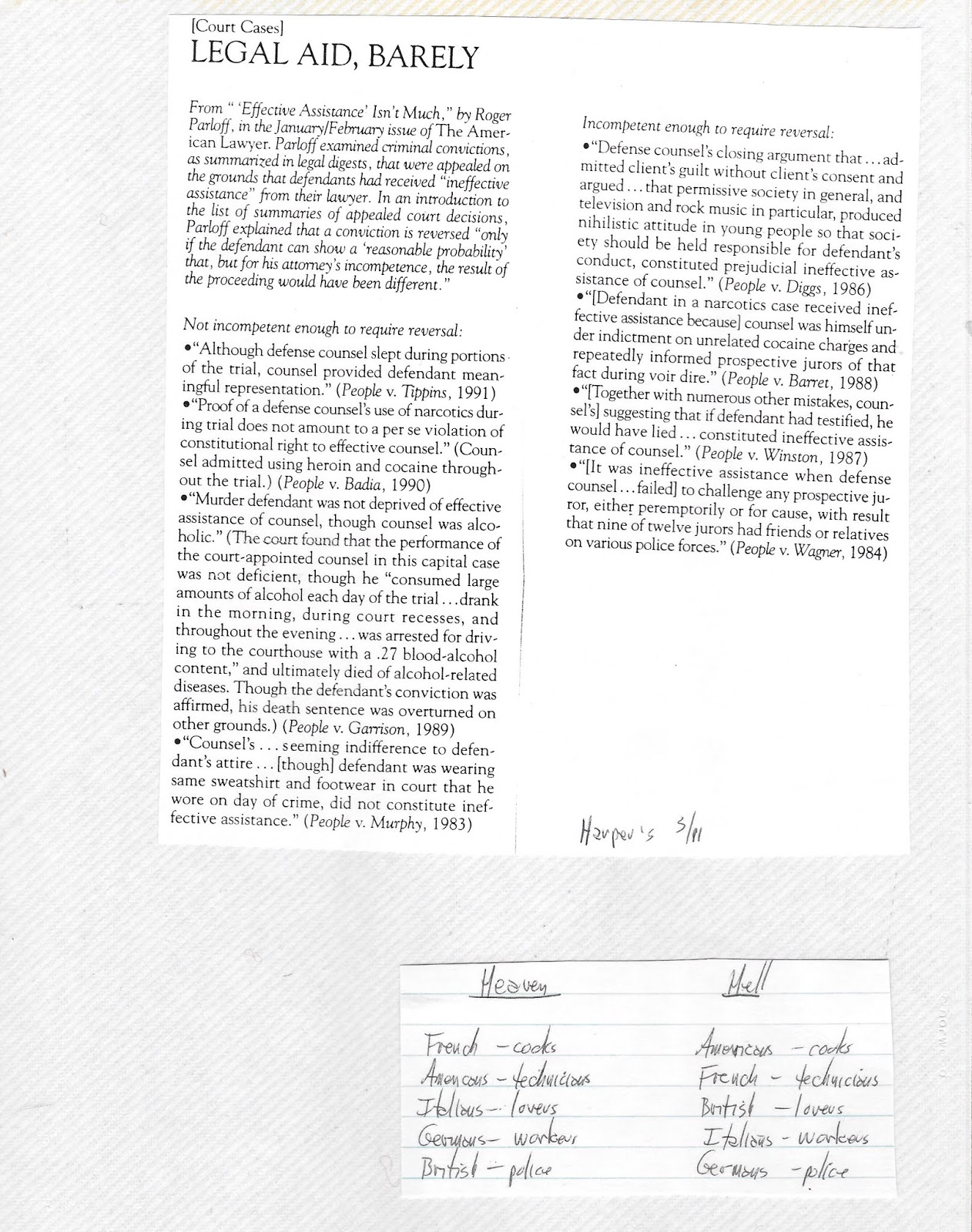
Humor scrapbook, part VI
This is the sixth of what will eventually be ten weekly posts with
material from my old "humor" scrapbook. The content varies from
priceless to junky (especially the case with humor, which often doesn't
age well), but there's no time to sort things out or curate the
content (which may include material from the 1970s that would be "politically incorrect" nowadays).
The text on "scrapbook" pages can be very difficult to read. One possible workaround is to right-click on a page to open it in a new tab, then zoom the image on that tab.


The text on "scrapbook" pages can be very difficult to read. One possible workaround is to right-click on a page to open it in a new tab, then zoom the image on that tab.



Subscribe to:
Posts (Atom)
