"The 2017 WindGames were held in Spain last weekend for competition in indoor skydiving. The winner of the freestyle category was 14-year-old Kyra Poh of Singapore, who was competing against adults for the first time."Via Neatorama.
12 February 2017
Indoor skydiving


Overwintering Monarch population down

The number of monarch butterflies wintering in Mexico dropped by 27% this year, reversing last year’s recovery from historically low numbers...More at The Guardian.
The experts say the decline could be due to late winter storms last year that blew down more than 100 acres (40 hectares) of forests where migrating monarch butterflies spend the winter in central Mexico...
Last week, authorities detained a man trying to truck about a dozen huge tree trunks out of the butterfly reserve, using false papers asserting the trees were diseased and were being removed to reduce risk. In fact, investigators found the trees had been healthy...
The loss of forests in Mexico and milkweed north of the border has proved devastating. This year the butterflies covered only 7.19 acres (2.91 hectares). Last year, the butterflies covered 10 acres (about 4 hectares), compared with 2.8 acres (1.13 hectares) in 2014 and a record low of 1.66 acres (0.67 hectares) in 2013. That is still well below the 44 acres (18 hectares) they covered 20 years ago.

In praise of walking
Three excerpts from Robert Macfarlane's The Old Ways: A Journey on Foot:
"...once you begin to notice them, you see that the landscape is still webbed with paths and footways... pilgrim paths, green roads, drove roads, corpse roads, trods, leys, dykes, drongs, sarns, snickets - say the names of the paths out loud and at speed and they become a poem or rite - holloways, bostles, shutes, driftways, lichways, ridings, halterpaths, cartways, carneys, causeways, herepaths."I can't rate the entire book because I only had time to browse a couple chapters, but I do enjoy a book that challenges me with new words.
"Americans have long envied the British system of footpaths and the freedoms it offers, as I in turn envy the Scandinavian customary right of Allemansratten ('Everyman's right'). This convention - born of a region that did not pass through centuries of feudalism, and therefore has no inherited deference to a landowning class - allows a citizen to walk anywhere on uncultivated land provided that he or she cause no harm; to light fires; to sleep anywhere beyond the curtilage of a dwellilng; to gather flowers, nuts and berries; and to swim in any watercourse..."
"Soren Kirkegaard speculated that the mind might function optimally at the pedestrian pace of three miles per hour, and in a journal entry describes going out for a wander and finding himself 'so overwhelmed with ideas' that he 'could scarcely walk'. Christopher Morley wrote of Wordsworth as 'employ[ing] his legs as an instrument of philosophy'... Nietzsche was typically absolute on the subject - 'Only those thoughts which come from walking have any value' - and Wallace Stevens typically tentative: 'Perhaps/The truth depends on a walk around a lake.'' In all of these accounts, walking is not the action by which one arrives at knowledge; it is itself the means of knowing."
drove road/droveway - road or track along which livestock are (or historically were) regularly driven
corpse road
sarn - (Welsh) a causeway
snicket - A narrow passage or alley (Northern England). Synonyms: ginnel, twitchel.
lichway - path by which the dead are carried to the grave
herepath
08 February 2017
Prom night

Every time I see this cartoon I am reminded of the classic one-liner "Other than THAT, Mrs. Lincoln, how was the play?"
Relevant link for those unfamiliar with the backstory.
Holloways explained

Several days ago I started reading The Old Ways: A Journey on Foot, in which the author "sets off from his Cambridge home to follow the ancient tracks, holloways, drove roads and sea paths that form part of a vast network of routes that crisscross the British landscape..."
I added "holloway" to my list of words to look up. Then by coincidence I encountered a recent post by Miss Cellania on The Sunken Lanes of Europe, citing Amusing Planet, which has a gallery of photos (whence the embed).
Details at Wikipedia:
A sunken lane (also hollow way or holloway) is a road or track that is significantly lower than the land on either side, not formed by the (recent) engineering of a road cutting but possibly of much greater age.Fascinating, both visually and conceptually.
Various mechanisms have been proposed for how holloways may have been formed, including erosion by water or traffic; the digging of embankments to assist with the herding of livestock; and the digging of double banks to mark the boundaries of estates. These mechanisms are all possible and could apply in different cases.
Sweden mocks Trump's minions


As reported by The Guardian:
Sweden’s deputy prime minister, Isabella Lövin, has published a photograph of herself signing a climate bill surrounded by her closest female colleagues, apparently mocking a photo of US president Donald Trump.More at the link.
Lövin, who also serves as environment and development aid minister, is seated in the photo at a desk as she signs the bill under the watchful eye of seven female colleagues, including one who is visibly pregnant.
Related: ‘What happens to us?’ Why Sweden is so worried about the Trump administration.
Medieval funeral poetry on an ostrich eggshell - updated

Archaeologists have uncovered a 500-year-old ostrich egg covered in Arabic poetry. The verses mourn the death of a loved one.Photo and text from Nature, via Erik Kwakkel.
The egg was found in the Red Sea port of Quseir, Egypt. In the fifteenth century, Quseir was a hub for trade between the Middle East and India, and a stop on the pilgrim route between North Africa and Mecca...
The shell is covered with quotations from the Koran and poetry: "It describes the soul's journey from death to life," says historian Dionisius Agius, of the University of Leeds, who is analysing the text.
Eggs bearing Arabic writing are rare, although another was found in Quseir 20 years ago. The ancient Egyptians used ostrich eggs for perfume containers and drinking cups, and the country's Coptic Christians hung them as lanterns in their churches.

Addendum: Reposted from 2010 to note that ostrich eggs were also used as a form to create some of the world's first globes, as reported at National Geographic:
A recently discovered globe from the early 1500s, carved onto ostrich eggs, may be the oldest globe of the New World ever identified...I learned about this from the podcast of No Such Thing as a Fish.
Throughout history mapmakers have turned to creative materials: There have been maps made of sticks or drawn on sealskin, vellum (calfskin parchment), or blocks of wood... But globes created from ostrich eggshells are not common, and for this reason—regardless of its age—the artifact is rare.
Neil Gorsuch's yearbook quote

In the 1988 Columbia University yearbook, the quote accompanying Supreme Court nominee Neil Gorsuch's photo comes from Henry Kissinger -
"The illegal we do immediately. The unconstitutional takes a little longer."However, Snopes notes that "determining Gorsuch's intention in offering this quote back then is a matter of speculation. It should be noted that Gorsuch founded a school newspaper called The Fed at Columbia University, which frequently published satirical content."
Rolling shutter effect revealed by a blink
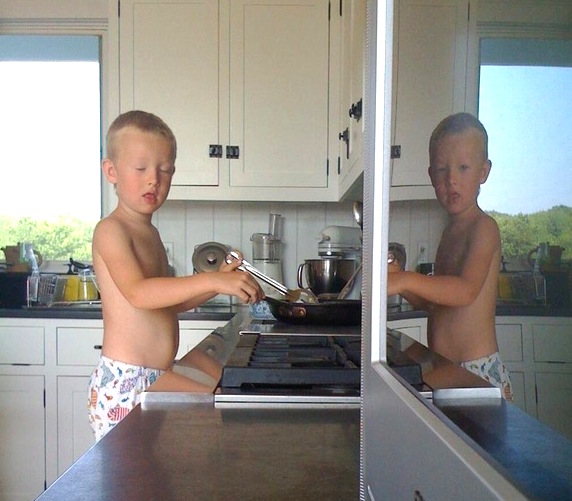
Discussed in this Pics subreddit thread (image cropped for emphasis from the original).
See also this 2010 post: How the rolling shutter effect is generated.
06 February 2017
Interesting fact about cacti

There are 1750 species of cacti. 1749/1750 are native only to the Americas.
The natural distribution of cactus species occurs exclusively in the New World with a single exception. This range includes North and South America, Central America, and the adjacent Islands such as the Caribbean and Galapagos islands. Rhipsalis baccifera, an epiphytic species, is the sole exception that can be found in Madagascar, tropical Africa, the Seychelles, Mauritius, Reunion, and Sri Lanka as well as tropical America.Think of all the great deserts of the world that don't have cacti: the Gobi, Sahara, Australia's Victoria. But it's worth adding this point from the Reddit discussion:
While there are not cacti in those deserts it should be noted there are cactus-like plants. Cactus belong to the family Cactaceae. These are "New World" plants that are only (except 1) endemic to the Americas. Meanwhile the Eastern continents got "Old World" plants to fill those ecological niches, many of which belong to the family Euphorbiaceae. This is not a cactus. This is also not a cactus. And another "not" cactus (image below)

The difference between cacti and cactiform succulents is explained here. You learn something every day.
Top photo credit, via the TIL subreddit.
Vestigial body structures
The palmaris longus tendon info was new to me.
Good talking points for discussions with children, or with doubters of evolution (though unlikely to be effective with the latter).
"Gott mitt uns"
Military leaders have always told their cannonfodder that God is on their side.
Gott mit uns ("God with us") is a phrase commonly used in heraldry in Prussia (from 1701) and later by the German military from the period spanning the German Empire (1871 to 1918) to the end of the Third Reich in 1945.Blogged in order to mention a lighter aspect I heard on a podcast of No Such Thing As A Fish. During the Christmas Truce of WWI, German soldiers erected a sign displaying the motto. Their English counterparts put up another, which said "We've got mittens too."
The Imperial Russian motto, "Съ нами Богъ!" ("S nami Bog!"), also translates the same.
Nobiscum Deus in Latin, Μεθ ημων ο Θεος (Meth imon o Theos) in Greek, С Hами Бог (S Nami Bog) in Church Slavonic, or God with us in English, was a battle cry of the late Roman Empire and of the Eastern Roman Empire. It is also a popular hymn of the Eastern Orthodox Church, sung during the service of Great Compline (Μεγα Αποδειπνον).
It was used for the first time in German by the Teutonic Order. In the 17th century, the phrase Gott mit uns was used as a 'field word', a means of recognition akin to a password, by the army of Gustavus Adolphus... In 1701, Frederick I of Prussia changed his coat of arms as Prince-Elector of Brandenburg. The electoral scepter had its own shield under the electoral cap. Below, the motto Gott mit uns appeared on the pedestal.


This $10 bill looks funny.

It's taped on a wall, presumably for the education of some employees. Do you know why it looks funny? Answer below the fold.
Controversial "A2 milk" discussed
From The Atlantic:
Cow’s milk gets a bad rap. Over the past few decades, it’s been maligned for everything from fat and sugar levels to synthetic-hormone and antibiotic content. It has faced fierce competition from alternatives like almond milk and soy milk. But what if the most dangerous thing in a glass of milk all this time has been something much more elemental?Much more at the link.
This was the question puzzling the New Zealand scientists Bob Elliott and Corran McLachlan in 1993, when their studies of Type 1 diabetes and heart disease pointed to milk as an unlikely culprit—specifically, a variety of milk known to scientists as A1, the ubiquitous variety stocked in most of the world’s grocery stores. A1, the research suggested, produces inflammatory compounds in the human digestive system that can cause mild symptoms like stomach pain, or much worse.
The research also showed, however, that a second type of milk—a variation known as A2—did not have these effects. McLachlan posited that A2 could be better for overall health, and maybe even digestible by those who consider themselves lactose intolerant...
Now, A2 milk stands poised to take these niche markets by storm—but first American consumers will have to be convinced that it’s actually good for them...
American dairy lobbies remain skeptical, though. Both the Dairy Farmers of America and the National Milk Producers Federation are aware of the trend—and dismissive of it...
Since A2 milk hit shelves in California in 2015, worries within the American dairy industry have mirrored those of commodity farmers Down Under, where A2 has already outstripped organic milk sales. Mainstream American dairies have expressed concern about how the introduction of these products will affect their existing product sales...
For now, this mixed attitude toward A2 genetics prevails in the U.S. A2MC could be on its way to changing the world, or cresting toward a quiet end. With the company shooting for a full presence in the U.S. market by next year, consumers have reason to hope that more research will be conducted before the onus is on them to make the call.
Subscribe to:
Posts (Atom)
