30 March 2022

Intergluteal cleft in the news

"It was Read Across America week, and the second graders in the Hinds County School District in Mississippi were waiting for an administrator to read to them.

The administrator had forgotten it was her turn, said Toby Price, the assistant principal at Gary Road Elementary School in Hinds County, who was in his office at the time. He decided to fill in.
Mr. Price, 46, quickly grabbed a book — “I Need a New Butt!” by Dawn McMillan, one of his children’s favorites — and began reading it to the roughly 240 second graders over Zoom.

Later that day, on March 2, the district superintendent, Delesicia Martin, called him into her office and told him he was on administrative leave, Mr. Price said. He was fired two days later, accused of violating the standards of conduct section of the Mississippi Educator Code of Ethics.

In a letter to Mr. Price, the superintendent called the book “inappropriate.” She particularly took issue with the references to farting in the story ...
... and how “the book described butts in various colors, shapes and sizes (example: fireproof, bullet proof, bomb proof).”..
“I expected a write up,” said Mr. Price, who had worked for the district for three years. “I did not expect to get terminated. I cried the entire way home.”..

“My granddaughter heard him read the book and thought it was hilarious and not at all inappropriate!” the grandmother wrote.

Mr. Price said that was the reaction from students after he read the book. He recalled going into the hallway and being approached by students who thanked him for his pick.

“They loved it,” he said. “They all stopped me and said, ‘Mr. Price, that book was really good.’”
“We have a lot of reluctant readers,” he said. “I am a firm believer that reluctant readers need the silly, funny books to hook them in.”..

He said he wanted only his job back so he could support his three children. His two eldest children — a daughter, 19, and a son, 18 — have severe autism.

“I’m tired. I’m stressed. I’m overwhelmed,” he said. “I need to work.”"
More at The New York Times.  I checked the book out from our library system, which has 20 copies.  

Magnolia State Live reported yesterday that "The Hinds County School Board’s decision on Price’s employment is expected in about two months."
“First and foremost, the book contains statements and cartoon pictures regarding bodily anatomy, bodily functions and removing clothing to expose private areas of the body in various positions,” Martin said. “These statements and pictures are inappropriate for an educator to read and display to second graders, especially without advance notice to the teachers of the students.”

28 March 2022

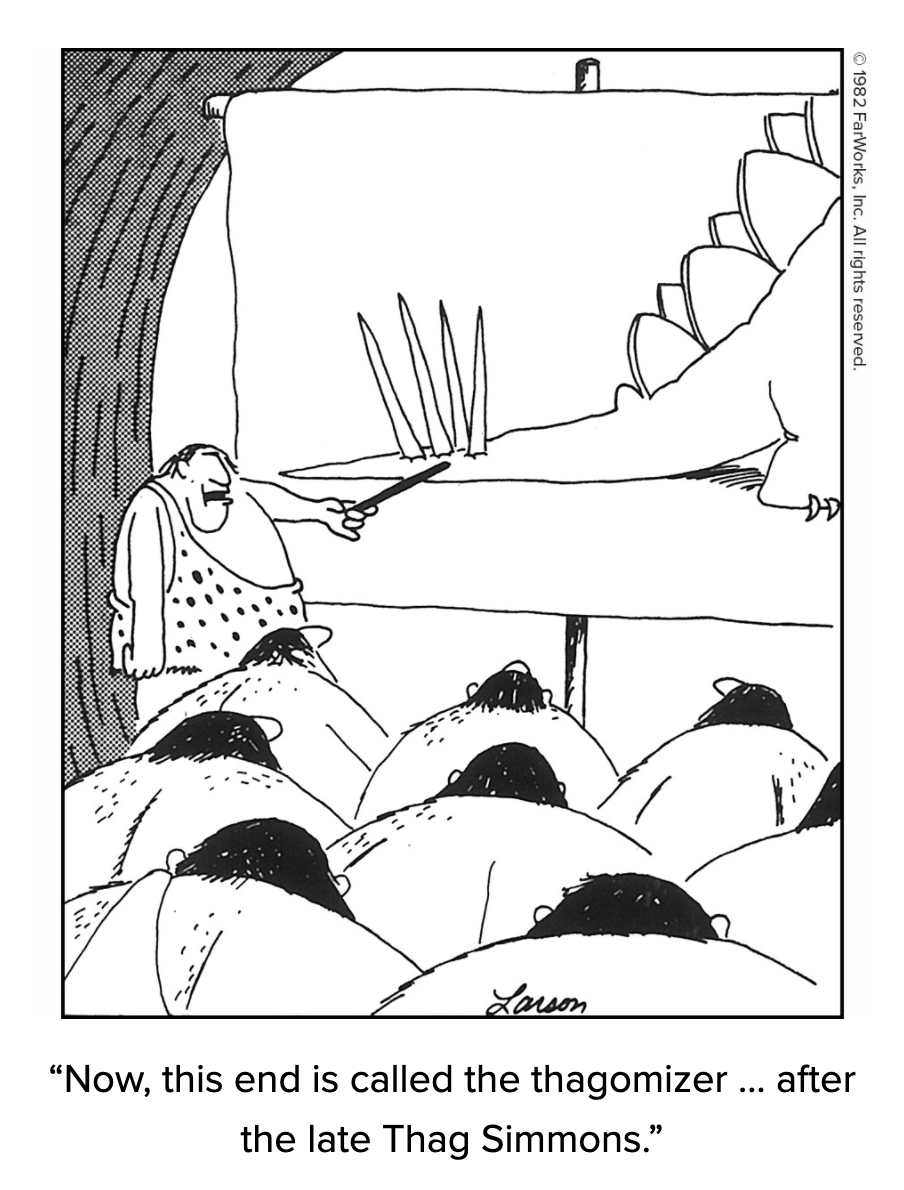
It actually IS called a "thagomizer"


This week The Far Side reposted the classic 1982 cartoon embedded above.  Many people don't realize that Gary Larson's neologism has now been incorporated into the scientific lexicon:
Thagomizer has since been adopted as an informal anatomical term, and is used by the Smithsonian Institution, the Dinosaur National Monument, the book The Complete Dinosaur and the BBC documentary series Planet Dinosaur. The term has also appeared in some technical papers describing stegosaurs and related dinosaurs.
The four spikes in the tail of the stegosaurus are now thought to have protruded horizontally rather than vertically.

Corporate code of ethics

Medicaid structured as a loan program

A guardian of the state admitted Edna into a nursing home and signed her up for the state’s Medicaid program, MassHealth. Tawanda was relieved that her mother was being cared for while she was busy arranging her brother’s funeral. But when she arrived in Boston from Brooklyn, where she and her husband had settled, she heard rumors about MassHealth “robbing people of their homes” as reimbursement for their medical bills.

She soon learned that the rumors held some truth. Medicaid, the government program that provides health care to more than 75 million low-income and disabled Americans, isn’t necessarily free. It’s the only major welfare program that can function like a loan. Medicaid recipients over the age of 55 are expected to repay the government for many medical expenses—and states will seize houses and other assets after those recipients die in order to satisfy the debt...

One of the reasons estate recovery works at all is that few people know about it. Although states disclose the policy in their Medicaid-enrollment forms, it’s often buried in fine print that can easily be overlooked, especially when applicants are anxiously seeking urgent medical care. MassHealth, for example, places its notice about three-quarters of the way down page 20 of its 34-page application: “To the extent permitted by law, and unless exceptions apply, for any eligible person age 55 or older, or any eligible person for whom MassHealth helps pay for care in a nursing home, MassHealth will seek money from the eligible person’s estate after death.”

“It’s all technically accurate, but it’s hard for a nonlawyer to know that that means We’re going to send you a bill,” says Gregory Wilcox, an elder-law attorney in California who’s received “lots of calls from people who are dismayed, shocked,” first by the loss of their loved one and then by the secondary blow of losing their inheritance.

Remember to clean your clothes dryer vent - updated


It's not sufficient to clean the lint trap screen on your appliance.  We did that for 15 years, but still found the efficiency of the dryer decreasing, so we called in the services of a professional.  The first thing he did was remove the contorted connector (above) that ran between the dryer and the wall conduit.  The previous owner of the house had done this because the dryer vent outlet and the wall site were not in line horizontally or vertically.   This segment was not occluded with lint, but it's inefficient and prone to collecting debris.

The replacement (not shown) is a short "transition vent" that runs diagonally; it will need to be detached in order to move the dryer out to clean the floor etc, but it's less likely to become plugged with lint.


The next step was to clean inside the dryer by removing the front panel. 


I've highlighted with a red oval the problem he usually finds - an accumulation of dust and (in our case) cat hair.   When home clothes dryers catch fire, THIS is the where the combustible material is typically located.  And most importantly, this material is NOT derived from the clothes in the dryer - it gets sucked into the cabinet from the floor of the room.

Think about it.  The dryer is going to heat and spin and blow air out its vent.  To do that, it has to pull air in from somewhere.  Not from outdoors, where the air might be subzero, but from behind itself and from the floor of the room.  Even if you're careful about cleaning, over the years dust and debris will accumulate.


The next step was cleaning the conduit between the utility room and the outdoors.  In our case, that conduit ran up the inside of the wall between the utility room and the garage, then horizontally between a crawlspace and the roof of the garage, then exited high on the outside wall.

Too high for me to access.  I don't have a ladder that long, and if I did, I wouldn't go up except at gunpoint.  He went up and removed the louvers that covered the vent.  The louvers were twisted and didn't move freely.  This happens because the exiting air is hot enough to warp the plastic slats of the louver (this risk is present on clothes-dryer vents, but not on ones for room-temp air such as bathroom vents).  He reached in and dropped down to me a handful of what he found inside:


That's typical clothes lint - the stuff that works its way through the trap in the dryer.

The next step was to clean the entire conduit - probably 30-40 feet in length.  On the internet I had read reports of homeowners claiming success in cleaning such vents by adapting the output of a leaf blower to the indoor end and blowing the ducts out.  He explained that it's seldom that simple.  The lint that exits sometimes carries some moisture and especially at bends or joins in the tubing it can accumulate in a consistency not unlike papier-mâché.

What professionals use (I didn't take a photo) is the air-duct equivalent of a Roto-Rooter for water drains.   It's a flexible "snake" with brushes that rotate as it traverses the ducts.  And as it goes through, vacuum is applied from the inside to suck out the material that is coating the duct.


Finally, he replaced the louver with an animal-exclusion cage (it lifts up for cleaning if lint accumulates).  Our exit site did not contain a bird's nest or any evidence of animal invasion.  Birds do sometimes nest in these sites if they are open (he had recently serviced the vents at an apartment complex where a dozen of the 30-40 vents had bird nests in them).  Chipmunks and other small rodents will nest in these locations if the outlet is low on the wall.  Bats are not a problem because they do not tolerate the heat.

We couldn't be happier with the result.  The first load we ran dried in probably half the time that similar loads required in the past, so there will be a saving in electricity plus much less wear and tear on tumbling clothes, plus eliminating one potential risk for a house fire.

Finally, a shout-out to the crew:


They were highly efficient and totally professional.  Their offices are on Odana Road in Madison, Wisconsin.

Addendum:  There is a relevant current article on "Dryer Duct Safety" in Reuben Saltzman's incomparable home inspection blog.

Reposted from 2017 to add this incredible GIF ("Renters demand a new dryer since this one "isn't working well"").

AddendumHere's another one - even more impressive. ("My friend asked me to switch her laundry over. I found out they didn’t know you were supposed to clean your lint trap.")

Addenda:  one-minute gif of cleaning a dryer vent and a gif of cleaning out a hotel laundry vent.

"Shoddy" as a noun - updated

"This heap is composed of the shredded remains of used wool rags, socks, clothes, and remnants from the textile industry, all slowly disintegrating into the earth. Despite containing the refuse of multiple fiber-based industries…this is not a dump in any typical sense. In various states of chemical decomposition and arranged in strata-like layers, this debris has a biological purpose; wool contains a high amount of nitrogen that it releases slowing as it breaks down….Here, textile waste…gradually turns into agricultural fertilizer that is intended for use on the surrounding fields of rhubarb….

Today when most people hear the word shoddy, they think of an adjective meaning “low quality” or “badly fabricated.” But, in fact, the term came into existence in the early decades of the nineteenth century as a noun, referring to a new textile material produced from old rags and tailors’ clippings. Workers made it by shredding wool rags in what were christened “devils,” grinding machines equipped with sharp teeth. Recycled waste and other leftovers were turned into plentiful “new” raw materials in the “shoddy towns” of Batley and Dewsbury….Over the next century, shoddy…was widely used in the production of suits, army uniforms, slaves’ clothing, carpet lining, and mattress stuffing.…"
An excerpt from Shoddy: From Devil’s Dust to the Renaissance of Rags (University of Chicago, $25), via Harvard Magazine.

Reposted from 2021 to add this interesting statistic:


70 pairs of pants per person per year.  We should clarify that it's not all pants - it's the equivalent of that many pants, and it's not all consumer discards, because much of it occurs "upstream" at industry level.

The concern is quite different from the "shoddy" described at the top.  Nobody worries about lost cotton or wool fibers.  The problem is that modern clothing contains high levels of plastic (polyester) that requires extracting from fossil fuels and winds up generating microplastics.  

Graphic adapted from The Global Glut of Clothing is an Environmental Crisis, where there is much more information:
Today, in fact, fashion accounts for up to 10% of global carbon dioxide output—more than international flights and shipping combined, according to the United Nations Environment Programme...

The International Energy Agency (IEA) estimates that plastics will be the largest driver of net growth in the demand for oil in the next two decades. Textiles are the second-largest product group made from petrochemical plastics behind packaging, making up 15% of all petrochemical products...

Most clothing around the world is made with polyester, the synthetic fiber derived predominantly from petroleum. It has overtaken cotton as the main textile fiber of the 21st century, ending hundreds of years of cotton’s dominance.

Shein puts out an average of about 1,000 women’s new clothing styles a day based on our sample, 85% of which were made with polyester...

 Santaniello, who worked in the fashion industry for 15 years, says retailers and consumers both need to change their habits and expectations for a true reckoning to occur. “When I worked in fashion, the other sales reps and I would sit there and talk about how we wanted to set fire to the whole industry and start over again,” she says. It may be a chicken-or-egg problem, but “if stores just started offering less inventory, maybe consumers could get used to there being less out there. I think that would make us all a little bit happier.”

27 March 2022

"If We Were Vampires" (things would be different...)


Kudos to The Reverend Morgan Allan for selecting the above ballad for the introduction to his lecture today comparing the horrors of the Marsten House in Stephen King's 'Salem's Lot to the beheading of John the Baptist as portrayed in the Gospel of Mark.  [The video at the lecture link is muted during the first minute during the playing of the ballad, perhaps to avert copyright infringement]; here are the relevant lyrics in the hinge refrain, which can be heard in the embed:

It's knowing that this can't go on forever
Likely one of us will have to spend some days alone
Maybe we'll get forty years together
But one day I'll be gone
Or one day you'll be gone.

If we were vampires and death was a joke
We'd go out on the sidewalk and smoke
And laugh at all the lovers and their plans
I wouldn't feel the need to hold your hand
Maybe time running out is a gift
I'll work hard 'til the end of my shift
And give you every second I can find
And hope it isn't me who's left behind...

The ballad by Jason Isbell and the 400 Unit is from his 2017 studio album "The Nashville Sound."  The Reverend Morgan Allan's presentation (the second link above) is 45 minutes in length and contains several insights into Stephen King's writing that I think some readers here will appreciate.  This is part of an ongoing series of lectures; the presentation last week focused on The Shining.  Coming up: Cujo, The Dead Zone, Firestarter, Pet Sematary, and Thinner - all in the context of the Gospel of Mark.  

26 March 2022

The Holodomor ("Death by Starvation") explained


A riveting documentary about stuff I didn't learn in school.

Addendum:  This book was recommended by a reader -


It is a scholarly, detailed report on all of the political and financial maneuvering that culminated in the mass starvation.  Sobering reading.

25 March 2022

I could listen to David Attenborough all day


(best viewed fullscreen)

Ex libris Hernando Colón (son of Christopher Columbus)

Hernando Colón tried to assemble a library of every book then in existence.  He and his staff composed summaries of those books.
“The ivory casket” by Hippocrates: In the medical section of the library there is a certain pamphlet of prognostics with the title “The Ivory Casket,” and here is what I’ve been able to find out about this mysterious name: Hippocrates, sensing his death was near, instructed that the contents of this pamphlet be placed in an ivory casket and buried in his grave with him, to keep people from discovering them. When this came to the attention of a certain emperor, he ordered the grave dug up and saw to it that the contents of the casket were saved for posterity. What is contained in this prognostic are rules or instructions by which to predict the very season, day, and hour of death coming to one who is sick, by the signs that are here set down.

A scholar’s manual beginning “respected teacher”: Whoever published this book wasted their money. It’s supposed to teach schoolboys what they should expect at university, but I doubt whether someone brought up among the Sarmatians or Scythians would recount such barbaric behavior as this. The Latin itself is awful. The dialogue describes what goes on in places such as Deventer and Cologne, where during the matriculation rituals the little graduate bitches and other wicked scoundrels bombard the freshman with abuse and insults and human filth, and also shave him and inflict other indignities. Then the freshman has to take them all out and get them drunk on his own dime. I will stop here so I don’t shock anyone too much, but the debauched author even includes dialogues about whores and prostitution. There’s nothing funny or clever or charming here—it’s just filth. And, as if that isn’t enough, there’s a string of grammatical errors more than a mile long.
Excerpted from an article wonderfully entitled "The Library of Babble," in the November 2021 issue of Harper's Magazine.  Another book summary there, along with info re a relevant upcoming publication.

The victims of "Manifest Destiny"

"At the time of first contact, around 1500 ce, Indian populations in North America had numbered, according to sober estimates, around 5 million. There were more than five hundred distinct tribes spread over the entire continent—from the Florida Keys to the Aleutian Islands. The deserts of the American Southwest hosted some of the most advanced societies, who built cities that still stand today. At the confluence of the Missouri and the Mississippi, where St. Louis now stands, was a city of more than twenty thousand. Along the resource-rich eastern seaboard, the coast was populated, without break, from Florida to Newfoundland. But four hundred years of warfare, disease, and starvation had taken its toll. According to the US census, there were only 237,000 Indians in the United States in 1900, a twentieth of the population at its peak.

The story of the land parallels that of the population. The United States comprises 2.3 billion acres. By 1900, Indians controlled only 78 million acres, or about 3 percent."
-- excerpt from The Heartbeat of Wounded Knee, published by Riverhead Books. Author David Treuer is Ojibwe, from the Leech Lake Reservation in northern Minnesota.

Awesome program on slime molds

Embedded above is the brief trailer for the recent NOVA program exploring the astounding capabilities of slime molds.  One can argue (at some length) about the definition of "intelligence," but the program does document that a slime mold is capable of learning and of remembering information.  Then the question evolves to ... how does a living creature store information when it has no brain, and when in fact the entire organism is comprised of a single cell?

Fascinating.  Best science video I have seen in a long time.  You can view The Secret Mind of Slime at PBS.

Word for the day: "Permacrisis"


Apparently it's not a new word; Google Ngram viewer seems to indicate its coinage in the early 1970s.  I first encountered it yesterday reading an op-ed lament on parenting which expressed concern about how to help today's children deal with climate change + coronavirus + war ......

It's a good word, useful for describing our current lives.

21 March 2022

"Is it safe?" (no)

[A] dentist in Jackson, Wis., drilled into and broke his patients’ teeth in order to charge them for fixing the damage he’d caused, according to federal prosecutors. By doing so, Charmoli went from pulling in $1.4 million and affixing 434 crowns in 2014 to raking in $2.5 million and performing more than 1,000 crown procedures a year later...

Charmoli’s methods were exposed after he sold his dental practice in 2019. The new owners, in reviewing his files, noticed the high rate of crown procedures. One reported his predecessor to authorities.

Jade burial suit


As reported at Heritage Daily:
Because of its hardness, durability, and subtle translucent colours, jade became associated with Chinese conceptions of the soul, protective qualities, and immortality in the ‘essence’ of stone (yu zhi, shi zhi jing ye)...

The Han thought that each person had a two-part soul: the spirit-soul (hun 魂) which journeyed to the afterlife paradise of immortals (xian), and the body-soul (po 魄) which remained in its grave or tomb on earth and was only reunited with the spirit-soul through a ritual ceremony. The early Han rulers came to believe that jade would preserve the physical body and the souls attached to it in death, with various burials being found with large and small jade bi discs placed around the deceased.

This developed into the practice of being buried in ornate jade burial suits, completely encasing the deceased in thousands of pieces of cut and polished jade sewn together with thread, believing that the suit ensured the body would remain immortal. It is estimated that it would require hundreds of craftsmen more than 10 years to polish the jade plates required for a single suit, emphasising the power and wealth of the deceased...

According to the Hòu Hànshū (Book of the Later Han), the type of thread used was dependent on status. An emperor’s jade suit was threaded with gold, whilst lessor royals and high-ranked nobility with silver, sons and daughters of the lessor with copper, and lowly ranked aristocrats with silk.

It is believed that the practice ceased during the reign of the first emperor of the state of Wei in the Three Kingdoms period (AD 220-280), in fear of tomb robbers who would burn the suits in order to retrieve the gold or silver thread.
So far, 20 of these suits have been found.  More pix at the link.
Related Posts Plugin for WordPress, Blogger...