21 February 2011

Sea coal

[Chalk drawing, 'Sea Coal Gatherers' by Frederic Shields, undated]

This past week I encountered the drawing above at Victorian/Edwardian Paintings.  My personal experiences with coal began when I lived for a time in a semi-rural location in Kentucky and heated my house with a coal-burning stove.   I was surprised at the time to note how relatively light in weight coal was, but I had never thought much about it floating in water until I saw this drawing.

A quick search led me to Within the Walled Garden, which had a story about harvesting the material along a beach:
We followed the high tide line because I love to search for treasures. Coloured or shiny bits glinting in their recent wetness. A woman in front had a dog and a bag of stuff she kept gleaning from the berm ahead of us. I asked her what she was scavenging. "Sea coal" she said, and showed us how to identify the lumps and distinguish them from the black pebbles by their lighter weight and glimmer even when dry... It wasn't a great harvest because we only had DJ's hat to carry it in. But we shall return.
The post included this photo of freshly acquired sea coal -
- showing the rounded edges consistent with wave action, quite different from the material available in Kentucky roadcuts.

The next useful item I found was "A Manxman's Tale", about sea coal scavenging, in The British Journal of Photography:
Killip first visited the beaches around Lynemouth in 1975 but, he says, it took him years to win the sea coalers' trust. 'I went there when I was first in Newcastle, and I couldn't believe it,' he remembers. 'It was so odd, these guys getting coal from the sea, and so visually amazing with all these horses and carts. But when I went on the beach with my camera, they just turned around and tried to run me down. I pulled off the beach and didn't go back for two years. When I did, the same thing happened. This continued until 1981, when I had a very bad afternoon and decided to go to the sea coalers' local to reason with them. They said "Listen, we get photographed by the dole. They sit in the van and they spy on us, and then when we go to get welfare they produce these photographs and we won't get any money. For us photographs are bad news, and we don't want any."
The final question I had was whether sea coal was a purely natural phenomenon, from exposed veins on seashores, or whether it was somehow a byproduct of the transportation of coal in barges or other vessels.  The answer came from this Wikipedia entry about Cresswell, Northumberland:
Snab Point, 500 metres south of The Carrs, is a sheltered bay with the Alcan aluminium smelting plant on its south side. Embedded in the small cliffs of Snab Point are the remnants of fossilised trees. The beach area is littered with the remnants of fossilised wood and small seams of coal can be seen in the cliffs. Depending on the tides and wind, vast swathes of sea coal is washed up within the bay.
A photo at the link shows a beach strewn with sea coal.   There's more on the history of sea coal at The Public "I":
“In the last four decades of the thirteenth century, the cost of wood increased about 70 percent, while sea coal increased only 23 percent… Londoners had no choice but to resort to sea coal, which was rapidly becoming known simply as "coal." By 1300, London's total annual wood fuel demand was 70,000 acres. By 1400, it was only 44,000, despite prodigious industrial, commercial and population growth.” The street in London where merchants sold their cargos still bears the name “Seacoal Lane”...
The Durham County Council has this probably Victorian-era photo of the gathering of sea coal:
and the BBC shows the modern equivalent:
Sadly, this photo from the Science Photo Library is also relevant:
"...coal waste being dumped into the North Sea from Easington Colliery, County Durham (background). In the foreground is a discharge pipe emptying effluent from the mines into the sea. The sea is discoloured for several miles around the dump and the beaches are black with coal waste."
You learn something every day.

"Saucered and blowed"

This colloquial expression, often used to refer "to coffee, too hot to drink until it was poured into the saucer for a moment, blown on, and then drunk from the saucer," is discussed at World Wide Words.  I was surprised at how far back the roots of the phrase can be traced:
The expression is certainly American, turning up at various times in the south and west of the country... In the negative it meant something hadn’t yet been made fully ready — a football coach commented on one of his young players in the Charleston Gazette in 1972 that “He has a long way to go. He hasn’t been saucered and blown yet.”..

The idea goes back a long way, of course, much further than the expression itself. A squib appeared in a British newspaper two centuries ago, in which a Frenchman asked a friend to advise on the correctness of his manners at dinner:
“And the coffee?” “There I am certain I was right; it was boiling hot, and I poured it in small portions into my saucer.” “Which was what no one else did; every body takes his coffee in his cup, and never in his saucer.”   The Courier (Middlesex), 21 Mar. 1826.
The link concludes with an (?)apocryphal story about George Washington saying "“we pour our legislation into the Senatorial saucer to cool it.”

Aeroecology

From the BBC:
Meteorologists once treated the signals from flying animals as a nuisance that complicated their measurements. But recent improvements in computing power and networking of radar stations have turned that nuisance signal into a valuable data source on animal ecology.

A panel told the AAAS conference that radar could spot a single bee at 50km...

"One of the things that's most exciting to me is that we sometimes see an airmass that's moving, like a weather front, and insects actually get trapped up in that - you can see the insects pooling up along this air mass. If this happens to pass over the bat caves at sunset, the bats come out and distribute themselves right along that gust front and presumably gobble up those insects. Marine biologists probably think that kind of thing happens all the time in the ocean, but we've never been able to see that in the aerosphere."
See also: Mayflies seen on radar.

"Slave children from New Orleans"

The photo is from a carte de visite in the Library of Congress, acquired in 1864, and described as follows: "Photograph shows freed slaves, Rosina Downs, Charley Taylor, and Rebecca Huger, each wrapped in a portion of the U.S. flag."

A search of the Library of Congress archives reveals quite a few additional photographs of these children, such as this one -
- obviously created as propaganda instruments for the abolitionist movement.  Some of the background story is presented in an article in Harper's Weekly (January 30, 1864):
Rebecca Huger is eleven years old, and was a slave in her father's house, the special attendant of a girl a little older than herself. To all appearance she is perfectly white. Her complexion, hair, and features show not the slightest trace of negro blood. In the few months during which she has been at school she has learned to read well, and writes as neatly as most children of her age. Her mother and grandmother live in New Orleans, where they support themselves comfortably by their own labor. The grandmother, an intelligent mulatto, told Mr. Bacon that she had "raised" a large family of children, but these are all that are left to her.

Rosina Downs is not quite seven years old. She is a fair child, with blonde complexion and silky hair. Her father is in the rebel army. She has one sister as white as herself, and three brothers who are darker. Her mother, a bright mulatto, lives in New Orleans in a poor hut, and has hard work to support her family.

Charles Taylor is eight years old. His complexion is very fair, his hair light and silky. Three out of five boys in any school in New York are darker than he. Yet this white boy, with his mother, as he declares, has been twice sold as a slave. First by his father and "owner," Alexander Wethers, of Lewis County, Virginia, to a slave-trader named Harrison, who sold them to Mr. Thornhill of New Orleans. This man fled at the approach of our army, and his slaves were liberated by General Butler. The boy is decidedly intelligent, and though he has been at school less than a year he reads and writes very well. His mother is a mulatto; she had one daughter sold into Texas before she herself left Virginia, and one son who, she supposes, is with his father in Virginia.

These three children, to all appearance of unmixed white race, came to Philadelphia last December, and were taken by their protector, Mr. Bacon, to the St. Lawrence Hotel on Chestnut Street. Within a few hours, Mr. Bacon informed me, he was notified by the landlord that they must therefore be colored persons, and he kept a hotel for white people. From this hospitable establishment the children were taken to the "Continental," where they were received without hesitation.
I'm sure much additional information can be found on this rather interesting topic.

Via Historical Indulgences.

Anglicisms invading the German language

Ach, du lieber!  The Guardian reports that "leaken" has been voted this year's Anglicism of the Year in Germany:
Germans already "chillen" in their downtime, "surfen" the internet and, when they leave a nightclub, they may go on to "eine Afterparty".

But the latest English word to creep into the deutsche Sprache is the verb "leaken", which has just been voted Anglicism of the Year in Germany.

Proving the international influence of WikiLeaks, Germans have quickly shunned their old way of describing information being secretly passed on to others and adapted the English verb "to leak". So they talk of the "geleakte Dokumente" released by the controversial site as an alternative to the somewhat unwieldy "durchgesickerte Unterlagen" of yore...

Coming in second place to "leaken" was "entfreunden", a literal translation of the brutal term "to unfriend", which has become common parlance on social networking sites...

Further shortlisted words included "shitstorm" and "scripted reality".

Snow slide


Located in South Lake Tahoe (California).  Quite impressive; I suppose there must be some type of rigid understructure.

Chess in the slums of Uganda

Excerpts from a story at The Guardian:
Phiona Mutesi is 15. She has just finished primary school and is still learning to read. Her family is so poor they have been evicted from tiny, rented shacks more times than she can remember. She is about as far as you could get from the typical chess player in Uganda – doctors, bankers, and their children who attend elite schools.

Yet Mutesi already has a strong claim to be the best female player in the country. Last September she competed in the World Chess Olympiad in Siberia as Uganda's No 2, the only girl in a team of university students and working women. On her return she triumphed in the richest and most prestigious local tournament, defeating the country's top-ranked player along the way...

After initial resistance from the chess federation, which had insisted that the national junior championships were for schoolchildren, but not "children from the streets", Katende was allowed to enter a team from Katwe in 2005.

For most of the children it was the first time they had left the slums.

"At the tournament they were isolated, and some of the other competitors thought they were dirty," Katenda recalls. "In fact they were wearing their best clothes and looking as smart as they could."

In 2007, aged 11, Mutesi entered for the first time. Some of her opponents were twice her age. She won the competition. She defended her title the following year...

"In Uganda chess has always been seen as a game for the rich, like golf," says Gali. "Now the kids from the slums are among the best players in country."
More at the link. Photograph: Xan Rice for the Guardian

20 February 2011

Love tokens retrieved from the mud of the Thames

From Spitalfields Life, a most interesting account of the retrieval of "love tokens" by mudlarker Steve Brooker ("Mud God"):
From the end of the eighteenth century and until the early twentieth century, smoothed coins were used as love tokens, with the initials of the sender engraved or embossed upon the surface. Sometimes these were pierced, which gave recipient the option to wear it around the neck. In Steve’s collection, the tokens range from heavy silver coins with initials professionally engraved to pennies worn smooth through hours of labour and engraved in stilted painstaking letters. In many examples shown here, the amount of effort expended in working these coins, smoothing, engraving or cutting them is truly extraordinary, which speaks of the longing of the makers.
Pictured above: "The intials M and W intertwined upon a Georgian silver coin, a pierced coin set with semi-precious stones, and cut coins from the early twentieth century."  Another dozen photos at the link.

For other, non-coin-related, retrievals from the mud, see this interesting link.

Via A London Salmagundi.

I need some advice regarding telephone interference

Our family signed up for AT&T's U-verse service, which "provides broadband internet access, TV, and phone through a fiber-to-the-node or Fiber to the Premise communications network."  We've been delighted with the television and internet access, but the phone component has an annoying complication.

When we use any of our landline phones, we can hear in the background (over the dial tone and, worse yet, over an ongoing conversation) a local radio station.  Sometimes the sound level of this interference is loud enough to interfere with normal use of the phone.

A quick Google search suggests to me that the phones are serving as antennas to pick up radio broadcasts, but I've not been able to find a solution.  Is there a way to shield the phones?  Or some type of blocking device?  Would this have to be done for each phone set, or is there a single quick-fix that could be applied?

We'd be grateful for any suggestions from readers of this blog who have experienced the same problem and have had success in coping with it.  Or from anyone with relevant knowledge about telephone technology.

Addendum March 5.  Problem solved (see comment section).

National broadband map

"The National Broadband Map is a tool to search, analyze and map broadband availability across the United States. Created and maintained by the NTIA, in collaboration with the FCC, and in partnership with 50 states, five territories and the District of Columbia."
The image above is static.  To access the zoomable map, go to this link.

Via The Centered Librarian

Update 2020:  The source for the image has not surprisingly undergone linkrot.  Those interested in the subject matter can find updated information at this link.

Enterprising photographer and assistant

A photograph showing Cherry Kearton standing on his brother Richard’s shoulders to take a picture of a bird’s nest, 1900.

The brothers were pioneers of wildlife photography and in 1892 took the first ever photograph of a bird’s nest with eggs. In 1899 they published 'With Nature and a Camera' illustrated with 160 photographs. Richard went on to develop the photographic hide, after a series of experiments one of which involved hiding in a stuffed ox in order to obtain better pictures.
From the Royal Photographic Society set at the National Media Museum (U.K.).  Posted for professional photographer Susan McKinney in Fort Worth, as a reminder of why you take Charlie on your expeditions.

Cricket cage

These miniature cages are made from various materials and today, used as a way of bringing good luck into the home. In ancient days, the cricket cage was used for exactly what it sounds like – holding crickets. Although cricket cages do come in various sizes, on average, they measure about 3x4 inches.
Photo and text via Lushlight.  There's lots more information available.  Insects.org has a webpage devoted to Chinese cricket culture:
Cricket Culture in China encompasses a 2000 year history of both singing insects and fighting crickets... We find a record of this kind of captivity in the book of “Kai Yuan Tian Boa Yi Shi” (Affairs of the Period of Tian Bao, 742-759 A.D.): “Whenever the autumn arrives, the ladies of the palace catch crickets and keep them in small golden cages, which were placed near their pillows so as to hear their songs during the night. This custom was also mirrored by common people.”

Most of the ladies of the palace were concubines to the Emperor. With emperors typically having three thousand concubines, their life was typified by a rich material life but starved emotional and cultural experience. A similarity can be drawn between the concubines and their captive crickets in their golden cages. Rather than enjoying the sweet chirps of the crickets, the concubines heard a reflection of their own sadness and loneliness in the cricket’s chirp...

During the Qing dynasty, the palace had professionals to take care of the singing insects in order to present these musicians whenever the Emperor or other high officers had some special occasions. (Meng, 1993). A very special Chinese art of handicrafting containers of varying characteristics was born with the requirements of keeping the singing insect pets in captivity. Of special interest to Western societies, good collections of various kinds of cricket cages and other utensils, especially those made from gourds and portieres, can be found in the Field Museum of Natural History and the Buffalo Museum of Science.
Much more at the link. Here's a photo of a Meiji Period Satsuma Cricket Cage, from Brian Kogan's Picasa web album:

"Bownessie", the English Loch Ness monster

The Telegraph and a variety of other news sources have reported the sighting of a mysterious object in Lake Windemere, consistent with the legendary creature of that lake.
The photograph, which shows an object with three humps breaching the surface of the lake, is said to be the best evidence yet of what some claim is a monster... It was taken on a camera phone by Tom Pickles, 24, while kayaking on the lake as part of a team building exercise with his IT company, CapGemini, last Friday.

Mr Pickles said he saw an animal the size of three cars speed past him on the lake and watched it for about 20 seconds. He said: “It was petrifying and we paddled back to the shore straight away. At first I thought it was a dog and then saw it was much bigger and moving really quickly at about 10mph. “Each hump was moving in a rippling motion and it was swimming fast. Its skin was like a seal’s but it’s shape was completely abnormal – it’s not like any animal I’ve ever seen before."

This is believed to be the eighth sighting of a long humpbacked creature – known by local residents as "Bownessie" – in the past last five years.
More details at the link, but more interesting is that a search for more information on "Bownessie" led me to a "List of reported lake monsters."  There must be almost a hundred there, from Canada and the U.S., Africa, Asia, Europe, Australia.  And so many unusual names: Ogopogo, Cressie, Mussie, Mokele-mbembe, Muc-sheilch, Lagarfljots Worm, Brosno Dragon.  Lots of links for cryptid enthusiasts to explore.

Good news for butterfly enthusiasts

This week the butterfly forum at GardenWeb, and Reuters have carried reports of a substantial increase in the number of monarchs overwintering in the forests of northern Mexico:
"... the butterfly colonies increased by 109 percent this year to cover roughly 10 acres of forest...  But while the monarch colonies rebounded this winter, it is still the fourth-lowest year for the butterfly since researchers started census-taking in 1993. Illegal loggers have picked away roughly 3 percent of a 138,000 acre reserve since it was created in 2000 but officials say they now have that illicit harvest under control."
On the other hand, NPR reports that the drug-related violence in Mexico is having an adverse effect:
Most of this violence happens far away from the butterfly reserves, but the general sense of insecurity in Michoacan has deterred visitors... Francisco Velazquez says the number of visitors to the area this butterfly season has been the lowest ever.
The problem is that in the absence of tourist-related income, local residents may revert to their old habits of logging the local forests for income.  Without those forest refuges for overwintering, the monarchs will die.

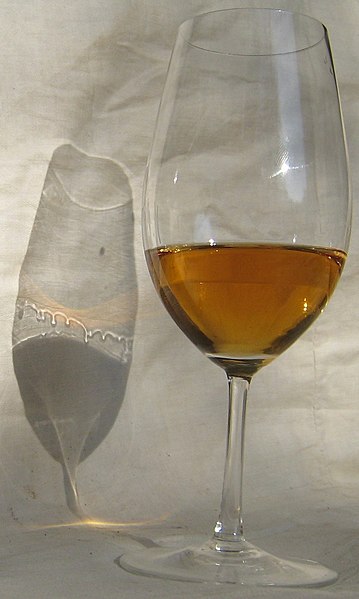
"Tears of wine (or bourbon)" explained

From the Wikipedia entry:
The phenomenon called tears of wine is manifested as a ring of clear liquid, near the top of a glass of wine, from which droplets continuously form and drop back into the wine. It is most readily observed in a wine which has a high alcohol content. It is also referred to as wine legs, curtains, or church windows...

Where the surface of the wine meets the side of the glass, capillary action makes the liquid climb the side of the glass. As it does so, both alcohol and water evaporate from the rising film, but the alcohol evaporates faster, due to its higher vapor pressure. The resulting decrease in the concentration of alcohol causes the surface tension of the liquid to increase, and this causes more liquid to be drawn up from the bulk of the wine, which has a lower surface tension because of its higher alcohol content. The wine which moves up the side of the glass and forms droplets that fall back under their own weight...

It is sometimes claimed incorrectly that wine with "lots of legs" is sweeter or of a better quality. In fact the intensity of this phenomenon depends only on alcohol content, and it can be eliminated completely by covering the wine glass (which stops the evaporation of the alcohol). British physicist C. V. Boys argues[4] that the biblical injunction
“Look not thou upon the wine when it is red, when it giveth his colour in the cup, when it moveth itself aright.” —Proverbs, 23:31
refers to this effect. Since the "tears of wine" are most noticeable in wine which has a high alcohol content, the author may be suggesting this as a way to identify wines which should be avoided in the interest of sobriety.
Followed by this interesting notation:
Beading refers to the formation of stable bubbles when liquor is shaken. This occurs only in liquor that contains more than 46% alcohol. It is an example of the Marangoni effect. Shaking a whisky bottle to form bubbles is referred to as “beating [beading] the whisky”.
I've added "bourbon" to the title this post after discovering that a video is available of the phenomenon using my favorite recreational beverage:
Related Posts Plugin for WordPress, Blogger...