21 November 2010

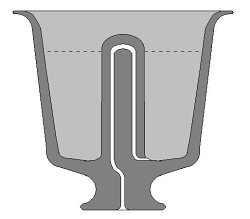
Ancient Greek "dribble glass"

"...this cup, credited to Pythagoras of Samos, works fine if you fill it no higher than the dotted line. If you add more, the liquid spills over the elbow joint and a siphon effect pours the cup’s entire contents onto your lap."
Found while rummaging in the Futility Closet.

Trying to reanimate corpses

Aldini attempted to revive the body of a murderer, one Thomas Forster, by the application of electrical charges six hours after he had been hanged at Newgate…

“On the first application of the [electrical] arcs, the jaw began to quiver, the adjoining muscles were horribly contorted, and the left eye actually opened… the conductors being applied to the ear, and to the rectum, excited muscular contractions much stronger… The arms alternately rose and fell…the fists clenched and beat violently the table on which the body lay, natural respiration was artificially established… A lighted candle placed before the mouth was several times extinguished… Vitality might have been fully restored, if many ulterior circumstances, had not rendered this – inappropriate.”

…The reports eventually caused such a public outcry that the experiments were banned, and Aldini forced to leave the country in 1805… (p. 317)
Text excerpted from The Age of Wonder: How the Romantic Generation Discovered the Beauty and Terror of Science. Richard Holmes. Pantheon Books, New York, 2008.  Additional information available online at Executed Today, where I found the illustration.

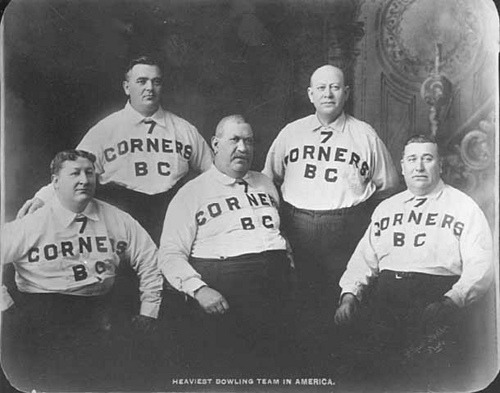
"Heaviest bowling team in America", 1911

Found at Black and WTF.

A "human orrery"

The young John Keats remembered an organized game at his school in Enfield, in which all the boys whirled round the playground in a huge choreographed dance, trying to imitate the entire solar system, including all the known moons… Unlike Newton’s perfect brassy clockwork mechanism, this schoolboy universe – complete with straying comets – was a gloriously chaotic “human orrery.”

Keats did not recall the exact details, but one may imagine seven senior boy-planets running round the central sun, while themselves being circled by smaller sprinting moons (perhaps girls), and the whole frequently disrupted by rebel comets and meteors flying across their orbits. (p. 113)
A quick search yielded evidence that this activity is still conducted today in various schools.

Text excerpted from The Age of Wonder: How the Romantic Generation Discovered the Beauty and Terror of Science. Richard Holmes. Pantheon Books, New York, 2008.

A curious orientation of the banisters

"Pender County, North Carolina. Sloop Point at Hampstead. House over 200 years old."
Found at Shorpy.

Mastectomy without anaesthesia

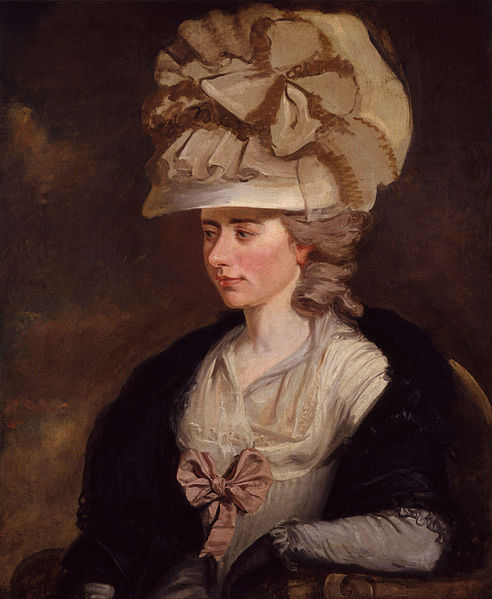
Frances Burney, an English novelist and diarist, transcribed her experience undergoing a mastectomy for breast cancer in the era before anaesthesia:
“In September 1811 the Herschels’ old friend Fanny Burney, by then the married Madame d’Arblay, underwent an agonizing operation for breast cancer without anaesthetic. It was carried out by an outstanding French military surgeon, Dominique Larrey, in Paris, and so successfully concluded that she lived for another twenty years. What is even more remarkable, Fanny Burney remained conscious throughout the entire operation, and subsequently wrote a detailed account of this experience, watching pats of the surgical procedure through the thin cambric cloth that had been placed over her face. At the time the surgeon did not realise that the material was semi-transparent. “I refused to be held; but when, bright through the cambric, I saw the glitter of polished steel – I closed my eyes. I would not trust to convulsive fear the sight of the terrible incision.”…

Indeed, she screamed throughout the operation. “When the dreadful steel was plunged into the breast – cutting through veins – arteries – flesh – nerves – I needed no injunction not to restrain my cries. I began a scream that lasted unintermittingly during the whole time of the incision - & agony… All description would be baffled… I felt the Knife rackling against the breast bone – scraping it!” (p. 305-6)
Some modern clinicians would note the twenty-year survival and suspect that her excised lesion was probably a fibroadenoma rather than a carcinoma, but that wouldn't detract from her amazing fortitude.

The text is an excerpt from The Age of Wonder: How the Romantic Generation Discovered the Beauty and Terror of Science. Richard Holmes. Pantheon Books, New York, 2008.

Collar necklace, Afghanistan, first century

"From a tomb in Tillia Tepe, Afghanistan."

Found in The Ancient World, via La Muse Verte.

19 November 2010

Lithium in 7-Up

Everyone knows that Coca-Cola was originally formulated to contain cocaine.  I didn't know that 7-Up contained lithium.
... lithium was widely marketed as one of a number of patent medicine products popular in the late-19th and early-20th centuries, and was the medicinal ingredient of a refreshment beverage, 7 Up. Charles Leiper Grigg, who launched his St. Louis-based company The Howdy Corporation in 1920, invented a formula for a lemon-lime soft drink in 1929. The product, originally named "Bib-Label Lithiated Lemon-Lime Soda", was launched two weeks before the Wall Street Crash of 1929.  It contained the mood stabiliser lithium citrate and was one of a number of patent medicine products popular in the late-19th and early-20th centuries. The beverage was marketed specifically as a hangover cure. Its name was soon changed to 7 Up.
More about 7-Up and the history of its name at Snopes.

The Woolworth sit-in (1963)

Our Woolworth Sit-In, Jackson Mississippi, 5/28/63 was the most violently attacked sit-in of the '60s and the most publicized. Involving a White mob of several hundred, it went on for several hours while hostile police from Jackson's huge all-White police department stood by approvingly outside and while hostile FBI agents inside (in sun-glasses) "observed." Seated, left to right are Hunter Gray (John R. Salter, Jr.) -- Native American; Joan Trumpauer (now Mulholland), a White Southern student at our private Black college, Tougaloo College [one of two White students at Tougaloo]; Anne Moody, Black, from Wilkinson County, Mississippi. I, Gray [Salter] was a very young Tougaloo professor; and Joan and Anne were my students. All of us are covered with sugar, salt, mustard, and other slop. I was beaten many times -- fists, brass knuckles, and a broken glass sugar container -- and am covered with blood. 
More at the link.

A terrible omission of a comma

This grammatical error is in a tragic story about a young woman who was paralyzed just before her wedding.  I certainly don't want to make light of the incident itself, but I can't help noting the awkwardness that results from an oversight by the copyeditor.

The sentence as it should have been written: 
"One thing that hasn't changed for Friedman is her support system, from her fiance who bathes her and feeds her, to her bridesmaids, including the one who pushed her into the pool last May."

But it was printed like this:
"One thing that hasn't changed for Friedman is her support system, from her fiance who bathes her and feeds her to her bridesmaids, including the one who pushed her into the pool last May."
The "stacking room" in an opium factory

These two lithographs by W. S. Sherwill show an opium factory in Patna, India, in about 1850.
This series of prints shows the different stages in the processing of opium at the factory in Patna, the centre of the British East India Company's opium plantations in Bengal. The raw opium was formed into a ball about 3½ lb in weight and wrapped in poppy petals to protect it from damage.
The balls were then dried on shelves and boxed into chests each containing 25-40 balls before shipping to China and Europe.
The top image is the "stacking room" and the bottom image is the "drying room." One can't help but be in awe of the scale of production depicted.

Both images come from the "High Society" exhibit in the Wellcome Collection, via Uncertain Times.  click pix for full-size image.

Throwing dough around


"This is an Indian dish named 'Parotta'. The man makes it flat and throws it to the cook who will cook it in a hot and flat iron top."

Via 22 Words.

Where does the Chamber of Commerce get its money?

From membership fees by small businesses?   Well, not exactly...
The U.S. Chamber of Commerce astonished even the most jaded Washington-watchers last year when it reported spending nearly $150 million on lobbying. The figure obliterated all previous records and cemented the chamber's reputation as Capitol Hill's most formidable lobbying force.

But it turns out that a lot of that money came from an injection of funds from another lobbying powerhouse: America's Health Insurance Plans.

The private insurers' group gave $86.2 million toward the chamber's media and lobbying blitz against President Obama's health-care legislation in 2009 even as it was pledging general support for the idea of reform, according to tax records and sources familiar with the gift.

The donation made AHIP the chamber's single largest funder in 2009, accounting for about 40 percent of the business lobby's $205 million in contributions that year, records show. 
The rest of the story is at the Washington Post link.

3-year-old boy finds £2.5m treasure

A three-year-old boy using a metal detector for the first time has unearthed a gold pendant estimated to be worth over £2.5m. James Hyatt made the discovery while out with his father and grandfather in Hockley, Essex. He had only been scanning the soil for a matter of minutes when it started beeping...

Experts believe the rare locket, or reliquary, dates back to the 1500s and was used to hold alleged parts of Christ's crown of thorns or crucifix...

An inquest has declared the reliquary treasure trove and it could be bought for millions by an interested institution, including the British Museum. Proceeds will be split with the family and the owner of the field where the pendant was found.
I am recurrently in awe of the common sense approach British law takes to treasured discoveries.  In other countries the government would claim/try to grab the item, so instead of turning it in, the finder would probably melt this down and sell the gold lump to a jeweler.


Found at Nothing to do with Arbroath.

Cannery worker filling tuna cans, ~1930

It wasn't always done by machine.  This lady appears to be stuffing the cans with her bare fingers.

From the Flickr photostream of the University of Washington Libraries Digital Collections.
Related Posts Plugin for WordPress, Blogger...